An AI agent costs about $20 a month to start. What you pay after that comes down to one choice
We priced Manus, Claude, ChatGPT and n8n at July 2026 list rates. The gap is not the sticker price, which is nearly identical. It is whether you are buying seats or executions.
 By Ishan Vats · Founder of IV Consulting · builds AI agents & automations for 150+ teams
 Manus · $204,000 credits a month
 Claude · $20Usage caps
 ChatGPT · $20Usage caps
 n8n · 20 euros2,500 runs
In July 2026 an AI agent costs about $20 a month to start. Manus Standard is $20 for 4,000 credits, ChatGPT Plus is $20, Claude Pro is $20, and n8n Cloud Starter is 20 euros for 2,500 workflow executions. Those sticker prices are close enough to be useless as a decision, because they hide the thing that actually sets your bill. Manus, ChatGPT and Claude charge you per person and run out of credits or usage. n8n charges you per workflow execution and puts no cap on users or workflows at all. So the real question is not which is cheapest. It is whether the work you are automating is a person thinking or a process repeating.
The numbers
What does an AI agent actually cost in 2026?
List prices as of July 2026, taken from each vendor's own pricing page. Note that n8n prices in euros and the other three in US dollars, so the entry tiers are close but not identical once your card is charged.
| Tool | Free tier | Entry paid plan | Next tier up | What runs out first |
|---|---|---|---|---|
| Manus | 300 daily refresh credits | $20 Standard, 4,000 credits a month | $40 for 8,000 credits, $200 for 40,000 | Credits, burned per task |
| ChatGPT | Yes, capped | $20 Plus | Pro from $100 | Message and reasoning limits |
| Claude | Yes, capped | $20 Pro, or $17 billed annually | Max from $100 | Usage limits inside a rolling window |
| n8n | Community edition, self-hosted, free | 20 euros Cloud Starter, 2,500 executions | 50 euros Pro, 10,000 executions | Workflow executions |
Team pricing splits the same way. ChatGPT Business is $25 per seat billed monthly or $20 billed annually. Claude Team is $25 per standard seat monthly or $20 annually. Manus Team starts at $20 per seat with a two seat minimum. n8n does not charge per seat at all: every paid plan includes unlimited users and unlimited active workflows, and you are billed purely on how many times your workflows run. That parity is not a coincidence, and it is why price is close to useless for choosing between the two agent products those seats unlock. We take that decision apart in ChatGPT Work vs Claude Cowork.
That last line is the whole article in one sentence. Three of these four tools get more expensive when you add people. One gets more expensive when you add volume.
The mechanics
What runs out first: credits, messages, or executions?
Every plan here has a ceiling. The ceilings are just made of different material, and that is what decides whether your AI agent cost stays flat or climbs.
Manus: credits, and they go fast
Manus bills credits per task, and a genuinely complex multi step task consumes far more than a simple one. That is why the tier jumps are so steep: $20 for 4,000 credits, then $40, then $200 for 40,000. Monthly plan credits do not roll over, so an unused month is money gone. Credits you buy as add-ons carry over, but only while the paid subscription is still active.
ChatGPT and Claude: usage limits, not overages
Neither one hands you a surprise bill. They throttle instead. When you hit the cap on Plus or Pro, you wait for the window to reset or you upgrade. That makes budgeting easy and capacity planning hard, because the constraint shows up as your team being blocked at 4pm rather than as a line on an invoice.
Model and seat pricing is only half the bill, though. If the agent talks to customers on a messaging channel, that channel meters you separately and on completely different rules, which is why we costed the WhatsApp layer on its own and found it charges for follow-ups rather than for conversations.
n8n: executions, with unlimited people
n8n counts one execution each time a workflow runs, regardless of how many steps are inside it. A twelve step workflow and a two step workflow cost the same. Add ten colleagues and the price does not move. Self-host the Community edition and the licence cost is zero, leaving you with a server bill and your own model API keys.
The math
What does it cost at three real workloads?
Same published prices, three situations we see constantly in ops teams of two to fifty people.
1. One operator doing research and drafts
One person, thinking work, no repeating process. One $20 seat covers it. Claude Pro at $17 a month on annual billing is the cheapest serious option, and the free tiers are genuinely usable for light days. Automation tooling adds nothing here, because there is no process to repeat. Total: $17 to $20 a month.
2. A five person team that all use AI daily
Five seats is five times the price, whichever vendor you pick. Claude Team at $25 per seat billed monthly is $125 a month. ChatGPT Business is the same $25 monthly, dropping to $20 on annual billing, so $100 to $125. Manus Team starts at $20 per seat. Total: $100 to $125 a month, and it rises every time you hire.
3. One process that runs 3,000 times a month
Lead routing, inbox triage, invoice extraction: something that fires on a trigger, not when a person feels like it. On n8n Cloud that is inside the 10,000 execution Pro plan at 50 euros a month, with unlimited users. Self-hosted on Community edition the licence is free and you pay for a small server plus your model API usage. Total: 0 to 50 euros a month plus model usage, and it does not care how many people you employ.
Workload three is the one that breaks the seat model. Three thousand runs a month is not something you buy seats for. Try to serve it with chat subscriptions and you are not paying more, you are simply still doing the work manually.
The verdict
Which one should you actually pay for?
We will take a side, because "it depends on your use case" is not an answer anyone can spend money against.
For a typical ops team, buy two things, not one. Put $20 seats of Claude or ChatGPT in front of the people doing thinking work, and put n8n underneath for anything that repeats. That combination lands around $20 per person plus 20 to 50 euros for the automation layer, and it is the only arrangement here where adding volume does not add headcount cost.
Notice what is missing from that recommendation: a bespoke agent. For most jobs the automation layer is the answer and the agent is the exception you promote to, which is the argument we make at length in are AI agents worth it? Five Reddit threads, one clear verdict.
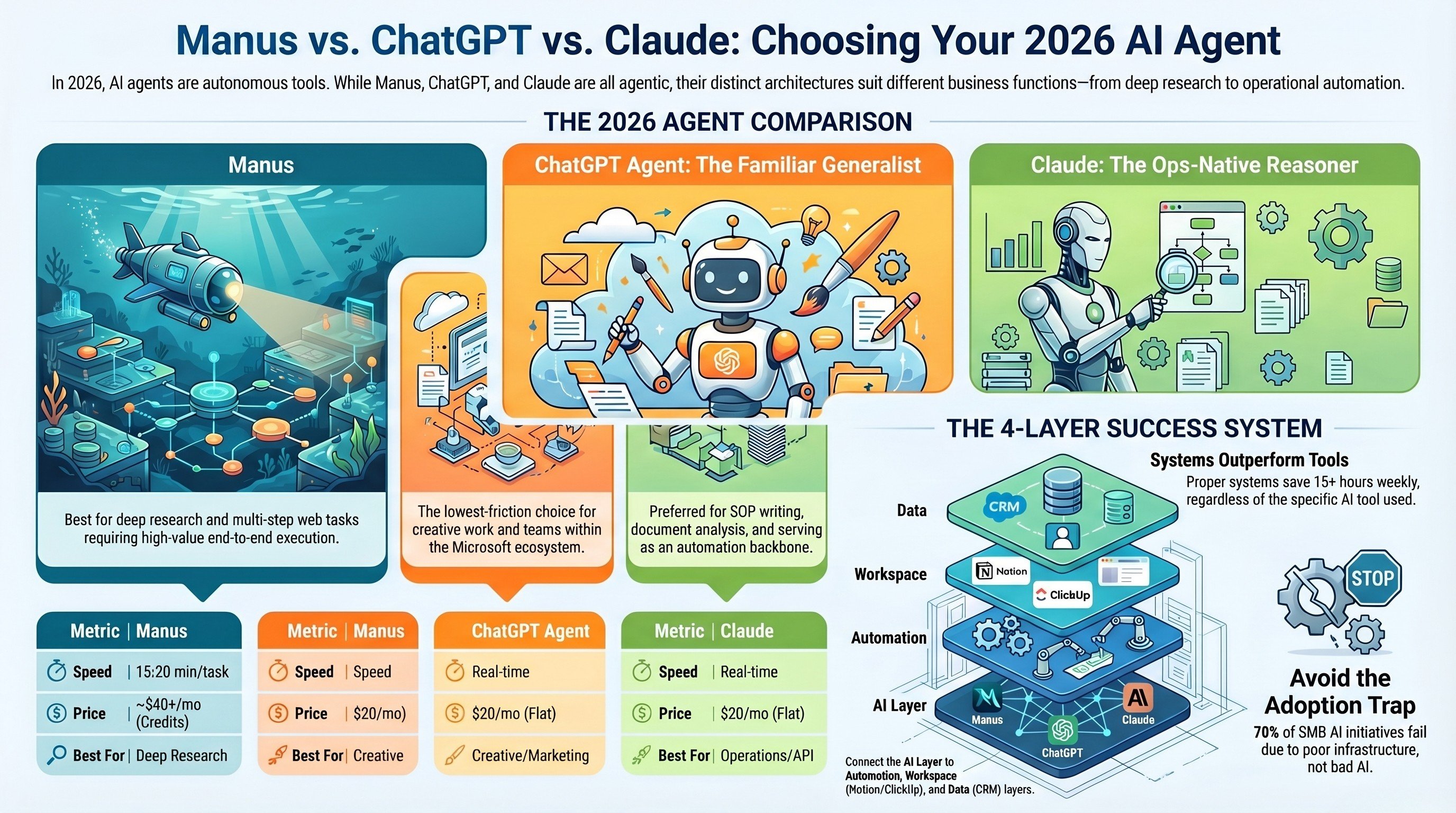
Pick Manus when you want finished deliverables rather than a conversation. It is a strong fit when the output is a document, a deck, or a built artefact and you are willing to watch the credit meter. It is a weak fit as an everyday thinking partner, because credits make you ration the exact back and forth that makes these tools useful.
Pick ChatGPT Plus if your team already lives in it. Switching costs are real and the $20 tiers are close enough in capability that migrating for the sake of it rarely pays back. We rank Claude first for ops work, and we explain why in our Manus vs ChatGPT vs Claude comparison, but "already adopted" beats a marginal capability edge.
Do not buy the $200 tier yet. Not Manus Extended, not Pro or Max at $100 and up. Buy the $20 plan, use it hard for a month, and let the tool tell you which ceiling you actually hit. Almost nobody we work with hits it in month one, and the teams that jump straight to the top tier are usually paying for headroom they never touch.
One caveat if you are building on the API rather than buying seats: the plan price stops being the number that matters and the model tier takes over. A cheap-tier model runs at about a third of a workhorse model, and the full ladder is roughly 10x end to end, so the tier you default to swings the bill harder than the plan you sign up for. That is a separate decision, and we work through it in which AI model for which task. If Claude is your model, budget the newest tier carefully too: the Sonnet 5 price cut shrinks from 33 percent to about 13 percent once its newer tokenizer is counted, which we priced in Claude Sonnet 5 for small business automations.
First hand
What a week with Manus taught us about credit pricing
Ishan Vats ran Manus for a full working week on real client style work: seven deliverables across five working days, documented as they happened rather than summarised afterwards. The full write-up is in our Manus AI review, but one finding belongs in a pricing article.
The credit model changes how you use the tool, and not for the better. With a seat based plan you throw work at it freely, because the marginal cost of one more attempt is zero. With credits you start pre-judging which tasks are worth spending on, and that hesitation is expensive in a way that never shows up on the invoice. The tool is genuinely strong at producing finished artefacts. The pricing model quietly discourages the iteration that gets you there.
That is the honest case for and against. Manus earns its place when the job is a deliverable. For open ended daily work, a flat seat is the better instrument, which is why we default ops teams to Claude and reach for Manus deliberately rather than by habit.
The other budget line
What if you pay someone to build it instead?
Everything above is tool subscription cost: what the software charges you every month. It is not what it costs to have an agent designed, built and wired into your stack. Those are two different budget lines and they get confused constantly.
The subscription is almost always the smaller number. A $20 plan is trivial next to the cost of the time it takes to map a process, connect the systems, handle the edge cases and keep it running. If you are trying to budget for the build rather than the licence, we break that down separately in what you should pay for an AI agent build.
The useful sequence is this. Work out what the process costs you today. Compare that against a $20 experiment. If the experiment works and the process is worth automating properly, then price the build. Doing it in the other order is how teams end up with a signed statement of work for something a free tier would have disproved in an afternoon.
FAQ
Questions people ask about AI agent pricing
How much does an AI agent cost per month in 2026?
Is Manus more expensive than Claude or ChatGPT?
What is the cheapest way to run an AI agent?
Should I pay per seat or per execution?
Do Manus credits roll over to the next month?
What does it cost to have someone build the agent for you?
Ishan Vats
Founder, IV Consulting · AI & automation consultant
I build production AI agents, automations, and MCP servers for teams from startup to enterprise. 150+ ops transformations over 10+ years. I tested Manus for a week on real client work before writing any of the pricing advice above.
Price your own process →Keep reading
Related guides and work
Manus vs ChatGPT vs Claude for ops teams
Price is only half the decision. Here is how the three compare on the work itself.
Read the comparison →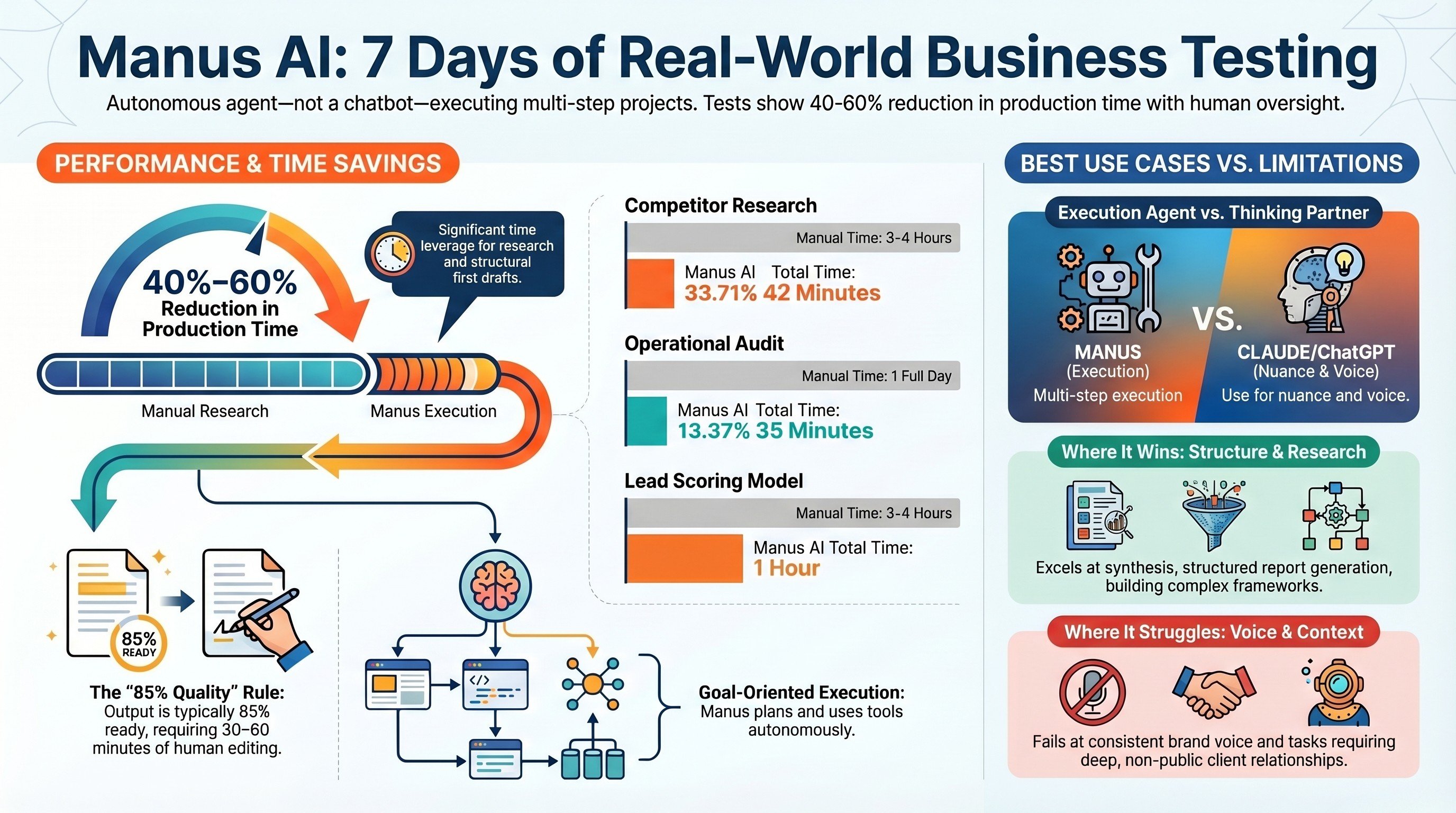
We tested Manus for a week on real work
Seven deliverables, five working days, and what the credit meter actually did.
Read the review →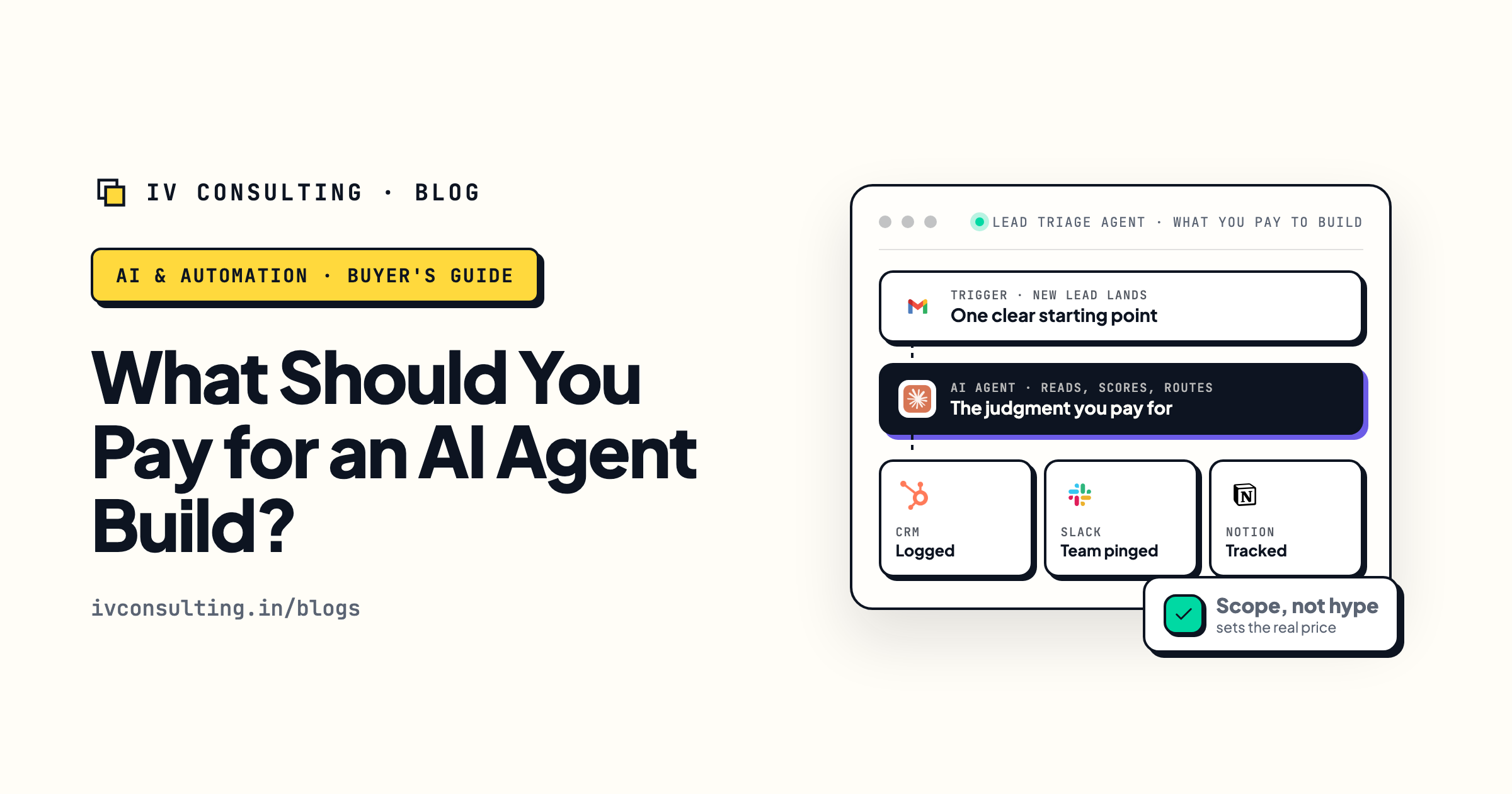
What should you pay for an AI agent build?
The other budget line: what it costs to have the thing built, not just licensed.
See the breakdown →Not sure which of these you actually need?
Book a free 30-minute strategy call. We will look at the processes eating your week, tell you which ones are worth a $20 seat and which ones need a proper automation layer, and give you the roadmap on the spot. If the honest answer is that a free tier covers you for now, we will say that.
Book a Free Strategy Call →Free 30-minute call. Honest take, even if that means "you do not need us yet."