Manus vs Claude vs ChatGPT: we tested all three on real ops work in 2026.
Not a spec sheet. We ran all three on real client deliverables and picked a side: Claude for operations, Manus for research, ChatGPT for creative. The uncomfortable part is that the tool you pick matters far less than the system you build around it.
 By Ishan Vats · Founder of IV Consulting · builds AI agents & automations for 150+ teams
 Best for · ResearchManus
 Best for · CreativeChatGPT
 Best for · OperationsClaude
Our verdict after running all three on real client work: pick Claude if you want one default agent for an ops team, because it fails least often on the document analysis, SOP writing, and automation work that fills most weeks. Add Manus only if unsupervised multi-source research is a weekly job, where it earns its keep outright. Use ChatGPT for creative work and for teams already living in Microsoft 365. The uncomfortable part: the tool matters less than the system you build around it. A great agent with no system underneath it saves almost no time.
Some links in this article are affiliate links. If you buy through them we may earn a commission, at no extra cost to you.
The verdict
Our verdict: which AI agent should you actually use in 2026?
If you want the short answer: run Claude as your default agent, add Manus only for research-heavy weeks, and keep ChatGPT for creative work. That is the call we make for most ops teams, and we make it from implementation experience across 150+ scaling businesses plus a documented week-long test of Manus on real client deliverables.
We re-checked that call in October 2026, after the model releases of September and the end of Manus’s brief time inside Meta, and it still stands. Here is the reasoning behind that ranking, because a verdict without one is just an opinion:
- Claude first, because the work that actually fills an ops week is document analysis, SOP writing, and being the reliable reasoning step inside an automation. Claude fails least often on exactly that, and when it does fail it fails gracefully rather than confidently.
- Manus second, and conditionally, because it is the only one of the three that reliably takes a goal and hands back a finished deliverable unsupervised. That is a narrow skill, but where it applies nothing else comes close.
- ChatGPT third for ops, first for adoption, because its real advantage is that your team already knows it. Near-zero adoption overhead is worth more than a benchmark point.
The wrong pick is not just a waste of twenty dollars a month. It actively slows a team down. But the single biggest pattern we see is not people using bad tools. It is people using decent tools with no system underneath them, which is why the last third of this guide is about the system rather than the tool. That system question has a sharper version once you know which agent you like: a general agent and a workflow platform are not substitutes, and we set out when to buy the agent and when to build the workflow instead.
All three start at roughly $20 a month, so the subscription is not the real cost. Your team’s setup hours are. Pick the task you would hand to the agent, enter what the person doing it costs you a year and what the build and first year of running it would cost, and our free calculator gives you a payback period in seconds. If the answer is “neither, yet,” it will say so.
The one people ask about
Manus vs Claude: is Manus actually better than Claude?
For most business teams, no. Manus beats Claude at exactly one job, and Claude beats Manus at nearly everything you do more often. Manus is better when the task is "go find out X across ten sources and hand me a finished document." Claude is better when the task is "read this, reason about it, and produce something my team or my client will actually rely on."
The distinction that matters is not intelligence, it is supervision. Manus is built to run without you. Claude is built to be excellent while you stay in the loop, and to be the dependable reasoning step inside a workflow that runs without you. For most ops teams, the second shape describes far more of the week. Supervision is also the security boundary: the moment an agent runs unsupervised against a live inbox or CRM, anything it reads can try to issue it instructions, which is the risk and the fix we lay out in prompt injection and AI agent security.
It is also worth saying plainly that Manus AI vs Claude is not really a like-for-like fight. Whether you frame it as Claude vs Manus or the other way round, you are comparing a Manus AI agent built to finish a job end to end against a model built to be the most reliable component inside a job. That is why our answer is "both, in that order" rather than a single winner.
| What you need | Manus | Claude |
|---|---|---|
| Unsupervised multi-step research | Wins. Goal in, finished deliverable back. | Needs you to steer between steps. |
| Long document analysis | Capable but slower than it needs to be. | Wins. Handles long contracts and SOP manuals at scale. |
| SOP and operations writing | Defaults to formal and generic on voice. | Wins. Output humans actually follow. |
| Backbone for n8n or Make automation | Not built for it. | Wins. The API most worth architecting around. |
| Speed on simple tasks | The agentic loop is overkill for quick jobs. | Wins. A plain chat is faster. |
| Fast-moving or live data | Verify anything time-sensitive before shipping. | Also needs a live data source wired in. |
| Cost predictability | Credit-based billing is harder to forecast. | Wins. Flat seat and API pricing. |
| Best overall default for an ops team | Add second, when research is weekly. | Wins. Start here. |
The definition
What an AI agent actually means in 2026
A real AI agent is more than a smarter chatbot. It can:
- Accept a goal, not just a prompt.
- Break that goal into steps autonomously.
- Execute those steps using tools like browsing, writing, and coding.
- Adapt when something goes wrong mid-task.
- Return a finished, usable output.
All three tools qualify by that definition. How they achieve it, and where they break down, is what separates them. The rest of this guide is the field test.
The contenders
Manus vs Claude vs ChatGPT, head to head on each tool
Manus: the autonomous operator
Give Manus a goal, walk away, come back to results. Its multi-agent architecture spins up specialised sub-agents simultaneously. One browses, one codes, one synthesises, producing outputs that rival what a person would return after a half-day of work.
Where Manus wins: deep competitive research, data synthesis from multiple sources, multi-step web tasks, and autonomous project outputs like pitch decks and financial models built from scratch.
Where Manus struggles: speed (15 to 20 minutes per complex task), unpredictable credit-based billing, occasional stalling mid-execution, and it is not production-ready for code deployment.
That billing point is worth pricing out before you commit, because all three tools start at roughly the same $20 a month and then diverge sharply on what runs out first. We put the July 2026 list prices side by side in what an AI agent actually costs, including why Manus credits do not roll over and where a per-execution tool works out cheaper than any seat.
Who you are buying from (October 2026): Manus is an independent company again. Meta’s December 2025 deal to buy it was ordered unwound by Chinese regulators in April 2026, and on 8 October 2026 Manus announced a round of more than $500 million led by Boyu Capital and IDG Capital (AFP report via Tech Xplore). That is good news for continuity, but it is still a young vendor shipping fast, so keep the outputs Manus produces in your own workspace rather than inside it.
ChatGPT: the familiar generalist
The strategic advantage ChatGPT has over every competitor is not capability. It is familiarity. Your team is already using it. The cognitive overhead of adoption is near zero, which matters more than most founders admit when rolling out AI across a team.
Where ChatGPT wins: the lowest barrier to entry, the strongest creative breadth, Microsoft 365 integration (seamless for Word, Excel, Teams, and Outlook), and the widest plugin ecosystem.
Where ChatGPT struggles: the sandbox wall means it works inside a virtual machine, not your live databases. It can also lose context on complex multi-document workflows.
If you call OpenAI from an automation rather than chatting in ChatGPT, the model tier matters more than the brand. OpenAI’s API lineup has moved to the GPT-6 family, and the flagship is rarely the right call for routine automation work. We re-priced the reasoning step across GPT-6.1 Sol, Claude Sonnet 5.5 and Claude Opus 5.5 in Opus 5.5 vs GPT-6.1 Sol for automations, and the older tier breakdown is in GPT-5.6 for small business automations.
Claude: the ops-native reasoner
Claude has become the preferred AI for operations-heavy teams in 2026. Not because of the loudest marketing or the most viral demos, but because of consistency. When your business depends on AI producing reliable, nuanced, accurate output, Claude fails least often and fails most gracefully.
Where Claude wins: document analysis at scale (50-page contracts, SOP manuals), SOP writing that humans actually follow, complex reasoning under nuance, the best API backbone for automation, and compliance and client-facing output.
Where Claude struggles: it is not fully autonomous as a standalone task-runner, and real-time web data gathering at scale lags behind Manus.
The wider field
Manus vs other AI agents: the top Manus competitors compared for 2026
Manus is not the only autonomous agent on the market, and for business use it is often not the one you should shortlist first. These are its realistic competitors.
Most "top Manus competitor" lists compare autonomous agents to other autonomous agents. That framing misses the option that actually wins for most small teams, which is an agent that lives inside your automation platform and runs on a schedule against your live systems.
- Claude and ChatGPT in agent mode. The obvious substitutes, and the right starting point if you want one tool rather than a specialist. Covered in detail above.
- Google Workspace Studio. The strongest option if your team already lives in Gmail, Docs, and Sheets, because the agent sits where the work is. We broke it down in Google’s no-code AI agent builder.
- Agents built into automation platforms. n8n, Make, and Zapier all ship native AI agents now. These are the most underrated Manus alternative for business use: they connect to your real systems, run on a trigger rather than on your attention, and cost far less than credit-based autonomous runs. See Zapier Agents vs Make AI Agents vs n8n.
- A Claude-plus-n8n stack you assemble yourself. Slower to set up, cheaper to run, and the only option on this list you fully own. This is what we build for clients most often, described in the practical SMB automation stack.
| Agent | How it runs | How you pay | Our take |
|---|---|---|---|
| Manus | You give it a goal, it works unsupervised in its own cloud environment | Plan plus credits that are consumed per task | Best for weekly research jobs. Not your ops backbone. |
| Claude | Chat with you in the loop, or as the reasoning step inside a workflow via the API | Seat plan, or pay per token on the API | Our default. The most reliable component to build around. |
| ChatGPT agent | Chat with you in the loop, agent mode for multi-step web tasks | Seat plan, or pay per token on the API | Best first tool for a non-technical team. |
| Google Workspace Studio | No-code agents inside Gmail, Docs and Sheets | Included in Workspace Business and Enterprise plans | Try it first if you already live in Google Workspace. |
| n8n, Make and Zapier agents | Run on a trigger or schedule against your live systems | Per execution, operation or task on the platform | The most underrated Manus alternative for recurring work. |
| Claude plus n8n, self-assembled | Your workflow, Claude called at the steps that need judgement | API tokens plus n8n hosting or executions | Cheapest to run and the only option you fully own. |
Our verdict on the wider field: if the work repeats on a schedule, a workflow-platform agent or a Claude-plus-n8n build beats Manus on cost and control every time. Manus only wins when the job is a one-off research deliverable that nobody wants to supervise.
The real lever
The system that actually moves the needle
Companies that buy the right AI tool but build no system around it save almost no time. Companies that pair even a mediocre tool with a well-built system consistently get 10 to 15+ hours back per week.
A system that works has four layers:
- The AI layer: Manus, Claude, or ChatGPT generates the output.
- The automation layer: n8n, Make, or Zapier routes that output to the right place.
- The workspace layer: Notion or ClickUp, where your team actually lives and works.
- The data layer: Apollo, your CRM, and other sources feeding live context back into the AI.
Without all four layers, you have a powerful engine with no chassis. The right question is not "which AI agent is best?" It is: "which tool fits the system I am building?" If you are a team of one, the same layering is what lets agents carry real work, and we cover where it quietly breaks and which checkpoints stay human in running a one-person company on AI agents.
Pick fast
Manus vs Claude vs ChatGPT: which tool for which use case
Skip the deliberation. Match your most common task to the tool that handles it best.
| Your use case | Best tool | Why |
|---|---|---|
| Deep competitive and market research | Manus | Autonomous multi-source synthesis |
| Marketing copy and campaign ideation | ChatGPT | Strongest creative breadth |
| SOP writing and internal documentation | Claude | Nuanced, reliable, human-readable |
| Automating workflows in n8n or Make | Claude via API | Best automation backbone |
| First AI tool for a non-technical team | ChatGPT | Near-zero adoption overhead |
| Document analysis and data extraction | Claude | Handles long documents at scale |
| Autonomous multi-step task execution | Manus | Goal in, finished output back |
| Building a full AI-integrated ops stack | Claude backbone + ChatGPT for creative | Reliability plus reach |
Picking the product is the first half of the decision. The second half sits inside it: which model tier you run for a given job, because the cheap tier is fine for most work and the expensive one earns its price on a narrow set of tasks. We break that down in which AI model for which task. If the job in front of you is one of the narrow, expensive ones, we cover when Claude Fable 5 earns its flagship price and when Sonnet 5 is enough.
FAQ
Questions teams ask before they commit
Is Manus better than Claude?
What are the best Manus alternatives and competitors in 2026?
Which AI agent is best for business use in 2026?
Can I use multiple AI agents together in the same workflow?
Is Manus AI worth the cost for small businesses?
Is Manus still owned by Meta?
What is the learning curve for implementing AI agents in a business?
Ishan Vats
Founder, IV Consulting · AI & automation consultant
I build production AI agents, automations, and MCP servers for teams from startup to enterprise. 150+ ops transformations over 10+ years. If you're weighing Manus, Claude, and ChatGPT for your own stack, start by checking whether the automation pays back at all.
Run my AI agent ROI numbers →Keep reading
Related guides and work
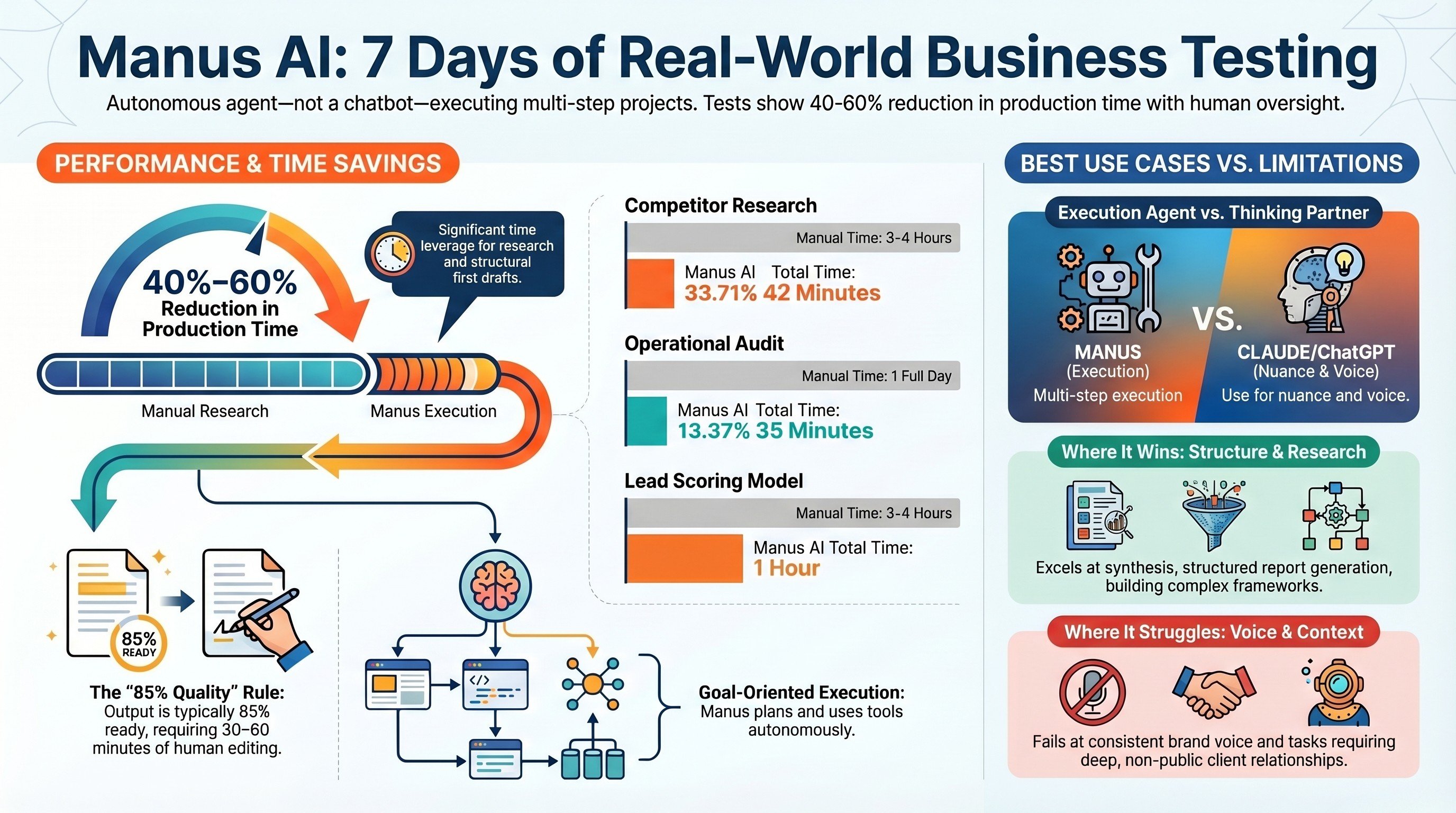
Manus AI Review 2026: 5 real client jobs, one verdict
What Manus actually delivered, where it stalled, and whether it earns a place in your stack.
Read the review →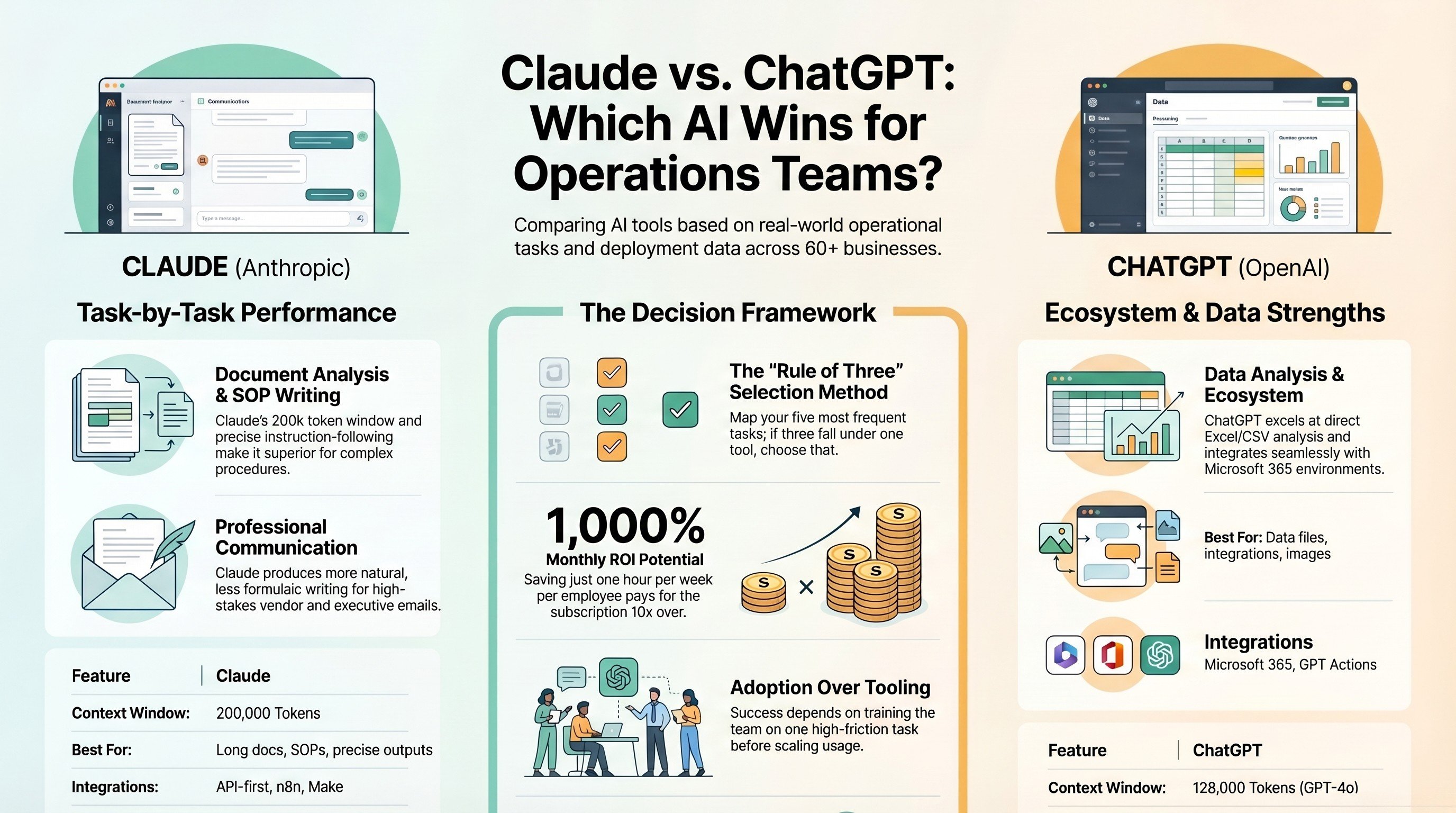
Claude vs ChatGPT for operations teams
The head to head for ops-heavy teams: reliability, reasoning, and which one to architect around.
Read the comparison →
The AI Engineering stage, built for you
Your agents wired into a real four-layer system, designed, built, and handed over.
See the offer →Still deciding between Manus, ChatGPT, and Claude?
Book a free 30-minute call. We will look at your actual workflows, tell you which agent fits (and where the system around it matters more than the tool itself), and hand you a build roadmap. If none of them fit yet, we will say so.
Book my free agent strategy call →Free 30-minute call. Honest take, even if that means "you do not need us yet."