Manus AI review 2026: I ran it for five days on real client work
Five real deliverables. Five working days. Documented time savings and an explicit verdict, not Twitter takes.
 By Ishan Vats · Founder of IV Consulting · builds AI agents & automations for 150+ teams
 Agent under testManus AI
 Second passClaude refines voice
 ComparedChatGPT
 Delivered toNotion
 ComparedGemini
Manus AI is worth paying for if your week contains research and report deliverables, and it is not worth paying for if your week is mostly writing. We rate it 4 out of 5 after running it for five working days on five real client deliverables, where it cut production time by 40 to 60% with no loss of quality on the final output. It is an autonomous agent: you hand it a goal, it breaks the goal into steps and executes them with real tools. It is genuinely strong on multi-source research, structured reports, and frameworks, and it still needs human judgment on voice, strategy, and high-stakes copy.
The verdict
Is Manus AI worth it in 2026?
Yes, if research and report deliverables are a real part of your week. No, if your week is mostly writing, client conversation, or judgment calls. That is the call we make after five working days running Manus on live client work we would otherwise have billed for, and it is the same call we give clients who ask whether to add it to the stack.
Here is the reasoning, because a rating without one is just a number. We scored five real deliverables, and the split was not close:
- Two came back near production quality (the operational audit report and the lead scoring framework). Both are structured outputs built from messy inputs, and both took under an hour against a day or half day manually. This is where Manus removes the work rather than speeding it up.
- One was strong with review (the competitor research brief): 22 minutes of autonomous browsing and 20 minutes of editing against 3 to 4 hours manually. Budget the review time and it is still a clear win.
- Two needed you (the outbound email sequence and the LinkedIn calendar). Structure was right, voice was not. Roughly a third of the output was generic enough to need rewriting, which is exactly the tax you pay when you ask a deliverables engine to be a writer.
So the rating is 4 and not 5 for one specific reason: Manus is excellent at the thing it is for and mediocre at the thing people will inevitably try to use it for. It loses the fifth point on voice, on anything time sensitive, and on the credit billing model, which quietly discourages the iteration that gets you to a good deliverable.
The honest counter case: if you already have Claude or ChatGPT and your research load is light, we would tell you to skip Manus for now and spend the same money on wiring what you already have into your workflows. A second agent subscription is not the constraint for most teams. And if you want the head to head rather than the review, we rank all three in Manus vs Claude vs ChatGPT, where Claude takes the default slot for ops teams and Manus earns a conditional one.
The premise
What can Manus AI actually do?
Manus AI is an autonomous AI agent: you give it a goal, it breaks the goal into steps, executes those steps using real tools (browser, code interpreter, file system), checks its own output, and delivers a finished result. It is not a chatbot, and that distinction matters more than it sounds. The analogy: the difference between asking an assistant a question versus handing them a project.
Every week a new AI tool arrives with claims that sound identical to the last one. Most do not survive contact with real work. When Manus launched and the hype cycle kicked off, I skipped the hot takes and ran a structured test instead. Five working days. Five real client deliverables. Documented results.
It sits in a different category from a conversational model like Claude or ChatGPT. Those answer. Manus does. That is the whole reason it was worth a full week of testing rather than an afternoon. It also sets the boundary of where it belongs: doing is not the same as doing on a schedule, and we draw that line in Manus vs Zapier Agents vs n8n.
The test
What Manus AI did across five days of real client work
No toy prompts. Each task was live work I would normally bill for or ship to a client. Here is what each one cost in time and what came back.
Day 1: Competitor research brief
Task: identify the top 5 competitors, summarise positioning and pricing, flag gaps a client could exploit. Manus browsed multiple tabs on its own, scraped competitor sites, pulled pricing pages, read G2 reviews, and cross-referenced LinkedIn positioning. Total run time: 22 minutes with zero prompting after the initial brief.
The output was 85% of what I would have produced manually, in about 15% of the time. I spent 20 minutes editing. A task that takes me 3 to 4 hours manually came in at 42 minutes total.
Verdict: strong. Budget 30 to 45 minutes of review on top of the run. Do not publish unedited.
Day 2: Outbound email sequence
Task: write a 5-email cold outreach sequence targeting operations directors at logistics companies. Three of the five emails were genuinely punchy and non-generic. Two needed a full rewrite. Still a 60% time saving versus writing the sequence from scratch.
Verdict: good starting point, not a finished product. Plan 40 to 60 minutes of editing on a 5-email sequence.
Day 3: Operational audit report
Task: from a messy internal brief (team size, tool stack, rough pain points), produce a structured operational audit with prioritised automation opportunities. Manus returned a 12-section report with workflow maps, automation recommendations ranked by ROI, and a phased rollout timeline.
It correctly identified that the client's biggest bottleneck sat between their CRM and their invoicing tool, something I had noticed but had not explicitly flagged. Total edit time: 35 minutes. This is a task that takes me a full day manually.
Verdict: outstanding. Structured report generation from messy inputs is where autonomous agents genuinely change the economics of knowledge work.
Day 4: LinkedIn content calendar
Task: build a 30-day LinkedIn content calendar with post themes, hooks, and format recommendations. Structure was perfect. Quality was uneven. About 70% of the hooks were genuinely strong. The other 30% were LinkedIn cliches that needed replacing.
Verdict: solid for planning, inconsistent for execution. Best used to build the scaffold rapidly, then refine individual pieces before publishing.
Day 5: Lead scoring framework
Task: design a lead scoring model with weighted criteria, tier thresholds, and a CSV template for the sales team. Manus produced an 18-criteria scoring matrix across four categories, weighted by category, with tier thresholds and a one-page implementation guide.
I adjusted three criteria weights and changed the tier labels. The core framework needed no structural changes. A task I would normally charge 3 to 4 hours of consulting time for was done in under an hour total.
Verdict: excellent. Structured frameworks, models, and templates are a strong use case. Near production quality on the first run.
The scorecard
How each Manus AI task scored
The short version: research and structure are where Manus earns its keep. Copy and voice still need you.
| Task | Manus rating | Time saved | Edit time needed |
|---|---|---|---|
| Competitor research brief | Strong | 3 to 4 hrs down to 42 min | 20 min |
| Outbound email sequence | Good start | About 60% | 40 to 60 min |
| Operational audit report | Outstanding | Full day down to about 1 hr | 35 min |
| LinkedIn content calendar | Mixed | Fast scaffold | Rewrite 30% of hooks |
| Lead scoring framework | Excellent | 3 to 4 hrs down to under 1 hr | Minor tweaks |
| Our call | 4 out of 5 | Worth it if research and reports fill part of your week | Always budget review time |
Where it lands
Where does Manus AI win and where does it struggle?
Genuinely strong at
Multi-source research synthesis. Structured report generation from messy inputs. Frameworks and template building. First-draft acceleration on research-heavy work. These are the tasks where it removes the work rather than just speeding it up.
Struggles with
Voice consistency. It defaults to slightly formal and generic. High-stakes creative copy and tasks needing insider knowledge of your client or relationships also fall short.
Slow on simple tasks
The agentic loop is overkill for quick one-shot jobs. For anything trivial, a plain chat with Claude or ChatGPT is faster.
Weak on live data
Accuracy drops on fast-moving data like recent pricing or breaking news. Verify anything time-sensitive before you ship it.
The economics
How much does Manus AI cost to actually use?
Manus Standard is $20 a month for 4,000 credits, with $40 for 8,000 credits and $200 for 40,000 above it, and every plan including the free one gets 300 daily refresh credits. Those are July 2026 list rates taken from the vendor's own pricing page, and monthly plan credits do not roll over, so an unused month is money gone. We price it against Claude, ChatGPT and n8n in what an AI agent actually costs.
Take an illustrative case rather than one of our measured tasks: a consultant billing at $150 an hour who spends 8 hours a week on research and report work. A 50% saving is 4 hours a week, which is roughly $600 a week in recovered billing capacity. At that ratio Manus pays for itself in the first day of the month.
Worth paying for is a different question from worth paying this way. Manus bills credits per task, which behaves nothing like the flat seat you get from Claude or ChatGPT at the same $20 entry price. That matters more than the sticker price, because credit billing quietly discourages the iteration that gets you to a good deliverable, and iteration is exactly what the two weaker tasks in this test needed.
If your work is primarily conversational, creative, or requires tight voice control, the case is weaker. The honest read: it is a deliverables engine, not a writing partner. That is also why we rank it second rather than first in our Manus vs Claude vs ChatGPT comparison, where Claude takes the default slot for ops teams and Manus earns a conditional one.
FAQ
Questions people ask before trying Manus
Is Manus AI suitable for small businesses or just enterprises?
How does Manus AI handle sensitive business data?
What tasks is Manus AI not good at?
How does Manus compare to hiring a virtual assistant?
Is Manus AI better than Claude?
How long does Manus AI take to finish a task?
What is the best way to get started with Manus AI for business tasks?
Ishan Vats
Founder, IV Consulting · AI & automation consultant
I build production AI agents, automations, and MCP servers for teams from startup to enterprise. 150+ ops transformations over 10+ years. If you want this mapped to your own stack, I'll do it with you on a free call.
Run my AI agent ROI numbers →Keep reading
Related guides and work
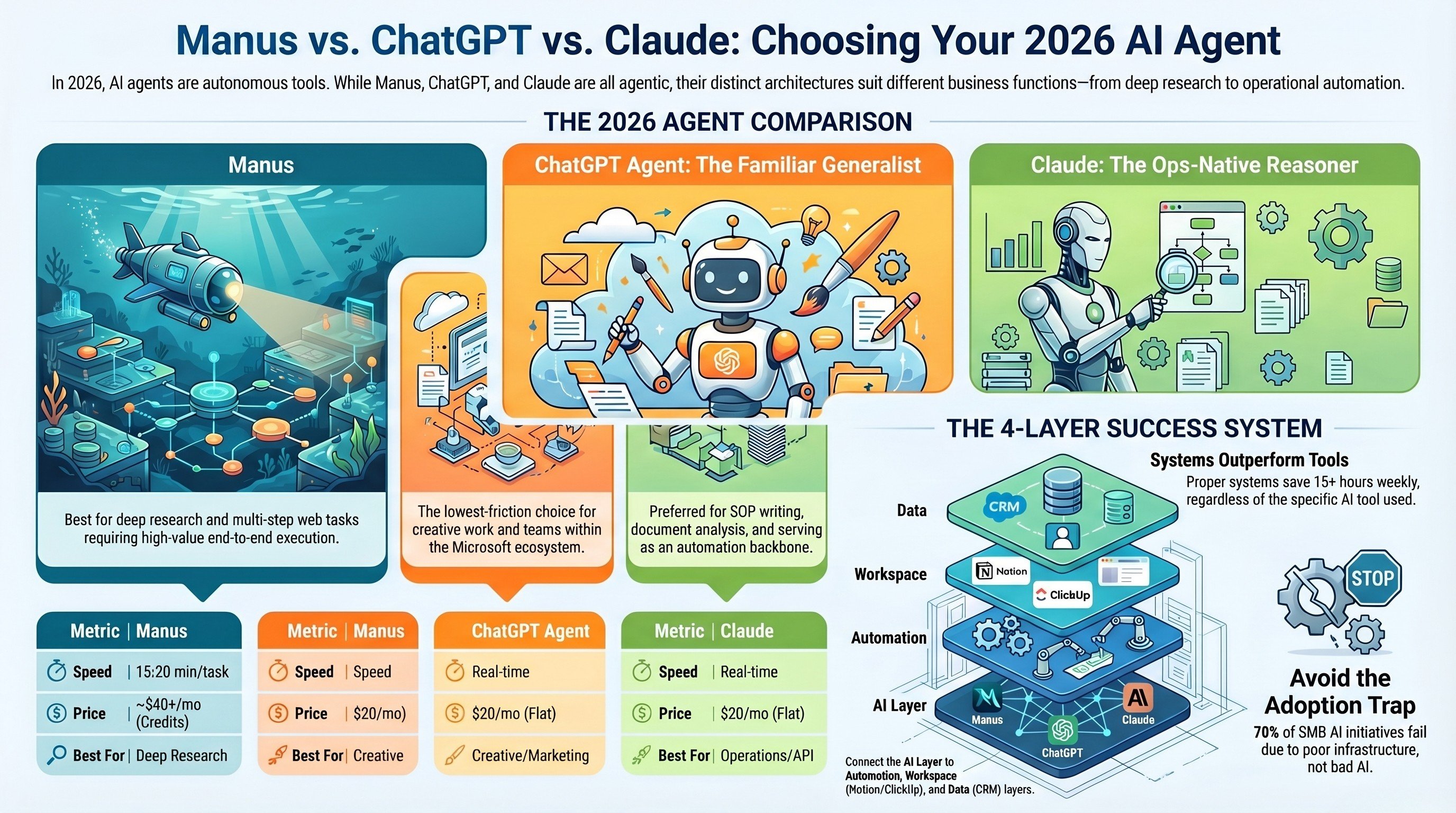
Manus vs Claude vs ChatGPT: which AI agent for 2026
The head-to-head on the three agents we test against real client work.
Read the comparison →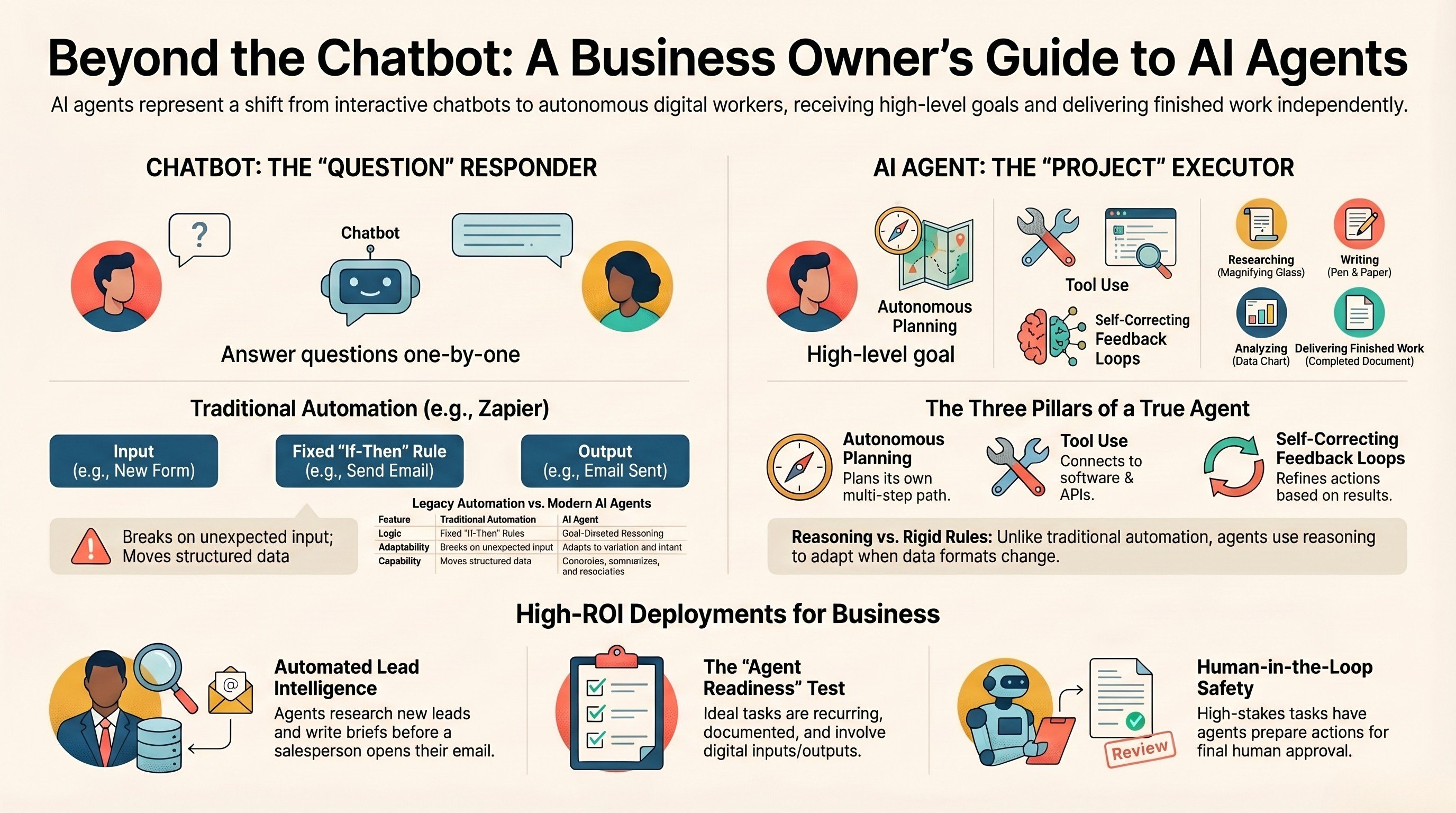
What is an AI agent? A guide for business owners
The plain-English version of what an agent actually is, and where it pays off.
Read the guide →
The AI Engineering stage, built for you
We pick the right agents, wire them into your stack, and hand over something that runs.
See the offer →Want the right AI tools picked for your business?
Book a free 30-minute strategy call. We will map your highest-ROI opportunities and give you a build roadmap on the spot. If we are not the right team for you, we will say so and point you somewhere better.
Book a Free Strategy Call →Free 30-minute call. Honest take, even if that means "you do not need us yet."