OpenAI Agents API vs n8n vs Zapier Agents: the model is the fee, not the platform
OpenAI opened its Agents API to every developer on 10 September and shipped cheaper GPT-6 models on 22 September. We priced one ordinary SMB agent job on all three routes from the vendors' own pricing pages, and the platform turned out to be the smallest line on the bill.
 By Ishan Vats · Founder of IV Consulting, builds production agents on n8n
 Agents API, GPT-6 Sol$118 to $140
 n8n Cloud Starter, same model$110 + €20
 Zapier Agents ProCovers ~375 runs
For a 5 to 50 person team without a full-time developer, keep your agent in n8n and call OpenAI's models from it. Build on the OpenAI Agents API only when the job needs a sandbox to run code over files for minutes at a time and someone on the team writes code. Use Zapier Agents for low-volume helpers: Agents Pro includes 1,500 activities a month, which covers roughly 375 runs of a four-step job. On our priced job the platform barely matters: the same agent costs about $118 to $140 a month on the Agents API and about $110 plus n8n's €20 plan on n8n with the same GPT-6 Sol model, while switching models moves the bill 10 to 15 times.
The verdict
Should you build on the OpenAI Agents API or keep your agent in n8n or Zapier?
Keep it in n8n unless your agent needs a computer. The Agents API is a better engine for long, code-running work, but it is an engine, and a small ops team without a developer needs the car around it: triggers, retries, an error path, and a screen a non-engineer can read at 9am when something failed overnight.
A disclosure first. We build production agents on n8n for clients, so we know that side from the inside. We have not run client work on the OpenAI Agents API: it has been public for thirteen days, and we are not going to pretend otherwise. Every price below is read from OpenAI's API pricing page, n8n's pricing page and Zapier's pricing page on 23 September 2026. The per-run arithmetic is ours, and so are the assumptions, which we state in full in section 04.
Three findings drive the verdict:
- The sandbox is cheap for short jobs. A 1 GB OpenAI container is 3 cents per 20-minute session, and eligible sessions bill by the minute with a 5-minute minimum. On a two-minute triage job that is under 3 cents a run.
- The model is the bill. The same job costs 3 to 5 cents a run on GPT-6 Luna and 48 to 50 cents on GPT-6 Astra. No platform choice comes close to that swing.
- Zapier's ceiling is volume, not price. Agents Pro is $33.33 a month billed annually for 1,500 activities. Past a few hundred runs of a multi-step job, the next tier is a sales call.
What launched
What is the OpenAI Agents API, and what does it cost?
The OpenAI Agents API is a managed service, in public beta since 10 September 2026, that runs long-lived agent sessions on the same Codex harness behind Codex and ChatGPT for Work. There is no platform fee: you pay the model's token rates, any tool calls, and container time if the agent uses a hosted sandbox.
OpenAI's changelog describes it as building agents "with a managed Codex harness" while OpenAI handles session orchestration, context compaction and recovery. In practice that means an agent can keep a session open for a long task, use MCP servers and custom tools, hand work to subagents, and run code and edit files inside a sandbox. Per MarkTechPost's launch write-up, the sandbox can be OpenAI-hosted, self-hosted, or one of nine partners including Cloudflare, E2B, Modal and Vercel.
The pricing, from OpenAI's pricing page on 23 September 2026:
- Containers: 1 GB $0.03, 4 GB $0.12, 16 GB $0.48, 64 GB $1.92 per 20-minute session. Since 20 August, eligible sessions bill per minute with a 5-minute minimum.
- Web search: $10 per 1,000 calls, plus the retrieved content billed as input tokens.
- GPT-6 Astra (released 3 September, the flagship): $10 per million input tokens, $50 per million output.
- GPT-6 Sol (released 22 September): $2 input, $10 output.
- GPT-6 Luna (released 22 September): $0.10 input, $0.50 output. If your automations still call GPT-5.6, our GPT-5.6 vs GPT-6 tier pricing shows GPT-6 Sol now costs less than GPT-5.6 Terra on the same step.
Two beta caveats matter for a business. MarkTechPost reports data residency is US-only and Zero Data Retention is not supported yet, which rules it out for some regulated or EU-bound work today. And TokenCost's pricing teardown points out that the pricing page never defines which container sessions count as "eligible" for per-minute billing, so budget for the full 20-minute rate until OpenAI says otherwise.
Side by side
OpenAI Agents API vs n8n vs Zapier Agents: how do they compare?
They bill three different things. The Agents API bills compute (tokens plus sandbox minutes), n8n bills whole workflow runs, and Zapier Agents bills every action the agent takes. That one difference decides which of them gets expensive as an agent loops, retries or grows.
| What matters | OpenAI Agents API | n8n | Zapier Agents |
|---|---|---|---|
| What you pay for | Tokens, tool calls, sandbox minutes | Executions, one per full run, plus your own model key | Activities: each action, web browse or knowledge lookup |
| Entry price | No platform fee | Starter €20/mo annual, 2,500 executions. Self-host free | Free: 400 activities. Pro: $33.33/mo annual, 1,500 |
| Next step up | Pay as you go | Pro €50/mo annual, 10,000 executions | Enterprise, price on request |
| Who can build it | A developer, in code | An ops person comfortable with a visual builder | Anyone, in plain English |
| Runs code over files | Yes, native sandbox | Code nodes, not a full sandbox | No |
| Models | OpenAI only | Any, including OpenAI and Claude | Zapier's choice, bundled |
| When it fails | You write the retry and alerting | Error workflows and execution logs built in | Activity history, limited control |
| Data residency | US-only in beta | Self-host anywhere | Zapier's cloud |
| Our call | Long, code-running jobs with a developer | Default for repeating ops agents | Low-volume helpers, no builder on staff |
If the billing-unit difference is new to you, we unpack it on its own in execution-based vs task-based automation pricing. The short version: an agent that retries a step twelve times is twelve billable activities on Zapier and still one execution on n8n.
The numbers
What does one AI agent job cost on each platform?
Our priced job, a lead-triage agent running 1,000 times a month, costs about $118 to $140 a month on the Agents API with GPT-6 Sol, about $110 plus €20 on n8n Cloud with the same model, and does not fit Zapier Agents Pro at all: 1,500 activities covers roughly 375 runs.
The job: a new inbound lead arrives, the agent researches the company on the web, scores it, writes a note to the CRM and drafts a reply for a human to send. It is the most common first agent we build. Our assumptions, which are illustrative, not measured on the Agents API:
- 1,000 runs a month, about 45 a working day.
- Per run: 30,000 input tokens (including retrieved search content), 3,000 output tokens, 2 web searches, no caching.
- Agents API: one 1 GB sandbox session per run, priced at the 5-minute minimum (low end) and the full 20-minute session (high end).
- n8n: one execution per run, calling the same OpenAI model and web search through your own API key, no sandbox.
- Zapier Agents: four activities per run (one web browse, one knowledge lookup, one CRM write, one email draft).
| Per month | GPT-6 Luna | GPT-6 Sol | GPT-6 Astra |
|---|---|---|---|
| Model tokens | $4.50 | $90 | $450 |
| Web search, 2,000 calls | $20 | $20 | $20 |
| Agents API sandbox, 1 GB | $7.50 to $30 | $7.50 to $30 | $7.50 to $30 |
| OpenAI Agents API total | $32 to $54.50 | $117.50 to $140 | $477.50 to $500 |
| n8n Cloud Starter total | $24.50 + €20 | $110 + €20 | $470 + €20 |
| Zapier Agents | 4,000 activities needed. Pro includes 1,500 ($33.33/mo annual), about 375 runs. The rest needs Enterprise, price on request. | ||
Read the table down, then across. Down each column, the platform moves the bill by tens of dollars. Across the model row, the bill moves 10 to 15 times. The decision that actually sets your agent budget is which model the job needs, and for triage and drafting a mid-tier model like Sol is usually enough. Reach for Astra only on the steps that need its reasoning, which n8n makes easy because each node can call a different model.
Where the sandbox stops being a rounding error: a job that crunches spreadsheets or builds a report for 20 minutes on a 16 GB container costs $0.48 a run in sandbox time alone, $480 a month at our volume. That is also exactly the job the Agents API is built for, and the one n8n does least well. Price the heavy work separately from the light work.
The 5 minute decision
Which should a small team choose for its next AI agent?
Decide on who maintains it and what the job does, not on the headline price. The price gap between routes is small. The maintenance gap is not.
n8n if
The agent repeats a known process: triage, enrichment, routing, drafting, reporting. You want retries and an error path you can see, the freedom to mix OpenAI and Claude per step, and the option to self-host. This is most ops agents.
OpenAI Agents API if
The job needs a real computer for minutes at a time: run code over files, build spreadsheets or reports, work through a long multi-step task. You have a developer to own it, and US-only data residency is acceptable for the data involved.
Zapier Agents if
Nobody on the team builds workflows, the agent runs a few hundred times a month or less, and the apps it needs are already in your Zapier account. Watch the activity meter, because each step counts.
You can also have both. The pattern we expect to use most is n8n as the trigger, router and error handler, calling the Agents API for the one step that needs a sandbox. If you are choosing between a general-purpose agent like Manus and a built workflow rather than between developer platforms, read our Manus vs Zapier Agents vs n8n verdict first. For the wider cost picture across Manus, Claude, ChatGPT and n8n, see what an AI agent actually costs. And if you want someone to build the n8n side, that is what our n8n developers do.
FAQ
Questions teams ask about the OpenAI Agents API
How much does the OpenAI Agents API cost?
Is the OpenAI Agents API a replacement for n8n or Zapier?
Is n8n cheaper than the OpenAI Agents API for an AI agent?
How many runs does Zapier Agents Pro cover?
Which GPT-6 model should an automation use?
Ishan Vats
Founder, IV Consulting · builds production AI agents on n8n
I build workspaces, automations, and production AI agents for teams from startup to enterprise. 150+ ops transformations over 10+ years. We build agents on n8n every week, which is why this page tells you where n8n is the wrong tool, and why it will not claim Agents API experience we do not have yet.
Run your own agent numbers →Keep reading
Related guides and work
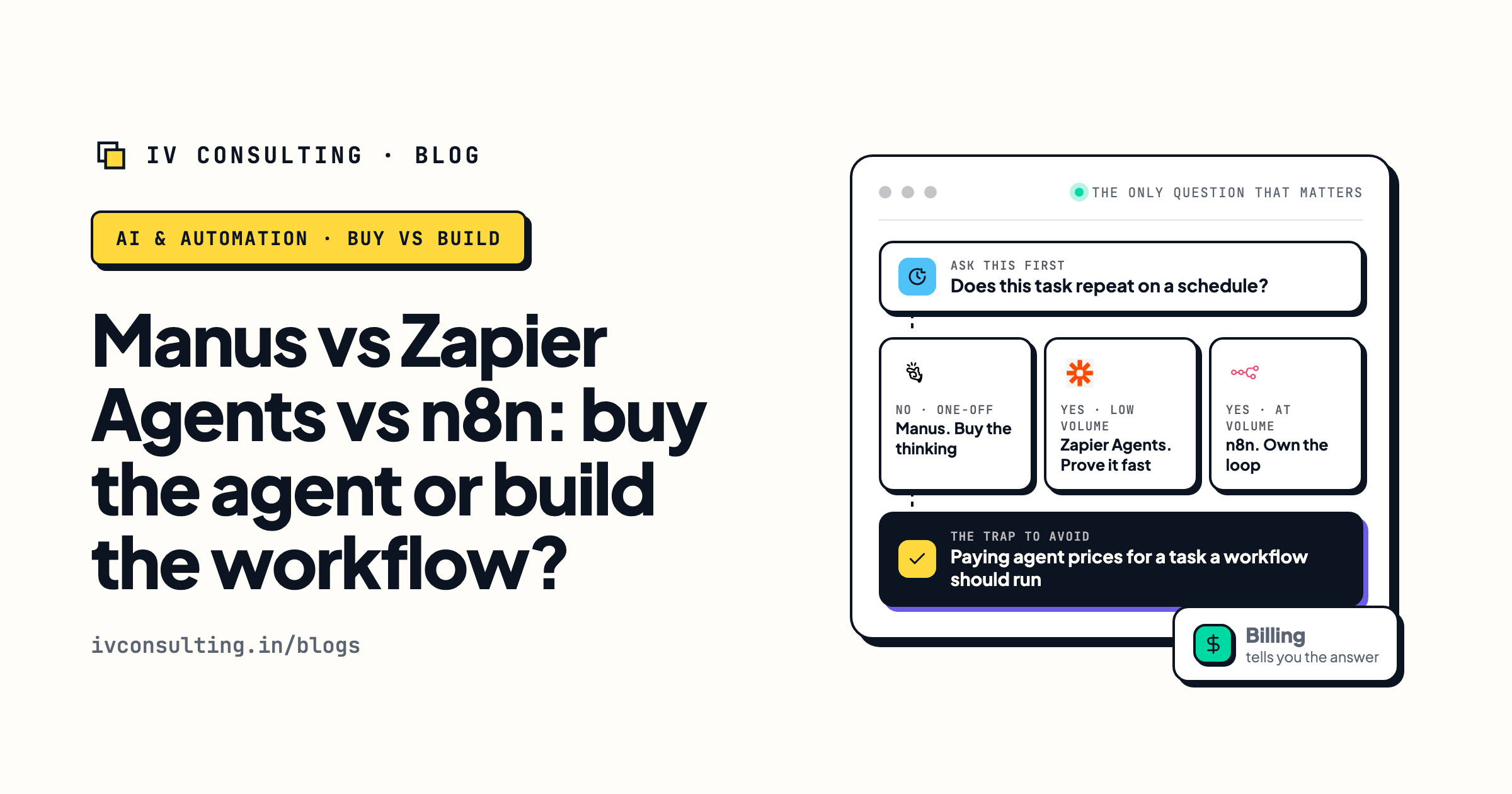
Manus vs Zapier Agents vs n8n
Buy a general agent or build the workflow? Our verdict.
Read the verdict →
Zapier Agents vs Make vs n8n
The three workflow tools head to head for SMB agents.
Read the breakdown →
AI Engineering
Production agents with triggers, retries and an error path, built and handed over.
See the stage →Want your first agent built on the right platform?
Book a free 30-minute strategy call. We will look at the job you want an agent to do, tell you whether it belongs in n8n, Zapier or the Agents API, and which model it actually needs. If you do not need us, we will say so.
Book a Free Strategy Call →Free 30-minute call. Honest take, even if that means "you do not need us yet."