n8n vs Make vs Zapier AI agents: which should your small business use in 2026?
All three now ship native AI agents. Below: the three pairwise matchups, the billing model that decides the bill, and our verdict on which one we would put a client on.
 By Ishan Vats · Founder of IV Consulting · builds AI agents & automations for 150+ teams
 ZapierWidest apps
 MakeVisual balance
 n8nDeepest control
In 2026, n8n, Make and Zapier all ship native AI agents, so the feature list no longer separates them. The billing model does. Zapier bills per task, Make per operation, n8n per execution, which means a 12 step workflow costs Zapier and Make 12 billable units per run and n8n one. Our verdict: pick Zapier only if nobody on the team will touch a settings page, pick Make if you want a visual canvas and lower unit burn, and pick n8n for anything agent heavy, high volume, or privacy bound. Then use an agent only for variable, judgment heavy steps and keep plain automation for everything predictable.
What shipped
Every major automation platform now has native AI agents
2026 is the year the AI agent stopped being a bolt-on. The three platforms most small businesses already use for automation, n8n, Make, and Zapier, each shipped a native AI agent feature inside their core builder. You no longer wire an LLM in by hand. The agent is a first-class part of the canvas.
Before you compare the three, check whether you need to pay for any of them yet. If your workflows start inside Gmail, Drive, or Calendar, the agent builder bundled into your Google Workspace plan may already cover them, which we walk through in Google Workspace Studio: you probably already have it.
That changes the question. For years the debate was "which AI automation platform has the better app list." Now all three can reason, call tools, and act on their own. So the real choice is two decisions stacked: which platform fits your team, and where in your workflow an agent earns its place.
What actually shipped
- n8n 2.0 (January 2026) added native LangChain integration, around 70 AI nodes, persistent agent memory across runs, self-hosted LLM support, and true agent loops where the model uses a tool, checks the result, and iterates until the task is done.
- Make AI Agents (February 2026) arrived in the same visual canvas as regular scenarios, with a real-time Reasoning Panel that shows every decision the agent makes. It sits next to Maia, Make's natural-language builder that wires a scenario from a plain-English description.
- Zapier Agents brought autonomous task execution across Zapier's 8,000 plus connected apps, with a plain-English builder so non-technical users can describe an agent and have it assembled.
The comparison
Zapier vs Make vs n8n AI agents, side by side
The short version: Zapier is the easiest with the most apps, Make is the visual middle ground, and n8n gives you the deepest agent control and full data ownership.
| What matters | Zapier | Make | n8n |
|---|---|---|---|
| Best for | Non-technical teams, simple automations | Visual builders who want cost efficiency | Technical teams, deep AI agents, data control |
| Integration breadth | Widest, 8,000+ apps | Strong, around 3,000 apps | Growing, plus any HTTP API and custom code |
| AI agent depth | Zapier Agents, plain-English builder | Make AI Agents with a live Reasoning Panel | Native LangChain, ~70 AI nodes, persistent memory, agent loops |
| Pricing model | Per task, every action counts | Per operation, cheaper at scale | Per execution, one run regardless of steps |
| Ease of use | Easiest, no setup | Visual, moderate learning curve | Most powerful, steeper learning curve |
| Self-hosting & data control | Hosted only | Hosted only | Self-host for full data ownership |
The matchups
n8n vs Zapier, Make vs Zapier, n8n vs Make
Most people are not choosing between three platforms. They already use one and are weighing a single switch. Here is each pair, with a call rather than a shrug.
n8n vs Zapier: which is better for AI agents?
n8n wins on agents, Zapier wins on time to first automation. Zapier Agents can be described in plain English and assembled without touching a config panel, which is genuinely the fastest path from idea to a running agent. But Zapier's agent is a closed box: you get the outcome, not the loop. n8n gives you the actual agent loop, roughly 70 AI nodes, persistent memory across runs and the option to point the agent at a self-hosted model.
The pricing gap makes the same choice again. Zapier counts every action as a task, and agent loops are action factories: one agent run that calls three tools and retries once is not one task, it is several. On n8n that entire run is one execution. Inside a regular Zap the same thing applies to AI by Zapier steps, where each tool call is charged at the model tier rate of up to 5x, as we work through in our AI by Zapier pricing breakdown. Our call: Zapier if the agent is a nice to have, n8n the moment it becomes load bearing.
Make vs Zapier: is Make cheaper and more capable?
Make, for almost every team that has outgrown a two step Zap. Make gives you a real canvas with branching, iterators and error handlers that you can see rather than infer, and its per operation billing is generally kinder than per task as step counts grow. Zapier's advantage is the app library, roughly 8,000 connectors against Make's roughly 3,000, so the honest tiebreaker is whether your specific stack is covered.
On agents, Make's Reasoning Panel is the underrated feature here: it shows you every decision the agent made, in order. When an agent does something strange in production, that panel is the difference between a fix and a guess. Our call: check Make covers your apps, and if it does, Make.
n8n vs Make: the one that is actually close
This is the real fight, and the answer is not a feature. Both give you a visual canvas, both give you branching and error handling, both ship a credible agent layer, though they behave very differently the moment a run actually fails, which we break down in Zapier vs Make vs n8n when workflows fail. The split is who maintains it. Make if the automation will be owned by an ops person; n8n if it will be owned by someone who can read a JSON payload without flinching.
Two things break the tie decisively when they apply. If customer data cannot leave your infrastructure, n8n self-hosting ends the conversation. If your workflows are long, n8n's per execution billing ends it the other way round, and the next section shows exactly how much that is worth. OpenAI has since opened a fourth route for teams with a developer, and we priced it against n8n and Zapier Agents in OpenAI Agents API vs n8n vs Zapier Agents.
The cost model
Which is cheapest? Count billable units, not sticker price
Comparing monthly plan prices is the most common mistake we see. The three platforms do not bill for the same thing, so the same workflow consumes wildly different amounts of plan.
Zapier bills per task, which means per action step. Make bills per operation, which means per module run. n8n bills per execution, which means one full workflow run no matter how many nodes it contains. Hold the workflow constant and the difference is pure arithmetic. Take a 12 step workflow that runs 1,000 times a month:
| 12 step workflow, 1,000 runs/month | Zapier | Make | n8n |
|---|---|---|---|
| Billing unit | Task (per action) | Operation (per module) | Execution (per run) |
| Units per single run | ~12 | ~12 | 1 |
| Units per month | ~12,000 | ~12,000 | 1,000 |
| Effect of adding 6 more steps | Bill rises ~50% | Bill rises ~50% | Bill unchanged |
| Effect of an agent that loops 3x | Multiplies again | Multiplies again | Still one execution |
Billable units are only the platform half of the bill. The other half is the model tier each agent step runs on, and on API pricing that half has the wider spread: cheap tier to top tier is roughly 10x, and a step that is really classification does not need the expensive end of it. We break that decision out on its own in which AI model for which task.
The verdict
Our verdict: n8n for agents, Make for most teams, Zapier for speed
Comparison posts usually end in "it depends." Here is the version with an actual opinion, based on how these builds go wrong rather than how the feature lists read.
If the AI agent is the point of the build, use n8n. Agent work is iterative by nature, and n8n is the only one of the three where the loop is inspectable, the memory persists, the model can be swapped or self-hosted, and the billing does not punish you for the retries that agents inevitably need. Every constraint that bites later is loosest here. If the platform is settled and the open question is what to point it at first, our field catalog of n8n use cases SMBs actually build ranks the workflows teams keep, with the effort and payback of each.
If automation is the point and an agent is one step inside it, use Make. This is most small businesses. Make is the best balance on the board: visual enough that an ops person can maintain it, cheap enough to scale, and its Reasoning Panel makes the agent step debuggable rather than mysterious. The only thing that should push you off Make is a missing connector.
Use Zapier when speed of setup outranks everything else. A team with nobody technical, a tool with a Zapier-only integration, or an automation that needs to exist this afternoon. Zapier is genuinely the best at that, and it is a real answer, not a consolation prize. Just budget for the migration conversation once the workflow gets long, because per task billing turns complexity into cost faster than teams expect. If nobody on the team will own the build at all, the platform is the second question, and we compare the five real routes, from DIY to templates to a freelancer, in done-for-you vs DIY automation.
Whoever ends up owning these builds is usually the closest thing you have to a tech team, and the automation platform is only one item on their plate. The AI use cases for tech teams guide covers the rest of that list, from code generation and DevOps automation to self-healing infrastructure.
The decision
Which AI automation platform should you actually pick?
Match the platform to your team and your constraints, not to a leaderboard. Here is the honest version for each situation.
Pick Zapier if you want to start today
No developers, no setup, and a tool you need to connect almost certainly has a Zapier integration. Zapier is the fastest path from idea to a working automation, and Zapier Agents let a non-technical owner stand up a simple agent in plain English. The trade-off is per-task pricing, which gets expensive as steps and volume grow.
Pick Make for the visual middle
You want to see the whole flow on a canvas, you need more logic than Zapier offers, and you care about cost as you scale. Make AI Agents and the Reasoning Panel give you agent power with visibility into every decision.
Pick n8n for depth and ownership
You have someone comfortable with a little setup, you run complex or high-volume automations, or you need data to stay on your own servers. n8n's execution pricing and self-hosting make it the most cost-efficient and private option for serious builds.
Regulated or sensitive data
If you are in healthcare, finance, or anything GDPR-bound, n8n self-hosting keeps customer data inside your own infrastructure. That single fact often decides the platform before any feature comparison.
The pragmatic answer: you can run more than one
Plenty of growing teams keep Zapier for quick, low-volume connectors and run n8n for the heavy, AI-driven core. The platforms are not a religion. Pick the one that fits the job, and let the expensive, complex work live where the pricing model rewards it. If you have already decided to shift the heavy work onto n8n, the sequencing is its own project, and we walk it step by step in the Zapier to n8n migration guide.
If you are still building your first agent before you compare platforms, start with our walkthrough on building your first AI agent workflow with n8n, then come back to this decision once you have one running.
The real question
When does an AI agent actually beat plain automation?
Here is the part the platform marketing skips. The most upvoted complaint in the automation community right now is not "which tool." It is people force-using AI for jobs plain automation already handles, then, in one builder's words, "reinventing the wheel with a few screws loose."
An AI agent is probabilistic. It reads context and decides. That is a strength when the input is messy and a liability when the input is predictable. You do not need a reasoning model to send a scheduled report or route a form to the right inbox. A simple deterministic rule does that more cheaply, more reliably, and with a clean audit trail.
Use deterministic automation when
- The rule is explicit and the outcome should be identical every time: scheduled reports, payroll runs, inventory alerts, order routing.
- The data is structured and stable.
- Every step must be auditable and reproducible.
Use an AI agent when
- The input is unstructured or varies a lot: inbound emails, support tickets, free-text form fields.
- The task needs judgment: classify, summarize, draft a reply, flag an exception.
- A human would otherwise read each item and decide case by case.
The 2026 consensus is hybrid: a deterministic core for reliability, with an agentic surface for the ambiguous parts. Validation, routing, and transforms stay as plain steps. Classification, summarization, and reasoning go to the agent. n8n, Make, and Zapier all support this pattern, which is the real reason native agents matter: you can mix both in one flow.
The connective trend
Why MCP is the quiet story behind all three
One reason native agents arrived across every platform at once is MCP, the Model Context Protocol. Created by Anthropic and now an open standard adopted across the industry, MCP standardizes how an AI agent connects to tools and data.
Before MCP, every tool an agent touched needed a bespoke integration. With MCP, an agent speaks one common protocol to many tools. For a small business that means agent builds are faster to assemble and far easier to maintain, because you are wiring to a standard instead of a hundred one-off connectors. If you are choosing a platform for the long run, its MCP support is a better signal of future-proofing than its current app count. We later connected all three platforms' MCP servers to Claude and priced one job through each in n8n MCP vs Zapier MCP vs Make MCP; the billing gap is far bigger than the app counts suggest.
Not sure what an agent even is under all this? Start with our plain-English primer: what is an AI agent, really.
FAQ
Questions owners ask before they choose
Did Zapier, Make, and n8n all add AI agents in 2026?
Which platform is best for a small business with no developers?
When should I use an AI agent instead of plain automation?
What is MCP and why does it matter for automation?
Is n8n cheaper than Zapier?
Is n8n or Zapier better for AI agents?
Is Make cheaper than Zapier?
Should I switch platforms if I already use Zapier?
Can IV Consulting build this for me?
Ishan Vats
Founder, IV Consulting · AI & automation consultant
I build production AI agents, automations, and MCP servers for teams from startup to enterprise. 150+ ops transformations over 10+ years. If you want this mapped to your own stack, I'll do it with you on a free call.
Book a free strategy call →Keep reading
Related guides and work
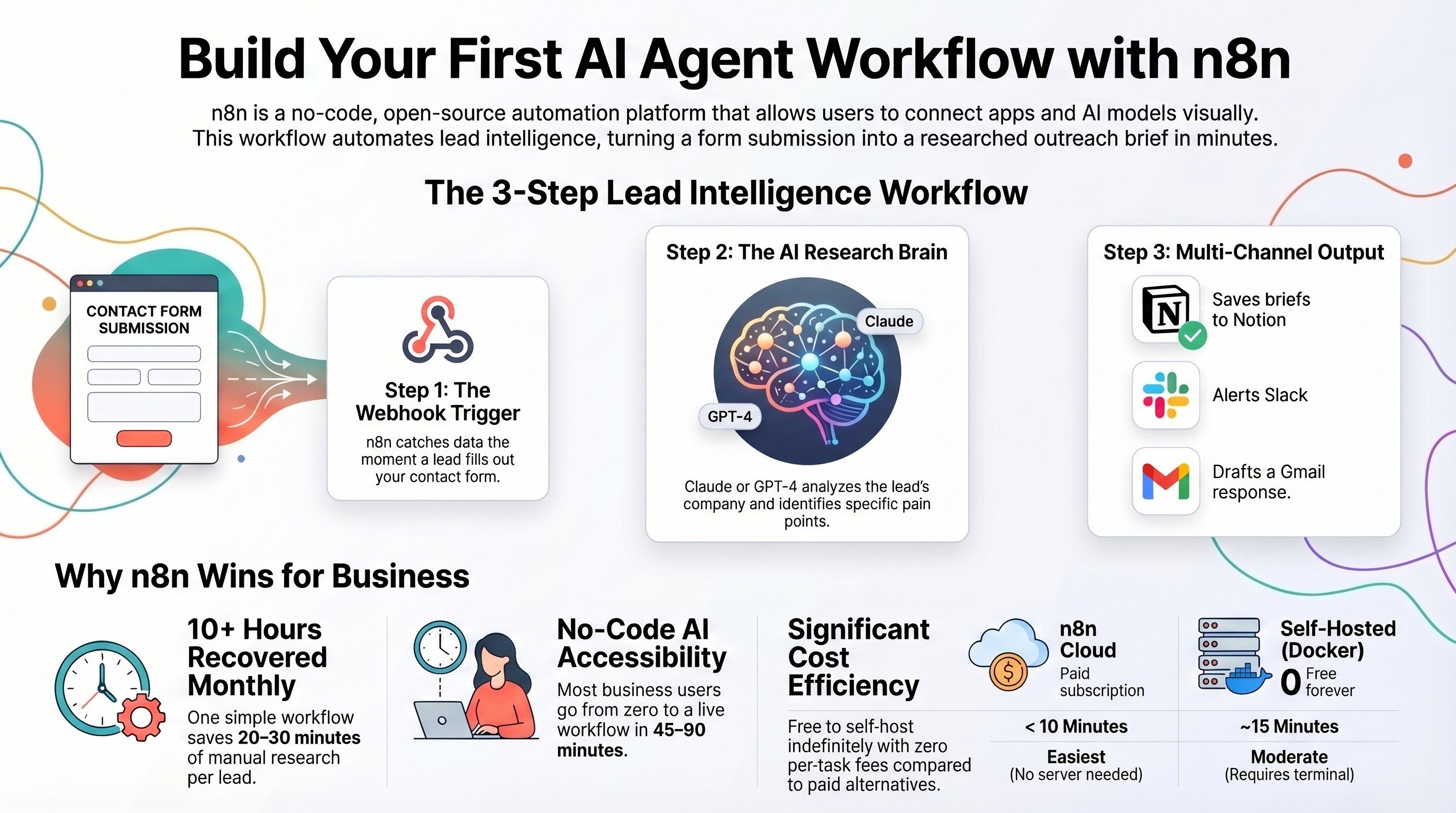
Build your first AI agent workflow with n8n
A zero-code walkthrough that gets a live AI workflow running in under an hour.
Read the guide →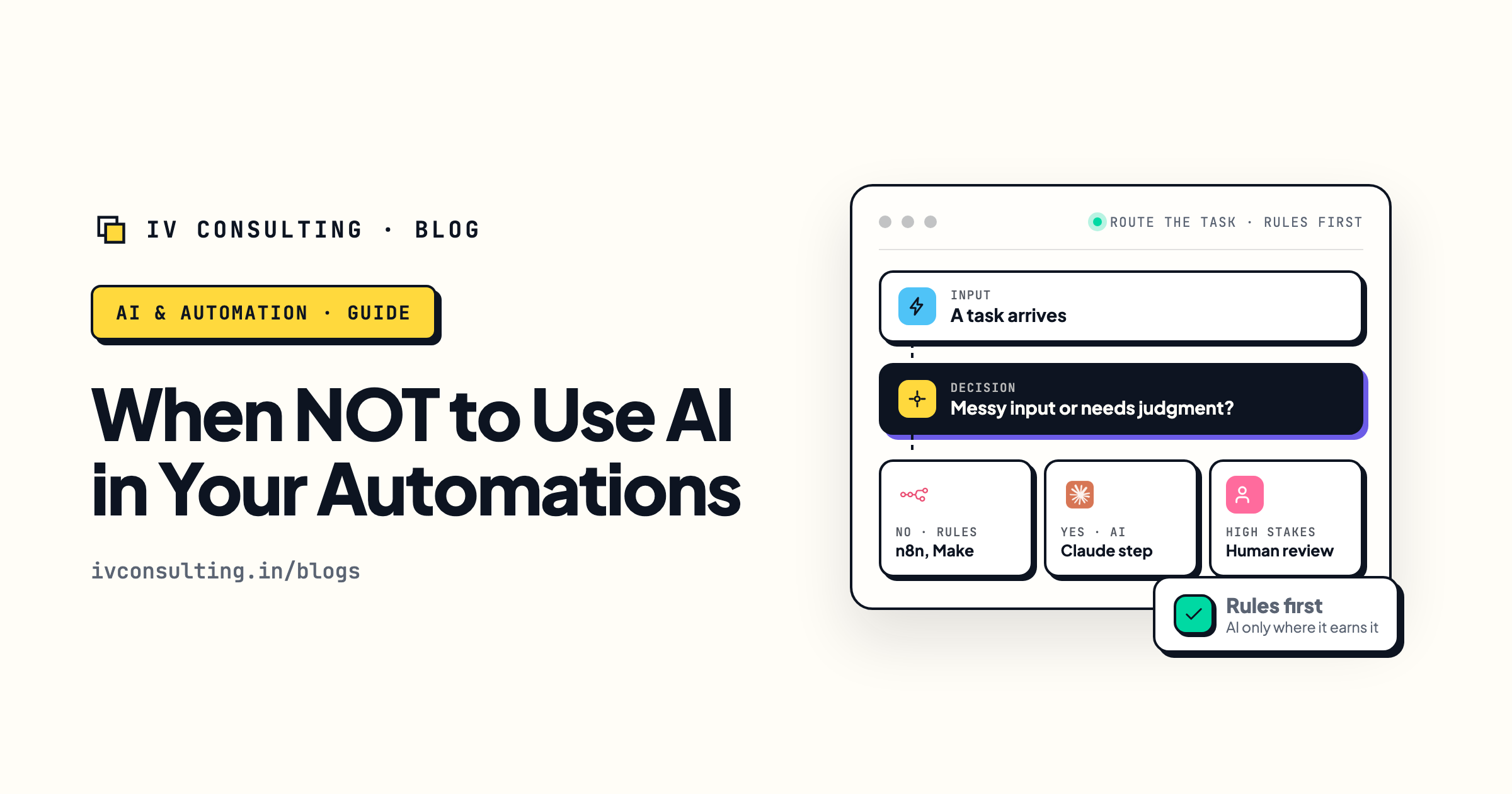
When not to use AI in your automations
The deterministic-vs-agent line, and the expensive mistake of agent-ifying everything.
Read the post →
The Automation stage, built for you
Your tools connected, the busywork gone, built on the right platform for you.
See the offer →Not sure which platform fits you?
Book a free 30-minute strategy call. We will look at your workflows, recommend the right platform across Zapier, Make, and n8n, and show you where an AI agent actually pays off. If you do not need us yet, we will say so.
Book a Free Strategy Call →Free 30-minute call. Honest take, even if that means "you do not need us yet."