Buy the agent for thinking. Build the workflow for running.
Manus, Zapier Agents and n8n get compared on intelligence. That is the wrong axis. Our verdict: the question is whether the task repeats. One-off judgement work belongs in a general agent like Manus. Anything that runs on a schedule and must not fail silently belongs in a workflow, and past a low volume that means n8n rather than Zapier Agents.
 By Ishan Vats · Founder of IV Consulting · builds AI agents & automations for 150+ teams
 No · one-offManus. Buy the thinking
 Yes · low volumeZapier Agents. Prove it fast
 Yes · at volumen8n. Own the loop
Manus, Zapier Agents and n8n are not three versions of the same product, so ranking them by intelligence gives you the wrong answer. Manus is a general autonomous agent you hand a goal to. Zapier Agents and n8n are workflow platforms where the agent is one component inside a run you define. The deciding question is not which is smartest, it is whether the task repeats. Buy a general agent for one-off, judgement-heavy work that changes every time. Build a workflow for anything that runs on a schedule and has to fail loudly when it breaks. Between the two workflow platforms, start on Zapier Agents to prove the idea quickly, and move to n8n once the job runs often enough that per-task billing on a looping agent starts to hurt. The billing model of each tool is the clearest signal of what its vendor built it to do.
The verdict
Manus vs Zapier Agents vs n8n: which should you actually buy?
Our verdict: buy Manus for thinking, build the workflow for running, and do not let one do the other's job. If a task happens once, or happens differently every time, and its output is a document a human will read and judge, that is Manus. If a task repeats on a schedule, touches your systems, and someone will notice when it stops, that is a workflow, and past a low volume that means n8n rather than Zapier Agents.
Almost every comparison of these three tools ranks them on capability. That framing quietly assumes they are substitutes. They are not, and the mistake is expensive in both directions:
- Running repeating work through a general agent is the costlier error. A general agent re-reasons the task from scratch on every run. That is exactly what you are paying it for on a one-off, and exactly what you do not want on the four hundredth identical invoice. You pay a thinking price for a task whose answer never changes, and you inherit a process that can quietly do something different this Tuesday than it did last Tuesday.
- Forcing genuine judgement into a rigid workflow is the more common error. Teams build an elaborate branching automation to approximate a decision a person would make in nine seconds, then maintain that branching forever as the edge cases arrive. If you cannot write down the rule, you do not have a workflow yet. You have a judgement, and a general agent handles judgement better than forty nested conditions.
- The two failure modes look nothing alike, which is why the distinction matters operationally. A workflow that breaks throws an error you can alert on. A general agent that goes wrong returns a confident, plausible, wrong deliverable and no error at all. That difference should decide where you put work that has to be right, not a feature list.
So the useful question is not "which of these three is best." It is "does this task repeat, and does anyone find out when it fails." Answer that honestly and the tool picks itself. The rest of this page is the reasoning, the comparison, and the one signal we trust most when a vendor's marketing and its actual design disagree.
The categories
What is the actual difference between Manus and an agent inside n8n?
The difference is who owns the loop.
Manus is a general autonomous agent. You hand it a goal in plain language. It decomposes that goal into steps, picks its own tools, executes, and hands back a finished artifact. You do not define the steps and you mostly cannot see them coming. That is the product: you are buying the decomposition, not just the execution.
Zapier Agents is a general agent wrapped in an automation platform. You describe what the agent should do in plain English and point it at Zapier's connected app library, which runs to roughly eight thousand apps. It then executes autonomously against those apps. The important structural detail is that you get the outcome rather than the loop: the reasoning happens, but it is not something you assemble or inspect step by step.
n8n is a workflow engine that can contain an agent. You build the run: triggers, nodes, branches, error paths. Since n8n 2.0 shipped in January 2026 it carries native LangChain integration, roughly seventy AI nodes, persistent agent memory across runs, and genuine agent loops where the model calls tools and iterates. The agent is a component inside a workflow you designed, not a replacement for designing one. You can also self-host it, which matters if the data cannot leave your environment.
That ordering, from "the agent owns everything" to "you own everything and rent some intelligence," is the real spectrum. It also predicts the failure modes precisely. The more the agent owns, the less you can inspect when the output is wrong, and the more you are trusting a system that is very good at sounding right.
The decision
Manus vs Zapier Agents vs n8n compared
Compared on the axes that actually change the decision, not on which model is behind them.
| Factor | Manus | Zapier Agents | n8n |
|---|---|---|---|
| What it is | General autonomous agent. You give a goal | General agent inside an automation platform | Workflow engine that can contain an agent |
| Who defines the steps | The agent | The agent, against apps you connect | You. The agent is one node in your run |
| Best shape of work | One-off, judgement-heavy, output is a document | Repeating work you want running this week | Repeating work that must not fail silently |
| Billing shape | Credits per run | Per task, so each tool call counts | Per execution, so a whole run counts once |
| What that billing rewards | Getting it right first time. Iteration is expensive | Short, simple, low-volume automations | Long, looping, high-volume workflows |
| When it fails you get | A confident, plausible, wrong deliverable | An error, though the reasoning is opaque | An error on the node, with an error path you built |
| Breadth of connections | General web and tool use | Widest app library, roughly 8,000 apps | Broad, plus anything with an API or a self-hosted service |
| Setup effort | Lowest. Write the goal | Low. Describe the agent in plain English | Highest. You are building a real system |
| Data can stay in-house | No | No | Yes, self-hosted |
| Right when | The task changes every time and a human judges the output | You need it live this week and volume is low | It repeats at volume, or the loop and the data need to be yours |
Read the "billing shape" and "what that billing rewards" rows together, because they carry more decision-making weight than anything else in the table. They are the subject of the next section.
The part nobody says
Why does the pricing model tell you what the tool is for?
Vendor marketing converges. Every one of these three will tell you it handles your business processes end to end. The pricing does not converge, and pricing is where a vendor states what it actually expects you to do, because that is the sentence it has to stand behind financially.
Line the three up:
- Manus bills credits per run, which penalises iteration. In our own five-day trial this was one of the four things we marked it down on: the credit model discourages you from re-running a task to refine it. A tool that is expensive to repeat is a tool built for work you do once. That is not a flaw, it is a statement of intent, and it lines up exactly with where Manus was strong for us.
- Zapier bills per task, which penalises autonomy. This is the sharpest one. An agent loop works by calling a tool, looking at the result, and calling another. Every one of those calls is a billable task. So the more genuinely agentic the agent behaves, the more it costs, and the cost is not predictable in advance because the agent decides how many steps it needs. Zapier's per-task model is superb for short deterministic Zaps and structurally awkward for the exact autonomy Zapier Agents sells.
- n8n bills per execution, which makes the loop free inside the run. One workflow run is one execution whether it took three steps or thirty, so an agent that iterates twelve times costs the same as one that got it right immediately. A twelve-step workflow running a thousand times a month consumes roughly twelve thousand Zapier tasks against a thousand n8n executions. That gap is not a rounding difference, and it widens with exactly the behaviour agents are supposed to exhibit. If you are also weighing OpenAI's developer route, we priced one agent job on the OpenAI Agents API vs n8n vs Zapier Agents, and the sandbox turned out to cost less than the model.
So the billing tells you the honest positioning. Manus is priced like a consultant you brief once. Zapier is priced like a switchboard, and its agent product is priced against its own grain. n8n is priced like infrastructure you run. Match your task to the pricing shape and you will rarely be wrong, even when the feature lists say all three could do it.
The case for buying
When is Manus the right answer over building a workflow?
We are not anti-agent, and this is the section where the general agent wins outright. We rated Manus four out of five after running it for five working days on five real client deliverables. It cut production time by forty to sixty percent on that work with no loss of quality in the final output. Two deliverables came back near production quality, one was strong with review, and two needed rewriting for voice.
Look closely at what that work was, because it defines the win condition. It was research synthesis across multiple sources, structured reports built out of messy inputs, and frameworks and templates. Every one of those is a task that arrives differently each time, cannot be reduced to a rule, and ends in a document a human reads and judges. That is the shape a general agent is genuinely better at than any workflow you could build, and it is not close. If that kind of report-from-messy-inputs work fills a whole team's week, we sorted it job by job, from unstructured-data processing to report generation, in AI use cases for data and insights teams.
Buy the agent when all of these are true:
- The task is different every time, so there is no rule to encode.
- The output is a deliverable a human will review before it matters.
- You need it once, or occasionally, not on a schedule.
- Being wrong is recoverable, because a person is in the loop by design.
The same trial showed where it stops. It was weak on time-sensitive and live data, it defaulted to a formal generic voice that needed rewriting on two of five deliverables, and the credit billing discouraged the iteration that would have fixed that. Notice that none of those weaknesses get better with volume. They get worse, because at volume nobody is reviewing every output and the generic voice ships.
If you want the general agents ranked against each other rather than against workflows, that is a different question and we answered it separately in Manus vs ChatGPT vs Claude. If you want the raw monthly cost of each option side by side, we broke that out in what an AI agent actually costs. For the two agent products the big labs now sell directly to ops teams, that is ChatGPT Work vs Claude Cowork.
The build side
Zapier Agents or n8n: which one should you build on?
Once you have decided the task repeats, the choice narrows to two and the answer is a sequence rather than a winner.
Start on Zapier Agents when speed of proof matters more than cost. You describe the agent in plain English, point it at an app library of roughly eight thousand connectors, and it runs. For a first experiment, or for a job that fires a handful of times a day against mainstream SaaS tools, that is the correct trade. Do not over-engineer a thing you are not yet sure you want.
Move to n8n when any one of these becomes true. These are the tripwires, and hitting one is enough:
- Volume makes per-task billing bite. The moment your agent loops, the cost stops being predictable on a per-task model and starts being predictable on a per-execution one.
- You need to see and shape the loop. n8n exposes the agent loop itself, with roughly seventy AI nodes and persistent memory across runs. Zapier Agents gives you the outcome. When you need to constrain which tool the agent may call, or what happens on the third retry, you need the loop.
- The data cannot leave your environment. Self-hosting n8n is the only option here of the three, and it removes per-task fees entirely at the cost of running the instance yourself.
- Failure needs to be loud. Building the error path is the whole point of a workflow engine, and it is the capability that separates something you can depend on from something that works most of the time.
We build in n8n and Make for clients, so treat that as disclosed bias and check the reasoning rather than the recommendation. The reasoning is the billing shape and the loop visibility, both of which you can verify against the vendors' own documentation before you take our word for it. We go deeper on the three-way platform question, including where Make fits, in Zapier Agents vs Make AI Agents vs n8n.
FAQ
Questions ops teams ask about Manus, Zapier Agents and n8n
Can Manus replace Zapier or n8n?
Is Manus better than n8n for business automation?
Is n8n or Zapier Agents better for AI agents?
When should you use an AI agent instead of a normal workflow?
Which is cheaper for a small team, Manus or n8n?
Can you use Manus and n8n together?
Ishan Vats
Founder, IV Consulting · AI & automation consultant
I build production AI agents, automations, and MCP servers for teams from startup to enterprise. 150+ ops transformations over 10+ years. Most of the tool debates I get pulled into are settled by one question nobody asked first: does this task actually repeat?
Run my automation numbers →Keep reading
Related guides and work
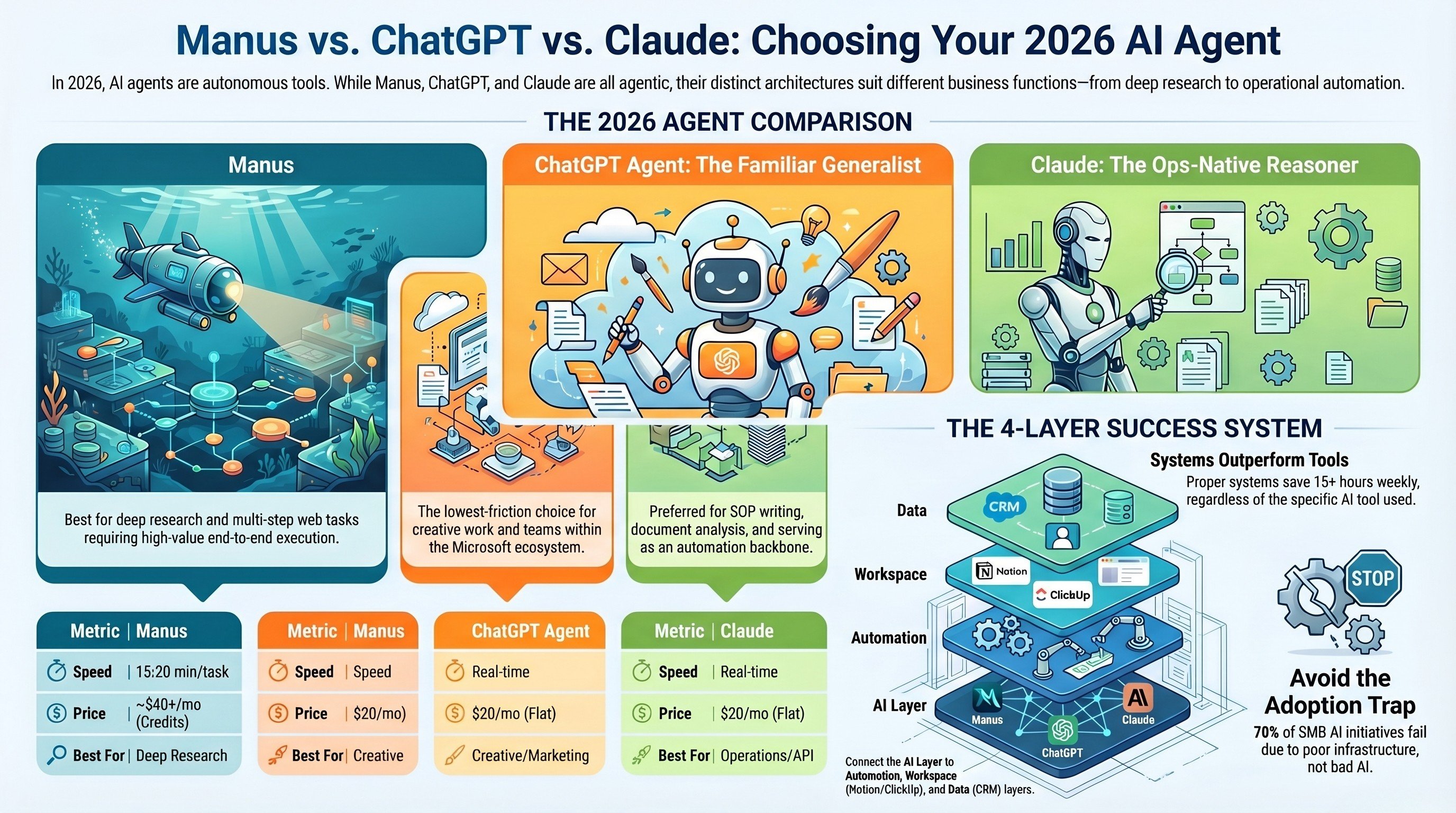
Manus vs ChatGPT vs Claude
If you have decided you want a general agent, this is the one that ranks them against each other.
Read the comparison →
Zapier Agents vs Make AI Agents vs n8n
If you have decided to build, this is the platform question in full, including where Make fits.
Read the comparison →
The AI Engineering stage, built for you
Agents built into workflows you own, with the error paths and the runbook written down.
See the offer →Not sure whether your task is a one-off or a workflow?
Book a free 30-minute call. Bring the job you were about to point an agent at. We will tell you whether it repeats often enough to be worth building, which of the three fits it, and what it would cost to run properly. If the honest answer is that a general agent and twenty minutes a week already solves it, we will say that instead.
Map my highest-ROI workflow, free call →Free 30-minute call. Honest take, even if that means "keep doing it by hand."