Claude Opus 5.5 vs GPT-6.1 Sol vs Sonnet 5.5: we re-priced 3 automations after the September cuts.
Anthropic shipped Claude Opus 5.5 on 22 September at $4 in and $20 out per million tokens. A week later OpenAI shipped GPT-6.1 Sol at $2 and $10 with cached input halved to $0.10. If an n8n, Make or Zapier step still points at the model you picked in August, it is probably mispriced. We took both vendors' price lists, checked on 7 October 2026, and re-costed the three workflow shapes small teams actually run.
 By Ishan Vats · Founder of IV Consulting, builds n8n and AI agent workflows for ops teams
 n8n AI Agent node8 turns, 30K tokens of cached context
 GPT-6.1 Sol$153 per 1,000 runs
 Claude Sonnet 5.5$246 per 1,000 runs
Claude Opus 5.5$437, half of GPT-6 Astra
Claude Sonnet 5.5$246 per 1,000 runs
Claude Opus 5.5$437, half of GPT-6 Astra
Claude Opus 5.5 costs $4 per million input tokens and $20 per million output, with cache reads at $0.20. GPT-6.1 Sol costs $2 and $10, with cached input at $0.10. Claude Sonnet 5.5 costs $2 and $10, with cache reads at $0.20. On a cache-heavy agent run 1,000 times, that works out to about $153 on GPT-6.1 Sol, $246 on Sonnet 5.5 and $437 on Opus 5.5, against $870 on GPT-6 Astra. Our verdict: GPT-6.1 Sol is the new price default for judgement steps, Opus 5.5 should replace both Opus 5 and GPT-6 Astra on your hardest step today, and high-volume sorting still belongs on GPT-6 Luna or Claude Haiku 4.5.
The verdict
Claude Opus 5.5 vs GPT-6.1 Sol: which should run your automations?
For most judgement steps, GPT-6.1 Sol. It has the same sticker price as Claude Sonnet 5.5 but costs less on every shape we priced, and about 38% less on agent runs that re-read a long context. Use Claude Opus 5.5 only for the one step where being wrong is expensive, and on that step it is now half the price of GPT-6 Astra.
How we got these numbers. Every price on this page comes from Anthropic's API pricing page and OpenAI's API pricing page, both read on 7 October 2026. The workflow shapes, token counts and arithmetic are ours, and every assumption is written out so you can swap in your own. We have not run a quality benchmark between these models, and we will not pretend to. This is a cost comparison with an opinion attached, not a leaderboard.
Four calls drive the verdict:
- Same sticker, different bill. GPT-6.1 Sol and Claude Sonnet 5.5 both list at $2 in and $10 out. Sol still comes out cheaper because its cached input is half the price, OpenAI charges no extra to write the cache, and Anthropic says its newer models produce about 30% more tokens for the same text.
- Opus 5.5 is a straight saving over Opus 5. Same family, 20% lower list price, 60% cheaper cache reads. If any workflow calls Opus 5 today, switching the model name is the cheapest win on this page.
- GPT-6 Astra lost its job. On our agent run, Opus 5.5 costs $437 per 1,000 runs and Astra $870. GPT-6.1 Sol is $153. Astra now needs to be meaningfully better than both on your task to earn a place.
- The cheap tier still does most of the work. A triage step costs $0.30 per 1,000 runs on GPT-6 Luna and $6 on GPT-6.1 Sol. Nothing in September changes the rule: start on the cheapest model and escalate only what fails.
The new price list
What do Claude Opus 5.5, Sonnet 5.5 and GPT-6.1 Sol cost per million tokens?
Opus 5.5 is $4 in and $20 out. Sonnet 5.5 and GPT-6.1 Sol are both $2 in and $10 out. The difference that matters for agents is the cached-input line: $0.10 on GPT-6.1 Sol, $0.20 on both new Claude models.
| Model | Input | Cached input | Output | Batch (in / out) |
|---|---|---|---|---|
| GPT-6 Luna | $0.10 | $0.01 | $0.50 | $0.05 / $0.25 |
| Claude Haiku 4.5 | $1 | $0.10 | $5 | $0.50 / $2.50 |
| GPT-6.1 Sol (new, 29 Sep) | $2 | $0.10 | $10 | $1 / $5 |
| GPT-6 Sol | $2 | $0.20 | $10 | $1 / $5 |
| Claude Sonnet 5.5 (new) | $2 | $0.20 | $10 | $1 / $5 |
| Claude Opus 5.5 (new, 22 Sep) | $4 | $0.20 | $20 | $2 / $10 |
| Claude Opus 5 | $5 | $0.50 | $25 | $2.50 / $12.50 |
| GPT-6 Astra | $10 | $1 | $50 | $5 / $25 |
Three footnotes change real bills. First, OpenAI doubles the input price on GPT-6 models once a request goes over 272,000 input tokens, and raises output by half. Anthropic bills its full 1M-token context at the standard rate. Second, Anthropic's pricing page says Claude 4.7 and later models use a newer tokenizer that produces about 30% more tokens for the same text, so a Claude price is not directly comparable to an OpenAI price at face value. Third, Anthropic now lists Sonnet 5.5 at exactly the price of Sonnet 5, and Sonnet 5's $2 and $10 became its permanent price in September, which we covered in our Claude Sonnet 5 pricing breakdown.
Our arithmetic
What does each model cost per 1,000 automation runs?
Per 1,000 runs, a triage step costs $6 on GPT-6.1 Sol, $7.80 on Sonnet 5.5 and $15.60 on Opus 5.5. A document extraction costs $34, $44.20 and $88.40. A cache-heavy agent costs $153, $245.70 and $436.80.
These are the three shapes behind most of the n8n, Make and Zapier AI steps we build for small teams:
- A. Triage and classify. Read a ticket, lead or email and label it. 2,000 input tokens and 200 output tokens per run, no caching.
- B. Document extraction. Pull fields out of an invoice, contract or form. 12,000 input and 1,000 output per run, no caching, because every document is different.
- C. Multi-step agent. An agent loop of 8 turns over a 30,000-token context (instructions, tool definitions, a knowledge doc). The context is written to the cache once and read back on the other 7 turns, plus 2,000 fresh input and 500 output tokens per turn.
Assumptions you can change: list prices, standard tier, no batch discount, and Claude Opus 5.5 and Sonnet 5.5 token counts raised 30% for Anthropic's tokenizer note. Claude Haiku 4.5 is an older model on the previous tokenizer, so it is not adjusted.
| Per 1,000 runs | A. Triage | B. Extraction | C. Cached agent |
|---|---|---|---|
| GPT-6 Luna | $0.30 | $1.70 | $8.70 |
| Claude Haiku 4.5 | $3.00 | $17.00 | $94.50 |
| GPT-6.1 Sol | $6.00 | $34.00 | $153.00 |
| Claude Sonnet 5.5 | $7.80 | $44.20 | $245.70 |
| Claude Opus 5.5 | $15.60 | $88.40 | $436.80 |
| Claude Opus 5 (before) | $19.50 | $110.50 | $614.25 |
| GPT-6 Astra | $30.00 | $170.00 | $870.00 |
Read the columns, not the rows. On triage, the whole spread from GPT-6.1 Sol to Opus 5.5 is under $10 per 1,000 runs, so pick on quality, because the money barely moves. On the agent shape the same choice is worth $284 per 1,000 runs. That is where the September price cuts actually pay out, and it is almost entirely a caching story.
Even if you ignore the tokenizer adjustment completely, the ranking holds. At face value Sonnet 5.5 comes to $189 on the agent shape, still 24% more than GPT-6.1 Sol's $153.
Why caching decides it
Why does prompt caching matter more than the sticker price?
On our agent shape, 210,000 of every run's 256,000 input tokens are re-reads of the same context. Whoever charges least for a re-read wins the agent bill.
Caching cuts the agent bill by about 70%
Run shape C on Opus 5.5 with no caching and it costs $1,435.20 per 1,000 runs. With the context cached it costs $436.80. On GPT-6.1 Sol the same move takes $552 down to $153. In n8n that means keeping the system prompt and tool list identical between turns, putting anything that changes (the date, the user's name) at the end, and not rebuilding the prompt from scratch on every call.
OpenAI does not charge to write the cache
GPT-6.1 Sol bills the first pass at its normal input rate and every re-read at $0.10. Anthropic charges 1.25x the input price to write the 5-minute cache, then $0.20 a read. On our agent shape that write premium alone adds about $39 per 1,000 runs to the Opus 5.5 bill.
GPT-6.1 Sol is the only Sol upgrade that matters here
Against GPT-6 Sol, the only price change is cached input, $0.20 down to $0.10. Triage and extraction cost exactly the same. Our agent shape drops from $174 to $153, a 12% saving for changing one model name.
Long context flips toward Claude
Once a single request passes 272,000 input tokens, GPT-6.1 Sol's input price doubles to $4 and output rises to $15. Claude keeps its standard rate across the full 1M window. If your agent reads whole contract sets or long transcripts in one call, re-run the math at those prices.
The flagship question
Is Claude Opus 5.5 worth it over Opus 5 and GPT-6 Astra?
Over Opus 5, yes, with no catch: it is 20% cheaper on simple steps and 29% cheaper on our cached agent at the same token counts. Over GPT-6 Astra, on price alone, yes: it is about half the cost on every shape we priced.
Anthropic's launch claim is that typical workloads cost about 40% less on Opus 5.5 than on Opus 5, as Inc42 reported at launch. Our arithmetic only reaches 20% to 29%, and the gap is worth understanding. The lower list price and the cheaper cache reads account for everything we can calculate. The rest of Anthropic's 40% rests on Opus 5.5 using fewer tokens to finish the same task, which is a vendor claim about behaviour, not a price. You will only see it in your own run logs.
So our advice is simple. Any step on Opus 5 should move to Opus 5.5 now, because even with zero token savings it is cheaper. Any step on GPT-6 Astra should be tested against Opus 5.5 and GPT-6.1 Sol on 20 of your real examples. Keep Astra only if it clearly wins on the cases that fail elsewhere. OpenAI pitched GPT-6.1 Sol at DevDay on 29 September as near-Astra intelligence at a fifth of Astra's token price, so the burden of proof now sits with Astra.
Model per step
Which model should each step of an n8n, Make or Zapier workflow use?
Route by difficulty, not by brand. Sort and label on the cheapest tier, judge and draft on GPT-6.1 Sol or Sonnet 5.5, and escalate the rare high-stakes step to Opus 5.5.
- High-volume sorting, tagging, routing: GPT-6 Luna or Claude Haiku 4.5. At $0.30 to $3 per 1,000 triage runs, the model bill is a rounding error. Escalate only the runs that fail a check.
- Extraction, summaries, drafts, most agent loops: GPT-6.1 Sol by default. Choose Claude Sonnet 5.5 instead if your workflow is already built and tested on Claude, or if Claude's writing and tool use simply work better on your data. On triage the difference is $1.80 per 1,000 runs, which is not worth a migration.
- The step where a wrong answer costs real money: Claude Opus 5.5, ideally behind a cheaper model that decides when to call it.
- Overnight or non-urgent batches: use the Batch API on either vendor and halve the bill. A nightly extraction run of 1,000 documents on GPT-6.1 Sol drops from $34 to $17.
In n8n the model is one field on one node, so this routing is cheap to build: a small classifier picks the lane, and each lane calls its own model. We walk through the full stack in n8n plus Claude, the practical SMB automation stack, and our which AI model for which task guide prices the wider ladder across Gemini and Kimi as well. If you want it designed and built for you, that is our AI Engineering stage.
FAQ
Questions teams ask about Opus 5.5 and GPT-6.1 Sol pricing
How much does Claude Opus 5.5 cost?
How is GPT-6.1 Sol different from GPT-6 Sol on price?
Is GPT-6.1 Sol cheaper than Claude Sonnet 5.5?
Is Claude Opus 5.5 really 40% cheaper than Opus 5?
Which AI model should I use inside n8n, Make or Zapier?
Ishan Vats
Founder, IV Consulting · builds automations and AI agents in n8n, Make and Zapier
I build workspaces, automations and production AI agents for teams from startup to enterprise. 150+ ops transformations over 10+ years. Choosing the model on each step is part of every build we ship, which is why this page shows its arithmetic and admits where a list price cannot tell you which model is better.
Price your automation →Keep reading
Related guides and work
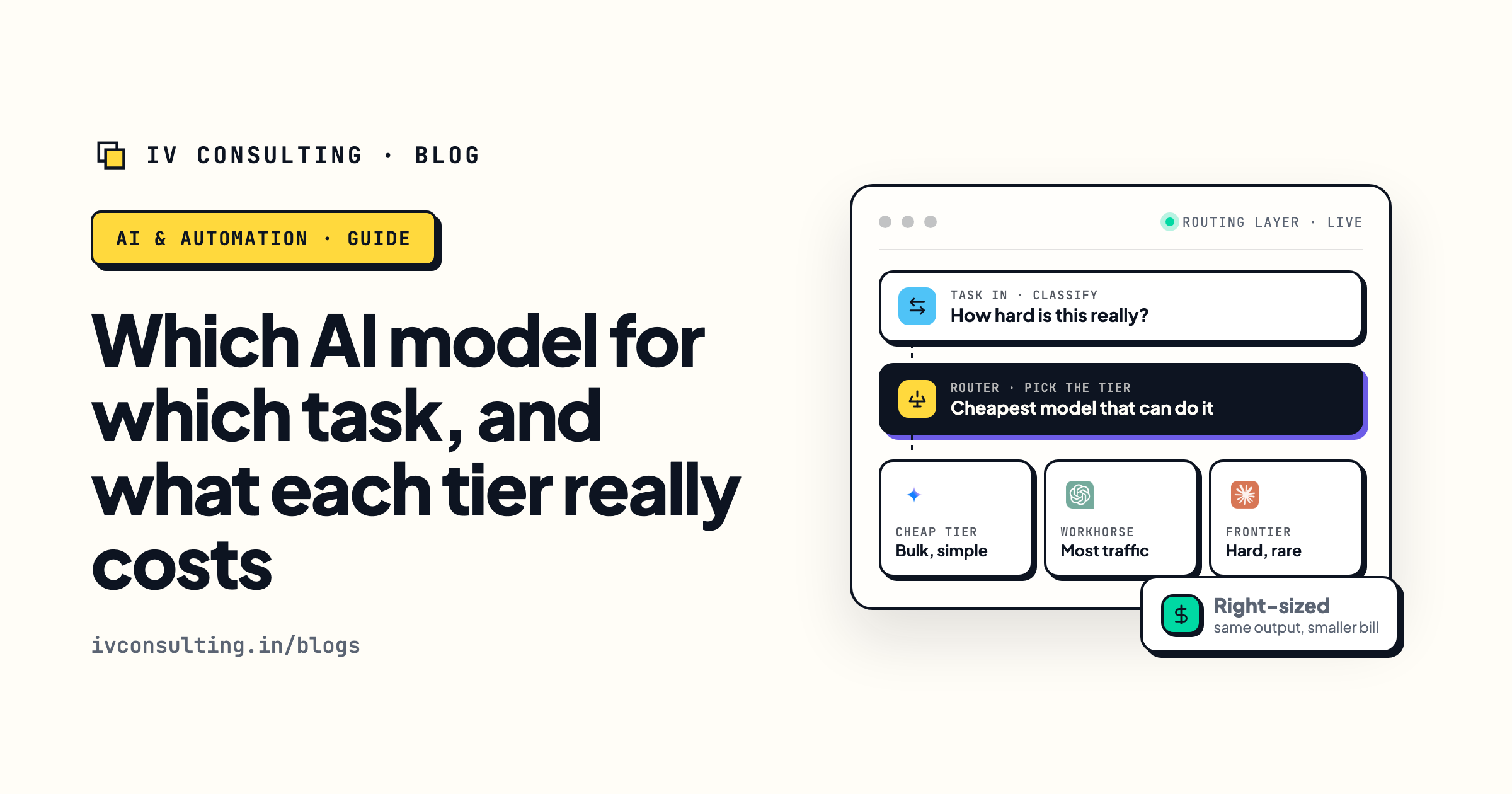
Which AI model for which task
The full model ladder across Claude, OpenAI, Gemini and Kimi, priced side by side.
Read the guide →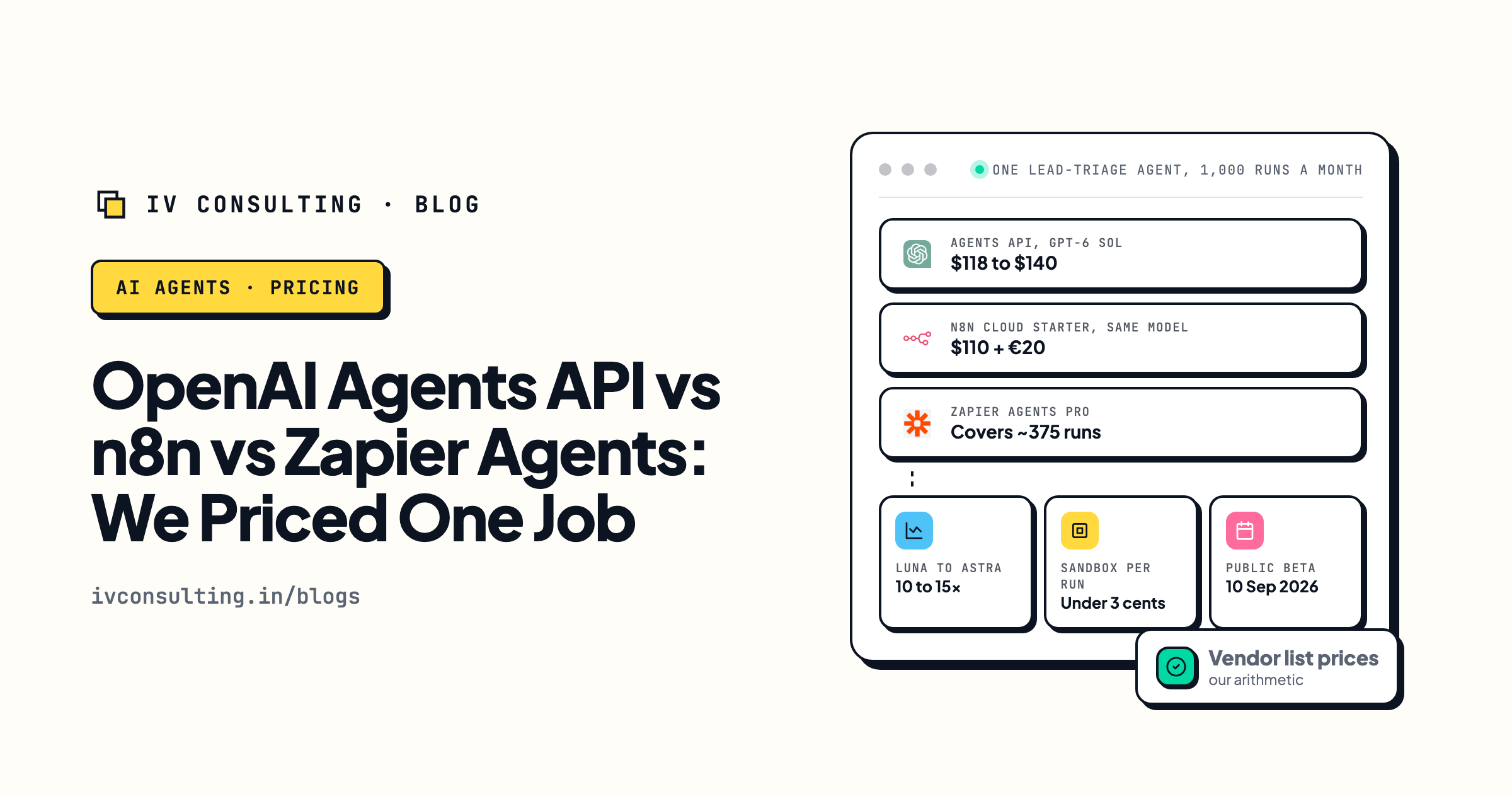
OpenAI Agents API vs n8n vs Zapier Agents
The platform fee next to the model fee, priced on one real agent job.
Read the comparison →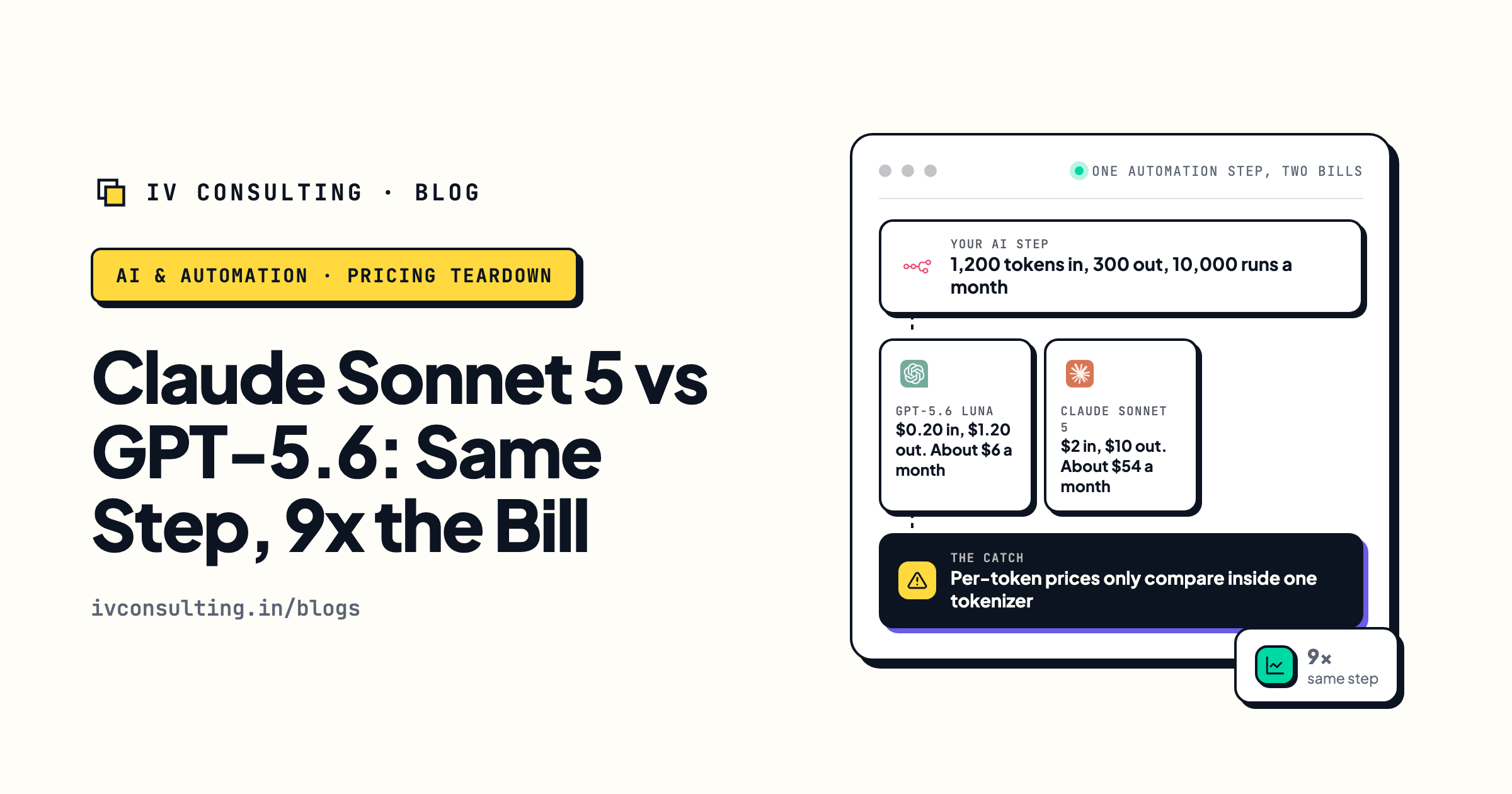
Claude Sonnet 5 vs GPT-5.6
The previous generation of this same question, if your workflows still run on it.
Read the comparison →Want every step on the right model?
Book a free 30-minute strategy call. We will look at the automations you already run, show you which steps are on a model that is too expensive for the job, and estimate what a re-route would save. If nothing needs to change, we will say so.
Book a Free Strategy Call →Free 30-minute call. Honest take, even if that means "you do not need us yet."