











Blog/AI & Automation · Pricing teardown
Claude Sonnet 5 vs GPT‑5.6: send the boring steps to Luna, keep Sonnet 5 for the steps that must not be wrong.
Both vendors repriced since we last wrote them up, and the gap is no longer where people think it is. Our verdict: default your automation steps to GPT-5.6 Luna, which is 10x cheaper on input than Claude Sonnet 5 and no worse at tagging and routing. Keep Sonnet 5 for the agentic steps where a wrong answer costs a human twenty minutes. Skip GPT-5.6 Terra entirely: it matches Sonnet 5 on input and costs more on output, which makes it the one tier with no job.

By Ishan Vats · Founder of IV Consulting · builds AI agents & automations for 150+ teamsUpdated 10 September 2026 · 10 min read · Pillar: AI & Automation

Your AI step1,200 tokens in, 300 out, 10,000 runs a month
The catch: per-token prices only compare inside one tokenizer. Treat this as arithmetic on sticker prices, then check your own invoice.
Quick answer
As of September 2026, Claude Sonnet 5 costs $2 per million input tokens and $10 per million output tokens, and Anthropic has confirmed the increase to $3 and $15 that was scheduled for 1 September will not happen. GPT-5.6 comes in three tiers: Luna at $0.20 and $1.20, Terra at $2 and $12, and Sol at $4 and $20. Our verdict: run Luna as the default model in your automations, because at roughly a tenth of Sonnet 5's input price it handles tagging, routing, extraction and first-pass drafts perfectly well. Move a step up to Claude Sonnet 5 when it is agentic, long-context, or expensive to get wrong, since Sonnet 5's $10 output undercuts Terra's $12. Do not use Terra for automation work at all. One warning before you compare the numbers yourself: per-token prices are only comparable inside a single vendor's tokenizer, and Anthropic documents that Claude 4.7 and later produce about 30 percent more tokens for the same text than earlier Claude models.
01 · The verdict
Claude Sonnet 5 vs GPT-5.6: which one should run your automation?
Most teams pick the model in an n8n, Make or Zapier dropdown once, on the day they build the scenario, and never look at it again. That single click is usually the largest cost lever in the whole automation, and it is almost always set wrong, because the default is whatever the vendor promoted the month you built it.
Here is where we land after pricing all four options at their current published rates.
GPT-5.6 Luna for anything deterministic
At $0.20 input and $1.20 output per million tokens, Luna is roughly a tenth of Sonnet 5 on input and an eighth on output. Tagging a lead, routing a ticket, extracting fields from an invoice, drafting a first-pass reply: these do not need frontier reasoning, and no tokenizer difference closes a 10x gap. If a step has a clear right answer that a human can verify in five seconds, it belongs on Luna.
Claude Sonnet 5 for agentic and long-context work
$2 in and $10 out, with the full 1M token context window at standard pricing (we covered what Sonnet 5 changes on its own separately). Worth it when the step chains several tools, reads a long document, or produces output a person will act on without checking.
GPT-5.6 Terra has no job here
$2 input matches Sonnet 5 exactly, and $12 output is 20 percent worse. If you want cheap, Luna is 10x cheaper. If you want strong, Sol or Sonnet 5. Terra is the tier we cannot find a use for in an automation.
GPT-5.6 Sol only for genuinely hard reasoning
$4 and $20, and OpenAI describes that as promotional pricing available at least through 21 November 2026. Do not build a twelve-month budget on it.
02 · The numbers
Claude Sonnet 5 pricing vs GPT-5.6 pricing: what does each tier cost?
All figures are per million tokens, taken from Anthropic's pricing documentation and OpenAI's API pricing page in September 2026. The cached column matters more than people expect in automations, because a scenario resends the same system prompt on every single run.
| Model | Input | Cached input | Output | Batch (in / out) |
|---|---|---|---|---|
| Claude Sonnet 5 | $2.00 | $0.20 | $10.00 | $1.00 / $5.00 |
| GPT-5.6 Luna | $0.20 | $0.02 | $1.20 | $0.10 / $0.60 |
| GPT-5.6 Terra | $2.00 | $0.20 | $12.00 | $1.00 / $6.00 |
| GPT-5.6 Sol | $4.00 | $0.40 | $20.00 | $2.00 / $10.00 |
Two things jump out. First, Luna is not slightly cheaper, it is an order of magnitude cheaper, and its cached input at $0.02 is effectively free. Second, Sonnet 5 and Terra are priced identically on input, so the entire cross-vendor decision at that tier comes down to output price and quality, and on output Sonnet 5 wins on paper.
03 · The arithmetic
What does one automation step actually cost per month?
Per-million pricing is meaningless until you attach it to a real step. So take a common one: an AI node in an n8n or Make scenario that receives about 1,200 input tokens (a system prompt plus one record) and returns about 300 output tokens, running 10,000 times a month. That is 12 million input tokens and 3 million output tokens.
| Model | Input cost | Output cost | Monthly total |
|---|---|---|---|
| GPT-5.6 Luna | $2.40 | $3.60 | $6.00 |
| Claude Sonnet 5 | $24.00 | $30.00 | $54.00 |
| GPT-5.6 Terra | $24.00 | $36.00 | $60.00 |
| GPT-5.6 Sol | $48.00 | $60.00 | $108.00 |
Nine times the bill for the same step, decided by a dropdown. And notice that Terra costs more than Sonnet 5 for identical work, which is the clearest argument against it. Run that step on twenty scenarios and the difference between a considered choice and a default is about $1,000 a month.
None of this tells you whether the step deserved to exist. That is a different question and usually the more expensive one, which is why we push clients through the payback maths on the Automation stage before we pick a model at all.
04 · The trap
Why is comparing price per token misleading?
Here is the part almost every comparison of these two models gets wrong, including ours until we went back to the documentation.
A token is not a fixed unit. It is whatever the model's tokenizer says it is, and tokenizers differ between vendors and even between generations of the same vendor's models. So a price of “$2 per million tokens” only tells you what a million of that model's tokens costs. It does not tell you what a page of your text costs.
Follow that through and a headline saving disappears. Suppose you are moving an existing automation from Claude Sonnet 4.6 at $3 and $15 to Claude Sonnet 5 at $2 and $10. On the sticker that is a 33 percent cut. But Sonnet 5 turns the same text into roughly 30 percent more tokens, so your 12 million input tokens become about 15.6 million and your 3 million output tokens become about 3.9 million.
| Same workload | Tokens billed | Monthly total |
|---|---|---|
| Claude Sonnet 4.6 at $3 / $15 | 12M in, 3M out | $81.00 |
| Claude Sonnet 5 on sticker price | 12M in, 3M out | |
| Claude Sonnet 5 after the tokenizer change | ~15.6M in, ~3.9M out | $70.20 |
So the real saving on that upgrade is about 13 percent, not 33 percent. Still a saving, still worth taking, but a third of what the price change advertises. If you budgeted the 33 percent you will be short.
The same logic is why we will not tell you Luna is exactly ten times cheaper than Sonnet 5 in practice. We do not know OpenAI's tokenizer ratio against Anthropic's, and neither does anyone quoting the sticker prices at you. What we can say is that a 10x gap on input is far too wide for any plausible tokenizer difference to close, while the gap between Sonnet 5 and Terra is narrow enough that it could flip either way on your actual text. That is precisely why Terra is not worth the risk.
05 · The levers
Can caching and batching beat the model choice?
Often, yes. Two mechanisms cut more from an automation bill than swapping vendors, and most teams have neither turned on. Flip them on in the calculator at the top of this page to see the effect on your own numbers.
Prompt caching. Automations are the ideal case for it, because the system prompt is byte-identical on every run and only the record changes. A cache read costs a tenth of the base input price on both platforms. Two caveats before you bank on it: a cache write costs more than base input, and Anthropic's default cache entry lives five minutes. At 10,000 runs a month spread evenly that is one run roughly every four minutes, which is close enough to the expiry that you should check it against your own traffic shape rather than assume the cache is always warm. A step that runs in bursts twice a day will pay the write far more often than the read. With that said, take the Sonnet 5 example above and assume 1,000 of the 1,200 input tokens are a stable system prompt. The cached portion is 10 million tokens at $0.20 rather than $2, so input drops from $24 to $2 plus $4 for the uncached remainder. Monthly total falls from $54 to about $36, a third off, without changing model.
Batch processing. If the work does not need to happen this second, both vendors give you 50 percent off. Sonnet 5 batch is $1 and $5. Luna batch is $0.10 and $0.60. Overnight enrichment, backfills, weekly digests and report generation should all be batched. A nightly queue in n8n is a twenty-minute change that halves that line of your bill.
Stack both on a step that runs on Luna and the cost effectively rounds to zero, which is usually the point at which the interesting question stops being the model and starts being whether the workflow around it is any good. That is the work we do at the AI Engineering stage.
06 · The decision
What should you change this week?
Four moves, in order of how much they return for the effort.
- 01
List every AI step and the model it uses
Most teams cannot answer this. Open each scenario, write down the model in the dropdown. You will find defaults nobody chose.
- 02
Demote the deterministic ones to Luna
Classification, routing, tagging, extraction, short summaries. Run them side by side for a week before you cut over, then keep the cheaper one.
- 03
Turn on caching for the stable system prompt
A third off the input line on any step whose prompt does not change between runs, which is nearly all of them.
- 04
Move anything non-urgent to batch
Half price on both platforms. Nightly enrichment and reporting are the obvious candidates.
07 · FAQ
Questions teams ask about Claude Sonnet 5 and GPT-5.6
Is Claude Sonnet 5 cheaper than GPT-5.6?
It depends entirely on which GPT-5.6 tier you mean. Claude Sonnet 5 costs $2 per million input tokens and $10 per million output tokens. That is cheaper than GPT-5.6 Terra on output ($12) and identical on input, and cheaper than GPT-5.6 Sol on both. But it is roughly ten times more expensive than GPT-5.6 Luna, which costs $0.20 and $1.20. For most automation steps Luna is the cheaper answer by a wide margin.
Did Claude Sonnet 5 go up in price on 1 September 2026?
No. The $2 and $10 rate was announced at launch as introductory pricing through 31 August 2026, with an increase to $3 and $15 scheduled for 1 September. Anthropic's pricing documentation now states that $2 and $10 is the standard price and that the scheduled increase will not occur. If you migrated a workflow off Sonnet 5 in August to avoid the rise, the rise never happened.
Which model should I use in n8n, Make or Zapier?
Use GPT-5.6 Luna as the default for steps with a verifiable right answer: classification, routing, tagging, field extraction and first-pass drafts. Move a step to Claude Sonnet 5 when it chains multiple tools, reads long documents, or produces output that a person will act on without checking. Avoid GPT-5.6 Terra for automation work, because it matches Sonnet 5 on input price and costs 20 percent more on output.
Why can I not just compare price per million tokens?
Because a token is not a fixed unit of text. Each vendor's tokenizer splits text differently, so the same paragraph becomes a different number of tokens on different models. Anthropic documents that Claude 4.7 and later produce approximately 30 percent more tokens for the same text than Claude Sonnet 4.6 and earlier. Per-token prices are therefore only directly comparable inside one tokenizer family. Across vendors, compare cost per run on your own payloads instead.
How much do I really save upgrading from Claude Sonnet 4.6 to Sonnet 5?
Less than the sticker suggests. Sonnet 4.6 is $3 and $15, Sonnet 5 is $2 and $10, which looks like a 33 percent cut. But Sonnet 5 uses the newer tokenizer that produces about 30 percent more tokens for the same text. On a workload that billed 12 million input and 3 million output tokens on Sonnet 4.6, costing $81, the same text on Sonnet 5 bills roughly 15.6 million and 3.9 million tokens, costing about $70. That is a real saving of around 13 percent, not 33 percent.
What cuts an AI automation bill faster than switching models?
Prompt caching and batch processing, and most teams have neither enabled. A cache read costs a tenth of base input price on both platforms, and because automations resend an identical system prompt on every run, caching typically removes about a third of the total cost of a step. Batch processing gives 50 percent off both input and output on both platforms, which suits overnight enrichment, backfills and scheduled reports.
08 · Keep reading
Related guides and work
 Single model
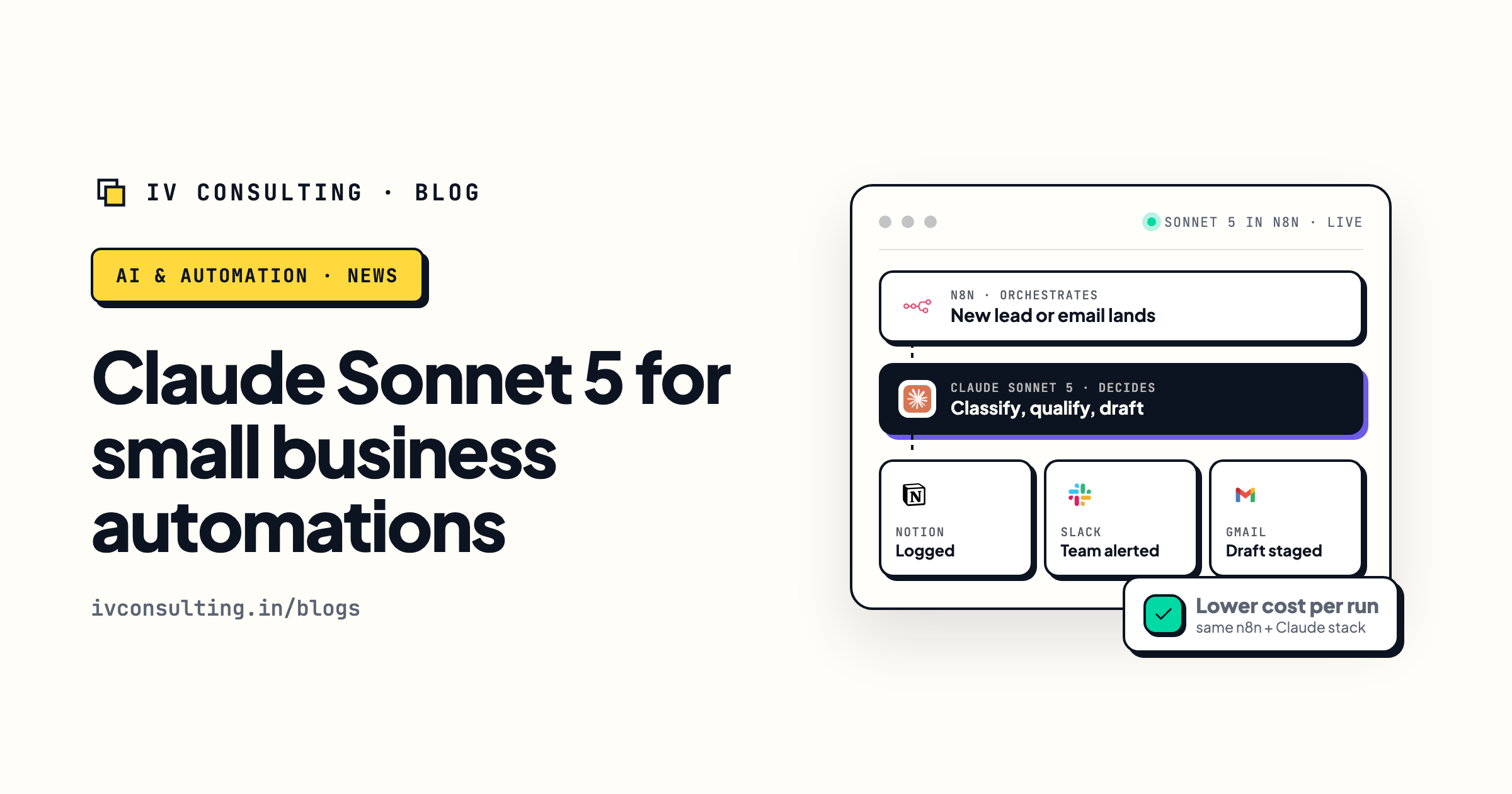
Claude Sonnet 5 for small business automations
What Sonnet 5 changes on its own, and the jobs inside an automation it is actually built for.
Read it →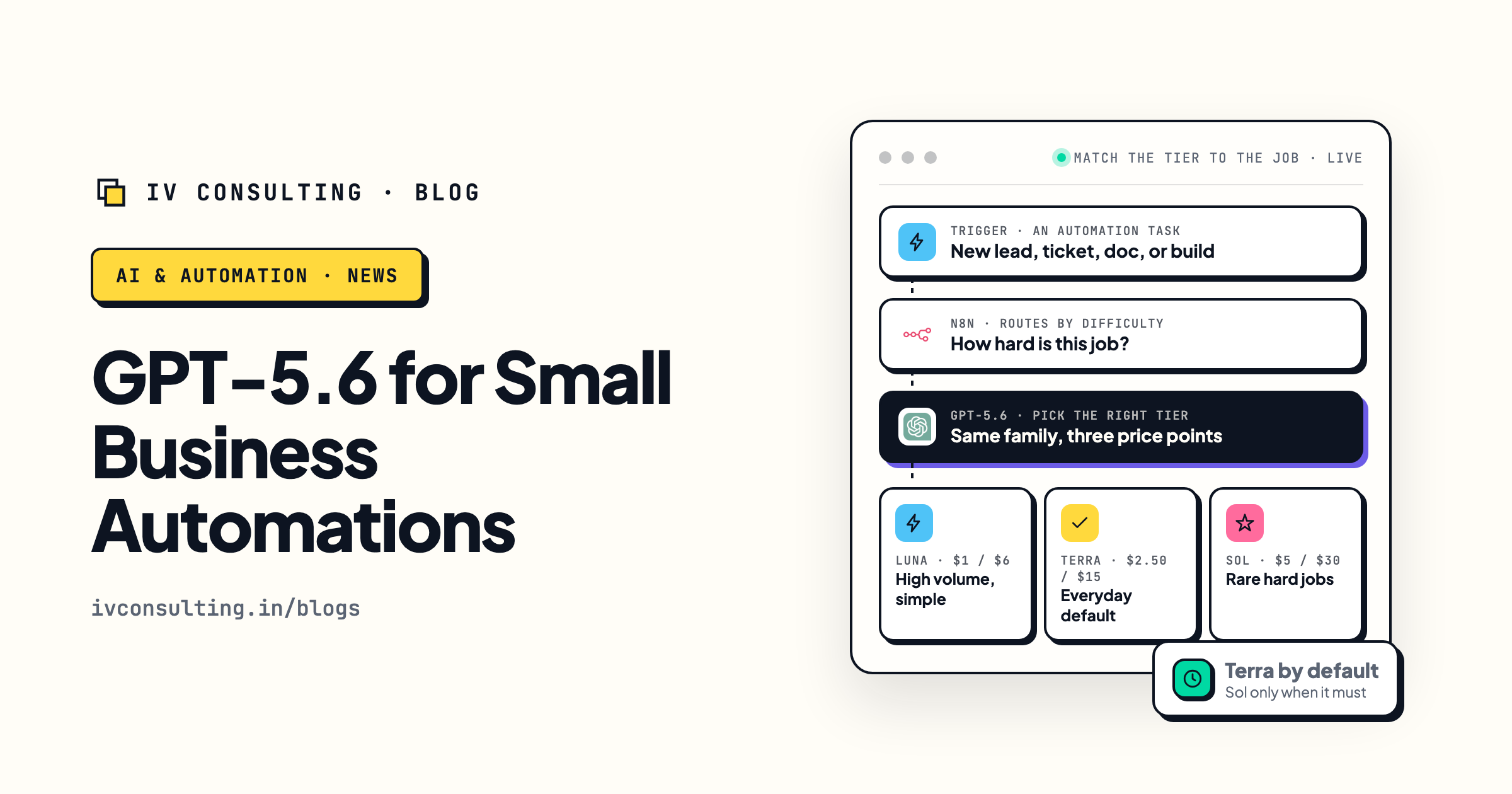 Single model
GPT-5.6 for small business automations
The three tiers explained, and which one a small team should point its scenarios at.
Read it → Routing
Which AI model for which task
The wider routing rule, beyond these two vendors, for teams running a mixed stack.
Read it →