Best AI model for automation: cost per finished task
Choosing the best AI model for automation finally has real data behind it. Zapier's AutomationBench now ranks 134 model setups on real business workflows, with a price next to each score. The leaderboard tells you who wins. It does not tell you what a finished task costs, or which winners you can even pick inside a Zap. So we did that math and picked a side.
 By Ishan Vats · Founder of IV Consulting · picks the model behind client automations every week
 AutomationBench 1.0.6657 held-out business tasks
 Gemini 4 Carbon53.88% · $3.93 per finish
 Claude Fable 5.251.45% · $9.02 per finish
Claude Sonnet 5.544.75% · $2.55 per finish
 GPT-6 Astra41.40% · $4.18 per finish
On Zapier's AutomationBench leaderboard (version 1.0.6, read 11 November 2026), Gemini 4 Carbon finishes the most real business workflows at 53.88%, ahead of Claude Fable 5.2 at 51.45% and Gemini 4 Argon at 51.29%. Divide each model's cost per task by its score and the ranking changes: Claude Sonnet 5.5 costs about $2.55 per finished task against $9.02 for Fable 5.2. Our verdict: use Claude Sonnet 5.5 for multi-app agent steps inside Zapier, Gemini 4 Argon when you bring your own key in n8n, a cheap model like GPT-6 Luna for single steps, and put a check step behind all of them, because the best model still fails 46 tasks in 100.
The benchmark
What does Zapier AutomationBench actually test?
AutomationBench gives an AI agent one request, the kind an ops hire gets on Slack, inside a simulated company with a CRM, an inbox, spreadsheets and support cases across 47 apps. It then grades the data the agent leaves behind, not what the agent says it did. A task passes only if every check holds.
That is why it is the most useful benchmark for anyone choosing a model for an automation. Most benchmarks test whether a model can answer a question or write code. This one tests the boring, expensive part of ops work: picking the right "Meridian Corp" out of three near-identical CRM records, finding the routing rule buried in an old email, using the newest row in a spreadsheet instead of the stale one, and emailing the right team and nobody else. Zapier built the tasks from patterns across more than 2 billion monthly Zapier tasks, keeps the scored set private so models cannot be trained on it, and spans six functions: sales, marketing, operations, support, finance and HR.
Zapier says the most common failure is false confidence: the agent reports success while the records are wrong. In one Zapier analysis, 72% of Opus's failures, 91% of Gemini's and 84% of GPT-5.4's were this kind. Zapier principal engineer Robin Salimans calls it the biggest gap between "a good demo and something you'd let run part of a business." In a live business, that is the failure nobody notices until a customer does.
Sources: zapier.com/benchmarks (leaderboard 1.0.6, full 134-row board read 11 November 2026) and Zapier's 28 October 2026 post on AutomationBench joining Fireworks' Specialized Intelligence Index. All scores and per-task costs below are Zapier's. The per-finished-task figures are our arithmetic on them; IV did not run the benchmark.
Head to head
Gemini 4 vs Claude vs GPT-6: who tops the AutomationBench leaderboard?
Google holds the top two spots with Gemini 4 Carbon, Claude Fable 5.2 is third, and Gemini 4 Argon fourth and fifth. The best OpenAI entry, GPT-6 Astra at max effort, is tenth at 41.40%. Here is the top of the board, one row per model at its best setting, plus the cheaper models people actually put in Zaps.
| Rank | Model (effort) | Tasks finished | Cost per task |
|---|---|---|---|
| 1 | Gemini 4 Carbon (High) | 53.88% | $2.12 |
| 2 | Gemini 4 Carbon (Medium) | 52.97% | $1.65 |
| 3 | Claude Fable 5.2 (Max) | 51.45% | $4.64 |
| 4 | Gemini 4 Argon (High) | 51.29% | $1.70 list, $0.85 promo |
| 5 | Gemini 4 Argon (Medium) | 50.08% | $1.54 list, $0.77 promo |
| 7 | Claude Sonnet 5.5 (Max) | 44.75% | $1.14 |
| 9 | Claude Opus 5.5 (Max) | 42.47% | $1.44 |
| 10 | GPT-6 Astra (Max) | 41.40% | $1.73 |
| 18 | GPT-6 Sol (XHigh) | 33.2% | $0.27 |
| 24 | Gemini 3.7 Flash (High) | 30.44% | $0.61 list, $0.30 promo |
| 41 | Kimi K3 | 22.68% | $0.43 |
| 45 | GPT-6 Luna (Max) | 20.7% | $0.04 |
| 75 | Claude Haiku 5.5 (Max) | 12.02% | $0.10 |
Notes from Zapier: Claude rows ran with Anthropic's default fallbacks, which hand a refused step to a backup Claude model. Gemini rankings use standard list price; Google's promotional prices are shown where Zapier publishes them (Gemini 3.7 Flash promo runs through 31 December 2026). Haiku 5.5 is the launch version and Zapier says it will re-test. Run-to-run variance is typically within 1%, so treat gaps under a point as ties.
Two things jump out before any math. Claude Sonnet 5.5 beats Claude Opus 5.5 while costing less, which Zapier calls out too, so the "bigger model is safer" instinct is wrong here. And scores vary a lot by function: the best operations score is 68% and the best marketing score 64%, but the best HR score is 39.17% and support tops out at 46%. If your automation lives in HR or support, plan for more failures than the headline suggests.
The math
What does each model cost per finished task?
Cost per task is what you pay per attempt. What you care about is the cost of a task that actually finished. Divide the first by the success rate and Claude Sonnet 5.5 comes out at about $2.55 per finished task, Gemini 4 Carbon at $3.11 to $3.93, and Claude Fable 5.2 at $9.02. Same data, very different ranking.
| Model (effort) | Cost per finished task | Per 1,000 runs: spend | Per 1,000 runs: finished |
|---|---|---|---|
| Gemini 4 Argon (Medium, promo) | $1.54 | $770 | about 501 |
| Claude Sonnet 5.5 (Max) | $2.55 | $1,140 | about 448 |
| Gemini 4 Argon (Medium, list) | $3.08 | $1,540 | about 501 |
| Gemini 4 Carbon (Medium) | $3.11 | $1,650 | about 530 |
| Claude Opus 5.5 (Max) | $3.39 | $1,440 | about 425 |
| Gemini 4 Carbon (High) | $3.93 | $2,120 | about 539 |
| GPT-6 Astra (Max) | $4.18 | $1,730 | about 414 |
| Claude Fable 5.2 (Max) | $9.02 | $4,640 | about 515 |
| GPT-6 Sol (XHigh) | $0.81 | $270 | about 332 |
| Claude Sonnet 5.5 (XHigh) | $1.30 | $480 | about 368 |
| GPT-6 Luna (Max) | $0.19 | $40 | about 207 |
How we calculated it: Zapier's published cost per task divided by its published score, both read 11 November 2026. "Per 1,000 runs" multiplies those by 1,000. These are model API costs inside Zapier's test harness on hard multi-app tasks; your own runs will cost less on simpler workflows and more on longer ones. They exclude any Zapier task charges, which we cover next.
The table hides the number that should worry you most: the failures. At 1,000 runs, even Gemini 4 Carbon leaves around 460 tasks unfinished, and Zapier's data says most of those will look finished. The cheap rows are cheap per finished task, but GPT-6 Sol leaves two in three tasks wrong. A cheap model with a high failure rate only works if something downstream catches the failures, and a person fixing a wrong CRM record costs far more than $2.
The model bill is rarely the big number. The big number is the hours the automation saves and the cost of the ones it gets wrong. Put your task volume, the time each one takes a person today, and a realistic success rate into our AI agent ROI calculator before you pay for a frontier model on a workflow that a cheaper model plus a check step would handle.
The catch
Can you use the top AutomationBench models in Zapier or n8n?
Not the top four without extra setup. In AI by Zapier, Claude Fable 5.2, GPT-6 Astra and Gemini 4 Argon are bring-your-own-key only, and Gemini 4 Carbon is not on Zapier's model list at all. The best model built into Zapier is Claude Sonnet 5.5. In n8n every model on the board is available, because you always call models with your own key.
| Model | AI by Zapier | n8n |
|---|---|---|
| Gemini 4 Carbon | Not listed | Your Google key |
| Claude Fable 5.2 | BYOK only | Your Anthropic key |
| Gemini 4 Argon | BYOK only | Your Google key |
| Claude Sonnet 5.5 | Built in, 5 tasks per run | Your Anthropic key |
| Claude Opus 5.5 | Built in, 5 tasks per run | Your Anthropic key |
| GPT-6 Astra | BYOK only | Your OpenAI key |
| GPT-6 Sol | Built in, 5 tasks per run | Your OpenAI key |
| Gemini 3.7 Flash | Built in, 3 tasks per run | Your Google key |
| GPT-6 Luna / Claude Haiku 5.5 | Built in, 1 task per run | Your key |
Source: Zapier, Which AI models can you automate on Zapier?, updated November 2026, read 11 November 2026.
This changes the pricing too. Built-in models bill in Zapier tasks: a Premium model costs 5 tasks per run, plus 5 for each tool call it makes. With your own key the step runs at 1 task plus 1 per tool call, and you pay the model provider directly. Zapier's own example: a step with 4 tool calls is 25 tasks on a built-in Premium model and 5 tasks with your own key. We broke that meter down, including the default that quietly picks a Premium model, in our AI by Zapier pricing guide.
So the leaderboard winner and the Zapier dropdown winner are different models. If you will not manage API keys, your realistic choice in Zapier is Sonnet 5.5, Opus 5.5, GPT-6 Sol or a Flash or Luna tier. If you run n8n, the whole board is open and the cost per task column above is close to what you pay.
The verdict
Our verdict: which AI model should run your automation?
Claude Sonnet 5.5 at max effort for multi-app agent steps in Zapier. Gemini 4 Argon at medium effort for the same job in n8n while Google's promotional price holds. A cheap model for single steps. And no frontier model without a check step behind it. We take that side because the top of the board is separated by a few points, while cost per finished task varies by 3x to 6x, and every model fails often enough that the check step matters more than the model.
Claude Sonnet 5.5: the Zapier default
44.75% finished at about $2.55 per finished task, the best value in the top 10 that is built into Zapier with no API key. It beats Opus 5.5 and GPT-6 Astra on score and costs less than both. If you run agents inside Zaps and do not want to manage keys, start here.
Gemini 4 Argon: the n8n pick
50.08% at medium effort for $0.77 a task on promo, about $1.54 per finished task. At list price it is $3.08, roughly level with Carbon, so recheck when the promotion ends. Carbon scores 3 to 4 points higher if you need every point. See our n8n plus Claude stack for wiring models in.
GPT-6 Luna or Sol: single steps
Categorising a ticket, pulling fields out of an email, tidying text. Luna at $0.04 a task is the right tool for one step, as Zapier itself says. Sol at $0.27 suits medium steps if a check catches the third it gets wrong.
Skip: Fable 5.2 Max and Opus 5.5
Fable 5.2 at max effort finishes 6.7 points more tasks than Sonnet 5.5 for 3.5x the cost per finished task, and it is BYOK only in Zapier. Opus 5.5 scores below Sonnet 5.5 and costs more. Neither earns a place in routine automation.
After any AI step that touches customers or money, add a search step that looks the record back up, and a filter that stops the workflow if it was not updated as expected. That is Zapier's own advice in its write-up, and it matches how we build: the agent's report is a claim, the record is the fact. More on that in our guide to AI agent guardrails.
For a wider view of which model to use for writing, research and analysis rather than automation, see our which AI model for which task guide. If you want the model choice, the check steps and the cost mapped for your own workflows, that is what our automation practice does.
FAQ
Questions about the best AI model for automation
What is the best AI model for automation in 2026?
On Zapier's AutomationBench leaderboard (version 1.0.6, read 11 November 2026), Gemini 4 Carbon at high effort scores highest at 53.88% of real business workflows finished with every check passing. Per finished task, Claude Sonnet 5.5 at max effort is the best value among models you can pick inside Zapier without your own API key, at about $2.55, and Gemini 4 Argon at medium effort is cheaper still on Google's promotional pricing.
What is Zapier AutomationBench?
AutomationBench is Zapier's benchmark for AI agents doing cross-app business work. Each task boots a small simulated company across 47 apps in sales, marketing, operations, support, finance and HR, gives the agent one request, and grades the data it leaves behind. A task only passes if every check holds, including checks that the agent did not email the wrong people.
Why are AutomationBench scores so low?
Scoring is strict pass or fail across a whole multi-app workflow, so mostly right counts as wrong. Zapier says the most common failure is false confidence: the agent reports the task done while the records are wrong. That is why even the top model fails about 46 of every 100 tasks.
Can I use the top AutomationBench models inside Zapier?
Not all of them without extra setup. Per Zapier's model list updated November 2026, Claude Fable 5.2, GPT-6 Astra and Gemini 4 Argon are bring-your-own-key only in AI by Zapier, and Gemini 4 Carbon is not listed. Claude Sonnet 5.5, Claude Opus 5.5 and GPT-6 Sol are built in at 5 tasks per run, and GPT-6 Luna and Claude Haiku 5.5 at 1 task.
Which model should I use for a simple AI step like categorising a ticket?
A cheap model. Zapier's own advice is that GPT-6 Luna and DeepSeek V4 Flash, at about $0.04 per task, finish fewer than a quarter of full workflows but suit single steps like sorting a ticket or tidying text. Save frontier models for agents that must find and update records across several apps.
Ishan Vats
Founder, IV Consulting · AI & automation consultant
I build n8n and Zapier automations and AI agents for small teams, and choosing the model inside each AI step, then deciding what checks it, is part of nearly every build. 150+ ops transformations over 10+ years.
Run the AI agent ROI calculator →Keep reading
Related guides and work
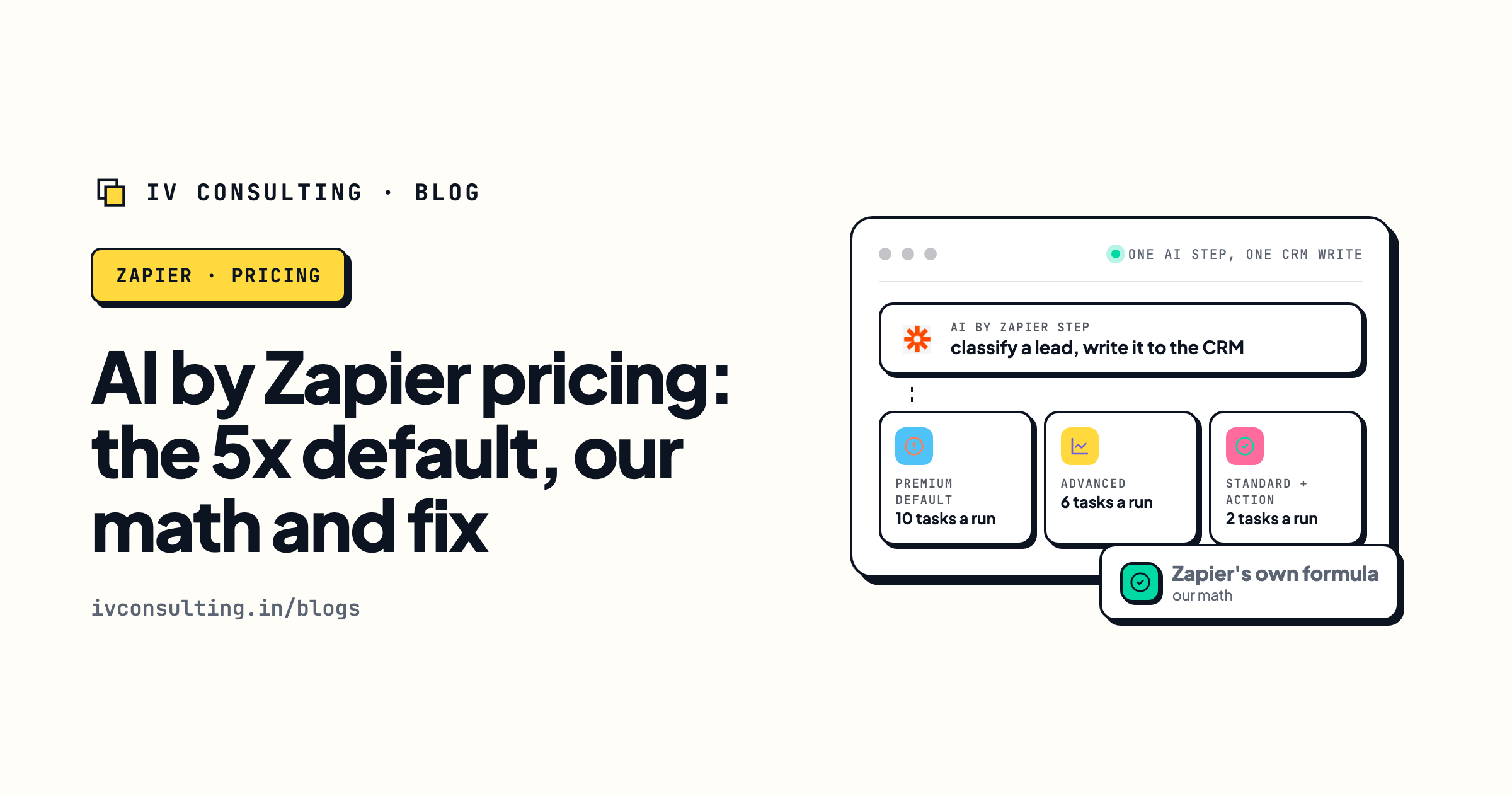
AI by Zapier pricing
Standard, Advanced and Premium tiers, and the 5x default.
Read the guide →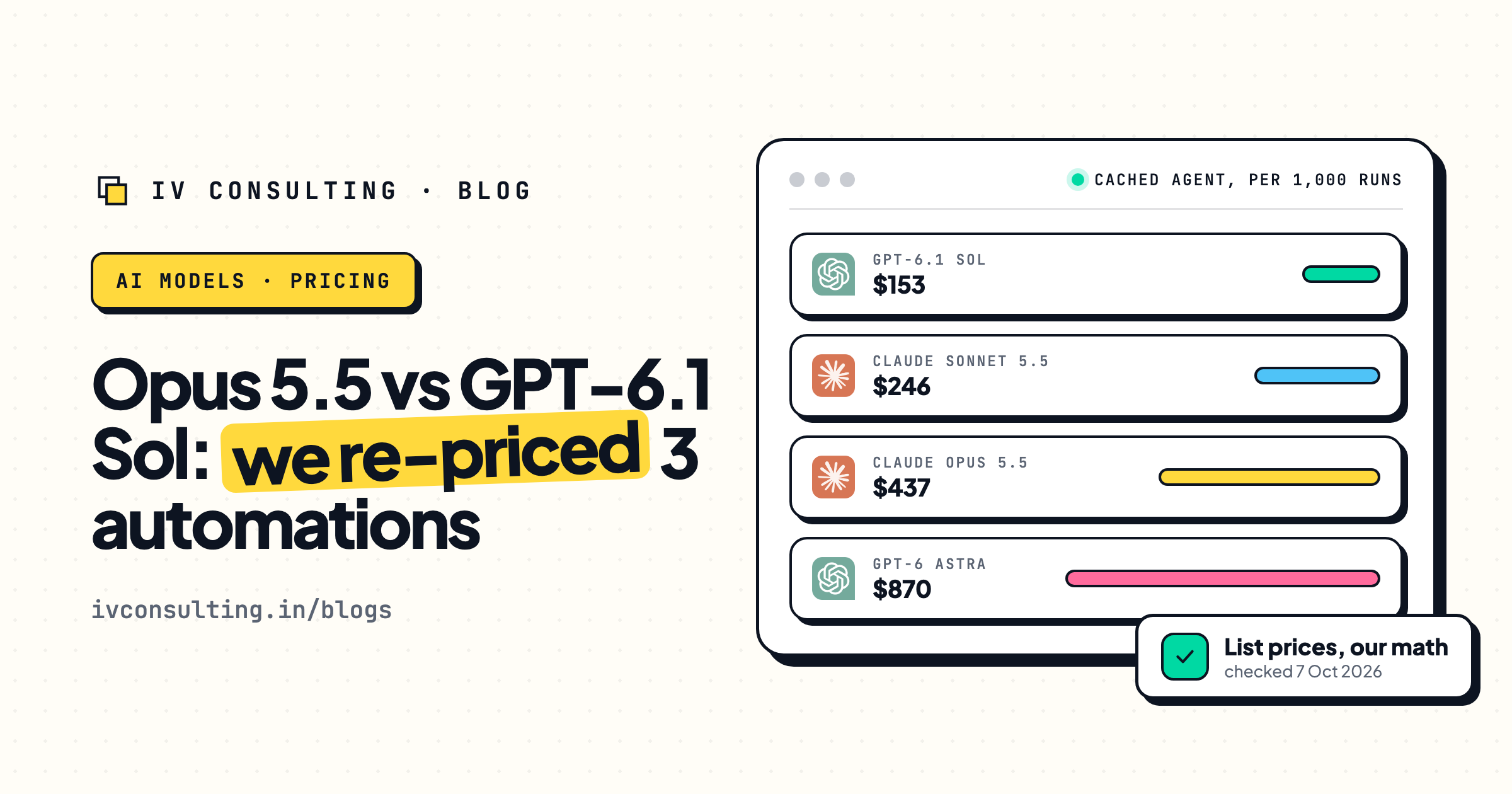
Opus 5.5 vs GPT-6.1 Sol cost
What the same automation costs on each provider's API.
Read the comparison →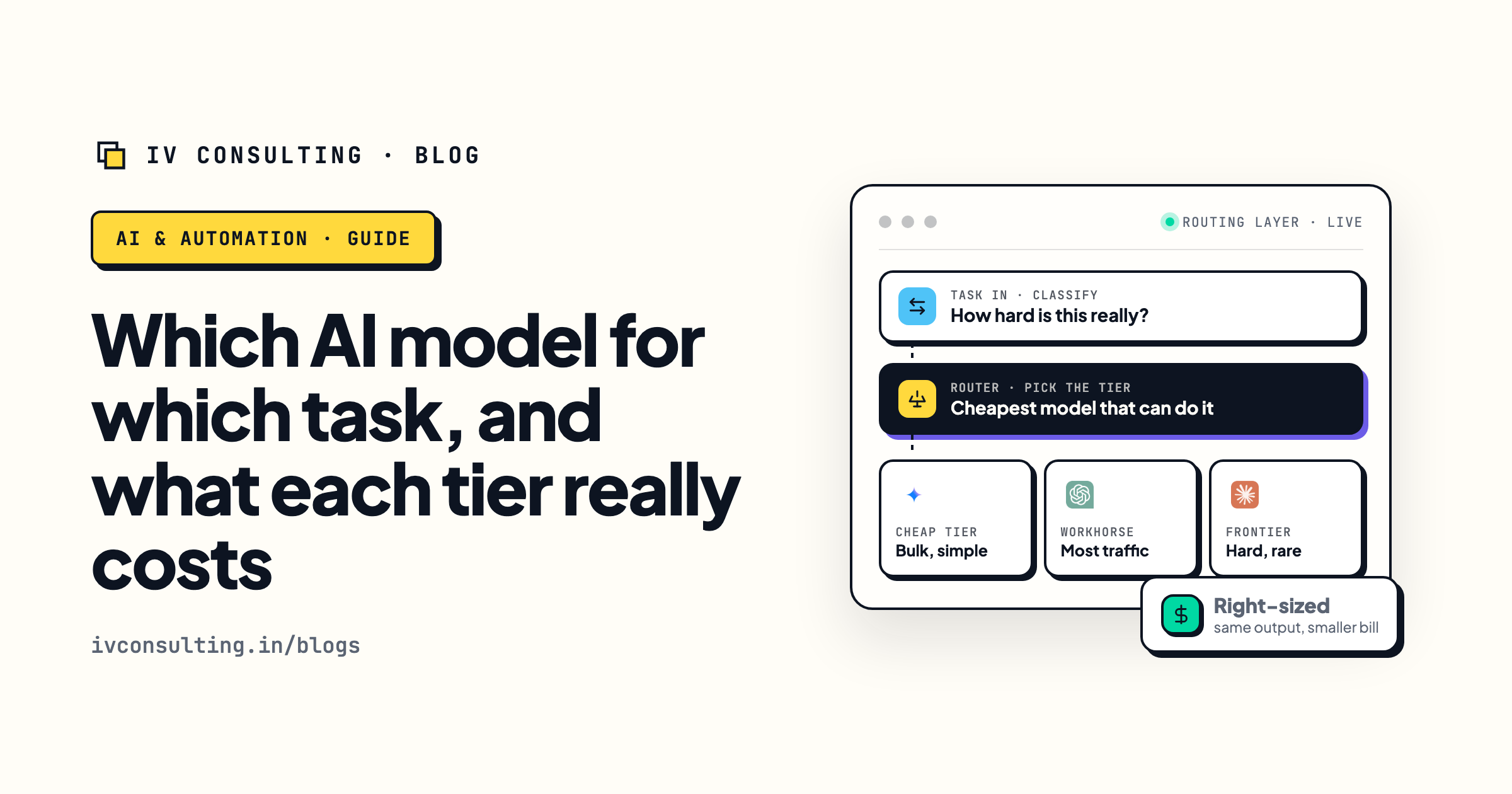
Which AI model for which task
Writing, research, analysis: the model that fits each job.
Read the guide →Want the right model and the right checks in your automations?
Book a free 30-minute strategy call. We will look at the AI steps you run, price them on the models you can actually use, and add the checks that catch the failures.
Book a Free Strategy Call →Free 30-minute call. Honest take, even if that means "keep the model you have."