Make's move to credits is a rename, not a price rise. Your AI steps are the real bill.
Make now bills in credits instead of operations, and the internet decided that meant a price increase. It did not. Make's own documentation says pricing is unchanged, and for non-AI apps 1 operation still equals 1 credit. Our verdict: ignore the panic, then go and look at your AI modules, because that is where the meter genuinely changed. The same AI step costs 0.2 credits on one model and 30 on another, a 150x swing you choose without noticing.
 By Ishan Vats · Founder of IV Consulting · builds AI agents & automations for 150+ teams
 Billing unitOperations renamed to credits. Price unchanged
 AI moduleMetered on tokens, so it moves with your prompt
Make credits replaced operations as the name of the billing unit, and Make's help centre states that existing plans and pricing, including the cost of credits, remain unchanged. For non-AI apps 1 operation still equals 1 credit, so a scenario with no AI in it costs what it always did. Our verdict: the rename is not a price rise and does not justify migrating off Make. What it does justify is re-forecasting every scenario that contains an AI module, because those are metered on tokens rather than runs. On Make's own AI Provider a step sending 1,200 input tokens and returning 300 output tokens costs about 0.2 credits on GPT-5 nano, about 1 credit on GPT-5 mini, about 9 on Claude Sonnet 5 and about 30 on Claude Fable 5. That is the same step, a 150x range, decided by a dropdown. Credits themselves start at $9 a month for 5,000 on annual billing, which is $1.80 per 1,000.
The verdict
Did Make raise prices when it moved to credits?
No, and you can check it in one line. Make's help centre says plainly that credits replaced operations as the term for Make's billing unit, and that your existing plan and pricing, including the cost of credits, remain unchanged. Every automation pricing post that told you Make got more expensive in 2026 skipped that sentence.
We went and read Make's pricing page and the credits documentation rather than an aggregator's summary of them, because we build on Make and n8n for clients and a rumoured repricing changes what we recommend. Here is what actually holds:
For non-AI apps, nothing moved. 1 operation equals 1 credit, and Make states that rate is constant regardless of input or data transfer size. Uploading a 2KB file and a 200MB file to Google Drive both cost 1 credit. If your scenarios are triggers, routers, filters and CRUD against a handful of SaaS tools, your bill is doing exactly what it did before, under a new noun.
The real change is that the billing unit stopped being one thing. Under operations, a run count told you your bill. Under credits, most modules still cost 1, some cost a flat 2 or 10, and AI modules cost whatever their token consumption works out to. Make now distinguishes fixed credit usage from dynamic credit usage, and that distinction, not the price, is what breaks a spreadsheet forecast.
So the honest answer has two halves. If you have no AI in your scenarios, ignore this entirely and go back to work. If you do, your forecast is now only as good as your assumption about prompt length and model choice, and most teams have never made that assumption explicitly.
The forcing event
What exactly did Make change?
What is a Make credit? A credit is the unit Make bills you for. One credit is what a standard non-AI module consumes each time it runs, so a 10 module scenario running once costs about 10 credits. AI modules are the exception: they consume credits based on the tokens they process, so the number varies per run.
"Credits replaced operations as the term for Make's billing unit. Your existing plan and pricing, including the cost of credits, remain unchanged."
Make help centre, Credits, read 9 September 2026
Make now uses two words where it used one, and it uses them for different jobs. Credits are what you buy and spend. Operations are still there, but they now describe the outcome of your activity on the platform rather than the thing you are billed for. Make's own framing is that credits help you track what you are spending, and operations show what happened.
That sounds like semantics until you notice why the split was needed. A single word could not carry both meanings once AI modules arrived, because an AI module performs one operation and can consume thirty credits doing it. Splitting the vocabulary was the precondition for metering AI, and metering AI is the actual event here.
The pattern is not unique to Make. Notion, ClickUp and Zapier all moved their AI features onto credit or token style meters inside about a year, and we have written up the same shift in execution based versus task based automation pricing. Every vendor has landed in the same place: the deterministic part of the product stays priced per action, and the AI part gets priced per unit of consumption. Make just did the vocabulary cleanup more visibly than most. Zapier did it with model tiers: an AI step now costs 1x, 3x or 5x tasks a run, and we price what that does to a real Zap in AI by Zapier pricing 2026.
The mechanics
Fixed vs dynamic credit usage: which of your modules is which?
Taken from Make's credits documentation, September 2026. The right-hand column is the one that decides whether you can forecast.
| Module type | What it costs | Forecastable? |
|---|---|---|
| Non-AI apps, the bulk of the platform | 1 operation equals 1 credit, constant regardless of input or data transfer size | Yes. Run count times modules |
| Higher rate fixed modules | More than the default, tagged per module. Parts of Make AI Content Extractor are tagged at 2 or 10 credits per operation | Yes, once you read the tag |
| Third-party AI apps with your own connection, such as OpenAI or Anthropic Claude | 1 credit per operation to Make. You pay your AI provider directly for tokens | Yes on Make's side. The token bill moves elsewhere |
| Make's AI Provider, used in Make AI Agents and AI Toolkit | Credits based on tokens and operations, varying by model | No, unless you pin the model and prompt size |
| Automatic AI provider connections, such as Make AI Web Search and AI Content Extractor | Credits based on tokens, operations and other usage-based factors | No. Make chooses the provider |
| Make Code App | 2 credits per 1 second of code execution time | Only if your code runs in predictable time |
Make tags the dynamic ones in the interface, with labels for tokens, file size, per page and run time. That tagging is the single most useful thing to go and look at, because it turns "our Make bill went up" into a specific list of modules worth examining. Everything untagged is still the flat, boring, forecastable 1 credit it always was.
Note the third row, because it is the escape hatch most teams miss. Connect your own OpenAI or Anthropic key and Make charges you 1 credit for the operation, full stop. The token cost then appears on your model provider's invoice instead. You have not saved money, but you have made the Make half of the bill predictable again, and you can see the AI spend on its own line.
The arithmetic
What does one AI step actually cost in credits?
Make publishes tokens per credit for every model on its AI Provider. So we can price a single realistic step exactly, rather than guessing. Take a support triage step that sends about 1,200 input tokens, a ticket plus its instructions, and returns about 300 output tokens, a classification and a drafted reply. Run it 1,000 times a month.
| Model on Make's AI Provider | Tokens per credit, in and out | Credits per run | Credits a month | Tier that covers it |
|---|---|---|---|---|
| GPT-5 nano, the Small tier | 18,080 in, 2,260 out | 0.2 | 199 | Free plan, 1,000 credits |
| GPT-5 mini, the Large tier | 3,616 in, 452 out | 1.0 | 996 | Free plan, only just |
| Claude Sonnet 5 | 301 in, 60 out | 9.0 | 8,987 | 10,000 credits, $16 a month |
| Claude Opus 4.8 | 180 in, 36 out | 15.0 | 15,000 | 20,000 credits, $29 a month |
| GPT-5.6 Sol | 180 in, 30 out | 16.7 | 16,667 | 20,000 credits, $29 a month |
| Claude Fable 5 | 90 in, 18 out | 30.0 | 30,000 | 40,000 credits, $53 a month |
That is the whole story in one table. One ordinary non-AI module costs 1 credit. The identical AI step costs a fifth of a credit or thirty credits depending on a dropdown nobody revisits, and the difference between the cheapest and dearest row is 150x. Not 15 percent. 150 times.
Two things fall out of it that are worth more than the headline. The first is that GPT-5 mini lands at almost exactly 1 credit per run, the same as a plain module. If you have been avoiding AI steps because you could not forecast them, that row is your answer: pick the Large tier model, and an AI step costs what a Google Sheets row costs.
The second is that output tokens dominate. Every model on the list bills output at roughly a fifth to a sixth of the input rate, so a chatty prompt is cheap and a chatty answer is not. In the Sonnet 5 row, 300 output tokens cost 5 credits while 1,200 input tokens cost 4. Telling the model to reply in one sentence rather than one paragraph is a bigger lever on your Make bill than anything you will do to the prompt.
None of this is an argument for always picking the small model. A ticket triage that misclassifies is worse than useless, and if Sonnet 5 gets it right and nano does not, 9 credits is cheap. The argument is that the choice should be deliberate and priced, which is exactly what the credit rename now lets you do. Under operations you could not see this at all. If Sonnet 5 is the model you are weighing, we priced what it really costs per job against Haiku 4.5, Sonnet 4.6 and Opus 4.8 in Claude Sonnet 5 for small business automations.
The price
What does a Make credit actually cost?
Straight off Make's pricing page, September 2026, for the Make Plan. The rate per credit falls as you buy more, which is the part that changes the answer at scale.
| Credits a month | Annual billing | Monthly billing | Cost per 1,000 credits, annual |
|---|---|---|---|
| 5,000 | $9 a month | $10 a month | $1.80 |
| 10,000 | $16 a month | $18 a month | $1.60 |
| 20,000 | $29 a month | $34 a month | $1.45 |
| 40,000 | $53 a month | $62 a month | $1.33 |
| 80,000 | $91 a month | $107 a month | $1.14 |
| 150,000 | $153 a month | $180 a month | $1.02 |
The curve keeps going past this table. At 300,000 credits the Make Plan is $268 a month on annual billing, at 500,000 it is $410, and at 750,000 it is $576, which works out to about 77 cents per 1,000 credits. So a credit at the top of the SMB range costs well under half what it costs on the entry plan.
The free plan gives you 1,000 credits a month, two active scenarios, a 15 minute minimum interval between runs and a 5 minute cap on a single execution. Moving to the paid plan lifts the interval to 1 minute, the execution cap to 40 minutes, and removes the limit on active scenarios. For most teams the interval is what forces the upgrade long before the credits do.
Put the two tables together and the practical shape appears. A team running 20,000 deterministic operations a month pays $29 and can forecast it exactly. Add one Sonnet 5 step to a scenario that fires 1,000 times and you have added roughly 9,000 credits, which is a bigger line item than the entire rest of the automation. That is not Make being expensive. That is what frontier model inference costs, shown to you in the same unit as everything else.
The decision
What should you actually do about it?
Do not migrate. If a rename triggered a platform review, the review was already overdue for other reasons. Make against n8n against Zapier is a real decision with real trade-offs, and we have written it up properly in Zapier Agents vs Make AI Agents vs n8n and in what each one does when a workflow fails. A vocabulary change on an invoice is not on that list.
Do go and read your own tags. Open the scenarios that run most often and look for the dynamic usage labels. You are looking for tokens, file size, per page and run time. That is your entire variable cost, and it is usually three or four modules out of several hundred.
Do make the model an explicit decision. For each of those AI steps, ask what the job actually needs. Classification, extraction and routing generally do not need a frontier model, and the table above shows what that choice is worth. Drafting that a customer will read usually does. Both answers are fine. Defaulting is not.
Do cap your outputs, because output tokens carry most of the cost on every model Make lists.
Consider bringing your own key if predictability matters more than a single invoice. Third-party AI connections cost 1 credit per operation on Make and move the token cost to your provider, which is the right shape when finance wants automation spend and AI spend separated.
FAQ
Questions teams ask about Make credits
Did Make raise prices when it switched from operations to credits?
How many credits does one AI step use in Make?
What is the difference between fixed and dynamic credit usage in Make?
What does a Make credit actually cost?
Do third-party AI apps like OpenAI or Claude cost extra credits in Make?
Can I still forecast my Make bill?
Ishan Vats
Founder, IV Consulting · AI & automation consultant
I build production AI agents, automations, and MCP servers for teams from startup to enterprise. 150+ ops transformations over 10+ years. We build on Make and n8n both, and we do not resell either, so when we say a pricing change does not warrant a migration, there is nothing in it for us either way.
Run my automation numbers →Keep reading
Related guides and work

Zapier Agents vs Make AI Agents vs n8n
If the credit math did send you shopping, this is the comparison that actually decides it.
Read it →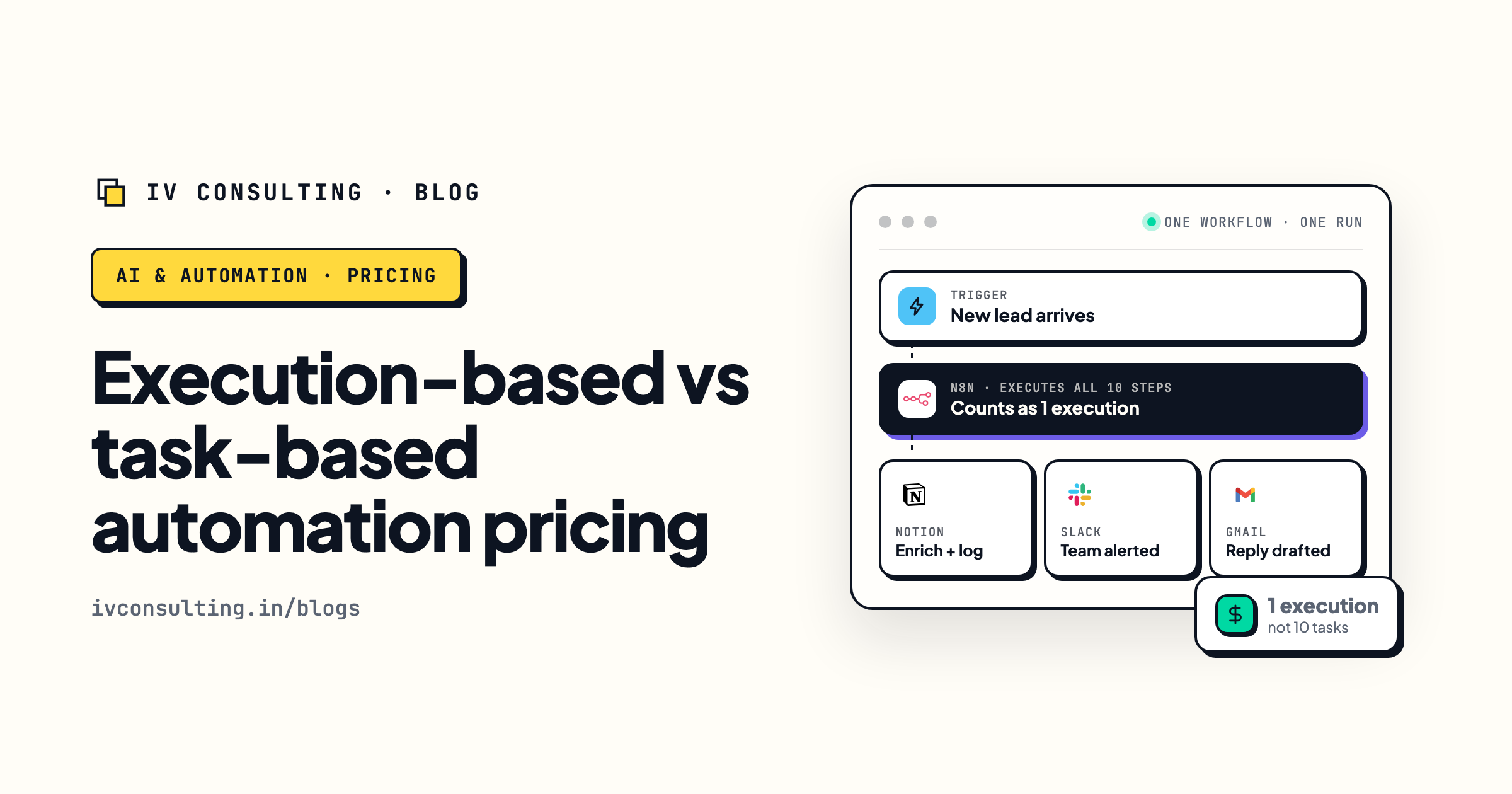
Execution based vs task based pricing
Why every automation vendor moved the billable unit in the same direction, and what it costs you.
Read it →
The Automation stage, built for you
Scenarios built to run cheaply on purpose, with the model chosen for the job instead of the dropdown default.
See the stage →Not sure what your automations actually cost to run?
Book a free 30-minute call. Bring the scenario you think is expensive and we will tell you where the credits are actually going, whether it is a model choice, an uncapped output, or a step that should never have been automated. If the answer is that your Make bill is fine and the rename spooked you for nothing, we will say that instead of quoting you for a rebuild.
Map my highest-ROI workflow, free call →Free 30-minute call. We build on Make and n8n both and resell neither, so the take is straight.