AI agents for small business in 2026: rent the leverage, do not buy the platform
Enterprises are spending $206.5 billion on AI agents this year. You do not need to match it, and you should not try. Here is the call we make for lean teams, and the one workflow to start with.
 By Ishan Vats · Founder of IV Consulting · builds AI agents & automations for 150+ teams
 AI Agent · ClaudeDecide and take action
 NotionLogged
 SlackAlerted
 GmailReplied
Rent the leverage, do not buy the platform. Gartner forecasts AI agent spending will jump from $86.4 billion in 2025 to about $206.5 billion in 2026, a 139% rise, but almost none of that budget buys a small business anything it cannot rent. Run agents on n8n plus Claude, pay model providers directly, scope exactly one repetitive workflow, and keep a human approval step until it earns trust. The enterprise path, buying a platform and then hunting for use cases, is the same path Gartner expects to cancel more than 40% of agentic AI projects by the end of 2027.
The verdict
What should a small business actually do about the AI agent boom?
Rent the leverage, do not buy the platform, and scope exactly one workflow before you spend a rupee on a second. That is the call we make every time a client brings us a $206 billion headline and asks what their version of it looks like. The honest answer is that the forecast is a signal about direction, not an invoice you are expected to match.
Here is the reasoning, because a verdict without one is just an opinion:
- The spend is buying capability you can rent for a fraction of it. Gartner's $206.5 billion is mostly platforms, seats and the people to run them. The underlying capability, a model that can read messy input and act across your tools, is sold to you directly at usage prices. A small team wiring n8n to Claude is renting the same engine the platform is reselling with a per-seat markup on top.
- Growth this steep is a timing signal, not a quality signal. Agent software growing 139% against 47% for AI overall tells you where budget is moving, roughly three times faster than the market around it. It tells you nothing about whether any given agent works. Treat it as a reason to start, never as evidence that buying broadly is safe.
- The enterprise pattern is the one Gartner expects to fail. Gartner forecasts that more than 40% of agentic AI projects will be canceled by the end of 2027, driven by escalating costs, unclear business value and inadequate risk controls. Every one of those three is a symptom of buying before scoping. A small business copying that sequence inherits the failure rate without the budget to absorb it.
- Narrow beats funded, and it is the one axis where you are ahead. You already know which job leaks the most hours. That is the scoping work an enterprise spends two quarters and a committee trying to produce. Starting from a known painful workflow is a genuine structural advantage, and it expires the moment you decide to shop for a platform first.
The honest counter case. Renting means you own the wiring and the maintenance. If nobody on your team can keep an n8n workflow alive, a packaged tool with real support may genuinely be the better buy even at a worse unit price, and paying for a platform to avoid owning fragile infrastructure is a legitimate trade rather than a mistake. The same goes for scattered data: if your records live in five places, an agent will confidently act on the wrong one, and the fix is a clean system first, not a smarter model. And it is worth saying plainly that a spending forecast is a forecast. Gartner's numbers describe budgets committed, not returns earned, and the 40% cancellation figure is the same firm telling you a large share of that money is expected to buy nothing at all.
The numbers
How big is the AI agent spending boom in 2026?
AI agent spending is the money businesses put into software that runs autonomous AI agents, and in 2026 it is the fastest-growing category in the entire technology budget. According to Gartner, spending on purpose-built AI agent software is forecast to reach about $206.5 billion in 2026, up roughly 139% from $86.4 billion in 2025, and then climb to $376.3 billion in 2027.
Put that next to the wider market and the signal is loud. According to Gartner, total worldwide AI spending will grow about 47% in 2026, which means AI agent software is growing close to three times faster than the AI market as a whole. When one slice of a booming market outruns the rest by that much, it is telling you where the value is moving. Forecasts are only one side of it, though: for what operators actually running agents say about the money, read what Reddit really thinks about the AI agent spending boom.
| Year | AI agent software spend | Year-over-year growth |
|---|---|---|
| 2025 | $86.4 billion | Baseline |
| 2026 | ~$206.5 billion | Up ~139% |
| 2027 | $376.3 billion | Up ~82% |
Sources: Gartner, "Gartner Forecasts Worldwide AI Spending to Grow 47% in 2026", press release, 19 May 2026, and Gartner on agentic AI project cancellations, 25 June 2025. Figures rechecked 1 September 2026.
The shift
Why is agent spending growing this fast right now?
The dominant theme across the 2026 product launches is simple: AI is moving from answering questions to completing work. That single shift is what the spending is chasing.
- Assistants became agents. At its June 2026 developer conference, Apple introduced a rebuilt Siri that can take actions on your behalf, like booking reservations and editing documents, not just reply with text.
- Frontier models got better at doing, not just talking. OpenAI's GPT-5.6 family, released in July 2026, and the latest Claude models pushed hard on agentic ability: using tools, operating software, and carrying out multi-step tasks instead of one-shot answers. We broke the tiers down in GPT-5.6 for small business automations.
- Platforms put agents in the everyday stack. Google reshaped its enterprise AI platform around agents, including a no-code agent builder for Workspace, so agents now live next to email, docs, and tasks rather than in a separate lab.
An answering AI waits for you to ask. An AI agent takes a goal and runs the steps itself: it reads the input, decides what to do, and acts across your tools. That is the difference between a smarter search box and a teammate who clears a queue. The budgets are flowing to the second one. If you want the plain-English version of what an agent actually is, read our guide to AI agents for business owners.
The translation
What does the AI agent boom actually mean for a small business?
The enterprise headlines are about platforms and headcount. The opportunity for a leaner team is different and, honestly, better. You can move faster, decide faster, and ship an agent in days, while the big company is still in procurement. Here is how to read the boom if you run a small business.
The leverage is rented, not bought
You do not need a seven-figure platform to run a capable agent. A small business can wire one up on n8n and Claude and pay model providers directly, with no per-seat platform markup. The same agent that costs an enterprise a department costs you a sensible monthly bill.
The advantage goes to the fast, not the funded
Agents reward focus. A small team that automates one painful, repetitive workflow well will out-execute a big company that bought a hundred seats nobody scoped. You know exactly where your hours leak. That clarity is your edge.
The risk is doing nothing
When work shifts from "answered" to "done," the businesses that wire agents into their operations pull ahead on speed and cost. The ones that wait keep paying people to do what an agent now handles in seconds. The boom is not hype you can ignore. It is a widening gap.
The comparison
Should a small business copy the enterprise AI agent playbook?
Same technology, two very different ways to adopt it. The enterprise path is broad and slow. The SMB path is narrow and fast. For a small business, narrow and fast wins.
| Dimension | Enterprise default | The smart SMB play |
|---|---|---|
| Budget | Six and seven figures on platforms and seats | A sensible monthly bill on n8n plus model usage |
| Starting point | Buy a platform, then look for use cases | Pick the one workflow that leaks the most hours |
| Time to value | Months of procurement and rollout | A working agent in days |
| Risk control | Committees and policy decks | One human approval step in the workflow |
| Tooling | Heavy all-in-one suites | n8n for orchestration, Claude for judgment |
| Measure of success | Seats deployed | Hours saved and response time on one job |
The playbook
Where should a small business start with AI agents?
Pick one narrow, repetitive, high-volume workflow where a mistake is cheap to catch. Here are four agents that pay for themselves fast, and they are the ones we build most often.
Lead follow-up agent
A new lead hits your form or inbox. The agent reads it, scores the intent, logs it in your CRM or Notion, alerts the right person in Slack, and drafts a tailored first reply for one click to send. No lead sits cold overnight again.
This is the highest-ROI first agent for most service businesses, because speed-to-lead directly drives booked calls.
Support triage agent
Reads each incoming ticket, tags urgency and topic, routes it to the right person, and drafts a first response so replies go out in minutes, not hours.
Invoice extraction agent
Pulls amounts, dates, and vendors off incoming invoices, drops the clean data into your sheet or accounting tool, and flags anything that looks off for a human to check.
Content and reporting agent
Turns raw notes, transcripts, or weekly numbers into a first-draft summary, recap, or report in your voice, so the writing starts at the editing stage instead of the blank page. A few hours back every week, on work that used to drain a whole afternoon.
The honest part
Why do most AI agent projects fail, and how do you avoid it?
Here is the part the spending charts leave out. Gartner also expects more than 40% of agentic AI projects to be canceled by the end of 2027, driven by escalating costs, unclear business value, and inadequate risk controls. On Reddit you can watch the same doubt in real time, with operators asking whether half the ways people use agents make any sense at all. They have a point.
The failures almost always share one root cause: someone bought agents before defining the job. The fix is not complicated, and it is the opposite of the enterprise pattern.
- Scope to one workflow. One painful, measurable job. Not a platform-wide rollout.
- Keep a human in the loop early. The agent drafts and stages. A person approves until trust is earned.
- Track a real ROI number from week one. Hours saved, response time, leads handled. If it does not move a number, it does not scale.
- Know when not to use an agent. Some jobs need rules, not judgment. We wrote about exactly that in when not to use AI in your automations.
Scoped this way, agents are some of the highest-return work a small business can do right now. Bought the enterprise way, they become the cancelled project in the Gartner stat. The technology is the same. The discipline is the difference. That discipline, scoping and shipping production agents that actually earn their keep, is the core of our AI Engineering stage.
FAQ
AI agents for small business, answered
How much are businesses spending on AI agents in 2026?
Are AI agents worth it for a small business?
What is the difference between an AI tool and an AI agent?
Where should a small business start with AI agents?
Do I need a big budget to use AI agents?
Why do so many AI agent projects fail?
Ishan Vats
Founder, IV Consulting · AI & automation consultant
I build production AI agents, automations, and MCP servers for teams from startup to enterprise. 150+ ops transformations over 10+ years. If you want this mapped to your own stack, I'll do it with you on a free call.
Run my AI agent ROI numbers →Keep reading
Related guides and work
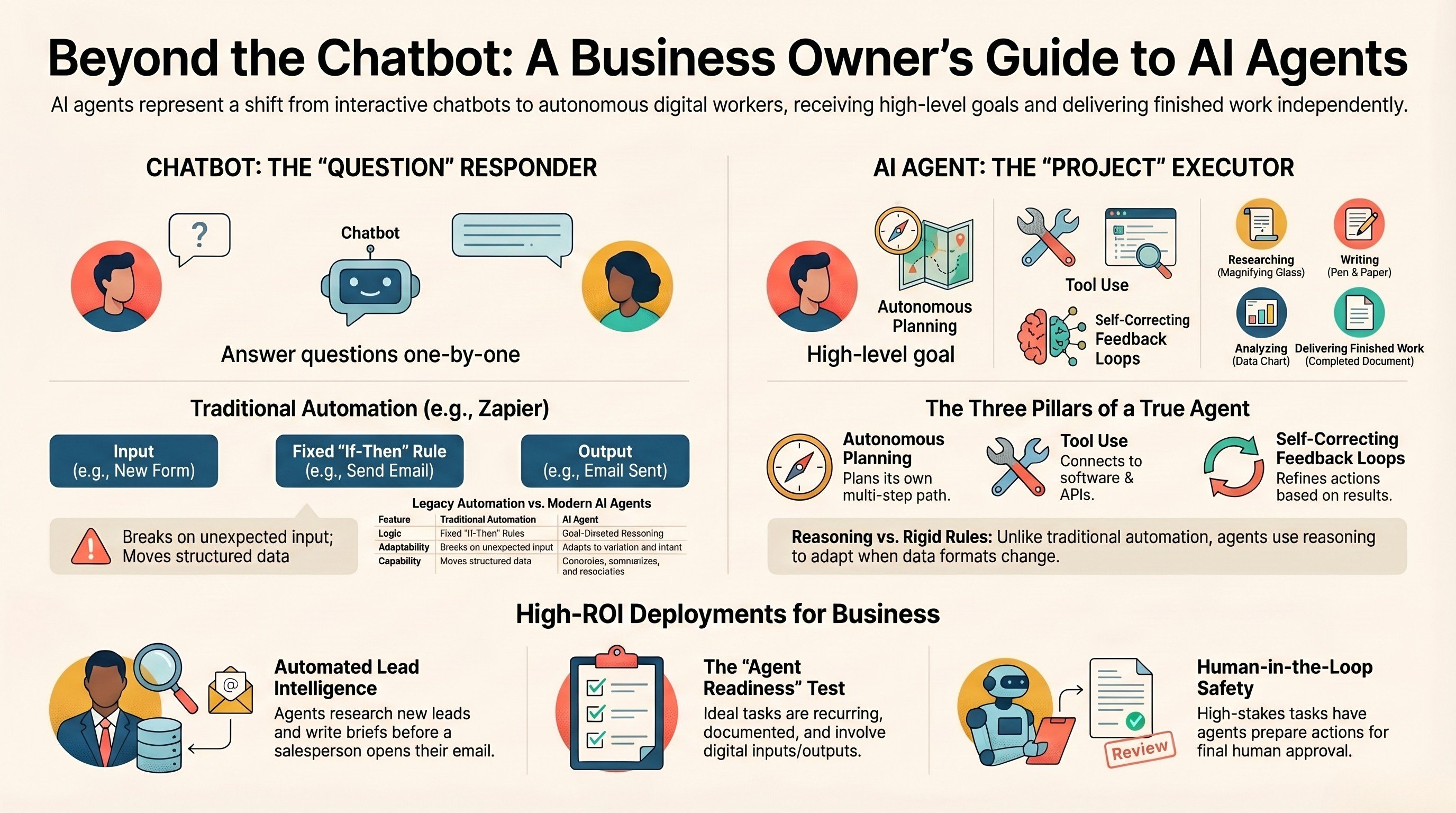
What is an AI agent? A guide for business owners
The plain-English version of what an agent actually is, and where it pays off.
Read the guide →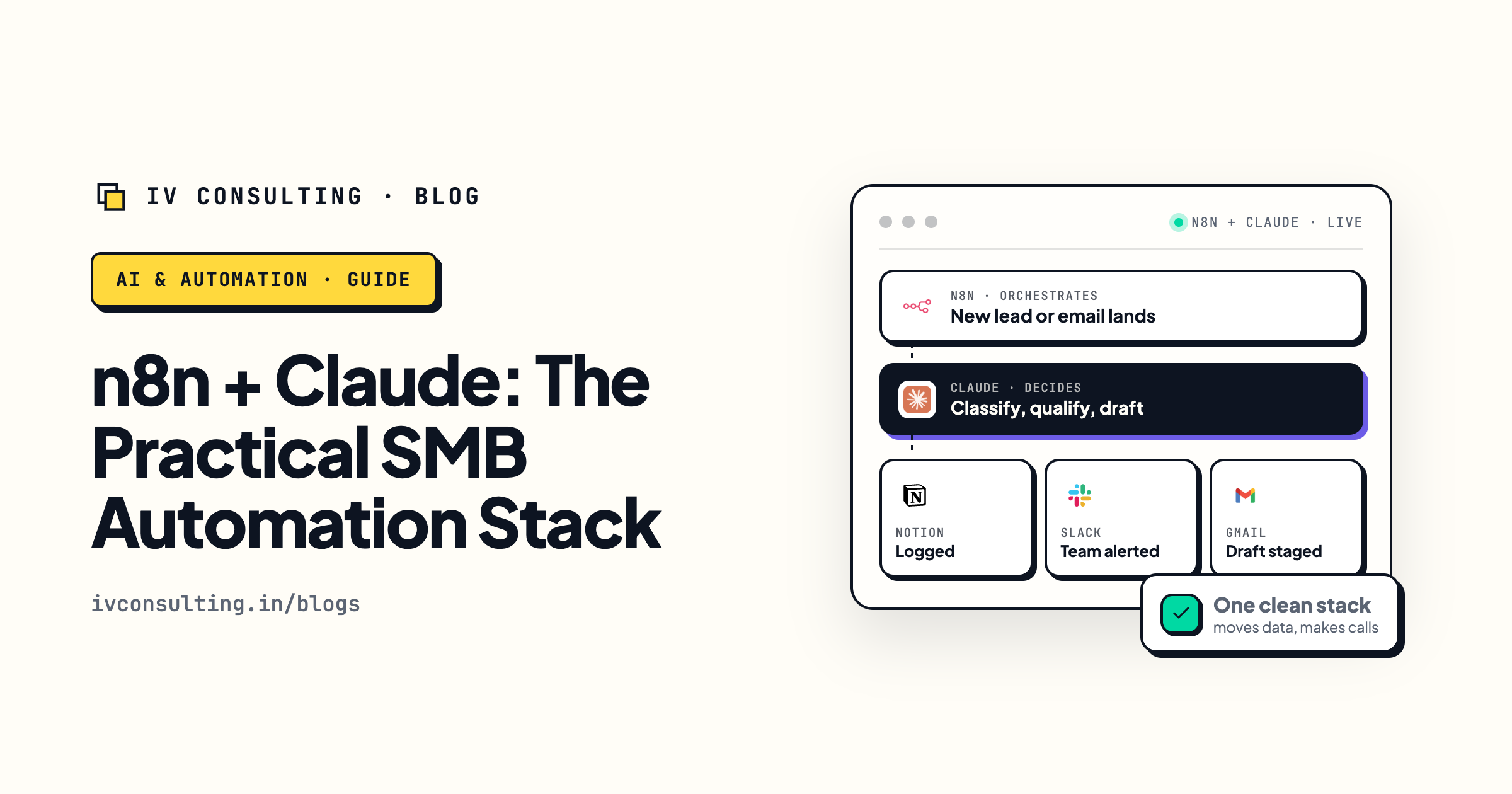
n8n + Claude: the practical SMB automation stack
The 2026 stack for small teams: n8n for the wiring, Claude for the judgment.
Read the playbook →
The AI Engineering stage, built for you
Production AI agents scoped to one job, wired into your stack, earning their keep.
See the offer →Want one high-ROI AI agent built for you?
Book a free 30-minute strategy call. We will find the workflow that leaks the most hours, scope the agent that fixes it, and give you a build roadmap on the spot. If an agent is not the right move yet, we will say so.
Book a Free Strategy Call →Free 30-minute call. Honest take, even if that means "you do not need an agent yet."