WhatsApp Business pricing in 2026: your auto-replies are still free, and here is what really changes on 1 October
A claim is circulating that Meta starts billing service and utility replies on 1 October 2026, so every WhatsApp auto-responder is about to become a per-message line item. We read Meta's own pricing documentation instead of the reseller blogs repeating it. It is not true. Service messages have been free since November 2024, and both free-form replies and utility templates are free inside an open 24-hour customer service window. What actually lands on 1 October is a rate-card change in nine specific markets. Here is what Meta bills, what it does not, and the one part of a WhatsApp build that genuinely costs money.
 By Ishan Vats · Founder of IV Consulting · builds AI agents & automations for 150+ teams
 n8n repliesInside the window · free
Meta is not about to start billing the replies your WhatsApp automation sends, and the widely repeated claim that it will from 1 October 2026 is false. Meta's own pricing documentation states that service conversations have been free for all businesses since 1 November 2024, and that non-template messages and utility templates delivered inside an open customer service window are free. That window opens when a person messages your business and stays open for 24 hours from their last message, so an inbound-triggered agent that replies, qualifies and books inside it sends nothing billable. What actually happens on 1 October 2026 is narrower than the claim: Bangladesh, Iraq, Nepal, Sri Lanka, Kazakhstan, Kuwait, Morocco, Oman and Ukraine move to standalone rate cards with adjusted rates. The part of a WhatsApp build that does cost money is the chase. Once 24 hours pass the window shuts, free-form replies are no longer permitted, and re-engaging that lead requires a template, which is billed. Your WhatsApp bill scales with follow-ups outside the window, not with conversations.
The claim
Is Meta about to start charging for WhatsApp service and utility replies?
The claim goes like this. From 1 October 2026 Meta begins charging for two things that used to be free: service messages, meaning the free-form replies your team or your AI sends inside the 24-hour window, and utility messages sent inside that same window. If it were true it would matter a great deal, because the free window is the thing every WhatsApp lead-response build leans on. An automation that answers instantly would turn into a per-message line item overnight.
It is not true. We went to Meta's own WhatsApp Business Platform pricing documentation on 26 August 2026 and read what it says rather than what is being said about it. Three things there contradict the claim directly.
First, service conversations are free, and have been since 1 November 2024. Meta's pricing documentation puts it plainly: “Service conversations are now free for all businesses.” That is written as a completed change, not a temporary promotion. Second, non-template messages delivered inside an open customer service window are free. Third, utility templates delivered inside an open customer service window are free. Those are exactly the two categories the claim says are about to start costing money.
There is a real 1 October 2026 entry in Meta's pricing calendar, which is presumably where the confusion started. It is a regional rate-card change covering nine named markets, and we cover it in section 03. It is a genuine change worth knowing about. It is not the change being described.
The actual rules
What does Meta actually charge for on WhatsApp in 2026?
Two things decide whether a WhatsApp message costs you anything: which of the four categories it falls into, and whether the customer service window is open when it is delivered. The window opens when a person messages your business and stays open for 24 hours from their last message. Since 1 July 2025 pricing is per message rather than per conversation, and messages are charged when delivered, not when sent.
| Message category | Inside an open 24-hour window | Outside the window | Does a lead-response build send it? |
|---|---|---|---|
| Service, meaning a free-form reply | Free | Not permitted, you must use a template | Constantly. This is the whole agent. |
| Utility template | Free | Billed | Only when chasing someone who went quiet |
| Marketing template | Billed | Billed | Only if you bolt campaigns onto it |
| Authentication template | Billed | Billed | No. These are one-time passcodes. |
Source: Meta's WhatsApp Business Platform pricing documentation, read 26 August 2026, for the free status of service conversations since 1 November 2024, the free status of non-template messages and utility templates inside an open customer service window, the per-message model effective 1 July 2025, and the charge-on-delivery rule. Per-message rates are set market by market and category by category on rate cards Meta publishes separately, so confirm the rate for your customers' countries at the source. We have deliberately not reproduced specific rates here, because they differ by market and change on a schedule.
The real change
What actually changes on 1 October 2026?
Nine markets move to standalone rate cards with adjusted rates: Bangladesh, Iraq, Nepal, Sri Lanka, Kazakhstan, Kuwait, Morocco, Oman and Ukraine. That is the whole of it. It is a template rate change in those countries, and Meta's documentation notes that utility and authentication messages sent inside an open customer service window are unaffected by these regional adjustments.
Rates are set by the recipient's country, not by where your business is registered. So the question is not where you are, it is where your customers are. If none of your WhatsApp volume goes to those nine markets, nothing about your bill changes on 1 October. If some does, the change reaches you only to the extent that you send templates into them.
It also helps to see this in context, because Meta has been running roughly quarterly rate-card adjustments for two years. This one is unremarkable next to its predecessors.
| Date | What changed | Shape of the change |
|---|---|---|
| 1 Nov 2024 | Service conversations became free for all businesses | Structural, and still in force |
| 1 Feb 2025 | Authentication rates cut in Egypt, Malaysia, Nigeria, Pakistan, Saudi Arabia, South Africa, UAE | Regional rates |
| 1 Jul 2025 | Moved from conversation-based to per-message pricing, with lower utility and authentication rates in several markets | Structural |
| 1 Oct 2025 | Colombia, Mexico, UAE, Argentina, Egypt, Saudi Arabia adjusted; Zimbabwe mapped to Rest of Africa | Regional rates |
| 1 Jan 2026 | India billing localisation, higher India marketing rates, lower France and Egypt, lower North America utility and authentication | Regional rates |
| 1 Apr 2026 | Eight new billing currencies added; Pakistan up, Turkey down | Billing plumbing plus regional rates |
| 1 Jul 2026 | Standalone rate cards for several markets; higher Hong Kong, Hungary, Italy, Qatar, Romania, Singapore, Spain, UK; lower Poland | Regional rates |
| 1 Oct 2026 | Bangladesh, Iraq, Nepal, Sri Lanka, Kazakhstan, Kuwait, Morocco, Oman, Ukraine move to standalone rate cards | Regional rates. No category becomes newly billable. |
Compiled from the pricing calendar in Meta's WhatsApp Business Platform pricing documentation, read 26 August 2026. Note the pattern: every entry since November 2024 adjusts rates within existing categories. None of them moves a category from free to paid.
The arithmetic
What does a real WhatsApp AI agent actually cost to run?
Rather than argue this in the abstract, we re-costed a build we already publish. Our WhatsApp AI agent for instant lead response is an n8n workflow: a lead messages the business, n8n catches it, an AI model reads and replies in natural language, asks two or three qualifying questions, sends a booking link and writes the lead to the CRM.
Count the billable messages in that flow. The trigger is the lead messaging you, which opens the customer service window. Every message the agent then sends is a free-form reply inside that window. The CRM write is not a WhatsApp message at all. So the count is zero. Not low, zero. It is zero at 100 conversations a month and it is zero at 2,000, because the number of free messages inside an open window is not metered.
That result holds after 1 October, in every market including the nine being repriced, because the repricing applies to template rates and this build sends no templates.
That arithmetic only covers WhatsApp, and WhatsApp is only one inbound channel. If your leads also phone you, the same always-on logic applies to the calls nobody picks up, which is the job an AI receptionist for service businesses does on the voice and web-chat side.
| Monthly WhatsApp conversations | Inbound-only build, as published | Same build plus a 3-step chase for leads who go quiet |
|---|---|---|
| 100 | 0 billable messages | 120 billable template sends |
| 500 | 0 billable messages | 600 billable template sends |
| 2,000 | 0 billable messages | 2,400 billable template sends |
The right-hand column is a worked example on stated assumptions, not a measurement: it assumes 40 percent of leads go quiet past the 24-hour window and each gets a three-message template chase. Change those two numbers to your own and the column moves with them. The point of the table is not the figures, it is the shape. The left column does not move with volume at all. The right column is entirely made of decisions you took, not of traffic you received.
This is why "what does WhatsApp automation cost" is close to unanswerable as asked. The Meta message bill is a function of how aggressively you chase people who stopped replying. Two businesses with identical inbound volume can differ by an order of magnitude. The model and hosting costs behind the agent, meanwhile, are usually the larger line and nobody argues about those.
The verdict
Our verdict: ignore the deadline, and fix the part of your build that actually bills
Here is where we come down, and it disagrees with most of what is being written about 1 October.
Do nothing about 1 October unless you message those nine markets. The deadline being pushed at you is not a deadline for you. If your customers are not in Bangladesh, Iraq, Nepal, Sri Lanka, Kazakhstan, Kuwait, Morocco, Oman or Ukraine, the date is irrelevant to your bill. Diarise nothing.
Do not switch off or throttle an inbound responder. This is the expensive mistake, and it is the one the false claim actually causes. Replies inside the window are free. Slowing them down to save money saves nothing and costs deals.
Do audit your templates, because that is the entire bill. If your WhatsApp costs are rising, the cause is not the window and it is not the rate card. It is that you are sending more templates to people who stopped replying. That is a strategy question wearing a pricing costume: is the fourth chase message earning its send. Most teams have never looked, because the number arrives as one undifferentiated line.
And treat single-source pricing claims about Meta with suspicion. Every figure in the claim we started with traced back to reseller and aggregator blogs, several of which sell WhatsApp messaging. Meta publishes its pricing documentation and its rate cards openly. When the two disagree, the vendor with a product to sell is not the one to believe.
Still free after 1 October
Free-form replies inside the 24-hour window, utility templates inside the window, and service messages generally. This is most of what an inbound agent sends.
What actually bills you
Templates sent after the window shuts, and marketing templates wherever they land. Your bill tracks how hard you chase, not how many people write to you.
Who 1 October affects
Only businesses messaging Bangladesh, Iraq, Nepal, Sri Lanka, Kazakhstan, Kuwait, Morocco, Oman or Ukraine. Rates follow the recipient's country, not yours.
Never do this
Turn off instant replies to control a cost that does not exist. You will not save a rupee and you will lose the leads that went to whoever answered first.
Do this next
What should you actually check before 1 October?
Four checks, and none of them is the one the claim tells you to make. All four are worth doing whether or not any date is approaching.
Find out where your recipients actually are
Pull a country breakdown of your WhatsApp sends. If the nine repriced markets are not in it, the 1 October entry does not touch you and you can stop reading pricing posts. If they are, you now know exactly how much of your volume is exposed.
Split your sends into inside-window and outside-window
This is the split that decides your bill, and most teams have never produced it. Everything inside the window is free. Everything outside it is a template you chose to send. Until you can see those two numbers separately, you are guessing at what your WhatsApp costs.
Check your templates are categorised correctly
Utility and marketing are billed differently, and a template that should be utility but got categorised as marketing is billed even inside an open window. This is a real and recoverable cost, and it has nothing to do with any deadline.
Ask whether the fourth chase message earns its send
Once you can see outside-window sends on their own, look at what they return. Follow-up sequences tend to be set once and never revisited. The last message in a chase is often the one paying for itself least, and it is the easiest line to cut.
Steps two and three are reporting problems rather than WhatsApp problems, which is the usual shape of these things: the cost is visible only if something is logging the right field at the right moment. That instrumentation is ordinary automation work, normally a day rather than a project. It is also the same discipline that decides whether you find out when a workflow breaks, which we wrote about in what Zapier, Make and n8n actually do when a workflow fails.
FAQ
Questions teams ask about WhatsApp Business pricing
Is Meta going to start charging for WhatsApp service messages on 1 October 2026?
Are replies inside the WhatsApp 24-hour window free?
What actually costs money on the WhatsApp Business Platform?
How much does a WhatsApp AI agent cost to run in Meta fees?
Does the 1 October 2026 change affect my market?
Should I switch off my WhatsApp automation before the deadline?
Ishan Vats
Founder, IV Consulting · AI & automation consultant
I build WhatsApp and lead-response automations for small teams, which means I read vendor pricing pages for a living and find that most panic about them is misplaced. The bill is almost never where people think it is. 150+ ops transformations over 10+ years. Want the number for your own business?
Run the AI agent ROI calculator →Keep reading
Related guides and work
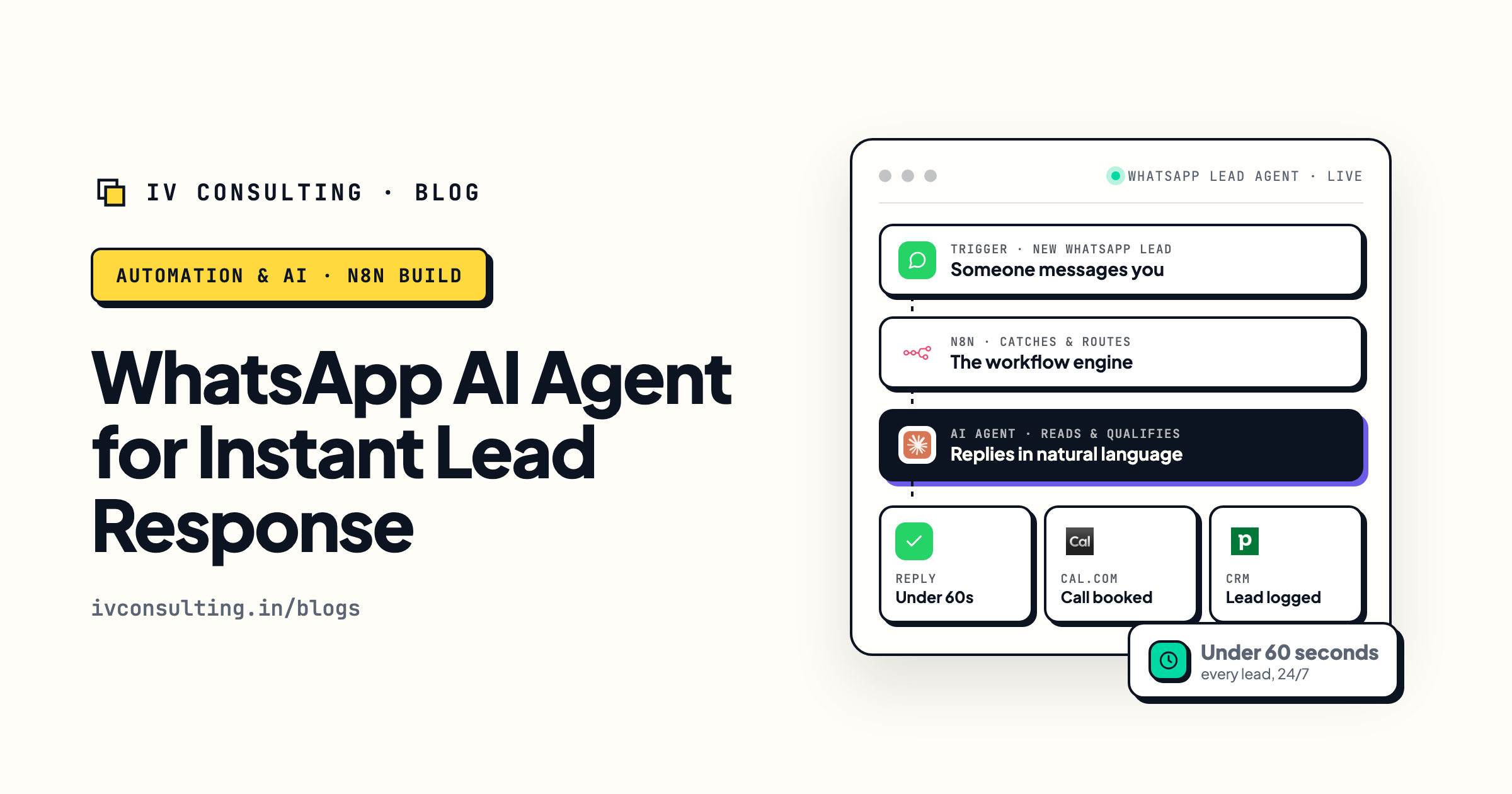
The WhatsApp AI agent we re-costed above
The n8n build itself: catches every inquiry, replies in under 60 seconds, qualifies, books the call and logs the lead.
Read the guide →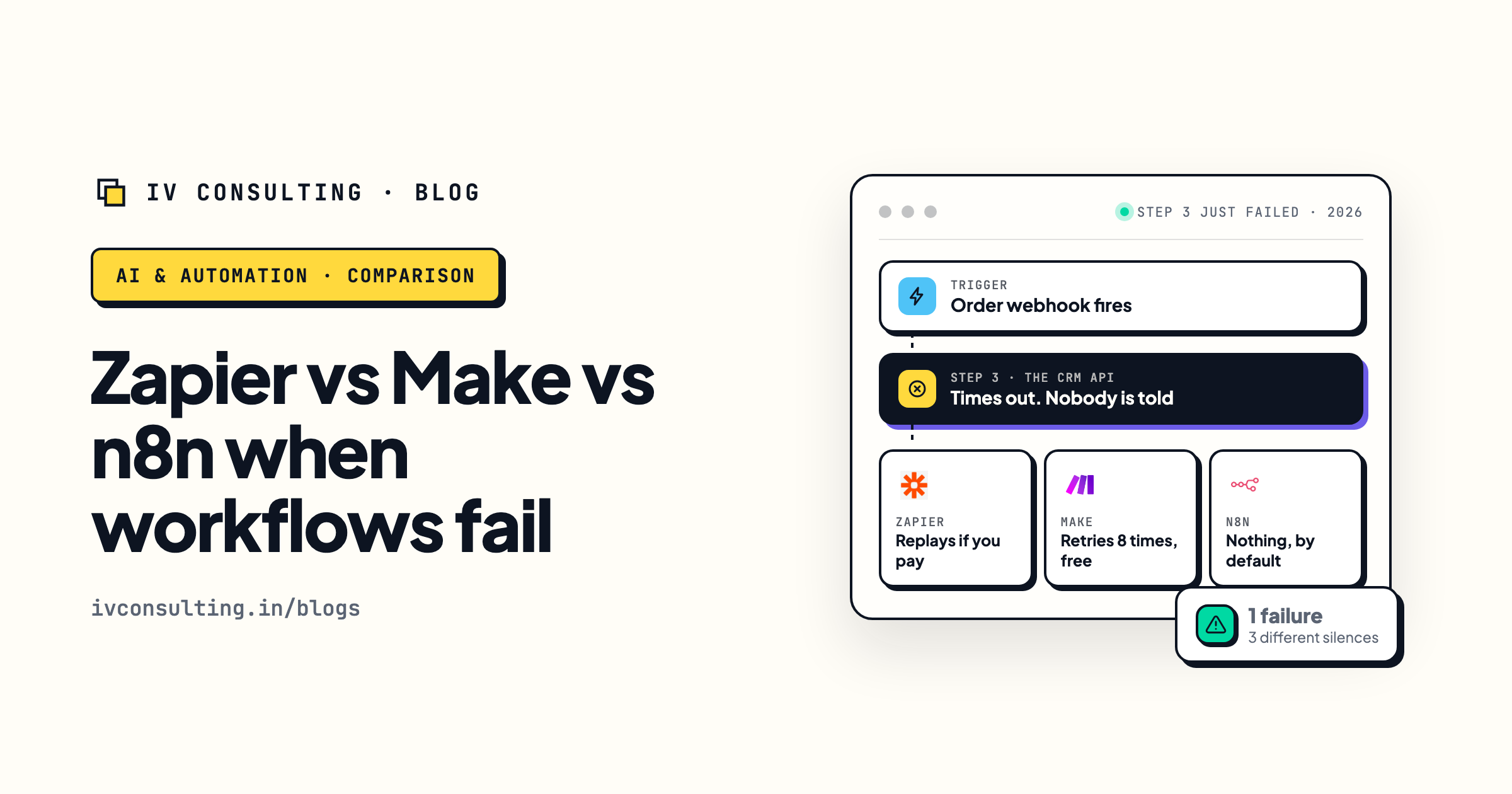
What Zapier, Make and n8n do when a workflow fails
The other thing nobody checks until it costs them: whether you find out when an automation quietly stops running.
Read the comparison →
The Automation stage, built for you
Lead response, follow-up and the reporting that shows you what each of them actually costs.
See the offer →Want to know what your WhatsApp automation actually costs?
Book a free 30-minute strategy call. We will look at how your inquiries actually arrive, split your sends into the free ones and the billed ones, and tell you whether there is a real cost problem or just a noisy pricing rumour. If your setup is already fine, we will say so and you will have lost half an hour.
Book a Free Strategy Call →Free 30-minute call. Honest take, even if that means "your WhatsApp bill is not the problem."