An AI agent build can cost nothing or five figures. Scope sets the price.
There are four ways to build an AI agent, from do-it-yourself to an in-house hire, and the right spend depends on the job, not the job title of who builds it. Here is what each route really costs, what drives the price, and how to scope a build so you never overpay.
 By Ishan Vats · Founder of IV Consulting · builds AI agents & automations for 150+ teams
 Trigger · new lead landsOne clear starting point
 AI agent · reads, scores, routesThe judgment you pay for
 CRMLogged
 SlackTeam pinged
 NotionTracked
What you pay for an AI agent build depends far more on the job than on the job title of who builds it. There are four routes: do it yourself with tools like ChatGPT and Zapier, where the cost is your time plus a few subscriptions; hire a freelancer, paid hourly or per project; work with an agency or consultancy, a scoped project build you own and get support on; or hire in-house, a salary plus ramp-up. The price is driven by how many systems the agent touches, how much it must run unattended, how sensitive your data is, and how reliable it has to be, not by the label on the invoice. The cheapest build that actually works is almost always a tightly scoped one: one workflow, one clear outcome, room to expand later.
The short answer
What should you actually pay for an AI agent build?
There is no single price for an AI agent build, because the term covers everything from a free workflow you wire up yourself to a five-figure custom system that runs your operations. What you should pay depends on the job, not on who is holding the invoice. So the useful question is not "how much does an AI agent cost" in the abstract. It is "what does this specific agent, doing this specific job, safely and reliably, cost to build."
There are four ways to get an AI agent built, and they sit on a clear cost curve. You can do it yourself with tools like ChatGPT, Zapier, or n8n. You can hire a freelancer. You can work with an agency or consultancy. Or you can hire someone in-house. Each one trades money for time, reliability, and ownership in a different way, and the right choice changes with the complexity of the job.
The mistake most small businesses make is shopping on the wrong axis. They compare quotes against each other instead of against a written scope, so a $500 build and a $15,000 build look like the same product at wildly different prices, when they are actually two completely different things. Get the scope right first, and the price question mostly answers itself.
The drivers
What actually drives the price of an AI agent build?
The price of an AI agent build is set by five things, and none of them is the tool you use. Two agents built on the exact same platform can differ in cost by 10x because the jobs are different. Before you judge any quote, look at these drivers:
- How many systems it connects to. An agent that reads one inbox is cheap. One that syncs your CRM, calendar, billing, and a spreadsheet is not, because every integration is more building, testing, and edge cases.
- How much it runs unattended. An agent that drafts a reply for you to send is low-risk and low-cost. An agent that sends, pays, or updates records on its own needs guardrails, approvals, and error handling, and that engineering is where the cost lives.
- How sensitive the data is. Customer records, financials, and health or legal data raise the bar on access control, logging, and testing. Higher stakes, higher build cost.
- How much judgment it needs. Simple rules are cheap to automate. Genuine reasoning, where the agent has to weigh messy, unpredictable inputs, needs a stronger model and much more testing to trust.
- Who maintains it after launch. Tools change, APIs break, your process shifts. A quote with no maintenance is cheaper today and more expensive the first time it breaks and nobody owns the fix.
Notice what is not on that list: how impressive the demo looks. A slick demo is easy. A build that survives your real data, your edge cases, and six months of use is the thing you are actually paying for. When a price feels high or low, map it back to these five drivers before you react.
Your options
The four ways to build an AI agent, and what each really costs
Every AI agent build lands in one of four routes. They are ordered here from lowest upfront cost to highest. The right one depends on how complex the job is and how much of your own time you want to spend.
1. Do it yourself (ChatGPT, Zapier, n8n)
The lowest-cost route. You wire the agent together with off-the-shelf tools, so the only spend is a few subscriptions and your time. It works genuinely well for simple, low-risk jobs: drafting replies, sorting inbound messages, summarizing documents, moving data between two apps. The hidden cost is your hours and the ceiling: once the workflow needs real reliability, several integrations, or logic that off-the-shelf tools cannot express cleanly, you hit a wall. Our guide to building an AI agent workflow with n8n shows how far this route can take you.
2. Hire a freelancer
A step up in cost and capability. A good freelancer builds a working agent faster than you can and handles integrations you would struggle with. You typically pay hourly or per project, and rates vary widely with skill and region. The tradeoff is consistency and continuity: quality ranges a lot, and if they move on, you may be left with a build only they understood. Best for a well-defined, single build where you can judge the work.
3. Work with an agency or consultancy
The route for a build you want to rely on and own. You pay more upfront than a freelancer, and in return you get a scoped project: discovery, the build, testing, documentation, and handover, with a team behind it rather than one person. This is where reliability, guardrails, and maintenance are treated as part of the job, not an afterthought. Best when the agent touches real systems, needs to run without babysitting, or matters to revenue. It is the AI Engineering lane, and it is what IV Consulting does.
4. Hire in-house
The highest-cost route, and the last one to reach for. A full-time AI engineer is a salary, benefits, ramp-up time, and management, and it only pays off when you have a steady stream of AI work to keep them busy. For most small businesses that stream does not exist yet. The usual smarter path is to have a freelancer or agency build and document one or two agents first, then reassess whether the volume of work justifies a permanent hire.
Side by side
The four AI agent build routes, side by side
Same job, four ways to pay for it. This table maps what you actually buy with each route, its cost shape, and where each one is the right call. The agency column is highlighted because it is the lane most small businesses reach for once an agent has to be reliable and owned.
| Route | What you pay for | Cost shape | Best when | Watch out for |
|---|---|---|---|---|
| Do it yourself | Tool subscriptions and your own time | Lowest. A few monthly subscriptions | Simple, low-risk, single workflows | Your hours, and a hard ceiling on complexity |
| Freelancer | One person's build time | Low to mid. Hourly or per project | A well-defined build you can judge | Uneven quality, and continuity if they leave |
| Agency / consultancy | Scoped build, testing, docs, ownership | Mid to high. A scoped project fee | Reliable agents that touch real systems | Cost of a bad fit. Check their real work |
| In-house hire | A full-time engineer on your team | Highest. Salary, benefits, ramp-up | A steady, ongoing pipeline of AI work | Paying full time for part-time need |
The playbook
How do you scope an AI agent build so you don't overpay?
Overpaying almost always comes from a vague ask. Tighten the scope and you both lower the price and get a better build. Follow these five steps before you approve any quote.
The five steps at a glance: (1) start with one workflow and one outcome, (2) count the integrations before you ask for a quote, (3) decide what must run unattended, (4) buy reliability and ownership, not hype, and (5) pilot small, then expand.
Start with one workflow and one outcome
Do not ask for "an AI agent." Ask for one job done: triage inbound leads, draft first-response support replies, reconcile invoices. A single, named workflow with a single, measurable outcome is something anyone can price accurately and build fast. It also gets you a win in weeks instead of a sprawling project that stalls.
Count the integrations before you ask for a quote
List every tool the agent has to read from or write to: inbox, CRM, calendar, spreadsheet, billing. That list is the single biggest driver of the price, so writing it down turns a fuzzy request into a real scope. If half the tools on the list are "nice to have," cut them from version one.
Decide what it is allowed to do unattended
Be explicit about what the agent can do on its own versus what needs a human to approve. Letting it draft and queue is cheap. Letting it send, pay, or delete without a person is where the engineering, and the cost, climbs. For many jobs, keeping a human on the final click gets you most of the value at a fraction of the build cost.
Buy reliability and ownership, not hype
The cheapest quote often skips the unglamorous parts: testing against real data, error handling, documentation, and handover. Those are exactly what separate a demo from something you can trust on Monday morning. Ask any builder what happens when an API changes or the agent gets confused, and make sure you own the final system, not rent it through them.
Pilot small, then expand
Ship the one scoped agent, run it on real work, and measure what it saves before you commit to more. A proven pilot tells you whether to widen this agent, build the next one, or stop. It is also the cheapest way to learn what you actually need, so you never pay for a big, speculative build up front. The same discipline from when not to use AI in your automations applies here.
FAQ
Questions people ask about AI agent build costs
How much does it cost to build an AI agent?
Is it cheaper to build an AI agent yourself or hire someone?
Why do AI agent build quotes vary so much?
Should a small business hire an in-house AI engineer?
What is a fair price for a custom AI agent?
How do I avoid overpaying for an AI agent?
Ishan Vats
Founder, IV Consulting · AI & automation consultant
I build production AI agents, automations, and MCP servers for teams from startup to enterprise, scoped tightly so you pay for outcomes, not hype. 150+ ops transformations over 10+ years. If you have a build quote in front of you, I'll help you scope it and sanity-check the price on a free call.
Book a free strategy call →Keep reading
Related guides and work
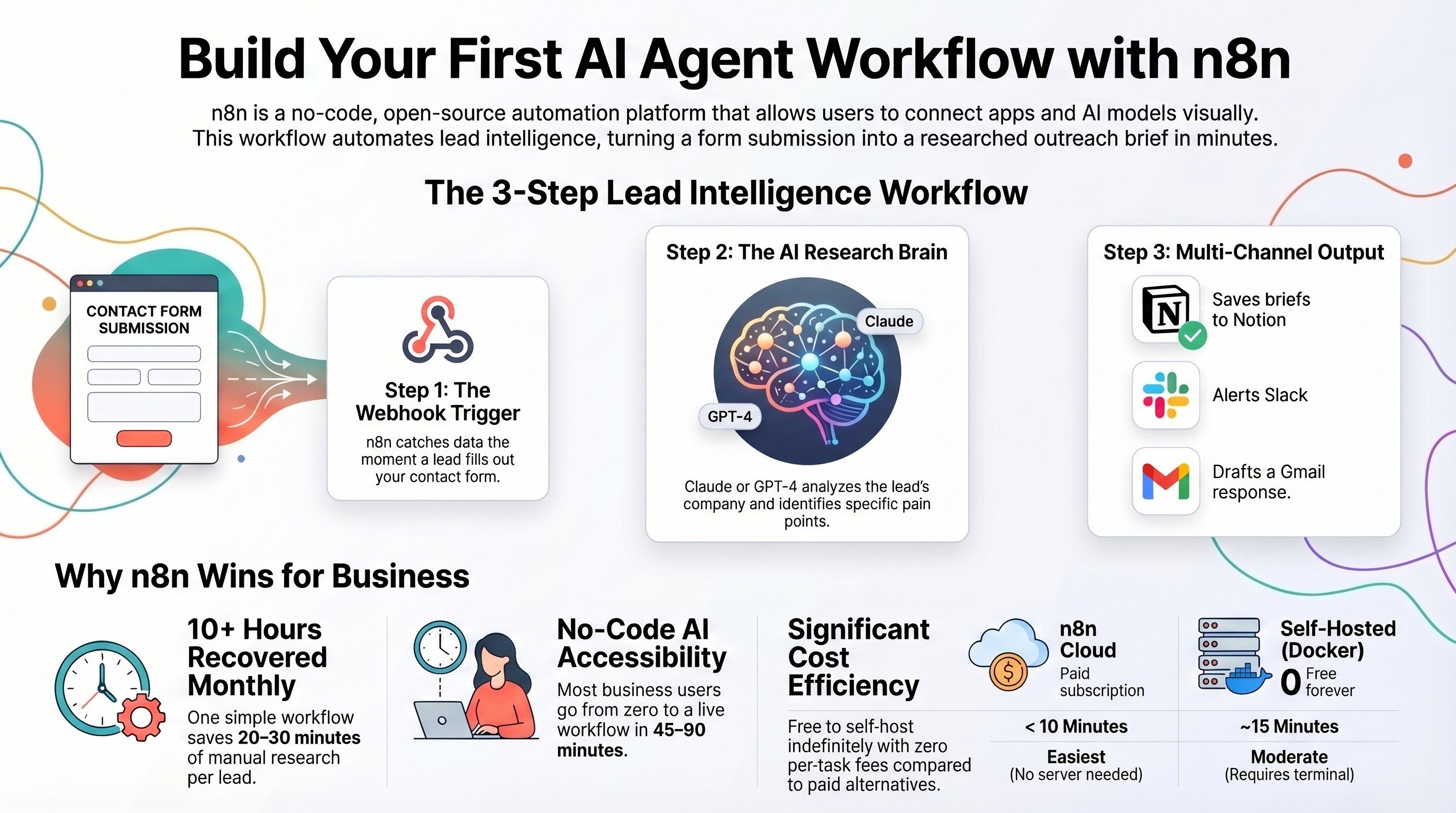
Build an AI agent workflow with n8n
The do-it-yourself route in detail: how far you can get building an agent yourself before you need to hire.
Read the guide →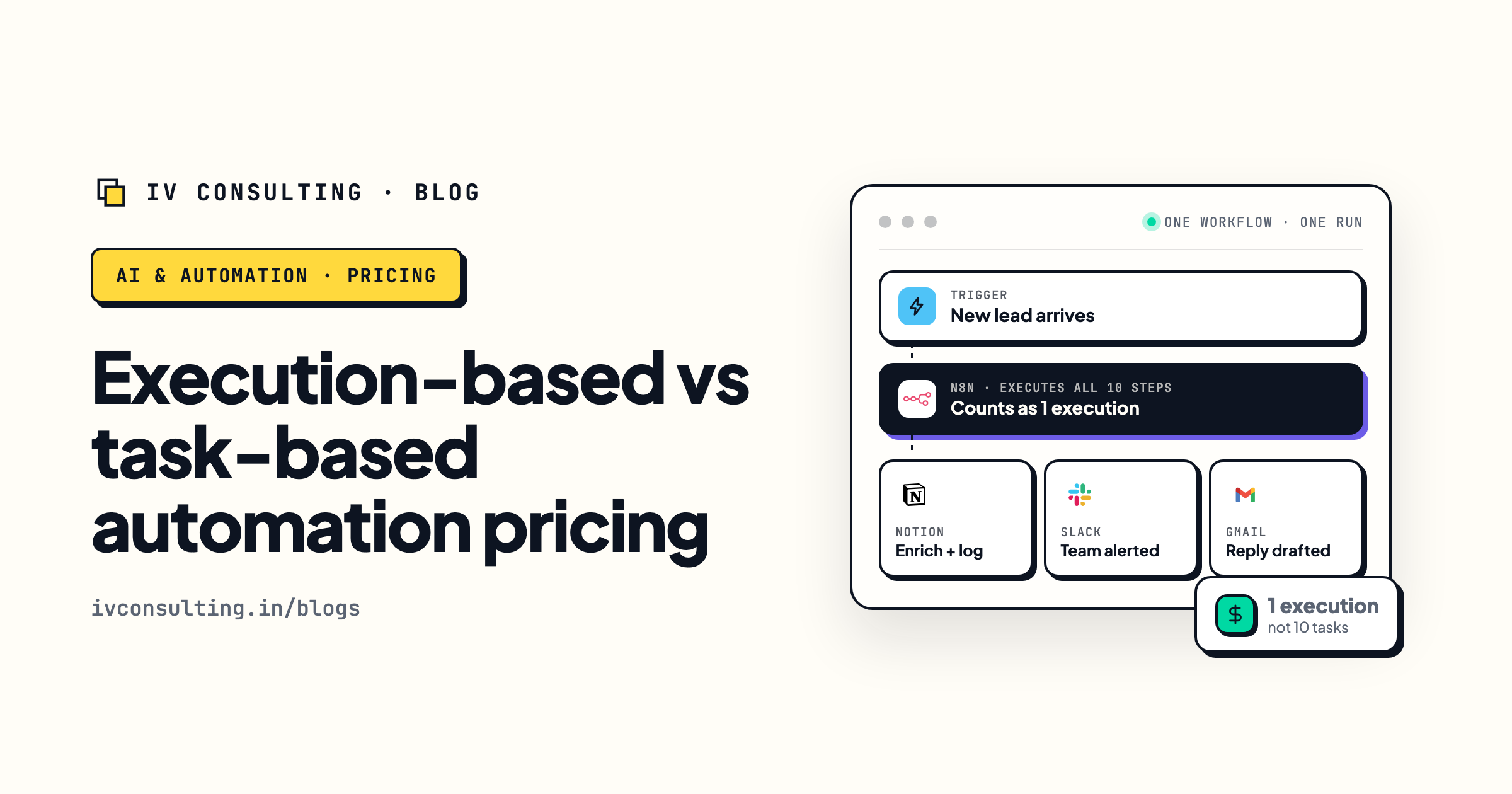
Execution vs task-based automation pricing
The tool-cost companion: why the same automation costs very different amounts depending on how it is billed.
Read the guide →
The AI Engineering stage, built for you
We scope, build, test, and hand over production AI agents, so you own a reliable system, not a fragile demo.
See the offer →Not sure what your AI agent build should cost?
Book a free 30-minute strategy call. We will scope the one workflow worth automating first, map the integrations that actually drive the price, and give you a straight answer on what a fair build costs. If do-it-yourself is the right call for you, we will tell you that too.
Book a Free Strategy Call →Free 30-minute call. Honest take, even if that means "you do not need us yet."