Salesforce Core vs Enterprise: the 10-seat AI upgrade math, and our verdict.
On 3 September 2026 Salesforce replaced Enterprise Edition with Core, a $195 seat with Agentforce, Slack and 500,000 Flex Credits bundled in. Enterprise was $175. The non-AI middle tier is gone from the price list, so the AI stopped being optional for anyone buying above Pro Suite. We priced every path a 10-person team actually has, from staying on legacy Enterprise to dropping to Pro Suite and owning the automation layer yourself, and we take a side on each one.
 By Ishan Vats · Founder of IV Consulting · builds AI agents & automations for 150+ teams
 3 Sep 2026Enterprise replaced by AI-bundled Core
 Core$23,400 with Slack and Flex Credits
 Pro Suite + n8nAbout $12,900, you own the AI
Salesforce Core is the edition that replaced Enterprise on 3 September 2026. It lists at $195 per user per month billed annually, against $175 for Enterprise, and it bundles Agentforce, Slack, Premier Success and 500,000 Flex Credits per org per year. For 10 seats that is $23,400 a year against $21,000, so the AI bundle costs $2,400 more. At Salesforce's $500 per 100,000 list price those credits are worth about $2,500, roughly 25,000 standard agent actions. Existing Enterprise customers keep their legacy pricing. Our verdict: if your team already pays for Slack or will genuinely run an agent, Core is the better deal at renewal. If neither is true, stay on Enterprise. And if you are a new buyer under about 20 seats, Pro Suite at $100 plus an automation layer you own beats Core by around $10,000 a year.
The event
What replaced Salesforce Enterprise Edition, and what does Core cost?
Salesforce Core replaced Enterprise Edition on 3 September 2026 and costs $195 per user per month billed annually, up from $175, with Agentforce, Slack and 500,000 Flex Credits per org per year bundled in.
On 3 September 2026 Salesforce announced three new editions for Agentforce Sales and Agentforce Service. Core replaces Enterprise, Advanced replaces Unlimited, and Max succeeds Agentforce 1. Every one of them includes Agentforce capabilities, Slack and Slackbot, embedded analytics, data security and a Premier Success Plan. Salesforce frames it as simplification: one purchase instead of stitching SKUs together.
The other way to read it is the one this post is about. The middle of the Salesforce price list no longer has a seat without AI in it. If you want more than Pro Suite, you are now buying Agentforce whether you planned to or not.
| New edition | Replaces | Old list price | New list price | Flex Credits included |
|---|---|---|---|---|
| Core | Enterprise | $175 | $195 (+11%) | 500,000 per org per year |
| Advanced | Unlimited | $350 | $395 (+13%) | 1 million per org per year |
| Max | Agentforce 1 | $550 | $550 (no change) | 2.75 million per org per year |
| Pro Suite | Unchanged | $100 | $100 | None listed |
Sources, read 12 October 2026: the Salesforce newsroom announcement, the Sales pricing page and SalesforceDevops' edition analysis, which supplied the old $175 and $350 list prices from Salesforce's August 2025 pricing action. All prices are US list, per user per month, billed annually.
Salesforce says pricing for existing customers on legacy editions is unchanged, and Agentforce 1 customers can move to Max at no extra cost. Nobody on Enterprise is being moved to Core today. The pressure arrives at renewal and at your next expansion, which is why this is worth working out before your account executive brings it up.
The comparison
Salesforce Core vs Enterprise vs Pro Suite: what does a 10-person team pay?
At list price, billed annually, 10 seats cost $12,000 a year on Pro Suite, $21,000 on legacy Enterprise, $23,400 on Core, $36,000 on Enterprise with the Agentforce add-on, and $47,400 on Advanced. This is our arithmetic on published list prices, not client invoice data. Most SMBs negotiate a discount, so treat the gaps between rows as the useful number, not the totals.
| Path | Per user / month | 10 seats / year | AI included | Who can buy it |
|---|---|---|---|---|
| Pro Suite | $100 | $12,000 | None listed | Anyone |
| Pro Suite + n8n Cloud Pro + a model API | $100 + €50 per month for the whole team | About $12,900 | Whatever you build | Anyone |
| Enterprise (legacy) | $175 | $21,000 | None unless you add it | Existing customers |
| Core | $195 | $23,400 | Agentforce, Slack, 500K credits | Anyone |
| Enterprise + Agentforce add-on | $175 + $125 | $36,000 | Agentforce per user | Existing customers |
| Advanced | $395 | $47,400 | Agentforce, Slack, 1M credits | Anyone |
How we got the DIY row: n8n Cloud Pro is €50 a month billed annually for 10,000 executions a month, about €600 a year, which we round to roughly $650 to $700. Model cost for 25,000 simple classify-and-update steps a year is under $250 on the list prices we re-costed in our October model pricing breakdown. The Agentforce add-on is listed from $125 per user per month on Salesforce's pricing page.
Three rows matter. Core over Enterprise is $2,400 a year, and that buys the credits plus Slack. Core under Enterprise-plus-add-on is $12,600 a year cheaper, so anyone paying the per-user Agentforce add-on today should be asking to move. And Core over the DIY row is roughly $10,500 a year, which is the real price of letting Salesforce own your AI layer instead of owning it yourself.
The bundle
How many Flex Credits come with Core, and what do they actually buy?
Core includes 500,000 Flex Credits per org per year. Salesforce sells extra credits at $500 per 100,000, and a standard agent action costs 20 credits, about 10 cents. So the allowance is worth about $2,500 at list and covers about 25,000 standard actions a year. A voice action is reported at 30 credits, so that drops to about 16,600 if your agent talks.
Here is the part nobody is pointing out. The allowance is per org, not per seat. A 10-seat org gets the same 500,000 credits as a 300-seat org. Divide it out and the small team gets about 2,500 actions per person per year, roughly 10 per working day. The 300-seat org gets fewer than 85 per person. The bundle is priced for the enterprise, but the credit math quietly favours the small team.
The Slack line is real money
Salesforce lists Slack in every new edition, and SalesforceDevops reports it as Slack Business+. Slack's own pricing page lists Business+ at $15 per user per month billed annually. For 10 people that is $1,800 a year. Check which Slack plan your Core contract actually names before you count it.
Credits do not equal value
An unused credit is worth zero. If nobody on your team has written down what an agent would do, which record it reads, and what it changes, the $2,500 is a number on a contract, not a saving.
The break-even, in one line
Core costs $2,400 more than Enterprise for 10 seats. If you would otherwise pay for Slack Business+ ($1,800) and you will use even a quarter of the credits (about $625), Core pays for itself. If you will use neither, it is a $2,400 a year price rise with a better name.
The verdict
Our verdict: should a small team move to Salesforce Core?
Move to Core if you already pay for Slack or will run a real agent; stay on legacy Enterprise if you will use neither; and if you are buying Salesforce fresh with under about 20 seats, start on Pro Suite and own your automation layer. Four situations, four answers.
On Enterprise, using Slack: take Core
You pay for Slack already and Core folds it in. The $2,400 gap mostly disappears and you get the credits on top. Ask for Core at renewal and negotiate the Slack licences you no longer need off the other bill.
On Enterprise, no Slack, no agent plan: stay
Salesforce says legacy pricing is unchanged. Renew on Enterprise and get the renewal terms in writing. Paying 11 percent more for AI you have no job for is not an upgrade.
Paying the $125 Agentforce add-on: move now
Enterprise plus the add-on is $300 a seat. Core is $195 with credits included. On 10 seats that is $12,600 a year back. This is the one case where you should call your account executive before they call you.
New buyer, under ~20 seats: Pro Suite plus your own layer
Core costs $95 a seat more than Pro Suite. For 10 seats that is $11,400 a year, and most of what a small team wants from "AI in the CRM" (enrich the lead, summarise the call, route the ticket, chase the follow-up) is a few hundred dollars a year in an n8n workflow you own and can move. Buy Core for Core's CRM features if you need them, never for the AI.
The honest caveat on the last branch: check that Pro Suite exposes what your automation needs, including API access and the objects you plan to write to, before you plan around it. If it does not, that is your answer, and Core is the floor. This is the same trade we priced in execution-based vs task-based automation pricing: the vendor's bundled AI is easiest to start, and an automation layer you own is cheapest to run.
The whole verdict hinges on one question: what would an agent actually do for your team each week, and what is that time worth? Put your real hours into our AI agent ROI calculator. It takes about two minutes, and it tells you whether 500,000 Flex Credits are a saving or a line item.
The pattern
Which other tools removed the plan without AI?
Salesforce and Notion have both removed the AI-free version of the tier most teams buy, Atlassian ships Rovo credits inside every paid seat, and ClickUp is the holdout that still sells AI as an optional add-on. Salesforce is the sharpest example, not the first. The 2026 pattern is that vendors stop selling AI as an add-on and fold it into the tier most teams buy, so the seat price rises whether you use it or not. Here is where the tools a small team actually pays for stand today.
| Tool | What changed | Can you still buy the seat without AI? |
|---|---|---|
| Salesforce | 3 Sep 2026: Enterprise and Unlimited replaced by AI-bundled Core and Advanced, at +11% and +13% | Yes, but only down at Pro Suite ($100), or by staying on a legacy edition |
| Notion | 13 May 2025: the AI add-on ended for new Free and Plus users; AI moved into Business, which went from $15 to $20 per member | Yes, on Plus, which keeps only a trial of Notion AI |
| ClickUp | Brain AI stays an add-on: $9 per user per month annually on top of the base plan | Yes, AI is still optional |
| Atlassian | Rovo AI comes with Jira and Confluence paid plans, metered in credits | No, the credits ship with the seat |
Sources: Notion's 2025 pricing changes page, ClickUp pricing and Atlassian's Rovo usage docs, as verified in our earlier posts. Notion's previous $15 Business price is as reported in coverage of the change.
The playbook for every row is the same: work out what you now pay for AI you did not ask for, then decide per tool whether to absorb it, downgrade, or move the job into an automation you own. We ran that exercise for workspace tools in Rovo vs Notion AI vs ClickUp Brain and ClickUp Brain vs Notion AI per seat. Salesforce is the same question with bigger numbers, and it sits next to the support side of the same vendor, where Salesforce now owns Fin.
Do this next
What should you do before your Salesforce renewal?
An hour of prep changes the conversation with your account executive from "here is the new edition" to "here is what we will and will not pay for".
Write down your current edition, seat count and renewal date
And what you pay today, after discount. The list-price gaps above are what moves; your discount is what you protect.
Total your Slack bill
If you pay for a Slack plan, Core's bundled Slack can offset most of the price gap. If you do not use Slack, give that line zero value.
Name three agent jobs, or admit there are none
For each: which record it reads, what it changes, and how often. Multiply by 20 credits. If the total is far under 500,000 a year, you are being sold capacity you will not use.
Price the job outside Salesforce
The same three jobs as an n8n workflow writing back to Salesforce. That number is your walk-away price for the AI half of Core.
Ask for legacy renewal terms in writing
Salesforce says legacy pricing is unchanged. Get your next renewal confirmed on Enterprise so you choose the move, rather than having it chosen at the deadline.
If step four is where you get stuck, that is the work our automation practice does: build the agent jobs as workflows you own, writing into the CRM you already run.
FAQ
Questions small teams are asking about Salesforce Core pricing
What replaced Salesforce Enterprise Edition?
Core. On 3 September 2026 Salesforce announced Core, Advanced and Max editions for Agentforce Sales and Agentforce Service. Core replaces Enterprise, Advanced replaces Unlimited, and Max succeeds Agentforce 1. Every new edition bundles Agentforce, Slack, embedded analytics, data security and a Premier Success Plan. Free, Starter and Pro Suite remain on the price list below them.
How much does Salesforce Core cost for a 10-person team?
$23,400 a year at list price. Core is $195 per user per month billed annually, so 10 seats cost $23,400, against $21,000 on the legacy Enterprise Edition at $175. Pro Suite is $100 per user per month, or $12,000 a year for 10 seats. These are US list prices; most teams negotiate a discount.
Do existing Salesforce Enterprise customers have to move to Core?
Not according to Salesforce. Its announcement says pricing for existing customers on legacy editions is unchanged, and Agentforce 1 customers can move to Max at no extra cost. The decision arrives at renewal or expansion, so ask for your next renewal terms on Enterprise in writing if you plan to stay.
How many Flex Credits come with Salesforce Core, and what are they worth?
500,000 per org per year. At Salesforce's list price of $500 per 100,000 credits that is about $2,500 of value, and at 20 credits per standard agent action it covers about 25,000 actions a year. The allowance is per org, not per seat, so a 10-person team gets about 2,500 actions per person per year.
Is Core cheaper than adding Agentforce to Enterprise?
Yes, by a wide margin. The Agentforce add-on is listed from $125 per user per month, so Enterprise plus the add-on is $300 a seat, or $36,000 a year for 10 seats. Core is $195 with 500,000 Flex Credits included, or $23,400 a year. A team paying for the add-on today saves about $12,600 a year at list by moving to Core.
Should a small business buy Salesforce Core for the AI?
No. Buy Core for its CRM features if you need them. If the AI is the reason, Pro Suite at $100 a seat plus an automation layer you own, such as n8n Cloud Pro at 50 euros a month with a model API, costs roughly $10,500 a year less for 10 seats and keeps the workflows portable. Check that Pro Suite exposes the API access your automation needs first.
Ishan Vats
Founder, IV Consulting · AI & automation consultant
I build the automation layer small teams run on top of their CRM and workspace tools, mostly in n8n with Claude. That puts me on the other side of the "buy the vendor's AI or build your own" question every week, and the honest answer is usually a mix. 150+ ops transformations over 10+ years.
Run the AI agent ROI calculator →Keep reading
Related guides and work
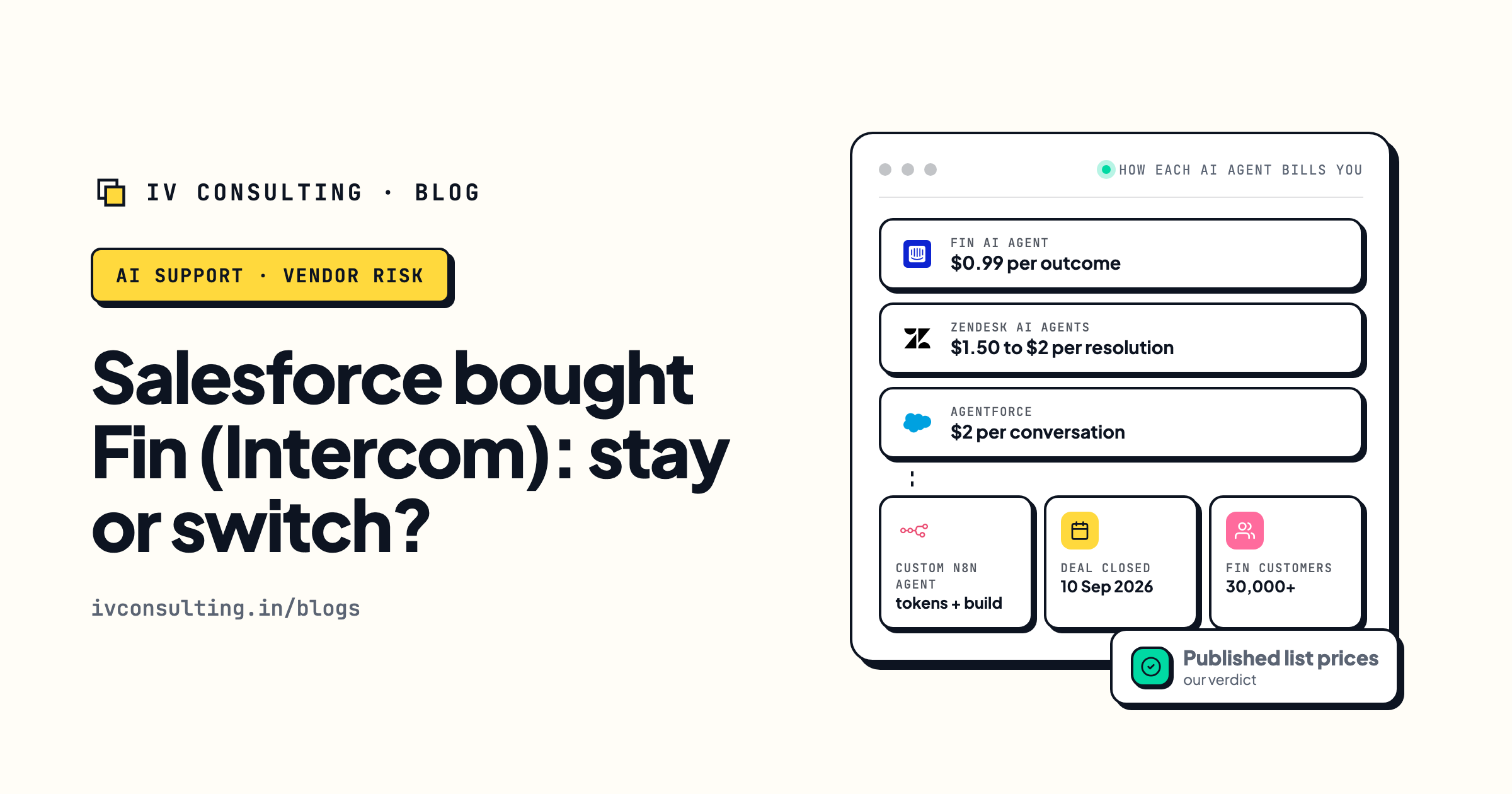
Salesforce bought Fin, too
What the Intercom Fin deal means for your support bot, and our stay-or-switch verdict.
Read the verdict →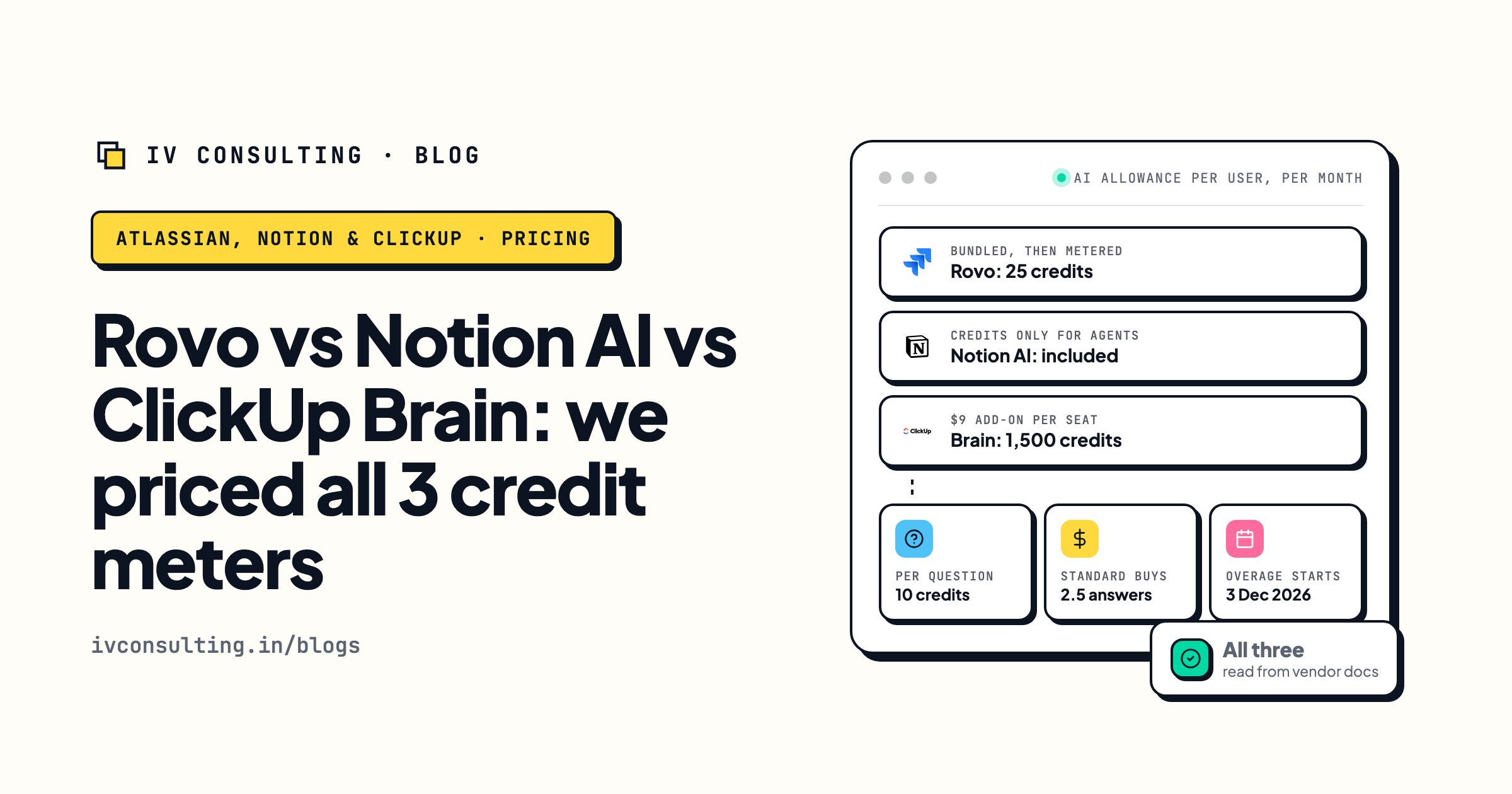
Rovo vs Notion AI vs ClickUp Brain
Three workspace AI credit meters, priced for a 10-person team.
Read the comparison →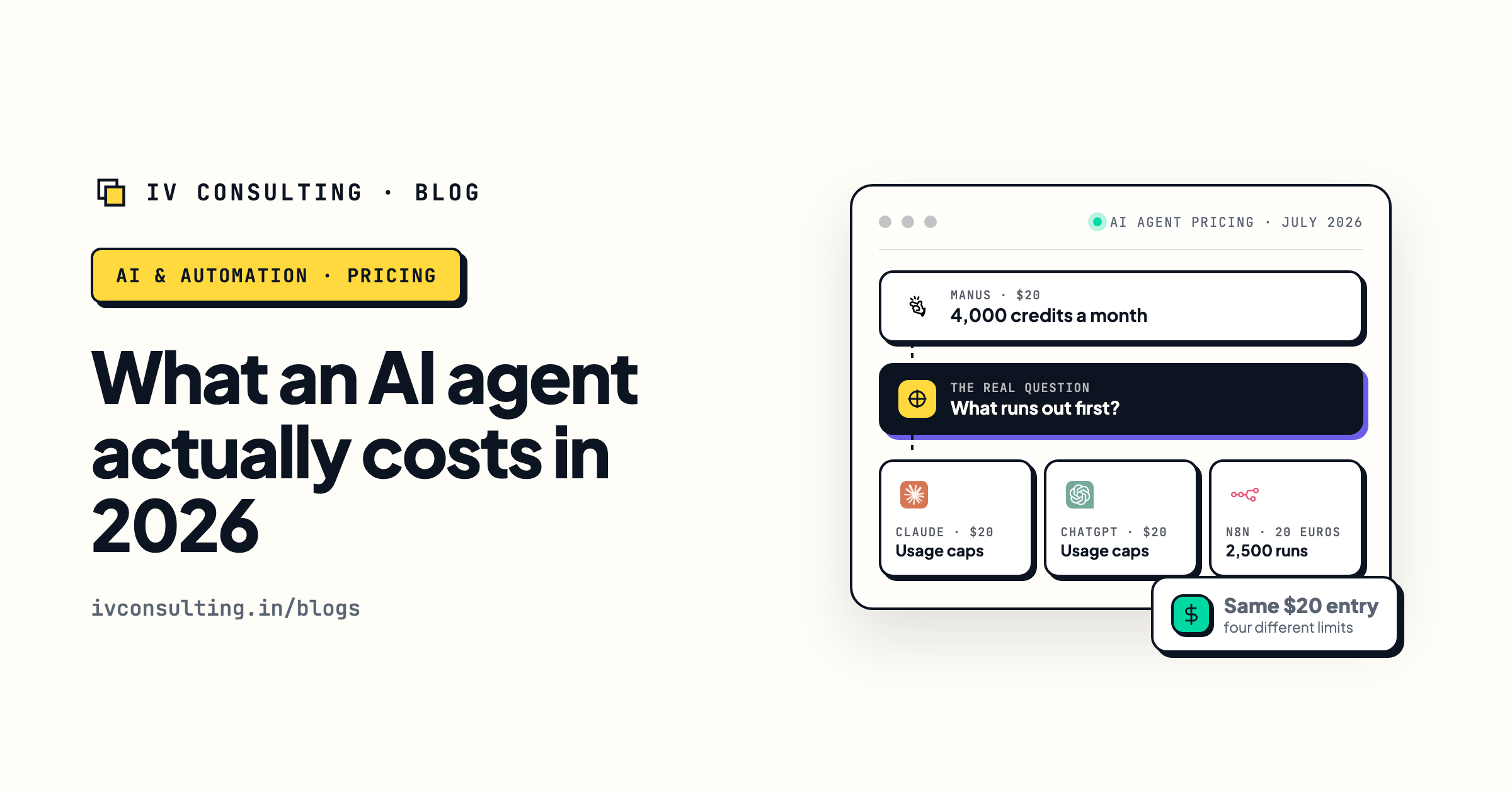
What an AI agent actually costs
Manus vs ChatGPT vs Claude vs n8n, priced per month for a small team.
Read the breakdown →Want a second opinion before your Salesforce renewal?
Book a free 30-minute strategy call. We will look at what your team would actually use an agent for, price it inside and outside Salesforce, and tell you which edition the numbers support.
Book a Free Strategy Call →Free 30-minute call. Honest take, even if that means "renew what you have."