Salesforce bought Fin, the old Intercom. Stay, but build your exit.
Intercom renamed itself Fin in May, Salesforce signed to buy it in June, and the deal closed on 10 September 2026. If your support team runs on Intercom or on the Fin AI Agent, your vendor now sits inside the company that sells Agentforce. We priced the alternatives from each vendor's own pages and took a side on what a small support team should do this quarter.
 By Ishan Vats · Founder of IV Consulting, builds AI agents and automations for clients
 Fin AI Agent$0.99 per outcome
 Zendesk AI agents$1.50 to $2 per resolution
 Agentforce$2 per conversation
 Custom n8n agenttokens + build
Salesforce completed its roughly $3.6 billion acquisition of Fin, the company formerly called Intercom, on 10 September 2026. Nothing in your Fin or Intercom account changed that day: Fin still bills $0.99 per outcome with a 50-outcome monthly minimum, and Intercom helpdesk seats still start at $29. Our verdict for a small support team is to stay for now, because Fin's outcome billing is cheaper than both Zendesk's per-resolution meter and Agentforce's per-conversation price. But lock your per-outcome rate into your next renewal, keep your help content portable, and set three tripwires that tell you when to leave.
The verdict
Should you leave Intercom now that Salesforce owns Fin?
No, not this quarter. Migrating a support stack costs weeks of rebuilt workflows, retrained agents and a dip in resolution rate while the new AI learns your content. Today, you would be paying that cost to escape a price change that has not happened. Stay, but spend one afternoon making leaving cheap.
A disclosure first. We build AI agents and automations for clients, including custom support agents in n8n, so we have a mild bias toward building over buying. We have not deployed Fin for a client and we are not going to pretend we have. Everything below comes from Fin's pricing page, Intercom's pricing page, Salesforce's own press releases and the vendors' published billing rules, read on 28 September 2026. The arithmetic and the opinion are ours.
Three findings drive the verdict:
- Fin's billing model is the thing worth protecting. Fin charges per outcome. Salesforce's own Agentforce charges per conversation or per action. For a support team, paying only when the agent finishes the job is the better deal, and that is the term to lock in while you can.
- The public commitment is continuity, not a price freeze. Fin's own announcement says that within Salesforce, Fin "will continue to serve its customers." Neither company has said anything about pricing, contract terms or the Intercom helpdesk product. Silence is not a promise.
- Your real exposure depends on which helpdesk you run. If Fin sits on Salesforce Service Cloud, this acquisition is mostly good news. If Fin sits on Zendesk or HubSpot, you depend on a Salesforce product continuing to integrate well with Salesforce's competitors. That is the setup to watch most closely.
What happened
What happened: Intercom became Fin, then Salesforce bought it
Three dated events, all confirmed by the companies themselves. Intercom renamed itself Fin on 12 May 2026, Salesforce signed a definitive agreement to acquire Fin for approximately $3.6 billion on 15 June 2026, and the acquisition closed on 10 September 2026.
- 12 May 2026, the rename. Intercom announced that the company would take the name of its AI agent. The Intercom name stayed on the customer service platform, the helpdesk your human agents log into, while the corporate identity moved to Fin.
- 15 June 2026, the agreement. Salesforce announced it would acquire Fin for approximately $3.6 billion, subject to customary purchase price adjustments.
- 10 September 2026, the close. Salesforce completed the acquisition, bringing Fin's platform, its AI team and a customer base of more than 30,000 companies into Salesforce. Salesforce positions Fin alongside Agentforce in its customer service AI portfolio, with Fin covering "rapid deployment on existing systems." The same release credits Fin with an average resolution rate of 76 percent across channels, a vendor figure rather than an independent benchmark.
That last phrase is the most useful thing in the announcements for a small team. Salesforce is describing Fin as the fast, works-with-what-you-have option and Agentforce as the deeply tailored enterprise option. That suggests Fin keeps its own identity for now. It does not tell you what Fin will cost in two years, and nobody outside Salesforce knows that yet.
Fin is not the only independent support AI being folded into a bigger platform this year, and it is not the first vendor change to force a support team's hand. Zendesk is switching off its legacy AI agents on 10 December 2026, which we covered in what to do about Zendesk's legacy AI agent removal. The pattern is the same each time: the product keeps working, and the terms around it move.
What Fin costs
What does Fin cost after the Salesforce deal, and what could change?
Today, Fin costs $0.99 per outcome with a 50-outcome monthly minimum, and Intercom's helpdesk seats cost $29, $85 or $132 per seat per month. Neither price has changed since the deal closed. What has quietly changed is the word: Fin now bills "outcomes", and an outcome is broader than a resolution.
From Fin's pricing page on 28 September 2026:
- $0.99 per outcome for resolutions, procedure handoffs, disqualifications and self-serve routing.
- $9.99 per qualification, for teams using Fin to qualify sales leads.
- 50 outcomes per month minimum when you run Fin on top of another helpdesk. Fin lists Salesforce, HubSpot and Freshworks among supported helpdesks, and says there are no integration, setup or platform fees on top.
- Intercom helpdesk: Essential $29, Advanced $85 and Expert $132 per seat per month, each including Fin, per Intercom's pricing page. Intercom says you are charged at most once per conversation, even if Fin answers several questions in it.
Read the first bullet twice. A procedure handoff, where Fin runs a workflow and then passes the customer to a human, is a billable outcome. So is routing a customer to self-serve. If you budgeted Fin on your old resolution rate, your outcome count can be higher than your resolution count, and your bill with it. Check last month's invoice against your own resolved-conversation report before you renew.
As for what could change, we will not predict a price rise nobody has announced. What we can say is where the pressure sits. Salesforce's own customer service agent, Agentforce, is sold on consumption: Flex Credits at $500 per 100,000 credits, which works out to $0.10 per standard action, or $2 per conversation on the conversation model. Two pricing philosophies now live inside one company. At some point one of them wins, and for a small support team, the outcome model is the one you want to win.
The alternatives, priced
Fin vs Zendesk AI vs Agentforce: what does a month of AI support cost?
On published prices, Fin is the cheapest way to buy AI resolutions off the shelf. In our example month, the AI layer costs $990 on Fin, $1,500 to $2,000 on Zendesk and $4,000 on Agentforce's conversation pricing. The gap comes from what each vendor counts, not only from the rate.
The example is ours and it is illustrative, not client data: a 10-agent support team where 2,000 conversations a month reach the AI agent and the AI finishes 1,000 of them. We price only the AI layer on top of the helpdesk seats you already pay for, except in the Intercom row where seats and Fin come together.
| Option | What you pay for | Rate | AI cost / month | Vendor risk now |
|---|---|---|---|---|
| Intercom Essential + Fin | Seats plus outcomes | $29 a seat + $0.99 | $1,280 incl. 10 seats | Inside Salesforce, terms unannounced |
| Fin on your current helpdesk | Outcomes only | $0.99, 50 minimum | $990 | Depends on Salesforce supporting rivals' helpdesks |
| Zendesk AI agents | Automated resolutions | $1.50 committed, $2 pay as you go | $1,500 to $2,000 | Low: Zendesk's own product |
| Agentforce, conversation pricing | Every conversation the agent handles | $2 | $4,000 | None new, but needs Salesforce |
| Custom agent in n8n | Model tokens, hosting, the build | No per-outcome fee | Depends on volume and build | You own it, and you maintain it |
Two caveats keep this honest. First, the Zendesk rate comes from third-party pricing trackers rather than a single Zendesk page, and Zendesk plans include a small allowance of resolutions per agent, so confirm your own rate before you compare. Second, Agentforce's action-based Flex Credit pricing can come in well under $2 a conversation if your conversations use only a few actions. We show the conversation model because it is the one Salesforce quotes for customer-facing agents.
The lesson is in the second column. Fin and Zendesk bill when the AI finishes something. Agentforce's conversation model bills when the AI shows up, including the half of conversations it hands to a human. That is why "stay and lock in the outcome model" beats "move to the Salesforce-native option" for a team that is not already on Salesforce.
The tripwires
When should a small support team leave Fin?
Decide now what would make you leave, write it down, and check it at every renewal. Three tripwires cover almost every case.
Tripwire 1: the billing model changes
If Fin moves from per-outcome billing to per-conversation billing, credits, or a bundle that requires Salesforce seats, redo the table above with the new terms. If Zendesk's per-resolution meter now wins, that is your moment to move.
Tripwire 2: your integration gets worse
If you run Fin on Zendesk or HubSpot and new Fin features start arriving for Salesforce Service Cloud first, or your connector stops getting fixes, the native AI inside your own helpdesk becomes the safer bet.
Tripwire 3: your cost per resolution climbs
Divide your monthly Fin bill by the conversations your own reports say Fin actually resolved. If that number rises two renewals in a row, the outcome definition or the rate is working against you, whatever the headline price says.
Who should consider leaving before a tripwire fires? Only teams that were already unhappy. If Fin's resolution rate on your content has been poor for months, the acquisition is a good excuse to test the native AI in your own helpdesk, not a reason in itself. And if you are already on Salesforce Service Cloud, the opposite applies: this deal is likely to bring Fin closer to the tools you already run.
If you are weighing a custom agent instead, be realistic about what you take on. A support agent built in n8n on top of a model API has no per-outcome fee and no acquirer, but you own the prompts, the knowledge retrieval, the handoff logic and the on-call. We compare the build and buy routes for agents in OpenAI Agents API vs n8n vs Zapier Agents, and the support use cases worth automating first in AI and automation use cases for customer support teams.
Build your exit
How do you keep an exit ready without migrating?
Own your content, write down your terms, and measure your own resolution rate. None of it requires leaving, and all of it makes leaving a two-week job instead of a two-month one.
- Export your help center and Fin's content sources. Keep a dated copy of every article, snippet and custom answer Fin draws on, outside Fin. Your content is what makes any support AI good. It should never exist in only one vendor's system.
- Write your procedures down in plain language. Every workflow Fin runs, such as refunds, order lookups or plan changes, should exist as a written procedure your team could hand to a different agent. That document is your migration spec.
- Measure resolution yourself. Track resolved conversations from your own helpdesk reports every month, not only the outcome count on the invoice. You need your own baseline to spot tripwire 3 and to compare any alternative fairly.
- Get your rate in writing at renewal. Ask for the per-outcome rate, the definition of an outcome and the minimum commitment to be stated in the order form for the full term. A renewal is the one moment you have leverage.
- Keep integrations outside the vendor where you can. Order lookups, CRM updates and ticket tagging that run through an automation layer such as n8n or Make can be pointed at a new AI agent in an afternoon. Logic buried inside one vendor's workflow builder cannot.
- Pilot the alternative on a slice, once a year. Route one channel or one topic to your helpdesk's native AI for a month and compare cost per resolution. It keeps your numbers honest and your renewal conversation real.
Teams that have been through a forced vendor change before will recognise this list. It is the same stance we took when Bending Spoons bought Airtable: do not migrate on the news, record the numbers an acquirer tends to move, and make sure the vendor never holds the only copy of how your business works.
FAQ
Questions support teams ask about Fin and Salesforce
Did Salesforce buy Intercom?
Will Fin's pricing change under Salesforce?
Does Fin still work with Zendesk and HubSpot?
Is Fin cheaper than Agentforce for customer support?
What is the best Intercom alternative in 2026?
Ishan Vats
Founder, IV Consulting · builds AI agents and automations for clients
I build workspaces, automations, and production AI agents for teams from startup to enterprise. 150+ ops transformations over 10+ years. We build custom agents for a living, which is exactly why this page tells you to keep the one you have until the terms give you a reason not to.
Run your support numbers →Keep reading
Related guides and work
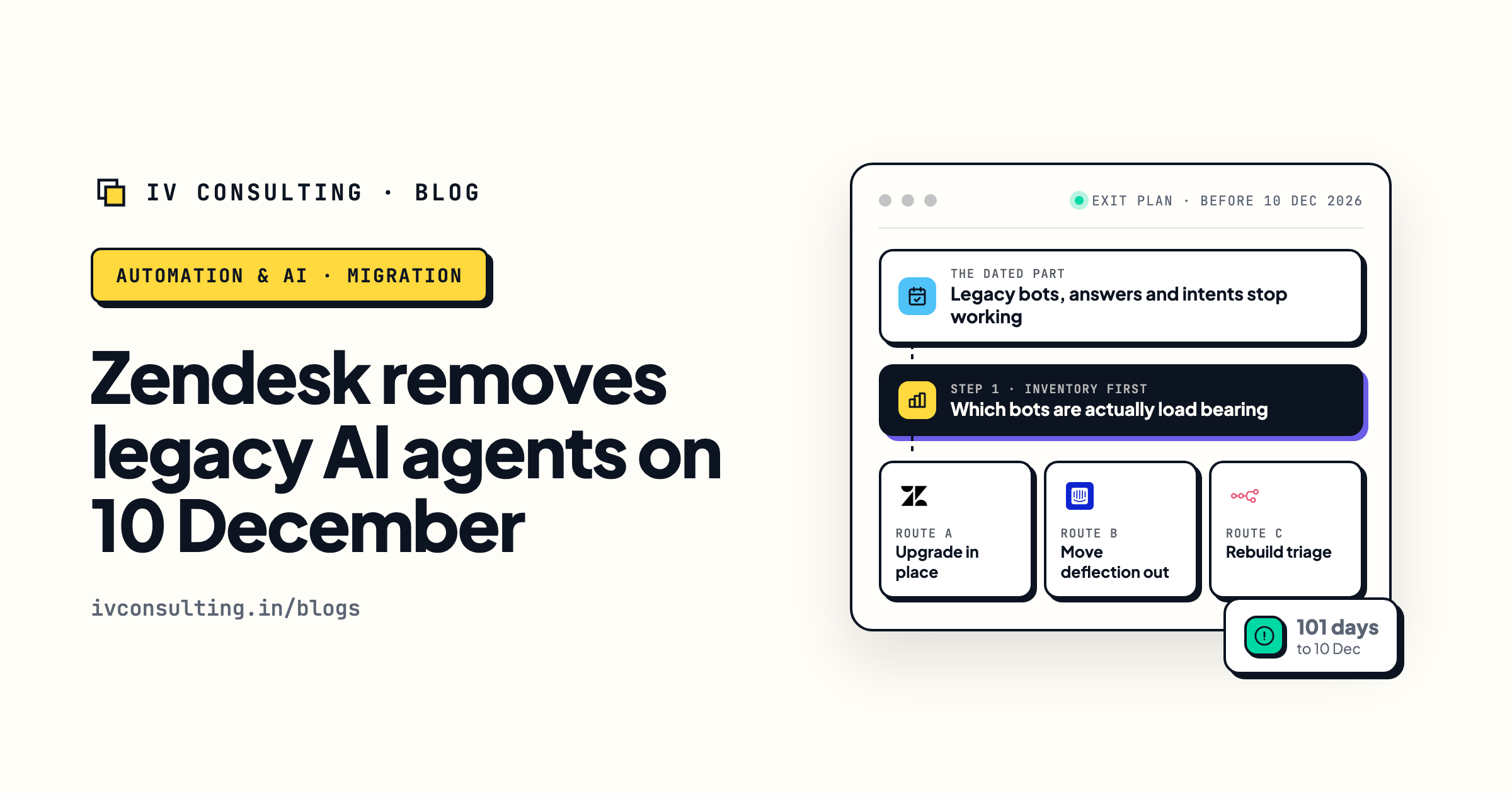
Zendesk legacy AI agents removal
What to rebuild when Zendesk retires its older AI agents.
Read the guide →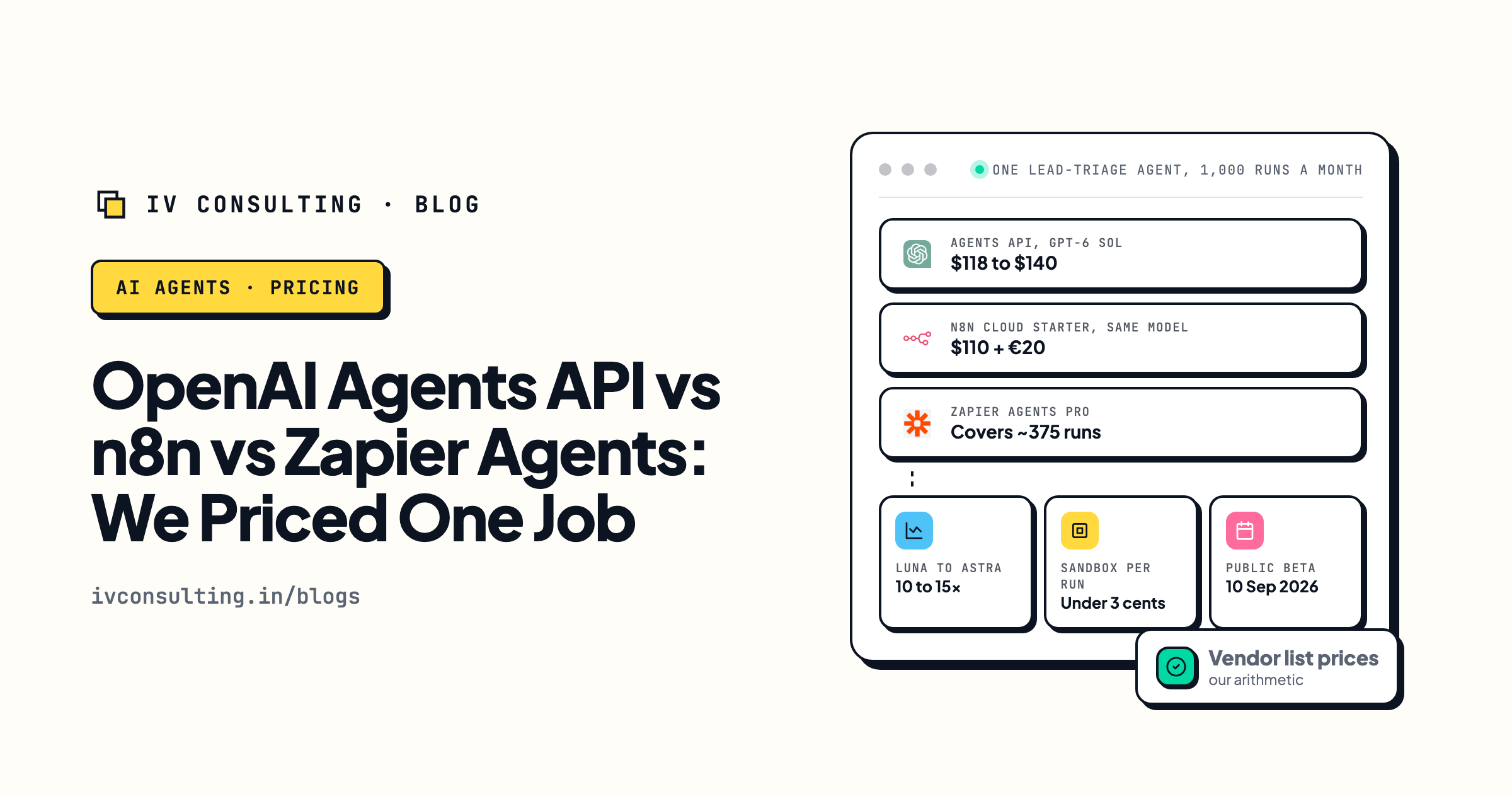
OpenAI Agents API vs n8n vs Zapier Agents
Build or buy an AI agent, priced for a small team.
Read the comparison →
AI Engineering
Production AI agents, including support agents, designed, built and handed over.
See the stage →Not sure whether to renew Fin, switch, or build?
Book a free 30-minute strategy call. We will look at your support volume, your resolution rate and your current terms, and tell you whether to lock in, pilot an alternative, or leave things alone. If you do not need us, we will say so.
Book a Free Strategy Call →Free 30-minute call. Honest take, even if that means "you do not need us yet."