Airtable was acquired by Bending Spoons, and the deal has closed. Do not migrate yet, do this instead.
On 4 August 2026 Bending Spoons signed a definitive agreement to buy Airtable, and on 4 September 2026 the deal closed. The reflex across ops teams was to start pricing an exit, because Bending Spoons is the company that bought Evernote and then capped its free plan at 50 notes. That reflex is right about the pattern and wrong about the timing. Bending Spoons owns Airtable now, but nothing in your account has changed, and at the best-documented precedent the first customer-facing change came eleven months after close. A panic migration costs you weeks to avoid a change nobody has announced. We went back through what Bending Spoons actually did to Evernote, WeTransfer and Vimeo, and when, and turned it into a watch-list you can act on instead.
 By Ishan Vats · Founder of IV Consulting · builds AI agents & automations for 150+ teams
 4 Sep 2026Deal closed, Bending Spoons owns it
Airtable was acquired by Bending Spoons in a deal announced on 4 August 2026 and completed on 4 September 2026, at an enterprise value of $1.285 billion and an equity value of about $2.25 billion. Do not migrate yet. Bending Spoons now owns Airtable, but as of 2 October 2026 nothing about your plans, limits or prices has changed. What is worth doing today is cheap and takes an hour: record the four numbers Bending Spoons has historically moved at the products it already owns, which are the free-tier limits, the per-seat price, the API call cap and the AI credit pool. At Evernote those changes did not arrive at close. The first staff cut came about seven weeks after close and the free plan was not capped until roughly eleven months after close. On that clock, a first staff cut would land around late October 2026 and a free-tier change around August 2027. That gap is your planning window, and it only helps if you write down the before.
The event
What did Bending Spoons actually buy, and has anything changed since the deal closed?
On 4 August 2026 Bending Spoons announced a definitive agreement to acquire Airtable in an all-cash transaction. It is the company's first acquisition since going public on 1 July 2026. Two valuation numbers went around that week and they are not in conflict, they are simply measuring different things, so it is worth being precise before anyone quotes them back at you in a planning meeting.
Bending Spoons' investor release puts the enterprise value at $1.285 billion and the equity value at approximately $2.25 billion, the difference being Airtable's net cash. The $2.3 billion figure that led Bloomberg's coverage is the rounded equity value. Both describe the same deal. For context on what is being bought, the same release reports Airtable's annual recurring revenue at approximately $480 million as of June 2026, growing over 20 percent year over year, across more than 500,000 organisations including 80 percent of the Fortune 100.
That is a healthy, growing business rather than a distressed one, which matters for how you read the risk. It is also a long way down from where Airtable sat at the top of the last cycle, when it was valued above $11 billion in 2021.
Bending Spoons completed the acquisition on 4 September 2026, one month after signing. Its CEO said the company plans to invest heavily in Airtable's product, customer support and go-to-market. Three weeks after close, Airtable's community team reported 15 product updates shipped in 15 days. Six days after close, Bending Spoons also agreed to buy Miro for $1.355 billion, and our Miro stay-or-move verdict applies the same playbook to whiteboards. We re-checked on 2 October 2026: Airtable's published plans, per-seat prices and usage limits are exactly what they were before the announcement. Ownership changed. Your account has not, yet.
The precedent
What does Bending Spoons usually do after a deal closes, and how fast?
The fear is not irrational. Bending Spoons owns AOL, Brightcove, Eventbrite, Evernote, Harvest, komoot, Remini, StreamYard, Vimeo and WeTransfer, and it has been open that acquiring mature software and running it more efficiently is the strategy, not a side effect. The useful question is not whether things change. It is when, because that is the difference between a panic and a plan.
So we put the reported public record on one timeline. What stands out is that nothing customer-facing moved at close. It moved in stages, and the free tier was last.
| Product | Deal announced | Closed | First reported staff cut | First customer-facing tightening |
|---|---|---|---|---|
| Evernote | Nov 2022 | 3 Jan 2023 | Feb 2023, 129 roles, about 7 weeks after close | 4 Dec 2023, free plan capped to 50 notes and 1 notebook, about 11 months after close |
| WeTransfer | 2024 | Jul 2024 | Reported after close | Reported stricter free-plan limits and price rises |
| Vimeo | Sep 2025, $1.38B | 2025 | Jan 2026, reported as almost all staff | Not documented in the sources we checked |
| Airtable | 4 Aug 2026, $1.285B EV | 4 Sep 2026 | None announced as of 2 Oct 2026 | None as of 2 Oct 2026 |
| Miro | 10 Sep 2026, $1.355B EV | Expected Q4 2026 | Not closed | Not closed |
Sources, read 27 August 2026 and re-checked 2 October 2026: Bending Spoons investor release, its completion release, the Miro agreement, TechCrunch on the 129 Evernote layoffs, Evernote's own move-to-Europe announcement, TechCrunch on the 50-note free plan cap, PetaPixel on the Vimeo layoffs. The WeTransfer and Vimeo rows are press reporting rather than company announcements.
Read the Evernote row again, because it is the one with the fullest public record. The acquisition completed on 3 January 2023. Layoffs of 129 staff were reported by TechCrunch in February 2023. On 5 July 2023 most of the remaining US and Chile based team was cut and operations were centralised in Europe, which Evernote announced itself. The free plan was not capped until December 2023, and when it was, the cap of 50 notes and one notebook applied to existing free users, not only new signups. A further restriction to one device landed in August 2024. Reported paid pricing moved as well, with the personal annual plan going from about $69.99 to $129.99.
Two honest caveats. Every product on that list is a consumer or prosumer tool, and Airtable is the first with a real enterprise book of business behind it, which is a genuine reason the pattern might not repeat identically. And the WeTransfer and Vimeo rows come from press reporting rather than company announcements, so we have described them as reported rather than stating them as company policy.
At the best-documented precedent, roughly eleven months passed between the deal closing and the free tier being cut. The Airtable deal closed on 4 September 2026, so that clock started running in September, which puts the comparable point around August 2027. You are not late. You have time to prepare properly, which is a much better position than the one the headlines are pushing you into. The same logic holds for support tools: when Salesforce bought Fin, the old Intercom, the product and prices were unchanged on the day it closed.
The watch-list
Which four Airtable numbers should you write down today?
Here is the practical problem with a quiet repricing: you usually cannot prove it happened. Vendors change a limits page and the old version is gone. If you did not record the before, you end up arguing from memory about whether the API cap was always that low.
So do the cheap thing now. These are the four levers Bending Spoons has historically moved elsewhere, with Airtable's current published values read from Airtable's own pricing page and plan documentation on 27 August 2026 and re-checked on 2 October 2026, after close. Copy this into your own notes and screenshot the source pages.
| Lever | Free | Team | Business |
|---|---|---|---|
| Price per seat, billed annually | $0 | $20 / user / month | $45 / user / month |
| Price per seat, billed monthly | $0 | $24 / user / month | $54 / user / month |
| Records per base | 1,000 | 50,000 | 125,000 |
| API calls per workspace per month | 1,000 | 100,000 | Unlimited |
| AI credits per month | 500 per editor | 15,000 per billable collaborator | 20,000 per paid user |
| Editor seats included | 5 with editor or creator rights | Billed per collaborator | Billed per collaborator |
Source: Airtable pricing and plan documentation, read 27 August 2026 and unchanged on 2 October 2026. Re-check them yourself: these are the exact numbers this post exists to help you notice changing.
Pay particular attention to the two that people forget. The API call cap is the one that silently breaks automations rather than the one that raises an invoice: if you run integrations against a Team workspace, 100,000 calls a month is your real ceiling, and a cut there takes your workflows down before anyone notices a billing change. The AI credit pool is the newest lever and therefore the easiest one to adjust without breaking a headline promise, which is exactly the pattern we have watched play out across Notion, ClickUp and Zapier this year as every vendor moved the billable unit from a predictable action to a variable AI-weighted credit.
Most teams pricing an Airtable exit compare seat cost to seat cost, which quietly assumes you need to rebuild the same thing somewhere else. Often you do not: the base is a queue, and the work is really an automation. Run your own numbers on that path first with our AI agent ROI calculator. It takes about two minutes and it tends to change which option you are even comparing.
The verdict
Our verdict: should you leave Airtable?
No. Not on this news, not on the close, and not this quarter. We will take a side rather than hedge, because "monitor the situation" is not advice.
Migrating a live Airtable base is not a data export, it is a re-plumbing job. The records move in an afternoon. What takes weeks is everything pointed at them: the automations, the API integrations, the forms your clients fill in, the interfaces your team actually uses, and the views someone built two years ago that a report silently depends on. Paying that cost now buys you protection against changes that have not been announced and that, on the Evernote clock, are most likely the better part of a year away.
There is also a real cost to moving early that nobody puts in the spreadsheet. Airtable is a growing $480 million ARR business, not a wind-down. The early signals since close point to investment, not extraction: a stated plan to invest in product and support, and a burst of shipped fixes. If you burn three weeks of ops capacity migrating this autumn and the first meaningful change lands next year, you did not de-risk anything, you just spent the budget early and inherited a new tool's problems.
So the verdict is become portable, do not move. Concretely, here is where we would draw the lines:
Stay, and do the drill
Your base is under the record limits, your automations are inside the API cap, and the seat count is stable. That is most teams. Do the one-hour drill in the next section and get on with your quarter.
Start planning if a lever moves
Set the threshold in advance so the decision is not emotional. Ours would be a per-seat rise above roughly 30 percent, any cut to the API cap on a plan you actually run automations on, or a records-per-base cut that lands under your current largest base.
Move now only in one case
You were already going to move. If Airtable was on the review list before 4 August, because you had outgrown the record limits or you were paying for seats that only read data, the acquisition is a reason to stop deferring the project. It is not the reason for the project.
The teams that will be hurt by this are not the ones that stayed. They are the ones sitting on a single production base with no export, no owner and no idea what depends on it. That is a problem you already had. The acquisition just gave you a deadline to fix it.
Do this next
How do you make yourself portable without migrating?
This is the whole job, and it is an hour of work once plus fifteen minutes a quarter. It is the same drill we run whenever a tool a client depends on gets acquired, deprecated or repriced, and it is why a tool actually shutting down is usually a calm week rather than a fire.
Export every base, this week
CSV per table at minimum, and separately note the schema: field types, relations, rollups and formulas, because those are what a CSV silently loses. Put the export somewhere that is not Airtable.
Record today's numbers and screenshot the source
The five rows in the table above, plus your own usage against each one. You are creating the evidence that a future change is a change.
Write down what depends on each base
Every automation, integration, form, interface and report. Most teams cannot answer this, and it is the single item that turns a two-week migration into a two-month one.
Kill the seats you are paying for by accident
Only collaborators with edit rights are billable, so read-only people should not be costing you anything. Audit this now and you may find the acquisition already saved you money.
Set the threshold, then stop thinking about it
Decide in advance what would make you move, write it in the same doc, and put a quarterly calendar reminder to re-check the four numbers, with an extra one for August 2027, eleven months after close. Then go back to work.
Step three is the one people skip and the one that matters most. A base is rarely just a base by the time it has been in production for a year, and the dependency map you write today is the thing that makes any future move a project with an estimate rather than an open-ended archaeology exercise.
If you do move
Where does an Airtable base actually land?
If a lever does move past your threshold, the destination depends on why the base exists. Diagnose that first, because most bad migrations are a team moving a database into a tool that is not one.
It is really a workspace
Documents, tasks and a database bolted on the side. Notion or ClickUp absorbs it, and you trade relational strength for everything living in one place. Our workspace comparison covers that decision properly, and if Notion is where it lands, our Notion consulting for small businesses is built for exactly this rebuild.
It is genuinely relational
Real relations, rollups and a schema you would defend. The self-hosted Airtable-alikes are the honest destination if the goal is to stop renting per seat, with NocoDB the most-starred at roughly 65,000 GitHub stars as of August 2026.
It is a queue with a spreadsheet on top
Rows arrive, something happens to them, they leave. This is the most common case we see and the one where another spreadsheet-database is the wrong answer. Put the records in a real database and keep the logic in n8n or Make.
| Destination | Fits a base that is | Relations and rollups | What you pay for | Our pick when |
|---|---|---|---|---|
| Notion or ClickUp | Docs and tasks with a table attached | Weaker, rollups survive, complex formulas often do not | Per seat, like Airtable | The team lives in the base every day and wants one workspace |
| NocoDB, self-hosted | A real relational schema | Closest like-for-like to Airtable | Your own hosting and upkeep, not seats | You have someone who will own a server, and seat count is the pain |
| A database plus n8n or Make | A queue that feeds automations | Full, in a real database | Hosting plus automation runs | Most rows are touched by workflows, not people. This is the most common case we see |
| Stay on Airtable | Anything that works today | Unchanged | Today's published price | No lever has crossed your threshold. Right now, this is the answer for most teams |
Whichever way it goes, do not move and redesign at the same time. Move like for like, get it stable, then improve. The teams that try to fix the schema during the migration are the ones still finding broken rollups a month later. If you want the export-first version of this playbook applied to a tool that genuinely is going away, we wrote it up when Notion Mail announced its shutdown. Coda teams faced the same stay-or-move question when Coda was renamed Superhuman Docs, and the answer there is the same: become portable first, then decide on evidence.
FAQ
Questions teams are asking about the Airtable acquisition
Has the Bending Spoons acquisition of Airtable closed?
Yes. Bending Spoons completed the acquisition of Airtable on 4 September 2026, one month after the definitive agreement was signed on 4 August 2026, according to Bending Spoons' own completion release. Six days later, on 10 September 2026, Bending Spoons also agreed to buy Miro at an enterprise value of $1.355 billion, expected to close in the fourth quarter of 2026. At Evernote, the best-documented precedent, the first staff cut came about seven weeks after close and the free plan was capped about eleven months after close, so for Airtable the comparable dates fall around late October 2026 and August 2027.
Has anything changed about Airtable since the Bending Spoons acquisition?
Not yet. Bending Spoons signed a definitive agreement on 4 August 2026 and completed the acquisition on 4 September 2026, so Bending Spoons now owns Airtable. As of 2 October 2026, Airtable's plans, per-seat prices, record limits, API caps and AI credit pools are exactly what they were before the announcement, and no layoffs have been announced. The visible change so far runs the other way: Airtable's community team reported shipping 15 product updates in the 15 days after close. Anyone telling you to migrate this week is reacting to a headline, not to a change in your account.
How much did Bending Spoons pay for Airtable?
Two numbers are circulating and they measure different things. Bending Spoons' investor release states an enterprise value of $1.285 billion. The same release puts the equity value at approximately $2.25 billion, which is the enterprise value plus Airtable's net cash. The $2.3 billion figure in Bloomberg's headline is the rounded equity value, not a different deal. For scale, Airtable's annual recurring revenue was approximately $480 million as of June 2026, growing over 20 percent year over year across more than 500,000 organisations.
What did Bending Spoons do to Evernote after it bought it?
It is the most documented precedent, and it ran on a schedule rather than all at once. Bending Spoons announced the Evernote acquisition in November 2022 and completed it on 3 January 2023. In February 2023 it laid off 129 Evernote staff, per TechCrunch. On 5 July 2023 it cut most of the remaining US and Chile based team and centralised operations in Europe. On 4 December 2023, roughly eleven months after close, it capped the free plan at 50 notes and one notebook and applied that cap to existing free users, not only to new signups. In August 2024 free accounts were further limited to one device at a time. Paid pricing moved too, with the personal annual plan reported going from about $69.99 to $129.99.
Should I migrate off Airtable right now?
No, not on this news alone. Migrating a live base is weeks of work and it breaks every automation, integration, form and view pointed at it, and you would be paying that cost to pre-empt changes that have not been announced, at a point where the best-documented precedent says they are still months away. The better move is to become portable rather than to move. Export now, keep the export current, record today's numbers, and set a threshold in advance. Then migrate if and when a lever actually crosses it, which is a decision made on evidence rather than on a press release.
Which Airtable numbers should I write down today?
Four, because those are the four that Bending Spoons has historically moved at other products. Per-seat price: Team is $20 per user per month billed annually and Business is $45. Records per base: 1,000 on Free, 50,000 on Team, 125,000 on Business. API calls per workspace per month: 1,000 on Free, 100,000 on Team, unlimited on Business. AI credits: 500 per editor on Free, 15,000 per billable collaborator on Team, 20,000 per paid user on Business. Those figures come from Airtable's own pricing and plan documentation, re-checked on 2 October 2026 and unchanged since the deal was announced. Screenshot the page as well as noting the numbers. A quiet change is only quiet if nobody wrote down the before.
Where does an Airtable base actually go if you do decide to leave?
It depends on why the base exists, and most teams get this wrong by picking a destination before diagnosing the source. If the base is really a document and task workspace with a database bolted on, Notion or ClickUp absorbs it and you accept weaker relational behaviour. If it is genuinely relational and the goal is to stop renting per seat, the self-hosted Airtable-alikes are the honest destination, and NocoDB is the most-starred of them at roughly 65,000 GitHub stars. If the base is mostly a queue that feeds automations, the cleanest answer is usually not another spreadsheet-database at all: put the records in a real database and keep the logic in n8n or Make.
That diagnosis decides whether an Airtable exit costs you a week or a quarter, and it is the wrong thing to guess at. Run the numbers on rebuilding it as an automation with our AI agent ROI calculator before you price a seat-for-seat move.
Ishan Vats
Founder, IV Consulting · AI & automation consultant
I rebuild the systems small teams run their operations on, which means I have moved a lot of bases, boards and workspaces between tools and watched what it actually costs. Most vendor panics do not deserve a migration. The ones that do are worth spotting early. 150+ ops transformations over 10+ years. Want to know which one yours is?
Run the AI agent ROI calculator →Keep reading
Related guides and work
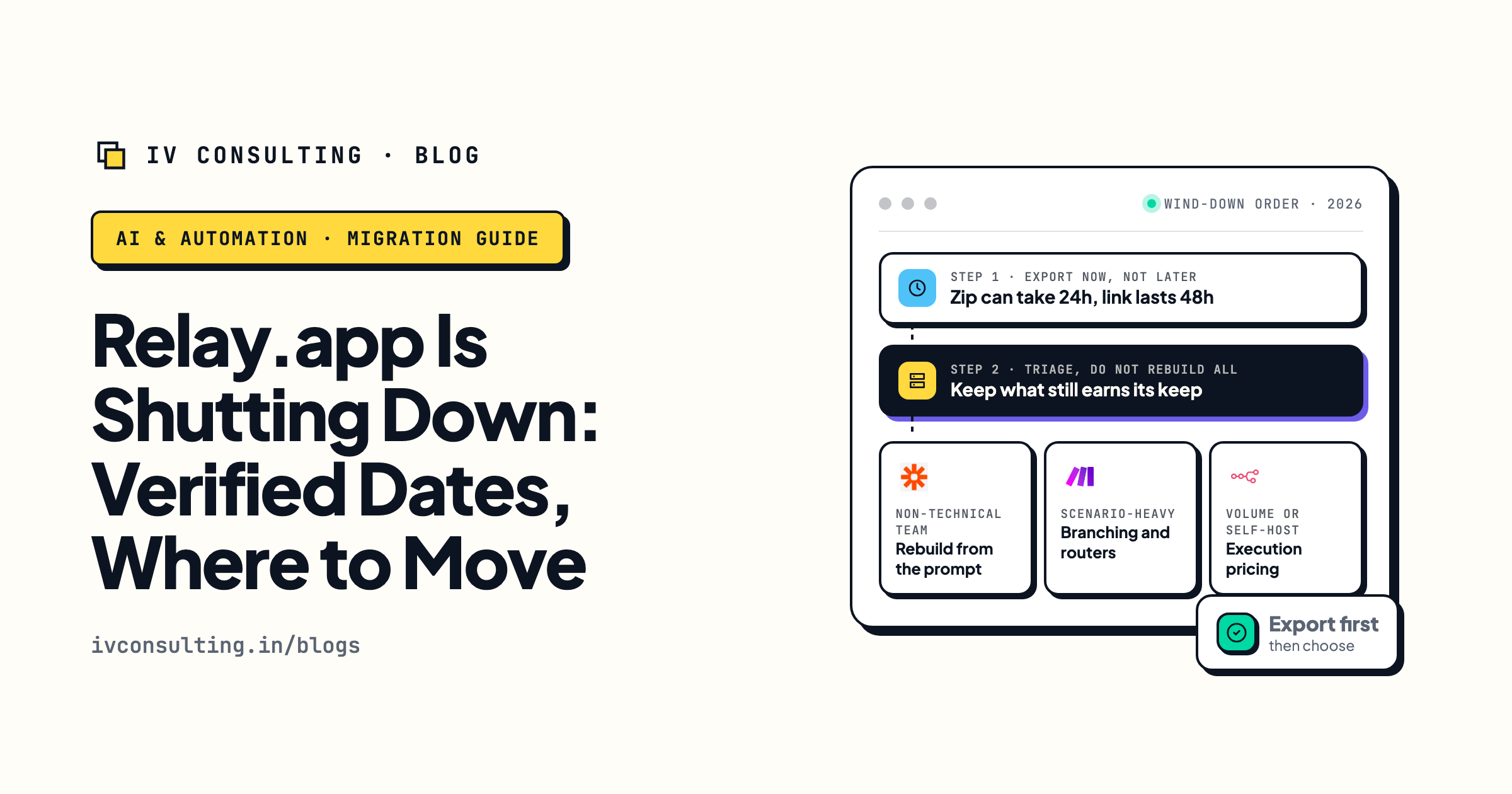
When a tool really is going away
The same drill, run for a product that actually announced a shutdown. What to export, what breaks, and where the workflows land.
Read the guide →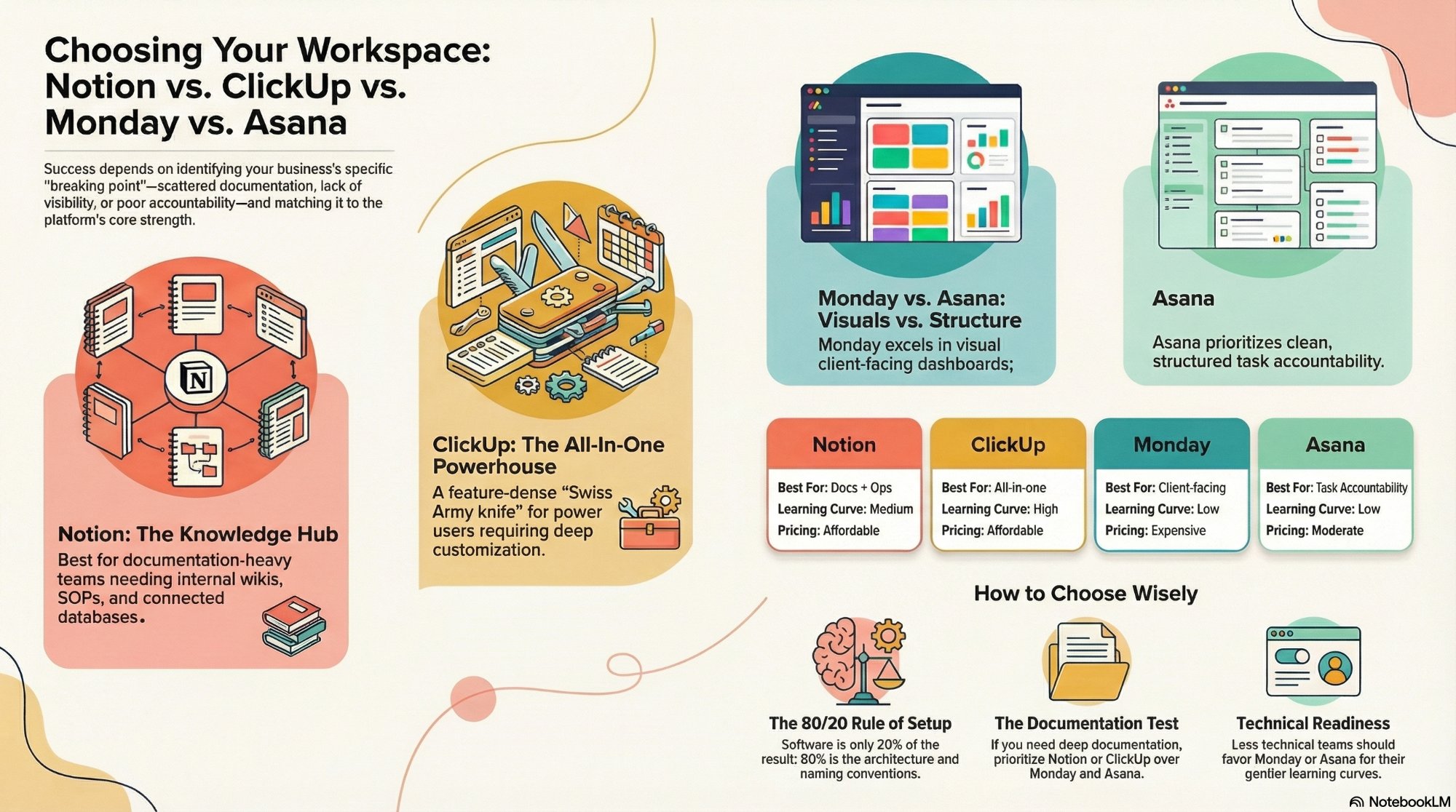
If the base is really a workspace
The head-to-head for teams whose Airtable base is documents and tasks wearing a database costume.
Read the comparison →
The Automation stage, built for you
If the base is a queue, the answer is usually a workflow. We build them in n8n and Make, and instrument them so you know when they stop.
See the offer →Want a second opinion before you move off Airtable?
Book a free 30-minute strategy call. We will look at what your bases actually do, what depends on them, and whether the honest answer is stay, become portable, or move. If your setup is fine as it is, we will tell you that and you will have lost half an hour.
Book a Free Strategy Call →Free 30-minute call. Honest take, even if that means "stay where you are and do nothing."