Miro is being acquired by Bending Spoons. Should you move your boards? Our verdict.
On 10 September 2026 Bending Spoons agreed to buy Miro for $1.355 billion, five weeks after it signed for Airtable. If your team runs workshops, process maps or sprint retros on Miro boards, you are asking the same question Airtable teams asked in August: stay, or start moving? Our answer splits your team in two. If Miro is where your workshops happen, stay and make the boards portable. If it is where three people draw a diagram once a month, you were overpaying before the deal, and you should fold it into the ClickUp or Figma seats you already pay for. Below are the dated precedent, today's Miro numbers to screenshot, and what a 10-person team pays on each alternative.
 By Ishan Vats · Founder of IV Consulting · builds AI agents & automations for 150+ teams
 FigJam$3 Collab seat on Figma Professional
 ClickUp WhiteboardsInside seats you may already pay for
 NotionNo canvas, diagrams only
Miro is being acquired by Bending Spoons, which signed a definitive agreement on 10 September 2026 at an enterprise value of $1.355 billion, about $1.79 billion in equity value. The deal is expected to close in the fourth quarter of 2026, and until then Miro operates independently, so nothing about your plan, price or boards has changed. Our verdict: do not migrate workshop-heavy boards on this news. Make them portable instead, by turning on board backups and exporting the frames that matter. The exception is teams that only use Miro for occasional diagrams. Ten Miro Business seats cost $2,400 a year at list price, while ClickUp Whiteboards come inside ClickUp seats and a FigJam Collab seat on Figma Professional is listed at $3 a month. If your boards are light, that is a reason to move now, acquisition or not.
The event
Is Miro being acquired by Bending Spoons, and has the deal closed?
Yes, it is being acquired, and no, it has not closed. On 10 September 2026 Bending Spoons announced a definitive agreement to buy Miro in an all-cash deal at an enterprise value of $1.355 billion. Including Miro's net cash, that implies an equity value of approximately $1.79 billion. Some Miro shareholders are reinvesting $295 million of their proceeds into new Bending Spoons equity. Both boards approved it unanimously, and the companies expect it to close in the fourth quarter of 2026, subject to regulatory approvals.
The same release describes what is being bought: roughly $600 million in annual recurring revenue, nearly 90 percent of it from business and enterprise customers, nearly 4 million paying users, and more than 750 customers paying over $100,000 a year. For scale, Miro was valued at $17.5 billion in its 2022 funding round. That is a healthy business sold at a steep markdown, which is exactly the profile Bending Spoons buys.
Miro's CEO told staff in his note on the deal that nothing changes in how Miro operates until closing. We re-checked Miro's pricing page on 8 October 2026: Starter is $8 and Business is $20 per member per month billed yearly, and the Free plan still keeps three editable boards. We found no report of a regulatory decision or a close. Until there is one, Bending Spoons cannot change your account even if it wanted to.
The precedent
What does Bending Spoons usually do after it buys a tool like Miro?
Bending Spoons owns Evernote, WeTransfer, Vimeo, Eventbrite, Harvest and, since 4 September 2026, Airtable. It has never hidden the strategy: buy mature software and run it far more efficiently. The useful question is not whether Miro changes. It is when, because that decides whether you plan or panic.
| Product | Deal announced | Closed | First reported staff cut | First customer-facing tightening |
|---|---|---|---|---|
| Evernote | Nov 2022 | 3 Jan 2023 | Feb 2023, 129 roles, about 7 weeks after close | 4 Dec 2023, free plan capped to 50 notes and 1 notebook, about 11 months after close |
| WeTransfer | 2024 | Jul 2024 | Reported after close | Reported stricter free-plan limits and price rises |
| Vimeo | Sep 2025, $1.38B | 2025 | Jan 2026, reported as almost all staff | Not documented in the sources we checked |
| Airtable | 4 Aug 2026, $1.285B EV | 4 Sep 2026 | None announced as of 2 Oct 2026 | None as of 2 Oct 2026 |
| Miro | 10 Sep 2026, $1.355B EV | Expected Q4 2026 | Not closed | Not closed |
Sources, read 8 October 2026: the Miro agreement, the Airtable completion release, TechCrunch on the 129 Evernote layoffs, TechCrunch on the 50-note cap, PetaPixel on Vimeo. The Airtable row is from our own re-check in our Airtable acquisition verdict. WeTransfer and Vimeo rows are press reporting, not company announcements.
Read the Evernote row twice. Nothing customer-facing moved at close. Staff went first, about seven weeks in. The free plan was capped about eleven months after close, and the cap applied to existing free users, not only new signups. If Miro closes in December 2026, the same clock puts a comparable free-tier change around late 2027.
Miro has a big free and Starter user base sitting under a business book, and the free plan is already the tightest lever it has: three editable boards, with older boards going read-only. That is the lever Bending Spoons pulled first at Evernote. If you run anything real on a free Miro account, you are the most exposed user in this deal.
The watch-list
Which Miro numbers should you screenshot before the deal closes?
A quiet repricing is only quiet if nobody wrote down the before. These are Miro's current published values, read from miro.com/pricing on 8 October 2026. Copy them into your own notes and screenshot the page.
| Lever | Free | Starter | Business | Enterprise |
|---|---|---|---|---|
| Price per member, billed yearly | $0 | $8 / month | $20 / month | Custom, from 30 members |
| Monthly billing | n/a | Miro says yearly saves 20 percent versus monthly | Custom | |
| Editable boards | 3, only the most recent stay editable | Unlimited | Unlimited | Unlimited |
| Export quality | Low resolution only | High-res JPG and PDF of frames | As Starter | As Business |
| Manual board backup and board history | Not included | Included | Included | Included |
Source: Miro pricing page, read 8 October 2026. AI credit allowances vary across third-party write-ups, so we have left them out rather than print a number we could not confirm at source. Record your own from inside your account.
On the Free plan you cannot do the one thing this whole post recommends. Board backup and board history start on Starter, and Free exports are low resolution. So a team running real work on free Miro boards has no clean way to become portable without paying first. If that is you, either upgrade one owner seat for a month to take backups, or move the boards now while Miro is still independent. Waiting is the worst of the three options.
The comparison
Miro vs FigJam vs ClickUp Whiteboards vs Notion: what does a 10-person team pay?
For a 10-person team at list price, billed yearly, Miro Business costs $2,400 a year, Miro Starter $960, FigJam about $360, and ClickUp Whiteboards nothing extra if you already pay for ClickUp. Notion has no native whiteboard at all.
Most teams price a whiteboard move seat for seat. The better question is what you already pay for. Here is the yearly cost for a 10-person team at list price, billed annually, using each vendor's own pricing page read on 8 October 2026. This is our arithmetic on published prices, not client invoice data.
| Option | Published price | 10 seats, per year | Real canvas? | Best for |
|---|---|---|---|---|
| Miro Business | $20 / member / month, yearly | $2,400 | Yes, the deepest | Facilitated workshops, big templates, external guests |
| Miro Starter | $8 / member / month, yearly | $960 | Yes | Small teams with steady board use |
| FigJam (Figma Professional, Collab seat) | $3 / month per Collab seat | $360 | Yes | Teams already designing in Figma |
| ClickUp Whiteboards | Included in ClickUp plans; Unlimited is $7 and Business $12 / user / month, yearly | $0 extra if you are on ClickUp, $840 on Unlimited if not | Yes, lighter | Ops teams whose boards turn into tasks |
| Notion | No native whiteboard | $0 extra, but no canvas | No | Diagrams that are really documentation |
Sources: Miro pricing, Figma pricing, ClickUp pricing, all read 8 October 2026. ClickUp's lower plans cap how many whiteboards you can create, so check the limit on your plan before you move a library of boards.
Two things jump out. First, the gap between Miro Business and an option you already own is the entire $2,400. For a team whose boards are a handful of process maps, that money was buying nothing the acquisition can take away. Second, Notion is not a destination for a whiteboard. It is a destination for the output of one. If you are mid-way through rethinking your Notion setup, do not add "replace Miro" to that project.
The verdict
Our verdict: should you leave Miro after the Bending Spoons deal?
Stay on Miro if your team runs workshops on it every week; move now if it only holds occasional diagrams and you already pay for ClickUp or Figma. It depends on one thing, and we will take a side on both branches rather than say "monitor the situation". How much of your work actually happens on the canvas?
Workshop-heavy: stay, become portable
You run facilitated sessions, client workshops or retros on Miro every week, with templates and guests. Nothing else in the table matches Miro there, and the deal has not even closed. Turn on backups, export your key frames, and get on with your quarter.
Set the trigger now, not later
Decide in advance what would make you move. Ours: a per-member price rise above roughly 25 percent, board backup or board history moving off Starter, or a cut to the Free plan's editable boards if your guests depend on it. Write the trigger down so the decision is not emotional.
Light use: move now, deal or no deal
If Miro holds a few diagrams a month and you already pay for ClickUp or Figma, you were paying for a second canvas before Bending Spoons showed up. The acquisition is not the reason to move. It is the reminder. Move the boards to the canvas inside a tool you already pay for.
This is a sharper answer than our Airtable verdict, where we said do not move at all. The difference is switching cost. Moving a live Airtable base means re-plumbing automations, forms and integrations. Moving a whiteboard usually means rebuilding a few diagrams and accepting that old sticky notes stay as a PDF. Cheap moves deserve a lower bar.
Do this next
How do you make your Miro boards portable before Bending Spoons takes over?
An hour once, fifteen minutes a quarter. It is the same drill we run when any tool a client depends on is acquired, renamed or repriced, the way Coda teams faced it when Coda became Superhuman Docs.
Inventory your boards and sort them three ways
Living workshop boards you will keep using, reference diagrams that are really documentation, and dead boards nobody has opened this year. Most teams find the third pile is the biggest.
Back up the living boards
On Starter and above, take a manual board backup of each living board and store it outside Miro. A backup restores into Miro, so it protects your work against account changes, not against leaving.
Export the frames that carry decisions
High-resolution PDF or JPG of the frames people actually reference: the process map, the org chart, the retro outcome. Those PDFs go in your docs tool, next to the work they explain.
Pull the action items out of the canvas
A sticky note is not a task. If workshop output lives only on a board, it is already lost. Move it into ClickUp or your project tool now. Miro's own ClickUp integration can convert a board object into a ClickUp task, one at a time.
Record today's numbers and set the trigger
The rows in the watch-list table, plus your seat count. Add a calendar reminder for the close and another for eleven months after it, the Evernote clock.
Step four is where the real cost hides. If someone on your team spends hours every week copying workshop output from a board into tasks, the cheapest fix is not a new whiteboard, it is automating that hand-off. Run that number with our AI agent ROI calculator. It takes about two minutes and it often changes which option you are comparing.
If you do move
Where does a Miro board actually land: FigJam, ClickUp or Notion?
Diagnose why the board exists before you pick a destination. Most bad migrations put a canvas into a tool that is not one.
FigJam, if design lives in Figma
The closest like-for-like canvas, and the cheapest one per seat at a listed $3 Collab seat on Figma Professional. It makes most sense when your product or design team already lives in Figma, so the board sits next to the work.
ClickUp Whiteboards, if boards become tasks
The right home for ops teams whose boards are sprint plans and process maps. The canvas is lighter than Miro's, but objects can become tasks in the same workspace. If you are already moving your project work into ClickUp, fold the boards into the same project.
Notion, only for diagrams that are docs
Notion has no native infinite canvas. It can embed a Miro board and render Mermaid diagrams from a code block. That is enough for an architecture diagram inside a wiki page, and not enough for a workshop. Use it for the output, not the session.
Whichever you choose, move like for like first and redesign later. And if you are still choosing your core workspace, settle that before the boards: our Notion vs ClickUp vs monday vs Asana comparison covers that decision. If ClickUp wins, our ClickUp implementation team builds the workspace and the whiteboard templates with it.
FAQ
Questions teams are asking about the Miro acquisition
Has the Bending Spoons acquisition of Miro closed?
No. Bending Spoons signed a definitive agreement to acquire Miro on 10 September 2026 at an enterprise value of $1.355 billion, about $1.79 billion in equity value, and expects the deal to close in the fourth quarter of 2026, subject to regulatory approvals. As of 8 October 2026 we found no report of a close. Until it closes, Miro operates independently, and its CEO told staff that nothing changes in how Miro operates before then.
Has anything changed about Miro pricing since the acquisition was announced?
Not as of 8 October 2026. Miro's pricing page still lists Starter at $8 and Business at $20 per member per month billed yearly, Enterprise as custom pricing from 30 members, and a Free plan that keeps three editable boards. Board backup and board history are included from Starter upward. Screenshot that page now, so you can prove a change if one comes.
What did Bending Spoons do to Evernote after buying it?
It changed things in stages, not at close. The Evernote deal closed on 3 January 2023. TechCrunch reported 129 layoffs in February 2023, about seven weeks later. On 4 December 2023, roughly eleven months after close, the free plan was capped at 50 notes and one notebook, and the cap applied to existing free users too. That is the best-documented precedent for how long a Miro team has before customer-facing changes.
Should I migrate off Miro right now?
Only if you use it lightly. If Miro holds a few diagrams a month and you already pay for ClickUp or Figma, move now, because ten Miro Business seats cost $2,400 a year at list price and ClickUp Whiteboards come inside ClickUp plans. If your team runs workshops on Miro every week, do not migrate on this news. Take board backups, export the frames that matter, record today's prices and set a trigger for moving.
What is the cheapest alternative to Miro for a small team?
The one you already pay for. ClickUp Whiteboards cost nothing extra on a ClickUp plan, though lower plans cap the number of whiteboards. FigJam is listed at $3 a month per Collab seat on Figma Professional, about $360 a year for ten people. Notion has no native whiteboard, so it suits diagrams that are really documentation, using embeds or Mermaid code blocks, not live workshops.
Can I move Miro boards into ClickUp or Notion?
Not as a one-click import. Export the frames you need as high-resolution PDF or JPG, which requires Starter or above, and rebuild the living diagrams in the new canvas. Miro's own ClickUp integration can convert a board object into a ClickUp task one at a time, which is the useful part: pull the action items out of the board first. Notion can embed a Miro board, but that keeps Miro as the source.
Ishan Vats
Founder, IV Consulting · AI & automation consultant
I rebuild the systems small teams run their operations on, which means I have moved a lot of bases, boards and workspaces between tools and watched what it actually costs. Most vendor panics do not deserve a migration. The ones that do are worth spotting early. 150+ ops transformations over 10+ years.
Run the AI agent ROI calculator →Keep reading
Related guides and work
Bending Spoons bought Airtable too
The deal that closed first, the four Airtable numbers to record, and why we said do not migrate yet.
Read the verdict →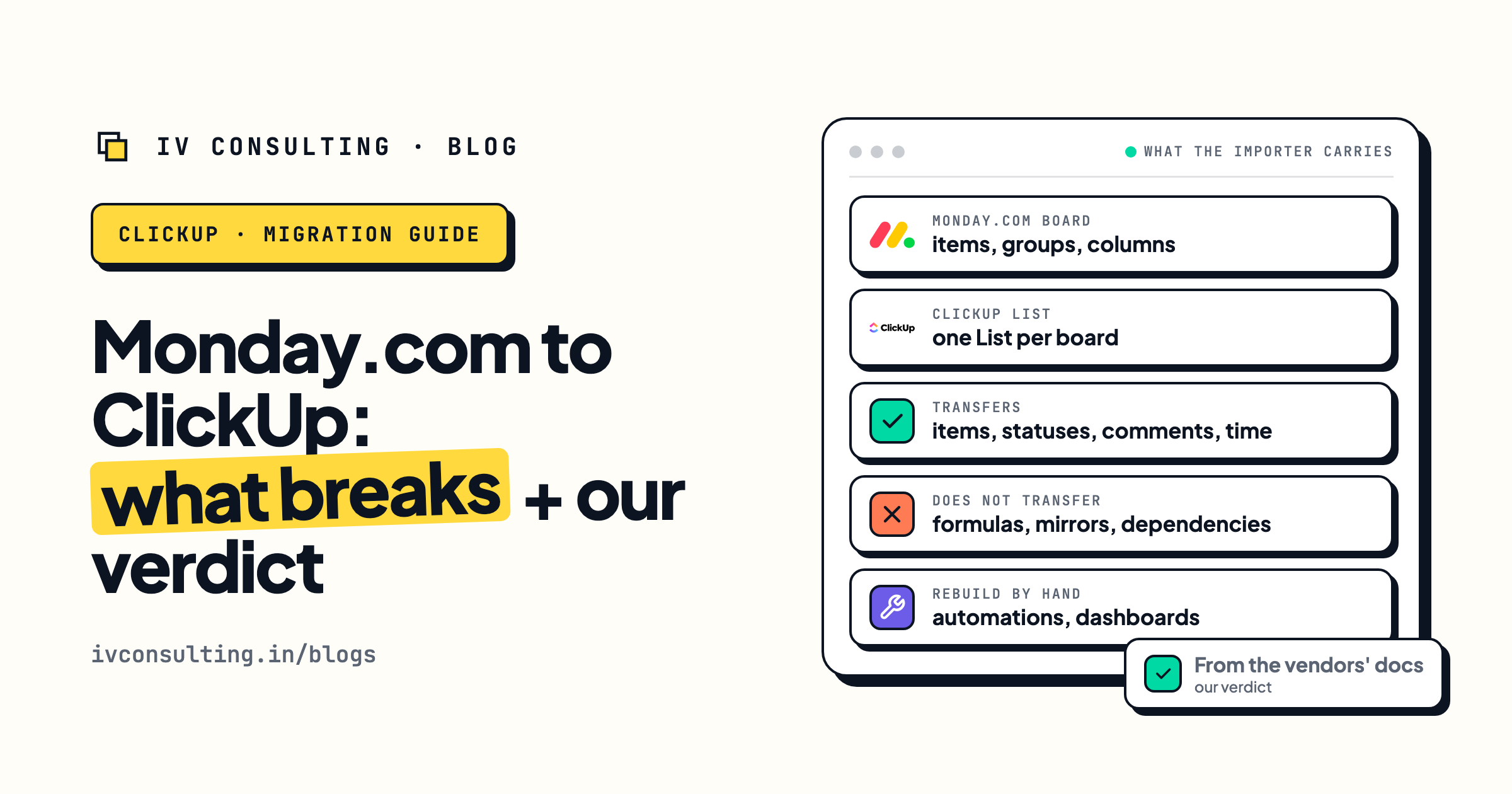
Moving your project work into ClickUp
What actually transfers when a team moves into ClickUp, and what you rebuild by hand.
Read the guide →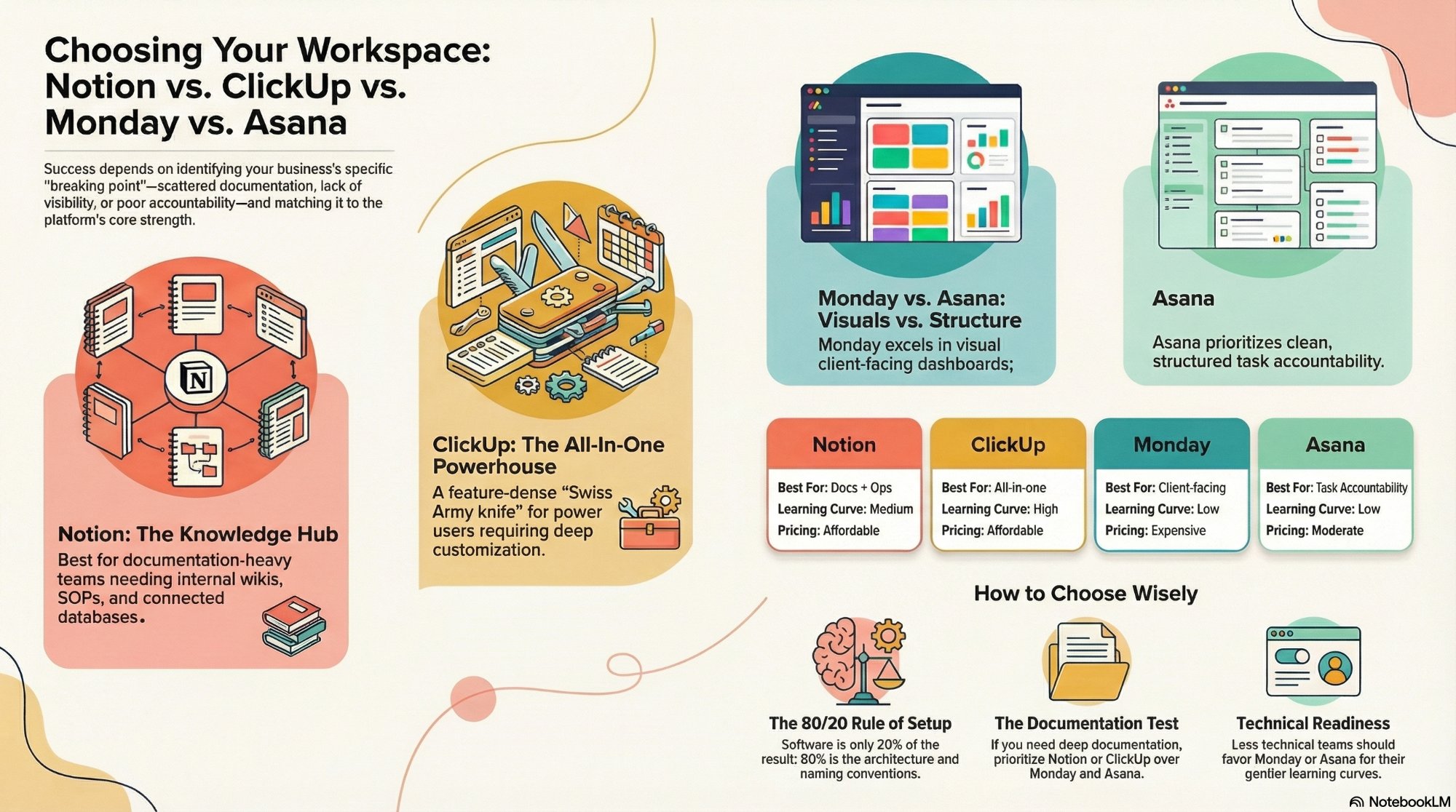
Pick the workspace before the board
The head-to-head for small teams deciding where their operations should live.
Read the comparison →Want a second opinion before you move off Miro?
Book a free 30-minute strategy call. We will look at what your boards actually do, what depends on them, and whether the honest answer is stay, become portable, or fold them into a tool you already pay for.
Book a Free Strategy Call →Free 30-minute call. Honest take, even if that means "stay where you are."