Coda is now Superhuman Docs. Stay put, unless one of three things is true.
On 8 July 2026 Coda was relaunched as Superhuman Docs. The reflex in ops teams was to start shopping for an exit, because the company behind it has changed its name, its owner or its product line five times in nineteen months. We put those five moves on one dated timeline, checked what the rename actually touched, and landed on a clear verdict: your docs, Packs and price did not change, so stay, and leave only in the three cases below.
 By Ishan Vats · Founder of IV Consulting · builds AI agents & automations for 150+ teams
 Doc-ledConsolidate in Notion
 PipelineRebuild in n8n
Coda is now called Superhuman Docs: the same product under a new name, not a shutdown. Superhuman, the company formerly named Grammarly that bought Coda, relaunched it under the new name on 8 July 2026. Your docs, tables, Packs, automations and formulas carried over and keep working, and Superhuman told existing customers their pricing is not changing and Maker Billing stays.
So our verdict is to stay. Leave only if one of three things is true: you are about to change plan or join the Superhuman bundle, which is the point your grandfathered price stops protecting you; your Coda doc is really a wiki and you already pay for Notion; or your doc is a data pipeline that belongs in a database and an automation tool rather than in any doc app. Whatever you decide, export every table to CSV this week.
The event
What actually changed when Coda became Superhuman Docs?
Less than the headlines suggest. On 8 July 2026 Superhuman announced that Coda is now Superhuman Docs: a new name, a new URL and a new visual identity, positioned as one product in a suite with Superhuman Mail, Go, Calendar and Grammarly. Every existing Coda doc converted automatically. There is no shutdown date and no export deadline.
The part that matters for your budget is one sentence in that launch post. Superhuman told existing customers their pricing is not changing, that everything launched that day is included in their plan, and that Maker Billing remains. Maker Billing is the Coda model where you pay only for the people who create docs, while editors and viewers are free. That is still how you are billed.
| Area | Changed | Unchanged |
|---|---|---|
| Brand and URL | Now Superhuman Docs. We checked on 14 September 2026 that coda.io/pricing redirects to superhuman.com/plans/docs | Old links redirect, existing docs converted automatically |
| Your docs | New look | Docs, tables, Packs, automations and formulas keep working |
| Existing pricing | Nothing, unless you change plan or join the bundle | Current plan price and Maker Billing stay |
| AI | New: Docs AI assistant, Docs MCP for Claude, ChatGPT and Cursor, AI Views in closed beta | Included in existing plans |
| Data at scale | New: Table Pages, and Superhuman Databases in closed beta, pitched at up to a million rows | Existing tables untouched |
Source: Superhuman's launch post, read 14 September 2026, plus our own check of the coda.io redirect the same day.
The Superhuman Docs plans page lists the rates for new plans. We could not read those figures on Superhuman's own pages on 14 September 2026, so we are not repeating anyone else's version of them. If you are on a grandfathered Coda plan, the only price that matters to you is the one on your current invoice, and it has not moved. Read the plans page yourself before you change anything.
The precedent
Who owns Coda now? Five moves from Grammarly to Superhuman
Because the rename is the fifth corporate move around Coda in nineteen months, and we had not seen them in one place. Coda is owned by Superhuman, the company formerly called Grammarly; Grammarly the writing tool still exists as one product in the Superhuman suite. So we put all five moves in one table. Read the table top to bottom and the pattern is a company assembling a suite, not a company winding a product down.
| Date | What happened | What it meant for Coda users |
|---|---|---|
| 17 December 2024 | Grammarly announces it will acquire Coda; Coda co-founder Shishir Mehrotra becomes Grammarly CEO | Coda becomes part of a much larger company. No product change. |
| 1 July 2025 | Grammarly acquires Superhuman, the email client | Signals the suite strategy Coda is now sold inside. |
| 29 October 2025 | Grammarly renames the whole company Superhuman and launches the Superhuman suite | Coda is packaged alongside Grammarly, Mail and Go. |
| February 2026 | Superhuman agrees to acquire Rows, the AI spreadsheet, and sets Rows to be discontinued by 31 May 2026 | The one precedent worth noticing: an acquired standalone product was folded in and switched off. |
| 8 July 2026 | Coda is relaunched as Superhuman Docs | New name, URL and look. Features kept, existing pricing kept, new AI added. |
Sources, all read 14 September 2026: Grammarly on acquiring Coda, TechCrunch on the Superhuman acquisition, Grammarly's rebrand announcement, Superhuman on acquiring Rows, Superhuman Docs launch.
The row to read twice is February 2026. When Superhuman bought Rows, the AI spreadsheet, it set the Rows product to be discontinued by 31 May 2026 and pulled the technology into Coda. That is exactly the outcome people fear for Coda, and it happened to a sibling. But notice which way the arrow points. Rows was absorbed into Coda. Coda was not absorbed into anything. It was relaunched with a new AI assistant, an MCP connector and new database infrastructure, which is what a company does with the product it is building the suite around.
The risk is real but it is pointed at small acquired side products, not at the flagship. Coda is now the flagship doc product in a four-product suite. That does not guarantee your plan forever, but it makes a panic migration this quarter very hard to justify.
The verdict
Our verdict: should you leave Coda now that it is Superhuman Docs?
No. For most teams the right move is to stay. We will take a side rather than tell you to monitor the situation, and here is the reasoning.
Nothing you pay for moved. Same docs, same Packs, same grandfathered price, same Maker Billing. A migration is a large cost you would be paying to escape a change that did not happen.
Coda docs are the hardest workspace to move. A Notion page is mostly content. A mature Coda doc is content plus logic: formula columns, buttons that write to other tables, Packs syncing outside systems, automations firing on row changes. The content leaves in an afternoon. The logic has to be rebuilt by hand, and that is where the weeks go.
The rename made the product more useful to an AI-heavy team, not less. Docs MCP means the agents you already run in Claude or ChatGPT can work against your docs directly. If your team is heading that way, you would be leaving just as the thing you use got a feature you want.
So the verdict is stay, and become portable. Leave only if one of these three is true:
1. You are about to change plan
Upgrading, downgrading or connecting to the Superhuman bundle is the moment the grandfathered price stops protecting you. Price the new plan against the alternatives before you click, not after.
2. It is a wiki and you already pay for Notion
If the doc is mostly pages with light tables and your company runs Notion anyway, moving is consolidation, one fewer bill and one fewer place to search. That is a good reason. The rename is not.
3. It was never really a doc
If the doc exists to sync data between other systems through Packs and buttons, it is a pipeline wearing a doc costume. That belongs in a real database with the logic in n8n or Make, whoever owns Coda. The rename is just a good prompt to fix something you already had.
The teams that get hurt by vendor churn are rarely the ones who stayed. They are the ones with one production doc, no export and no idea what depends on it. That is fixable in an hour, and it is the next section.
Do this next
How do you export a Coda doc and stay portable?
This is the same drill we laid out when Bending Spoons agreed to buy Airtable, and it is why a vendor headline is usually a calm week rather than a fire. One hour now, fifteen minutes a quarter.
Export every table to CSV
Each table has a three-dot menu with Download as CSV. Do it for every table in every production doc and store the files somewhere that is not Superhuman Docs.
Export the pages as PDF
Whole docs or single pages export to PDF, which preserves the canvas content your team reads. There is no native Markdown export, so if you want Markdown or Excel, use an export Pack or the API.
Write down the logic, because CSV loses it
List every formula column, button action, cross-table lookup, automation rule and Pack sync. This is the item that turns a two-day move into a two-month one, and almost nobody has it written down.
Screenshot your plan and your Doc Maker count
Your grandfathered price is only protected if you can show what it was. Record the plan name, the price on your invoice and who counts as a Doc Maker today.
Set your leave trigger in advance
Ours would be any notice that moves a grandfathered plan to new pricing, a Pack you depend on being retired, or an export route being removed. Write it in the same doc and put a quarterly reminder in the calendar.
If you do leave
Coda alternatives: where does a Coda doc land if you move?
Diagnose the doc before you pick the destination. Most bad Coda migrations are a team moving a relational app into a note-taking tool, or a pipeline into a spreadsheet, because they picked the tool first.
| What your Coda doc really is | Where it lands | What moves cleanly | What you rebuild by hand |
|---|---|---|---|
| A wiki, pages with light tables | Notion | Pages by copy-paste or PDF, tables by CSV import into Notion databases | Relations between tables, formula columns in Notion's formula language |
| A project tracker, tasks, owners, statuses | ClickUp or Notion | Tasks and fields by CSV | Views, automations, status logic |
| A relational app, many linked tables and rollups | A database-first tool, with care | Tables by CSV | Every relation, lookup and interface |
| A pipeline, Packs syncing other systems, buttons pushing data | A real database plus n8n or Make | The data | All of the logic. This is a rebuild, not a migration |
Two honest notes on that table. First, the obvious destination for relational Coda docs is Airtable, and Airtable is, as of 14 September 2026, itself in the middle of a pending acquisition. Moving from one tool with an ownership change to another with a pending one is not de-risking. Second, we are certified Notion consultants and we build Notion workspaces for a living, so weigh our Notion row accordingly. We have not run a Coda migration for a client, and nothing in this post claims one. The "what you rebuild" column comes from how the two products work, not from a case study.
If Notion is where the doc is heading, the question most teams skip is the AI bill. Superhuman Docs includes Docs AI in the plan you already have. In Notion, the full AI sits on the Business plan at $20 per member per month, and Custom Agents are billed on top in credits at $10 per 1,000 (per Notion's pricing page, read 14 September 2026), so a like-for-like move can quietly cost more than staying. Our Notion vs ClickUp comparison covers the workspace decision itself.
Moving off Superhuman Docs only makes sense if the destination is cheaper or clearly better for how your team works, and the AI line is where that comparison usually flips. Put your team size and usage into our Notion AI credit calculator. It takes about two minutes and tells you what the Notion side of the comparison really costs.
Whichever way it goes, do not move and redesign at the same time. Move like for like, get it stable, then improve. And if the doc turns out to be a pipeline, the fix is the single source of truth it should have had from the start.
FAQ
Questions Coda teams are asking about Superhuman Docs
Is Coda shutting down now that it is Superhuman Docs?
No, Coda is not shutting down. It was renamed Superhuman Docs, not retired. On 8 July 2026 Superhuman relaunched Coda as Superhuman Docs with a new name, URL and visual design, and your existing docs, tables, Packs, automations and formulas carried over automatically. No shutdown date and no export deadline has been announced. The company did shut a product down after an acquisition earlier in 2026, but that was Rows, the AI spreadsheet it bought in February and set to discontinue by 31 May 2026. Coda got the opposite treatment: new AI features and new data infrastructure.
Did Coda pricing change when it became Superhuman Docs?
No, Coda pricing did not change for existing customers who stay on their current plan. Superhuman's launch post told existing Coda customers that their pricing is not changing, that the new features are included in their plan, and that Maker Billing stays, so you still pay only for Doc Makers while editors and viewers are free. What can change your bill is a change you make: moving to a different plan or connecting your workspace to the wider Superhuman bundle. The public Superhuman Docs plans page lists the current rates for new plans. We could not read those figures at source on 14 September 2026, so check superhuman.com/plans/docs before you touch your plan.
Do my Coda Packs, formulas and automations still work in Superhuman Docs?
Yes, Coda Packs, formulas and automations still work in Superhuman Docs. Superhuman states that docs, tables, Packs, automations and formulas keep working as before. The rename changed the brand and the URL, not the product engine. The practical thing to check is anything outside the doc that points at it by old URL or name, such as a bookmark, an embed in another tool, or an integration someone configured with a hard-coded coda.io link. Redirects are in place today, for example coda.io/pricing now redirects to superhuman.com/plans/docs, but a dependency map is cheap insurance.
How do I export my data from Coda or Superhuman Docs?
Three native routes, and none of them is a one-click whole-workspace export. Tables download as CSV from each table's three-dot menu. Whole docs or individual pages export as PDF. Canvas and table content can be copied and pasted into another app. There is no native Markdown export, so teams that want Markdown or Excel use an export Pack or the API. The part a CSV silently loses is the logic: formula columns, button actions, cross-table lookups and Pack sync settings. Write those down separately, because they are what makes a Coda doc hard to move.
Should I move from Coda to Notion?
Only if your Coda doc is really a wiki with a few light tables and your team already pays for Notion somewhere else. That case is a consolidation win, not a rescue. Pages move by copy-paste or PDF and tables import into Notion databases from CSV. What you rebuild by hand is the logic: Coda formulas have to be rewritten in Notion's formula language, and multi-step button actions usually become an automation in n8n or Make. If your doc is a relational app or a data pipeline full of Packs, Notion is the wrong destination, and moving it there will cost you more than staying.
What is Superhuman Docs MCP?
It is a connector that lets outside AI tools, including Claude, ChatGPT and Cursor, read and work with your Superhuman Docs content. Superhuman launched it publicly with the rebrand on 8 July 2026 after a beta, alongside Docs AI, an in-doc assistant, and AI Views, which is still in closed beta. For a team already running agents in Claude or ChatGPT, it is a reason the rename made staying more attractive, not less, because your docs become a source those agents can use without a copy-paste step.
Ishan Vats
Founder, IV Consulting · AI & automation consultant
I rebuild the systems small teams run their operations on, which means a lot of time spent deciding what is worth moving between tools and what is not. Most vendor headlines do not deserve a migration. The ones that do are worth spotting early. 150+ ops transformations over 10+ years.
Run the Notion AI credit calculator →Keep reading
Related guides and work
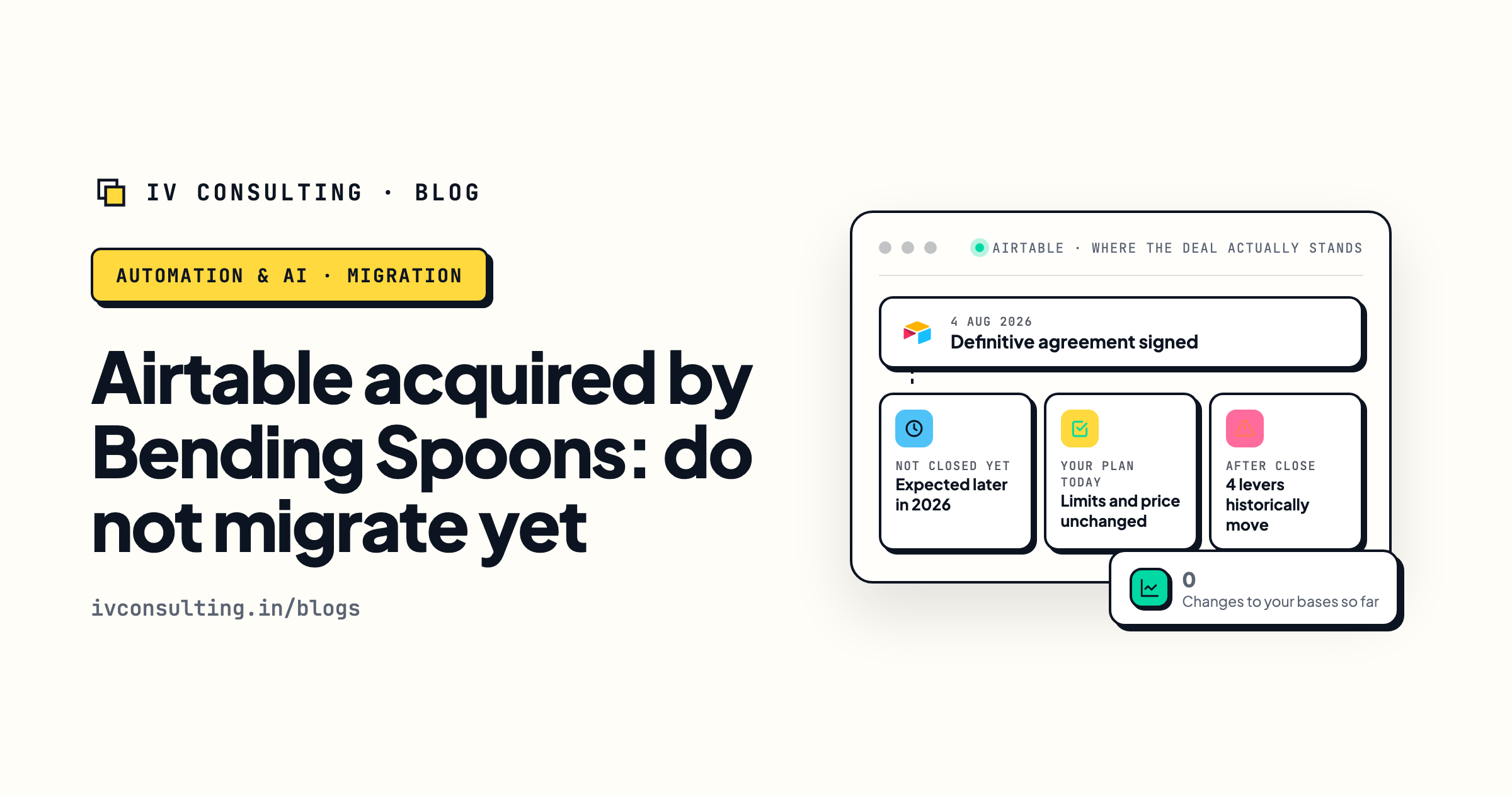
The same question, for Airtable
A pending acquisition rather than a rename, and the same stay-and-become-portable verdict with a dated watch-list.
Read the verdict →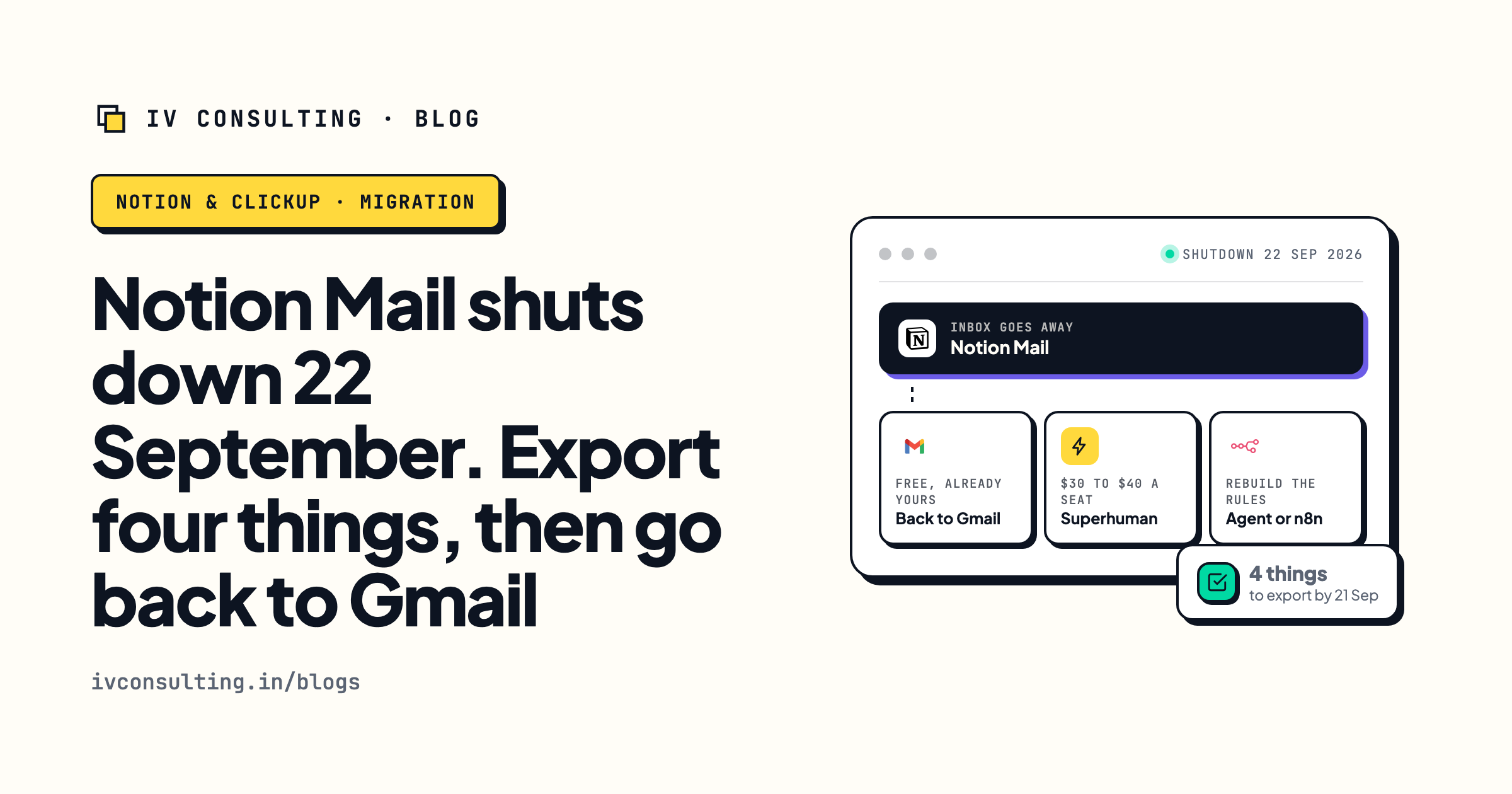
When a tool really is going away
The export-first playbook run for a product that did announce a shutdown date, including what to save and where to go.
Read the guide →
The Foundation stage, built for you
One central Notion or ClickUp workspace with SOPs and a single source of truth, so the next vendor headline is a non-event.
See the offer →Want a second opinion on your Coda docs before you move anything?
Book a free 30-minute strategy call. We will look at what your docs actually do, what depends on them, and whether the honest answer is stay, become portable, or rebuild the pipeline properly. If staying is right, we will say so.
Book a Free Strategy Call →Free 30-minute call. Honest take, even if that means "stay where you are and do nothing."