Zendesk removes legacy AI agents on 10 December. Migrate in place, unless you were already unhappy.
The deadline is real and it is dated. Our verdict: for most small teams the right move is the in-place upgrade to Zendesk's new AI agent experience, not a replatform. A forced removal is a bad reason to change vendors. It is an excellent reason to delete the bots you should have deleted two years ago.
 By Ishan Vats · Founder of IV Consulting · builds AI agents & automations for 150+ teams
 Route AUpgrade in place
 Route BMove deflection out
 Route CRebuild triage
Zendesk is removing AI agents Essential and its legacy AI agent functionality, which covers the bot builder, answers, intents, and autoreplies with articles. Two dates matter: from 31 August 2026 the legacy experience is in maintenance mode with critical bug fixes only, and on 10 December 2026 the functionality is removed and any AI agent still running on it stops working. The upgrade path is Zendesk's new AI agent experience, which includes agentic capabilities that used to require the AI agents Advanced add-on. None of this applies if you already bought that add-on. Our verdict for a 2 to 50 person team: inventory your bots first, delete the dead ones, and migrate in place. Only leave Zendesk if you were already unhappy with what the deflection was doing, because a forced removal is a deadline, not a reason to replatform your entire helpdesk in 101 days.
The verdict
Should you migrate in place or leave Zendesk before 10 December?
Our verdict: migrate in place. Take the upgrade to Zendesk's new AI agent experience, and use the deadline to delete rather than to replatform. Leave Zendesk only if you had already decided the deflection was not working before this announcement existed.
That is a less exciting recommendation than "here are five Zendesk alternatives," and we make it deliberately. Here is the reasoning, because a verdict without one is just an opinion:
- A vendor deadline is a terrible trigger for a vendor decision. You have 101 days, and a helpdesk replatform touches macros, views, SLAs, routing rules, reporting history, and every integration you have wired into tickets. Deciding to move your whole support stack under time pressure, with the removal date as the forcing function, is how teams end up mid-migration in December with two systems live and a queue nobody is watching.
- The upgrade is genuinely an upgrade, not a lateral move. Zendesk's own announcement says the new AI agent experience includes agentic capabilities that were previously available only through the AI agents Advanced add-on. Teams on the Essential tier are being pushed onto a more capable product. That is an unusual shape for a forced migration and it is worth taking at face value.
- Most of what is being removed should not be rebuilt anywhere. This is the part nobody says out loud. Intent-and-answer bots built in 2023 and 2024 tend to be a graveyard of half-finished flows. The honest output of this project is usually a much shorter list of automations than you started with, which is a good outcome that a replatform would have hidden behind migration busywork.
The one thing we will not tell you to do is nothing. Maintenance mode started on 31 August 2026, which means Zendesk has stopped developing this functionality and is fixing only critical bugs. A bot you leave alone is now sitting on frozen code with a hard stop date attached.
The dates
What exactly is Zendesk removing, and when?
Zendesk announced this on 23 June 2026 in its own help centre notice on the removal of AI agents Essential and legacy functionality, which is the only source you should plan against. Two dates carry the whole project, and they do different things.
- 31 August 2026: maintenance mode. The legacy experience stops receiving technical development. Zendesk continues to ship critical bug fixes only. Nothing breaks on this date, which is exactly why it is the dangerous one. Teams read "maintenance mode" as "still works" and stop paying attention for three months.
- 10 December 2026: removal. AI agents Essential and the legacy functionality are removed. In Zendesk's own words, any AI agents left on this technology will no longer function.
What is in scope for removal:
- The AI agents Essential experience.
- The legacy AI agent functionality, which specifically includes the bot builder, answers, and intents.
- Autoreplies with articles. This is the one teams forget, because it often was not set up by anyone still working there. If your Zendesk quietly answers common questions by suggesting help centre articles, that is a thing with a removal date on it.
And the exclusion that saves some readers the whole project: this announcement does not apply to customers who previously purchased the AI agents Advanced add-on. Check that line item on your bill before you plan anything. If you have Advanced, you are not in this migration.
Step zero
What should you inventory before you migrate anything?
One row per bot, answer, and intent. Do not open the new agent builder until this table exists.
The migration is not the hard part. Knowing what is load bearing is the hard part, and it is the same failure mode we see in every dated migration: the team rebuilds the three things it remembers and gets ambushed by the long tail in week six. Capture these columns for every legacy bot, answer, and intent, including the ones you are certain are dead:
- What it does, in one plain sentence. If nobody can write that sentence, that is your answer about whether to rebuild it.
- Which channel it fires on. Web widget, messaging, email, or a social channel. Channel is what determines who notices when it stops.
- Volume over the last 90 days. The single most useful column. A bot that has handled a trivial number of conversations in a quarter is a delete, not a migrate.
- Resolution or deflection outcome. Did the conversation end, or did it become a ticket anyway? A bot that deflects nothing is costing you customer patience for no benefit.
- What runs downstream. Triggers, automations, routing rules, tags, and any integration that keys off what the bot sets. This is where the December surprises live.
- A named business owner. Someone who would notice and care if it stopped. No owner is a strong signal for the decision column.
- Keep, kill, or merge. Filled in last, once the whole list is visible.
Fill in that last column only after the table is complete. Every dated migration we have worked through produces the same surprise once the list is in one place: a meaningful share of the automations get killed rather than rebuilt, and several near-identical intents collapse into one better-scoped agent. That is the real return on this project.
The same discipline applies whether you stay or go. If your help centre content is thin, no AI agent on any platform will deflect well, because they are all answering from your articles. Fixing the source of truth before the tool is the argument we make in Foundation, and it is more relevant here than the choice of vendor.
The decision
What are your three options once the legacy bots are gone?
Three honest routes. One of them is right for most readers of this page, and it is the boring one.
| Factor | A. Upgrade in place | B. Move deflection to Intercom Fin | C. Rebuild triage in n8n plus Claude |
|---|---|---|---|
| What you keep | Tickets, macros, views, SLAs, reporting history, every integration | The helpdesk, if you keep Zendesk behind it. Otherwise very little | The helpdesk. You are replacing the automation layer, not the ticketing |
| Work before 10 Dec | Inventory, then rebuild the surviving bots in the new experience | Inventory, plus a second vendor evaluation and a content sync | Inventory, plus building and testing workflows you now own |
| Who owns it after | Zendesk. Same admin, same console | A second vendor, and someone to keep both in sync | You, or a partner. Real ownership, real maintenance |
| Answers come from | Your help centre, same as before | Your content, synced into a second system | Whatever you point it at, including systems your helpdesk cannot reach |
| Realistic risk in 101 days | Low. Scope is bounded and reversible | High. Two live systems and a channel cutover under a deadline | Medium. Bounded if you scope it to triage, high if it creeps |
| Right when | The deflection was broadly fine and the deadline is your only problem | You had already decided Zendesk's deflection was the weak point | Your bottleneck is routing and enrichment, not answering |
Route A is the default and should be. It is the only one of the three where the deadline and the work are the same size. You inventory, you delete most of it, you rebuild the survivors in the new experience, and your ticketing, reporting, and integrations never move. If the honest answer to "what was wrong with our deflection before June?" is "nothing much," stop reading the other two columns.
Route B is a real option that is being chosen for the wrong reason right now. Moving the deflection layer to something like Intercom Fin is defensible if you had already concluded that answer quality was your problem. It is not defensible as a reaction to a removal notice, because you are adding a vendor evaluation and a channel cutover to a project that already has a fixed end date. If you genuinely want to compare, do it in January, on your own timeline, from a stable position. Factor in that Fin now has a new owner as well: Salesforce closed its acquisition of Fin on 10 September 2026, and we cover what that changes for Fin's pricing and whether to stay or switch.
Route C is ours, and we will still tell you it is the narrow case. Rebuilding first-line triage as a workflow, an inbound ticket classified, enriched from your own systems, routed, and drafted before a human sees it, is genuinely better than an intent bot when your bottleneck is routing rather than answering. It also hands you the maintenance. We wrote up what that layer looks like in practice in AI and automation use cases for customer support teams and the underlying stack in n8n plus Claude. Pick it because triage is your pain, not because December is coming.
Note what none of these routes are: a reason to move your ticketing system. Every option above keeps your helpdesk where it is. If somebody in the room is arguing for a full helpdesk migration off the back of an AI agent removal notice, that is scope creep wearing a deadline as a disguise.
The gotchas
What actually breaks when you rebuild a legacy Zendesk bot?
Even the in-place route is a rebuild, not a copy. These are the places where the mapping is not one to one.
- Intents do not survive as intents. The legacy model was: match an utterance to an intent, then serve the mapped answer. The new experience is agentic, which means it reasons over your content instead of matching to a list. Porting a hundred intents across one by one carries a 2023 design into a 2026 tool. Rebuild the outcomes, not the intent list.
- Answers were quietly load bearing for routing. Many teams used answers to set a tag or a field, and then built triggers on top of that. When the answer goes, the tag stops being set, and the trigger silently stops firing. Nothing errors. Tickets just start landing in the wrong queue.
- Autoreplies with articles are invisible until they are gone. Nobody monitors a feature that works. Check whether it is on, check what it deflects, and decide deliberately rather than discovering the answer from your December ticket volume.
- Your help centre content is the real dependency. Every route in the table answers from your articles. If they are stale, contradictory, or missing, the new agent will be confidently wrong in a way the old keyword bot was not. Auditing content is unglamorous and it is the highest-value work in this project.
- Two bots live at once means two replies. While you test the new agent alongside the legacy one, guard against both answering the same conversation. Point the new one at a test channel or an internal queue until you trust it. This is the single most common way a support migration embarrasses you in front of a customer.
The pattern behind all five is the same: the visible thing being removed is a bot, but the thing that actually breaks is something downstream that nobody documented. That is why the inventory column asking "what runs downstream" matters more than the one asking what the bot says.
The unpopular part
When should you not leave Zendesk over this?
Three situations where staying put is the better business decision, and we will say so even though route C is what we build for a living.
- Your deflection was fine and your complaint is the deadline. Annoyance at a vendor is not a strategy. If the bots were doing acceptable work and the only new fact is a removal date, the in-place upgrade costs you an inventory and a rebuild of the survivors. Leaving costs you all of that plus a vendor evaluation, a content migration, and a channel cutover, for a benefit nobody has articulated.
- Nobody on your team will own the replacement. This is the one that decides route C. Owning your own triage workflows means owning error handling, credential rotation, and the day the model output changes shape. If the honest answer to "who owns this in six months" is nobody, you have not upgraded your support automation, you have converted a vendor's problem into an invisible internal fragility.
- Your real problem is your help centre, not your bot. The most common one. If articles are out of date and half the answers your customers need were never written down, every platform in the comparison table will underperform, and you will conclude the new vendor is bad when the content was the constraint the whole time. Fix that first and the platform question gets much easier and much less urgent.
There is a fourth end state worth naming, because the all-or-nothing framing is a habit from vendor marketing rather than a constraint: keep Zendesk's new AI agents for customer-facing deflection, and build your own workflow layer for the internal work, the routing, enrichment, and drafting that never touches a customer directly. Those two things solve different problems and there is no rule that one vendor has to do both.
FAQ
Questions support teams are asking about the removal
What exactly is Zendesk removing on 10 December 2026?
What happened on 31 August 2026, and does anything break then?
Does this affect me if I already bought the AI agents Advanced add-on?
Should you switch to Intercom Fin or another vendor instead of migrating in place?
Do legacy intents and answers transfer into the new AI agent experience?
When should the migration actually be finished?
Ishan Vats
Founder, IV Consulting · AI & automation consultant
I build production AI agents, automations, and MCP servers for teams from startup to enterprise. 150+ ops transformations over 10+ years. If a vendor deadline is forcing your hand, start by working out what is worth rebuilding before you rebuild any of it.
Run my support automation numbers →Keep reading
Related guides and work
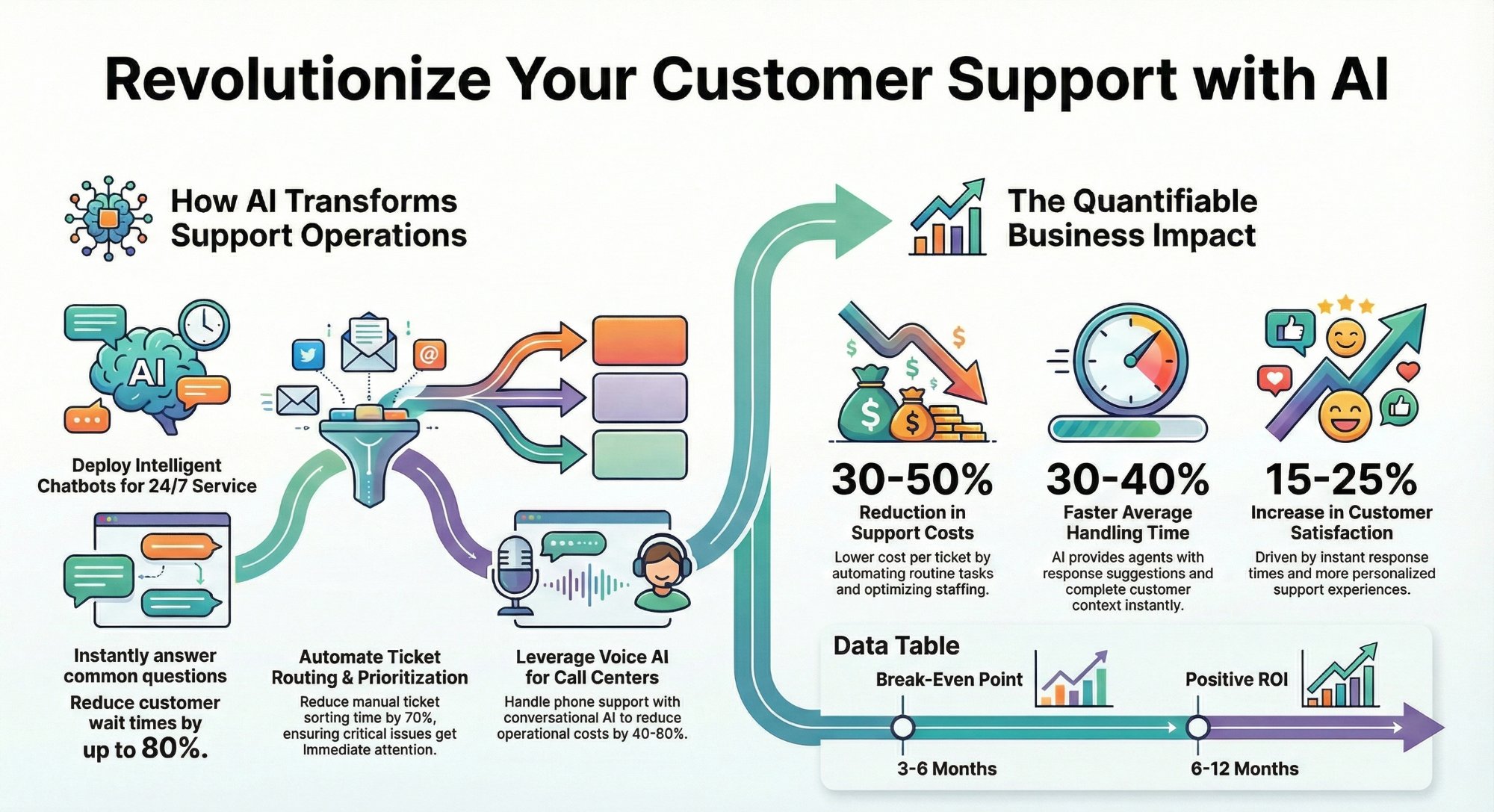
AI and automation use cases for support teams
What the automation layer around a helpdesk actually does once deflection is not the only goal.
Read the guide →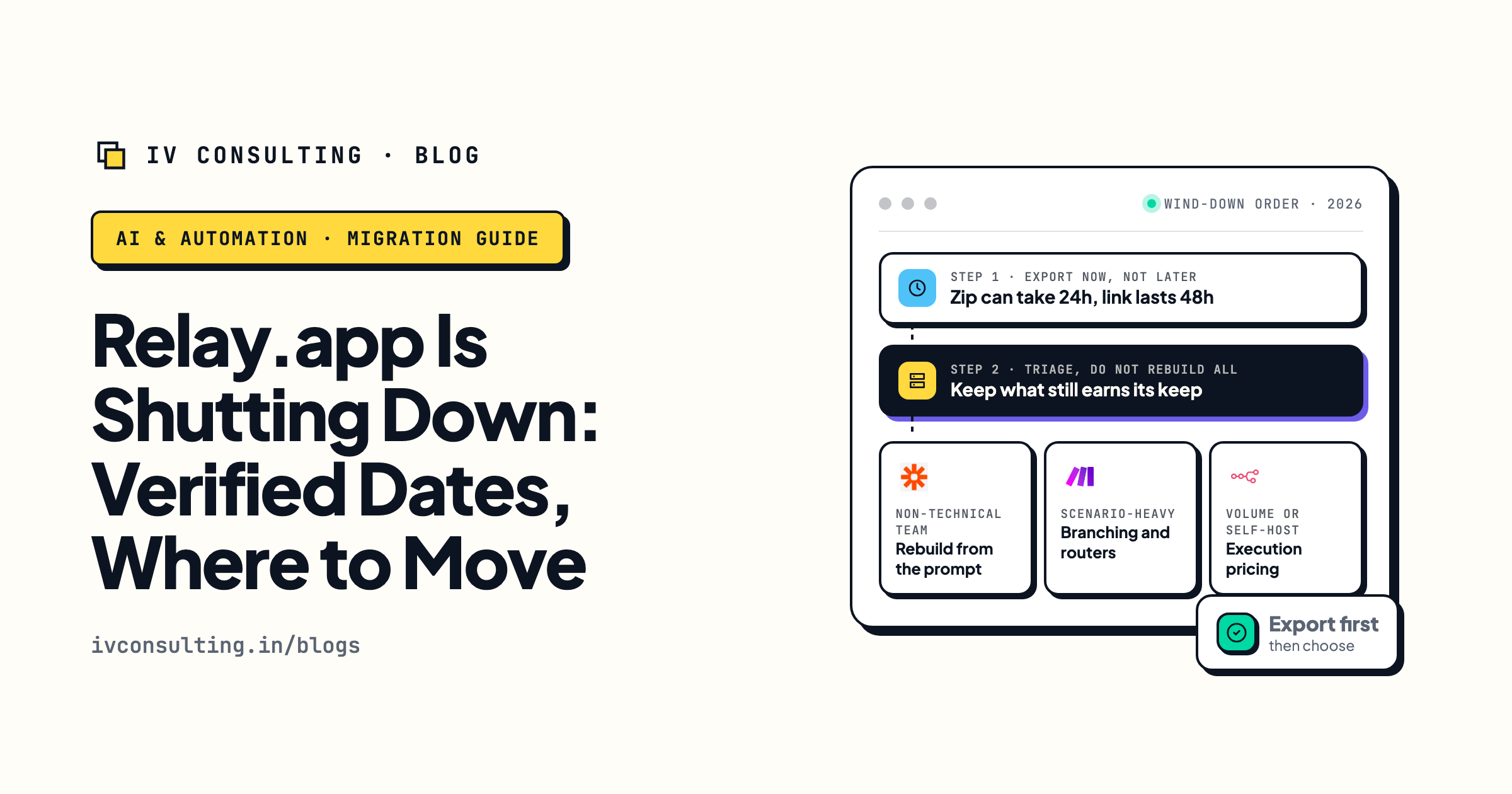
Relay.app is shutting down: where to move
The same inventory-first sequence, run against a shorter deadline and a harder cutover.
Read the playbook →
The Automation stage, built for you
Your support workflows audited, rebuilt, and handed over with the runbook written down.
See the offer →Not sure which of your Zendesk bots are worth rebuilding?
Book a free 30-minute call. We will walk your actual legacy bots, answers, and intents, tell you which ones are load bearing and which should simply be deleted, and hand you the order to do it in before 10 December. If the honest answer is that the in-place upgrade is all you need, we will say that instead.
Map my Zendesk exit, free call →Free 30-minute call. Honest take, even if that means "just take the in-place upgrade."