Three things burn Notion AI credits, not just Custom Agents
Custom Agents were the only meter until now. Workers start billing on 15 October 2026, and ordinary Notion AI past your usage allowance can draw on the same pooled balance. It resets monthly, never rolls over, and one badly scoped agent can drain what the whole team shares.
 By Ishan Vats · Certified Notion Consultant · 150+ workspaces built and handed over
 Agents, Workers, overflowThree metered sources
Notion AI credits are a workspace-wide pool costing $10 per 1,000 per month, shared by everyone regardless of who built or ran the thing that spent them. Three things draw on that pool: Custom Agents, metered since 4 May 2026; Notion Workers, free during the public beta but billing from 15 October 2026 at roughly $0.0023 per run; and ordinary Notion AI used past your plan's usage allowance, but only if an admin has switched that fallback on. Routine writing tools, the built-in Notion Agent and AI search stay free. Credits reset at the start of each billing cycle and never roll over.
The basics
What are Notion AI credits, exactly?
Notion AI credits are a metered currency Notion introduced to bill the one feature that can run away with cost: Custom Agents. A Custom Agent is an autonomous, multi-step workflow you configure once and let loose. It reads pages, makes decisions, updates databases, and keeps going until the job is done. That is a very different cost shape from clicking "summarise this page", and Notion prices it differently.
The mechanics are simple once someone states them plainly, which almost nobody does:
- Price: $10 per 1,000 credits per month (Notion credits documentation).
- Scope: pooled at the workspace level. Not per seat, not per person.
- Cycle: reset at the start of each billing cycle.
- Rollover: none. Unused credits expire.
- Adjustable: admins can move the purchased amount up or down each cycle.
Custom Agents began drawing on credits on 4 May 2026, and Notion is explicit that credits are only available on Business and Enterprise plans. Before that, the same work sat inside a flat AI allowance, which is why so many teams felt the change as a bill appearing rather than a bill increasing.
Worth knowing if you are weighing the alternative: ClickUp meters AI on a completely different axis, charging a per user add-on on top of the base plan rather than pooling credits by workspace. We put both models side by side, with the prices read straight off each vendor page, in ClickUp Brain vs Notion AI: what the AI actually costs per seat. And if the question underneath your credit spend is really whether the Notion seat is enough on its own, we priced it against buying ChatGPT and Claude seats on top in is Notion AI worth it, and do you need a second subscription.
The separate thing people conflate with credits is plan access. Full Notion AI is bundled into Business and Enterprise rather than sold as the old standalone add-on, and the Free and Plus tiers only get a small taste of AI responses. So there are two questions, not one: does your plan include AI at all, and do you need credits on top for Custom Agents. Most teams asking about credits actually have a plan question.
The meter
What actually burns Notion AI credits, and what does not
This is the single most useful table in this post, because the default assumption is wrong. Most day-to-day Notion AI usage still costs you nothing extra. Three things are metered, and none of them is the AI you actually use most.
| What you do in Notion | Burns credits? | What is going on |
|---|---|---|
| AI writing tools (summarise, translate, improve) | No | Included with your plan's AI access |
| Asking the built-in Notion Agent a question | No | Included, this is the chat you already use |
| AI search across the workspace | No | Included, retrieval is not metered |
| Running a Custom Agent | Yes | Metered since 4 May 2026 |
| A Custom Agent firing on a schedule | Yes | Every run draws from the same pool |
| A teammate's Custom Agent | Yes | Same shared pool, whoever built it |
| Running a Notion Worker | From 15 Oct 2026 | Free during the public beta, then billed per run |
| Notion AI past your usage allowance | Only if an admin allows it | Credits become the overflow, otherwise you wait for the window |
| AI Meeting Notes | No | Has its own daily cap instead of a credit price |
Read that last row again, because it is where the surprise lives. Credits are not attributed to the person who ran the agent. A single automation that someone built in a personal test area, forgot about, and left on a schedule will quietly draw down the balance the whole company depends on. Nobody gets a warning that it was their agent.
The most common version of this in the wild is a sales chore. Somebody points a Custom Agent at the pipeline to nudge deals that have gone quiet, sets it to run each morning, and never looks at it again: thirty runs a month against the shared pool for a job a filtered view does for nothing. If that is what you are about to build, the cheaper shape is a properly structured Notion CRM with a Deals Gone Cold view, and an agent only for the part that genuinely needs to read and reason.
The gotchas
Why do Notion AI credits run out faster than teams expect?
Pooled means one person can spend everyone's balance
Credits sit at the workspace level. There is no per-person cap, no departmental split, and no built-in way to say "marketing gets 40 percent". Any Custom Agent in the workspace draws from the same balance, regardless of who created it or who triggered it.
For a five-person team that is fine. For a forty-person workspace with three departments, it means your finance agent can be starved by somebody's content experiment, and the first signal you get is the agent failing to run.
Reset means the clock is the billing cycle, not the calendar month
Credits reset at the start of each billing cycle. If you are on a monthly subscription, credits are billed alongside it. If you are on an annual plan, credits are still billed monthly and separately, which trips up finance teams who expect one annual line item and get twelve small ones.
Practically: your usable balance is a monthly figure even if everything else about your Notion contract is annual. Budget it as opex, not as part of the seat renewal.
No rollover means over-buying is a real, repeating loss
Unused credits expire at the end of the cycle. They do not bank, and there is no credit-note equivalent. Buy 3,000 credits for a month where you only use 900 and you have simply spent the difference.
The correct response is not to buy generously "to be safe". It is to buy close to your real usage and use the admin control that lets you adjust the purchased amount up or down each cycle. Under-buy slightly, watch what breaks, and raise it. That costs you a little friction once. Over-buying costs you every single month, quietly, forever.
The other limit
How does the Notion AI usage allowance work?
Separately from credits, Business and Enterprise plans carry a usage allowance on certain Notion AI features. This is the part most write-ups get wrong: there is no single industry-wide switch-on date. The allowance is measured against your own workspace billing cycle, so the day it resets is whatever day your cycle starts.
There are actually two windows running at once, which is why the behaviour confuses people:
- A rolling six-hour window. Burn through your allowance in a burst and the affected features pause until that window refreshes. This is the one that bites, and it is why a heavy batch at 9am is riskier than the same work spread across the day.
- Your monthly billing cycle. The monthly allowance resets in full at the start of your next cycle, not on a shared calendar date.
What the allowance actually covers is narrower than the name suggests. It applies to the personal Notion Agent including chat, image generation, page translation, and Skills. It does not cover AI Meeting Notes, which has its own separate daily cap, and it does not cover Custom Agents or Workers, because those are on credits instead.
Credits are the escape hatch, but only if someone turns them on. An admin has to enable Allow workspace to use Notion credits after AI limit is reached under Settings, then Notion AI (Notion documents the toggle here). Leave it off and your team waits for the window. Switch it on and your pooled credit balance quietly becomes the overflow tank for everyday AI usage, which is the third way a balance you bought for two agents disappears.
The new meter
What do Notion Workers cost, and should your team care?
Workers are the third thing that will draw on your credit balance, and the deadline is close enough to plan for now.
A Notion Worker is a small Node or TypeScript program that you deploy with the Notion CLI and Notion then hosts and runs for you. Teams use them to sync an external system into a Notion database on a schedule, to give Custom Agents new tools to call, or to receive webhooks from services like GitHub, Stripe or Zendesk. They are a developer feature, not a no-code one: somebody writes code.
Right now Workers are in public beta and free to try on Business and Enterprise plans, including Business trials. That changes on 15 October 2026, when they start requiring Notion credits from the same pooled balance your Custom Agents already spend.
The published rate is about $0.0023 per run, which works out to roughly 4,348 runs per 1,000 credits. Notion is explicit that this is a typical figure rather than a flat one: a run that does more work, or runs longer, costs more. So the honest way to read the table below is as a floor, not a quote.
| How often it runs | Runs per day | Cost per month | Credits per month |
|---|---|---|---|
| Once a day | 1 | $0.07 | About 7 |
| Hourly | 24 | $1.66 | About 166 |
| Every 15 minutes | 96 | $6.62 | About 662 |
| Every 5 minutes (our extension) | 288 | $19.87 | About 1,987 |
| Our call | The price is not the risk. A Worker nobody remembers deploying is. | ||
The first three rows are Notion's own published examples. The fourth is our arithmetic at the same rate, because a five-minute sync is the schedule teams actually reach for when they want something to feel live, and it is the first one that costs real money. Full pricing is on Notion's Workers pricing page.
Our verdict: most 5 to 50 person teams should do nothing, and check one dashboard
If nobody on your team writes code, Workers are not a decision you have to make. Skip them. The reason this section exists anyway is that Workers do not bill separately: they land on the same pooled balance you sized for your Custom Agents. A single developer wiring up a fifteen-minute sync in beta, while it is free and invisible, can add several hundred credits a month to a bill somebody else owns from 15 October.
That is the whole risk, and it has a cheap fix. Since 24 July 2026 Workers appear in the Notion credits dashboard with a Free badge, showing credits used, runs completed, status and creator for each one (Notion release note, 24 July 2026). Go and read that screen before mid October, while the number is still hypothetical. If it says zero, you are done and you never think about Workers again. If it does not say zero, you have found spend that was about to arrive unannounced.
The counter case, honestly stated: if you do have a developer and the job is a scheduled sync from another system, a Worker is a reasonable place to put it, because it runs deterministic code rather than paying an agent to reason its way to the same answer every fifteen minutes. But if that sync is the only reason you would touch the developer platform, compare it against a dedicated automation tool first. We put the main options side by side in n8n vs Make vs Zapier for AI agents, and for most teams the answer is that the sync belongs outside Notion entirely.
The fix
How to cut your Notion AI credit bill without losing the automation
In order of impact. The first two usually do most of the work, and neither one costs you anything.
Audit every Custom Agent and give each one an owner
List them. For each: what triggers it, how often it fires, what it reads, and whose name is on it. Turn off anything nobody can justify in a sentence. In most workspaces this alone removes a third of the load, because experiments never get switched off.
Fix the trigger before you touch the prompt
An agent that runs on every page edit will cost many times more than the same agent running once a day on a filtered view. Triggers are where credit bills are made and unmade. Ask of every agent: does this need to react instantly, or is a scheduled batch fine? Almost always, batch is fine.
Narrow what the agent has to read
Point agents at a specific database or filtered view, never at a whole workspace or a sprawling parent page. The more context an agent has to chew through to find the answer, the more steps it takes. This is also why database properties beat free text: a property is a lookup, a paragraph is a search.
Move the deterministic steps out of the agent
If a step is a rule, it does not need a model. "When status changes to Won, create the project page" is a native Notion automation, not agent work. Reserve the agent for the judgement calls in the middle, and let plain automation handle the parts either side of it. This is the single biggest structural saving available, and it makes the workflow more reliable at the same time.
Right-size the purchase every cycle
Because credits do not roll over, the correct buying posture is slightly under your expected need, adjusted upward when you actually hit the ceiling. Put a 10-minute review in the calendar for the day after each billing date. Look at what you consumed and set next cycle to match.
If you want to estimate before you commit, we built a free Notion AI credit calculator that turns your agent count and run frequency into a monthly credit figure.
The decision
Should you buy Notion AI credits at all?
Four situations, four honest answers. Credits are a good deal in one of them and a bad deal in two.
Buy credits if you have one or two agents that already earn their keep
You know exactly which workflow the agent replaces, you can name the hours it gives back, and it runs on a schedule you control. This is what credits are actually priced for, and it is a clean trade.
Buy close to your measured usage, review it monthly, and keep the owner named. The cost stays boring and predictable.
Wait if your workspace is still messy
Agents pay for the disorder. Fix the structure first and the same automation costs a fraction as much.
Do not buy to "explore"
Exploration has no ceiling and no rollover. Explore with the free writing tools and the built-in agent instead.
Look outside Notion if the work spans tools
If half the workflow lives in your CRM or inbox, a dedicated automation platform is usually cheaper and easier to debug.
FAQ
Questions teams ask before they buy
Do Notion AI credits roll over to the next month?
Are Notion AI credits per person or per workspace?
What actually uses credits in Notion AI?
How much do Notion AI credits cost?
When does the Notion AI usage allowance reset?
How much do Notion Workers cost?
Do Notion Workers use the same credits as Custom Agents?
How do I estimate how many credits I need before buying?
Ishan Vats
Founder, IV Consulting · Certified Notion Consultant
I build Notion operating systems and the automations around them for teams from startup to enterprise, then hand them over documented. 150+ ops transformations over 10+ years. If your Notion AI spend stopped making sense, I'll go through it with you on a free call.
Price my Notion AI credits →Keep reading
Related guides and work
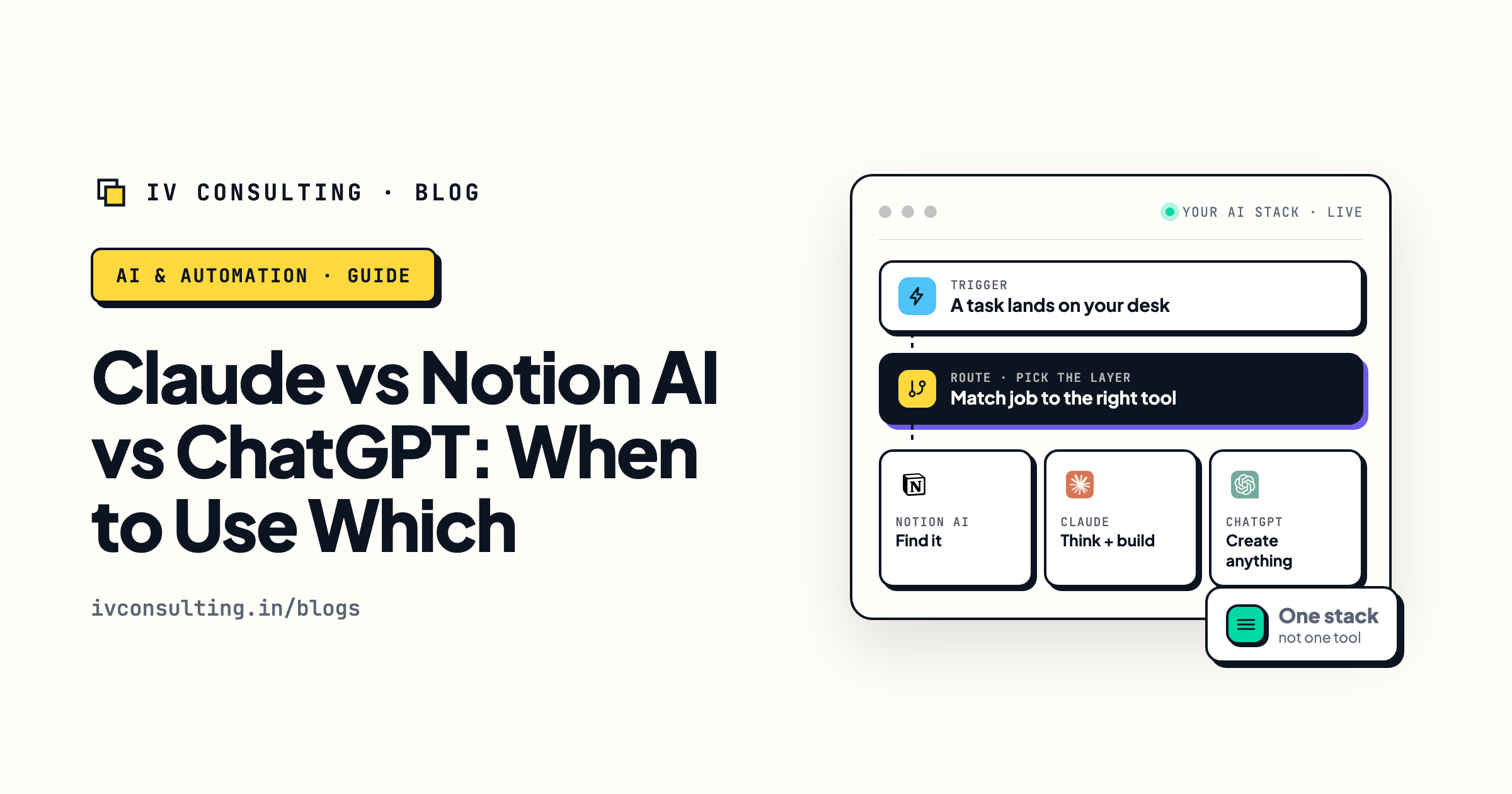
Claude vs Notion AI vs ChatGPT: when to use which
Which assistant earns its place for which job, without paying three times over.
Read the comparison →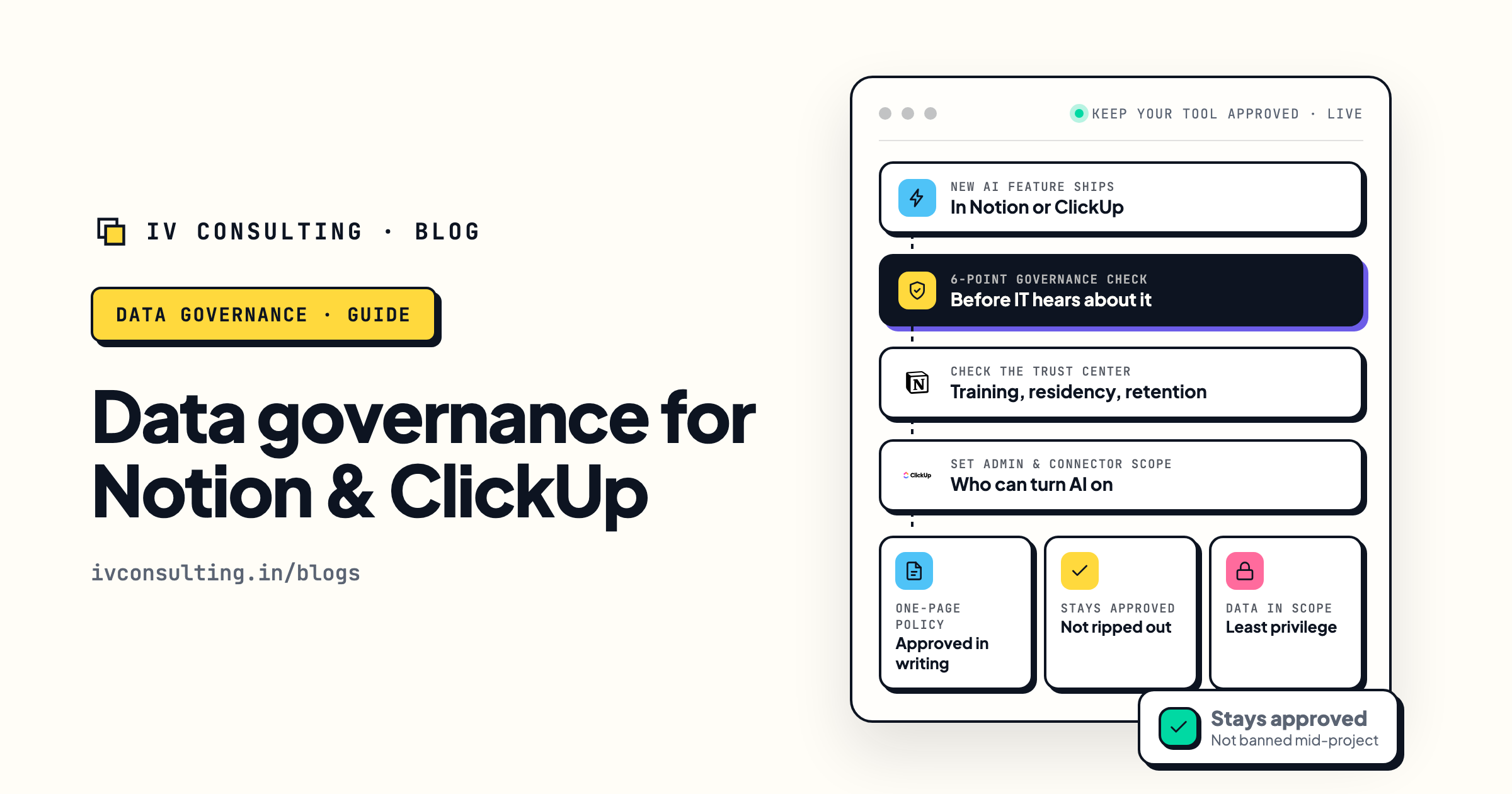
When your company bans AI in Notion or ClickUp
The data governance answer that gets AI approved instead of blocked.
Read the guide →
The Foundation stage, built for you
One clean workspace, real databases, and agents that cost a fraction to run.
See the offer →Not sure how many credits you actually need?
Book a free 30-minute strategy call. We will go through your Custom Agents, show you which ones are rules in disguise, and give you a credit number you can defend to finance.
Book a Free Strategy Call →Free 30-minute call. Honest take, even if that means "you do not need credits yet."