Notion Workers vs n8n vs Zapier: we priced our own syncs
Notion Workers are about to come off their free beta and start drawing Notion credits. Before you move a sync into Notion, or out of it, price it. We took the three Notion syncs IV actually runs, put each one on Notion Workers, n8n, Zapier and a serverless function, and picked a side.
 By Ishan Vats · Founder of IV Consulting · runs Notion syncs in production on this site
 DestinationA Notion database kept in sync
Notion Workers$6.62 a month
 n8n CloudPro plan, €50 a month
 Zapier2,880+ tasks, above the 2K tier
A Notion Worker run typically costs $0.0023, so a sync that runs every 15 minutes (2,880 runs a month) costs about $6.62 a month in Notion credits, sold in $10 blocks of 1,000 credits on Business and Enterprise plans. The same sync needs n8n Cloud's €50 Pro plan, more than 2,000 Zapier tasks, or nothing at all on a serverless free tier. Our verdict: use Notion Workers when a Notion Custom Agent needs to call the sync as a tool, keep plain scheduled syncs wherever your automations already run, and stop syncing Notion through Zapier once you pass about 1,000 runs a month.
The meter
Notion Workers pricing: how much does one run cost?
Notion says Workers typically cost $0.0023 per run, which works out to roughly 4,348 runs per 1,000 Notion credits ($10). Every scheduled sync, every Custom Agent tool call and every webhook event a Worker handles counts as one run.
Workers are Notion's code-in-the-background feature: small programs that sync data in, write updates and react to events, without the AI reasoning that makes Custom Agents expensive. Notion had scheduled credit billing for Workers to start on 15 October 2026, after pushing it back from 11 August. As of 28 October its help centre still shows Workers as a free beta, with a Free badge in the credits dashboard that tells admins when the free period ends. So the date has slipped, but the rate is published, and that is what you plan against.
| What Notion counts | One run is | Notion's own example |
|---|---|---|
| Scheduled sync | Each time the sync fires | A Salesforce sync every 15 minutes: 2,880 runs, $6.62 a month |
| Agent tool call | Each call a Custom Agent makes to the Worker | 4 calls per agent run, 3,000 agent runs: $27.60 a month |
| Webhook (alpha) | Each incoming event handled | 5,000 Zendesk events a day: $345 a month |
Source: Notion help centre, Understand pricing for Workers (beta), read 28 October 2026. Notion notes that heavier runs (longer runtime, more processing) use more credits than the typical figure. Credits are sold only as an add-on to Business and Enterprise plans.
Two things in that table matter more than the headline rate. First, an agent multiplies runs: one Custom Agent run that makes five tool calls is five Worker runs. Second, webhooks scale with someone else's event volume, which is how a busy helpdesk turns into a $345 line. If you want the wider credit picture, our Notion AI credits explainer covers how Workers share the same pool as agents.
Head to head
Notion Workers vs n8n vs Zapier vs a serverless function: what does each charge for?
Each tool counts a different unit. Notion bills per Worker run, n8n bills per workflow execution no matter how many steps, Zapier bills per action task so every step counts, and a serverless platform bills per request after a free allowance. That unit, not the sticker price, decides who wins at your volume.
| Notion Workers | n8n | Zapier | Serverless function | |
|---|---|---|---|---|
| Billing unit | Per run, about $0.0023 | Per workflow execution, any number of steps | Per action task, each step counts | Per request, after a free allowance |
| Entry price | Needs Notion Business, then $10 per 1,000 credits | Cloud Starter €20 a month (annual), 2.5K executions; self-hosted community edition is free software | Free: 100 tasks. Professional from $19.99 a month for 750 tasks | Cloudflare Workers Free: 100,000 requests a day. Paid from $5 a month with 10M requests |
| Next step up | Buy more credit blocks | Pro €50 a month (annual), 10K executions | Higher task tiers on the same plan | $0.30 per extra million requests |
| Who builds it | A developer, via the Notion CLI | An ops person in a visual editor | Anyone, no code | A developer |
| Custom Agent can call it as a tool | Yes, natively | Via webhook or MCP, with setup | Via Zapier MCP, with setup | Via your own endpoint |
| Talks to other apps | Your code calls their APIs | Hundreds of built-in nodes | 9,000+ apps | Your code calls their APIs |
Sources, read 28 October 2026: Notion Workers pricing, n8n pricing, Zapier pricing, Cloudflare Workers pricing. We used Cloudflare as the public serverless benchmark; IV's own functions run on Netlify, which hosts this site.
The row people skip is the last but one. Workers are the only option a Notion Custom Agent can call without plumbing. Everywhere else you are wiring an agent to an endpoint, which is fine for a developer and a wall for everyone else. That single row is the honest case for Workers, and it is why the verdict below is not simply "pick the cheapest".
The math
What does the same Notion sync cost at 1,000, 10,000 and 50,000 runs a month?
At 1,000 runs a month a Notion Worker costs $2.30 in credits, at 10,000 runs $23, and at 50,000 runs $115. Credits come in $10 blocks, so you actually buy $10, $30 and $120. Here is the same single-step sync priced on each option.
| Runs a month | Notion Workers | n8n Cloud | Zapier | Cloudflare Workers |
|---|---|---|---|---|
| 1,000 (about one every 45 min) | $2.30 used, one $10 block | Starter, €20 a month | Above the 750-task Professional entry tier | $0 on Free |
| 10,000 (about one every 4.5 min) | $23 used, $30 in blocks | Pro, €50 a month, right at its 10K cap | 10K-task tier, or 30K tasks if the Zap has 3 steps | $0 on Free |
| 50,000 (more than one a minute) | $115 used, $120 in blocks | Past Pro; Business is €667 a month for 40K, so self-host instead | 50K-task tier, or 150K tasks at 3 steps | $0 on Free, or $5 Paid |
How we priced it: Notion at its published $0.0023 per typical run; n8n Cloud annual plan prices in euros; Cloudflare's Free plan allowance of 100,000 requests a day. We list Zapier by task tier rather than a dollar figure because Zapier's price for each tier sits behind its tier selector and changes with plan and billing period; check it for your tier. All figures exclude the Notion Business seats you already need for Workers.
Two patterns jump out. Zapier is the only option where a more useful sync costs more per run, because a three-step Zap (find the page, update it, notify Slack) burns three tasks every time. And n8n Cloud has a cliff: it is the cheapest managed option up to 10,000 executions, then the next hosted plan is a big jump, which is the point where teams move n8n onto their own server. We walk through that decision in our Zapier to n8n migration guide.
Workers draw on the same Notion credit pool as your agents and Notion AI. Before you add a sync to that pool, put your seats, agents and expected runs into our Notion AI credit calculator. It shows how many credit blocks you would actually buy each month, so you can set a Worker's $6.62 against the rest of the bill instead of in isolation.
First-hand
What would IV's own Notion syncs cost on each option?
IV runs three Notion syncs today, all as serverless functions on the Netlify account that hosts this site. Moved to Notion Workers, the busiest one would cost about $6.62 a month at the typical rate. Moved to n8n Cloud, the three together would tip us past Starter onto the €50 Pro plan.
| Our sync | What it does | Runs a month | As a Notion Worker |
|---|---|---|---|
| Upwork job scan | Every 15 minutes, pulls new jobs, scores them and writes the keepers into a Notion database | 2,880 (fixed schedule) | About $6.62 at the typical rate, likely more (see below) |
| Careers page bake | Once a day, reads the Notion Job Postings database and bakes the open roles into the careers page | About 30 | About $0.07 |
| Lead logging | On every website form submission, writes the lead into our Notion Website Leads database | One per submission | $0.0023 per lead |
The arithmetic is simple and it is real: the job scan's schedule is set in code at every 15 minutes, which is exactly Notion's own 2,880-run example. But the run size is where we would get caught. Our scan hands each batch to a background job that can run for up to 15 minutes and calls a model to score jobs. Notion says runs that take longer or do more processing use more credits than the typical $0.0023, and a run that also needs AI judgement belongs in a Custom Agent, which is priced much higher. So for this sync the honest Worker number is "$6.62 is the floor".
Would we move them? No. All three already run for no extra effort on infrastructure we have to keep anyway, and none of them is called by a Notion agent. That is the test we would apply to any client sync too. We do not have usage numbers from running Workers ourselves yet, so treat the Worker column as Notion's published rate applied to our real schedules, not a measured bill.
Notion's own advice applies to every tool here: start syncs hourly or daily, and only speed up when someone needs fresher data. Dropping our job scan from every 15 minutes to hourly would cut it from 2,880 runs to 720, and the Worker bill from $6.62 to about $1.66.
The verdict
Our verdict: should you move your Notion syncs into Notion Workers?
Only when a Notion Custom Agent needs to call the sync. For plain scheduled syncs, leave them where your automations already live, and get them out of Zapier once they pass about 1,000 runs a month. We take that side because the per-run price differences are small at SMB volume, and the real costs are elsewhere: who can maintain it, and whether an agent can use it.
Notion Workers: pick it for agent tools
At $0.0023 a run, Workers are the cheapest hosted way to give a Custom Agent reliable hands, and the only one with no wiring. If your agent needs to fetch a Jira status or write back a Salesforce stage, a Worker tool is the right shape. The catch: it needs Notion Business, a developer comfortable with the Notion CLI, and it puts one more line in a credit pool your AI usage already draws on.
n8n: keep plain syncs here
If you already run n8n, a Notion sync is one more workflow inside a plan you pay for anyway, so its marginal cost is close to zero until you hit the plan cap. It is also the option an ops person can open and fix. Past 10,000 executions a month, self-host it. See our n8n plus Claude stack.
Zapier: fine for tiny syncs only
Under a few hundred runs a month, Zapier is the fastest thing to set up and nobody should over-engineer it. Above about 1,000 runs, task billing makes it the most expensive way to keep a Notion database fresh, and every extra step makes it worse.
Serverless: cheapest if you have a developer
This is how IV runs its own syncs. A free tier covers almost any SMB sync volume. The cost is ownership: someone has to write, deploy and watch the code, and an ops lead cannot open it the way they can open n8n.
If you are weighing Notion's AI pricing more broadly, our guide to leaving Notion over AI pricing covers when the credit model stops making sense. If you want your syncs and agents mapped and built properly, that is what our automation practice does.
FAQ
Questions about Notion Workers pricing
How much does a Notion Worker cost per run?
Notion says a typical Worker run costs $0.0023, about 4,348 runs per 1,000 Notion credits, which cost $10. Each scheduled sync, each Custom Agent tool call and each webhook event counts as one run. Runs that take longer or do more processing use more credits than the typical figure.
Are Notion Workers still free?
Notion had scheduled credit billing for Workers to start on 15 October 2026, after moving it from 11 August. As of 28 October 2026 the help centre still describes Workers as a free beta on Business and Enterprise plans, and the credits dashboard shows a Free badge that tells admins when the free period ends. Plan against the published per-run rate.
Is n8n cheaper than Notion Workers for syncing data into Notion?
It depends on whether you already pay for n8n. A single sync at 1,000 runs a month costs $2.30 in Worker credits versus n8n Cloud Starter at 20 euros a month. But if you already run n8n, the sync adds almost nothing until you hit your plan's execution cap, and self-hosted n8n has no per-execution charge at all.
Why is Zapier more expensive for Notion syncs?
Zapier bills per action task, so every step in a Zap counts on every run. A three-step sync that finds a page, updates it and posts to Slack uses three tasks each time, so 10,000 runs becomes 30,000 tasks. n8n counts the whole workflow as one execution and Notion counts one run.
Do I need Notion Business to use Workers?
Yes. Workers are available on Business and Enterprise plans, including Business trials, and Notion credits can only be bought as an add-on to those plans. Workspace admins can turn Workers on or off and control who can use them in the Workers settings tab.
Ishan Vats
Founder, IV Consulting · AI & automation consultant
I build Notion operating systems, n8n automations and AI agents for small teams, and this site runs its own Notion syncs for leads, careers and job scouting. Where a sync should live, and who can fix it when it breaks, is a question I answer on almost every build. 150+ ops transformations over 10+ years.
Run the Notion AI credit calculator →Keep reading
Related guides and work
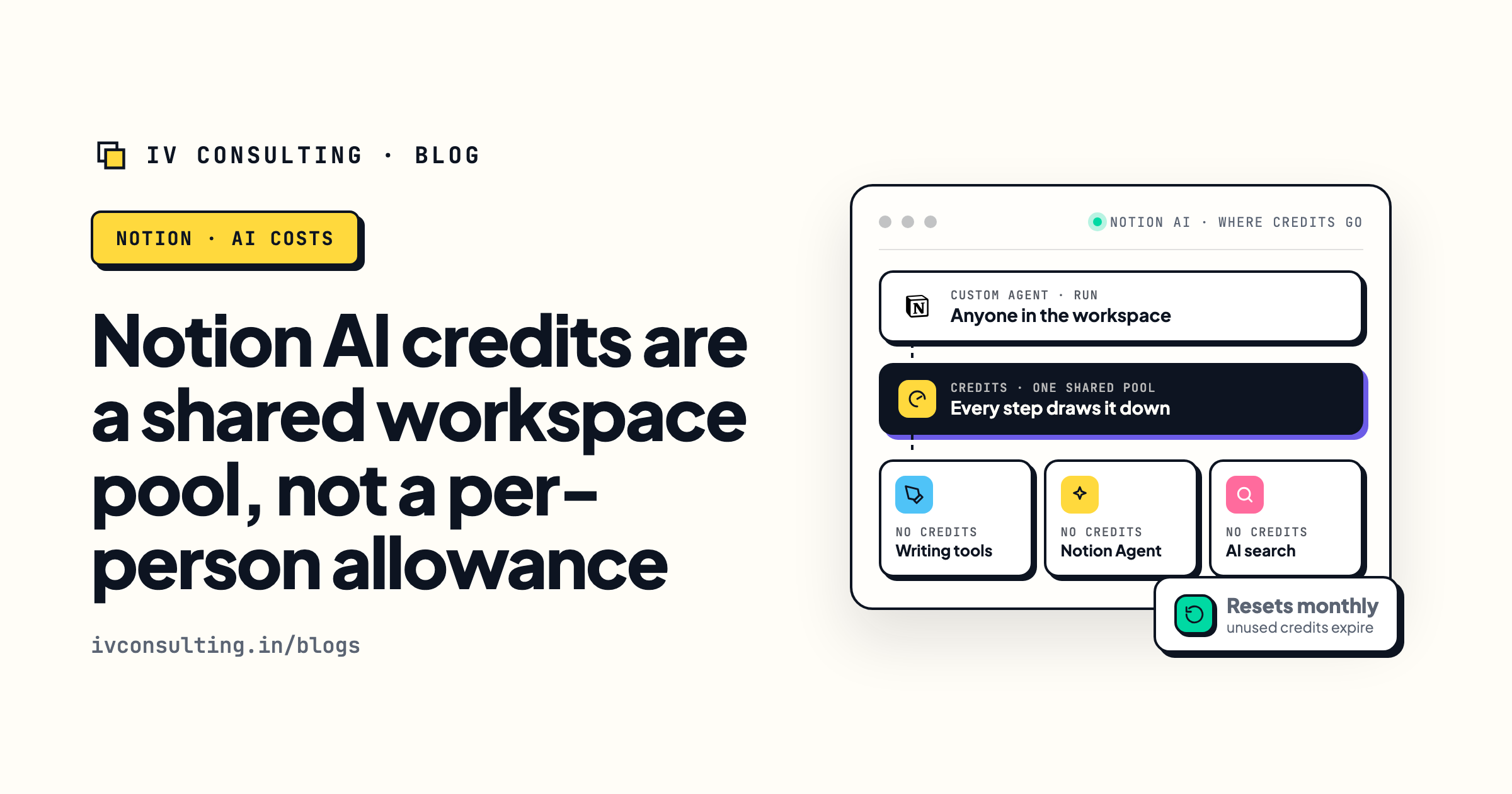
Notion AI credits explained
Standard, Select and pooled credits, and where Workers fit.
Read the explainer →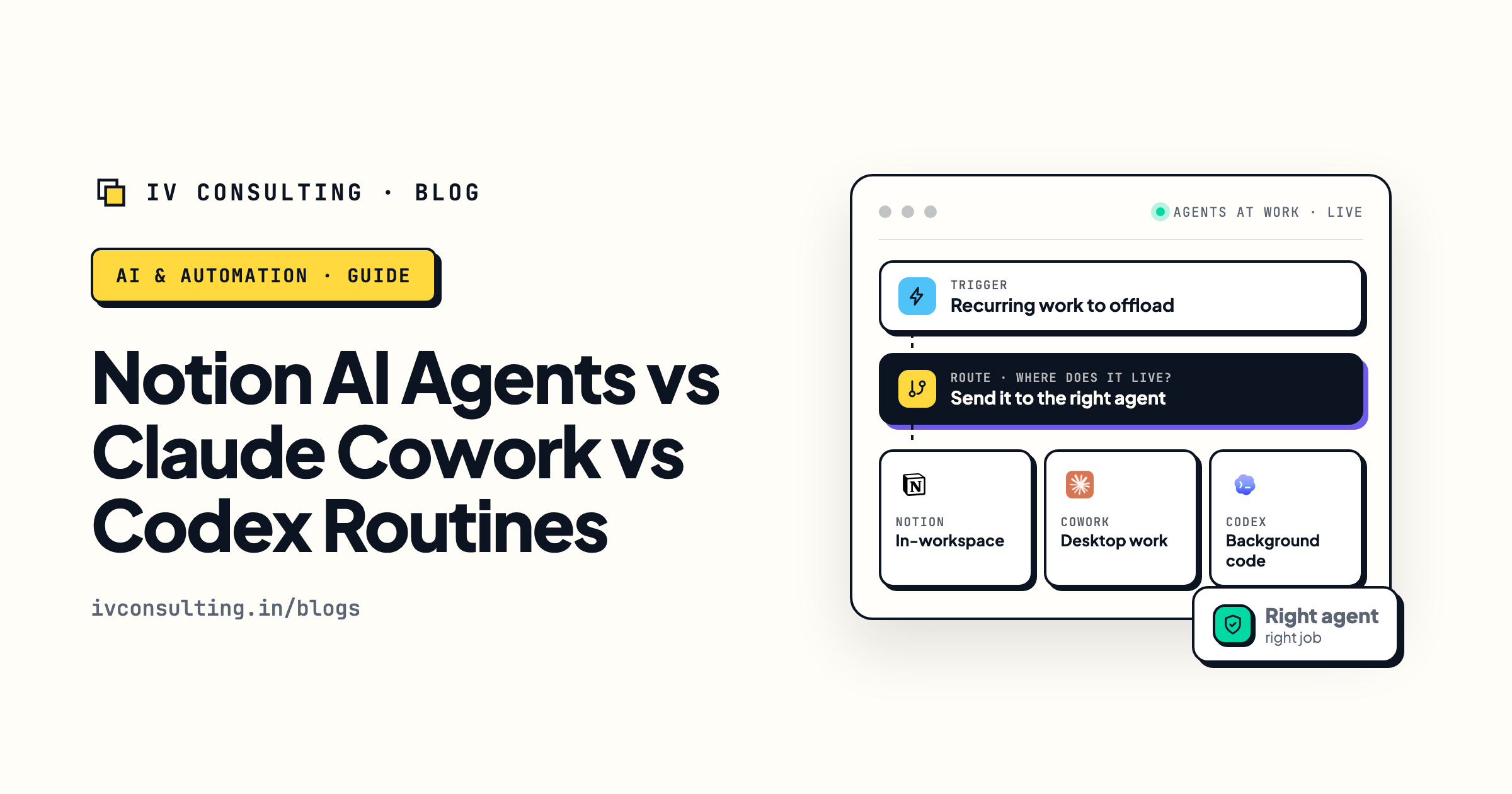
Notion agents vs Cowork vs Codex
Which scheduled agent should run your recurring ops work.
Read the comparison →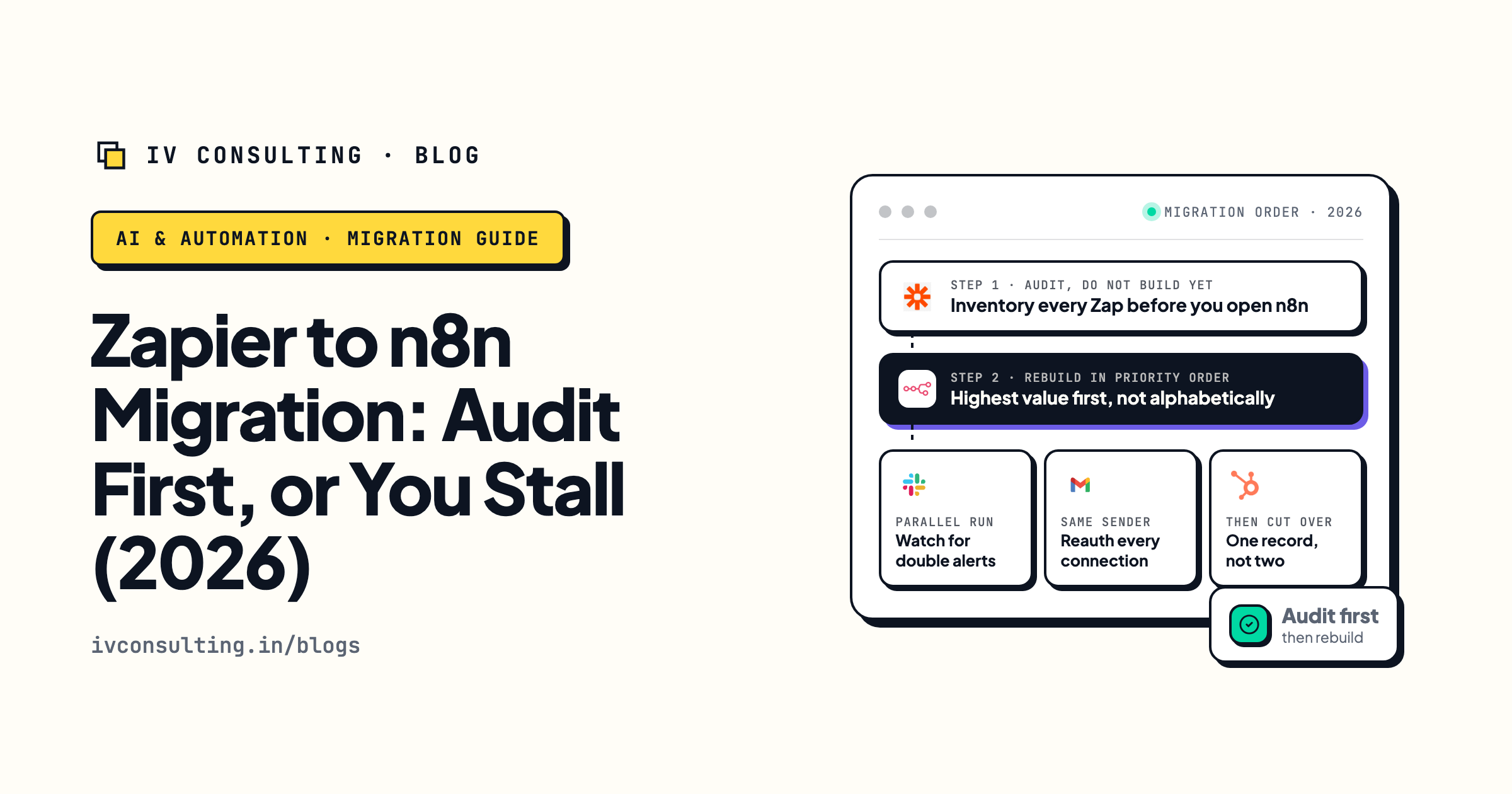
Zapier to n8n migration
What moves cleanly, what breaks, and when it pays off.
Read the guide →Want your Notion syncs and agents mapped properly?
Book a free 30-minute strategy call. We will list the syncs you run, price them on the tools you already pay for, and decide which ones an agent should be able to call.
Book a Free Strategy Call →Free 30-minute call. Honest take, even if that means "leave it where it is."