Asana vs ClickUp vs monday AI agents: we priced 450 runs for a 10-person team.
Asana AI Teammates, ClickUp Super Agents and monday agents all do roughly the same job now: read your tasks, decide something, act on it. They are priced three completely different ways. Asana bills a flat fee per AI request, ClickUp sells credits on top of a per-seat AI add-on, and monday meters credits by how hard the task is. We took each vendor's own pricing page and usage docs, read on 5 October 2026, and costed the same two agents on all three for a 10-person team.
 By Ishan Vats · Certified ClickUp Consultant, builds agents and automations for ops teams
 Asana AI Teammates$0.50 to $0.60 per request, flat
 ClickUp Super Agents100 to 300 credits, $0.10 to $0.30
 monday agents10 to 250+ credits per task, $0.10 to $2.50+
For a 10-person team on annual billing, Asana AI Teammates cost $109.90 a month in seats with 50 AI requests included, then $0.50 per request. ClickUp Super Agents need the Brain AI add-on, so Business plus Brain AI is $210 a month with 15,000 credits, and a Super Agent run uses 100 to 300 credits ($0.10 to $0.30). monday agents come with Standard at $120 a month and 2,000 credits, at $0.01 a credit and 10 to 250+ credits per task. Our verdict: Asana is cheapest and most predictable under about 50 agent runs a month, monday is cheapest for one simple high-volume agent, and ClickUp is never the cheapest agent bill, so only pick it for the workspace, not the agent.
The verdict
Asana AI Teammates vs ClickUp Super Agents vs monday agents: which is cheapest?
It depends on one number: how many times a month your agent runs. Under about 50 runs, Asana is cheapest and you know the bill in advance. At hundreds of simple runs, monday is cheapest by a wide margin. ClickUp sits in the middle on per-run cost but charges the most just to switch AI on, so it never wins on agent price alone.
A disclosure first. I am a Certified ClickUp Consultant and we build ClickUp workspaces for clients, so I have a reason to like ClickUp. That is why the ClickUp column below is the least flattering one, and why every number comes from the vendors, not from us. The prices are from Asana's pricing page, ClickUp's pricing page and monday.com's pricing page. The per-run credit figures are from ClickUp's AI Credits article and monday's AI credits article. All were read on 5 October 2026. The arithmetic and the opinions are ours. We have not benchmarked the three agents against each other on the same task, so this is a cost comparison, not a quality test.
Three calls drive the verdict:
- Asana is the only flat meter. One successful unit of work is one AI request, whatever it took. Failed, timed-out and canceled tasks do not count. That makes Asana the easiest bill to forecast and the most expensive one at volume.
- monday is the cheapest meter and the most sensitive one. A simple task can cost a tenth of an Asana request. A complex one can cost five times more. How you write the agent decides the bill.
- ClickUp's cost is mostly the seat, not the run. Brain AI is $9 per user per month on annual billing, on every seat, before an agent does anything. Runs themselves are cheap, at 100 to 300 credits each at $0.001 a credit.
How each one bills
How are Asana AI Teammates, ClickUp Super Agents and monday agents priced?
Asana includes a small pool of AI requests in every paid plan and sells the rest at $0.50 each. ClickUp sells AI as a per-seat add-on that comes with credits. monday includes a pool of credits per account in every paid plan and meters agent work by complexity.
| Asana AI Teammates | ClickUp Super Agents | monday agents | |
|---|---|---|---|
| Cheapest plan with agents | Starter, $10.99 ($13.49) | Any paid plan plus Brain AI. Business $12 ($19) + Brain AI $9 ($14) | Basic has a "limited" agent workforce. Standard $12 ($14) is the realistic start |
| AI included | 5 requests per user, up to 50 per account a month | 1,500 credits per user a month with Brain AI, pooled across the Workspace | 2,000 credits per account a month on Standard (1,000 on Basic, 3,000 on Pro) |
| Unit you pay for | One AI request = one successful unit of work | Credits, by complexity and number of actions | Credits, by task complexity and the model you pick |
| Price of extra usage | $0.50 per request prepaid, $0.60 pay as you go | $0.001 per credit, sold in $10 blocks of 10,000 | $10 per 1,000 credits on annual billing ($12.50 monthly), so about $0.01 each |
| Cost of one agent run | $0.50 to $0.60, flat | 100 to 300 credits, so $0.10 to $0.30 | Simple 10 to 50 credits ($0.10 to $0.50), intermediate 50 to 150, complex 150 to 250, extra complex 250+ per task |
| Do unused allowances roll over? | Prepaid packs last the whole annual contract | No, credits reset monthly | Monthly allowance per the pricing page |
| Spend controls | Alerts at 65, 85 and 100 percent, spend cap, per-user access toggle | Per-agent cost and usage panel for admins | Per-run credits in the Activity tab, per-user and per-use-case limits |
Two details change real bills more than the headline prices do. First, ClickUp has a bigger tier, Everything AI at $28 per user on annual billing ($33 monthly), which raises the allowance to 5,000 credits per user (we compare the per-seat AI bill in ClickUp Brain vs Notion AI, per seat) and is the plan ClickUp recommends for agents. For 10 people that is $280 a month in AI alone. Second, monday's calculator showed a 10-seat special offer on 5 October that cancels the cost of the included credits. At 20 seats the same calculator added the credits on top of the seats, so check your own seat count before you trust a quote.
Our arithmetic
What do PM-tool AI agents actually cost a 10-person team?
For one busy triage agent running 450 times a month, monday comes to about $154, ClickUp $240 to $330 and Asana about $310. For one weekly research agent running about 43 times a month, Asana comes to $109.90, monday about $152 and ClickUp $210.
We used two agents that monday itself publishes credit figures for, so at least one column is the vendor's own number rather than our estimate:
- Agent A, request router. Reviews every new request on an intake board, assigns it to the right person and posts an update. monday's article puts it at about 5,400 credits a month at 15 runs a day. We used 15 runs a day for 30 days, so 450 runs.
- Agent B, research and synthesis. Researches 10 topics a week, writes a doc and updates the board. monday's article puts it at about 5,160 credits a month. That is about 43 runs a month.
Assumptions, stated so you can change them: 10 seats, annual billing, the cheapest plan that runs agents properly, one Asana AI request per agent run, ClickUp at its published 100 to 300 credits per Super Agent run, and monday at its own published figures for these two agents.
| 10 seats, per month | Asana Starter | ClickUp Business + Brain AI | monday Standard |
|---|---|---|---|
| Seats, AI switched on | $109.90 | $210 ($120 plan + $90 Brain AI) | $120 |
| Included each month | 50 requests | 15,000 credits | 2,000 credits |
| Agent A: router, 450 runs | 400 extra requests x $0.50 = $200 | 45,000 to 135,000 credits needed, so $30 to $120 extra | 5,400 credits needed, so 3,400 x $0.01 = $34 extra |
| Total with Agent A | $309.90 ($349.90 pay as you go) | $240 to $330 | $154 |
| Agent B: research, ~43 runs | Inside the 50 included, $0 extra | 4,300 to 12,900 credits, inside the 15,000 included | 5,160 credits needed, so 3,160 x $0.01 = $31.60 extra |
| Total with Agent B | $109.90 | $210 | $151.60 |
Read the two rows together and the pattern is clear. Asana is the cheapest tool until you pass its 50 included requests, then every run costs up to five times what the same run costs on ClickUp. monday is cheapest when the work is simple and frequent. ClickUp starts $90 to $100 a month behind because the AI add-on is charged on every seat, and it never makes that back at this team size. On Everything AI instead of Brain AI, ClickUp would cover Agent A inside its 50,000 included credits at the low end, but the seats alone would be $400 a month.
Where the math flips
When is monday more expensive than ClickUp or Asana?
monday wins the table above because its own router example uses about 12 credits a run. Its published ranges are much wider than that, and that is where the ranking can turn upside down.
The same router, written loosely
If the router's runs land in monday's "intermediate" band of 50 to 150 credits, 450 runs need 22,500 to 67,500 credits. That is $205 to $655 of extra credits on top of $120 in seats, so $325 to $775 a month, which is more than both Asana and ClickUp. monday's own advice is to give agents granular instructions, name the exact tools and avoid web searches unless the task needs one. Follow it and you stay near the cheap end.
Asana never moves
A request costs $0.50 whether the Teammate updated one field or wrote a brief. That is the case for Asana: if your agents do heavy work a few times a week, the flat price is a bargain.
ClickUp moves inside a narrow band
100 to 300 credits a run is a 3x spread, against monday's 25x. Every Super Agent run counts, including runs that only answer a question and take no action, so chatty agents add up.
Model choice is a monday lever
monday lets you choose the model behind an agent. It recommends Claude Sonnet by default, says Opus is for complex multi-system tasks, and says OpenAI models generally use more credits at the same complexity.
The cheapest run is no agent
Should a high-volume job be an AI agent or an automation rule?
If the job runs hundreds of times a month and the decision follows a rule you could write down, make it an automation, not an agent. An automation run costs nothing extra on Asana Starter and almost nothing on ClickUp Business, and it gives the same answer every time.
Our request router is the honest example. If "assign by request type" is a dropdown value, that is a rule, and every tool here has rules. The allowances matter, though:
- Asana Starter includes unlimited automations, so a 450-a-month routing rule is free.
- ClickUp Business includes 5,000 automations a month, which covers it with room to spare.
- monday Standard includes only 250 automation actions a month. A 450-a-month rule does not fit, so you either move to Pro at $19 a seat with 25,000 actions, or you route through an external tool.
Use the agent for the part that needs judgement: reading a messy request, working out what it is really about, drafting the first reply. Run that on fewer items and the agent bill falls into the "included" row on every tool. Anything that crosses tools, such as a CRM update or a client email, is usually sturdier in n8n or Make than inside any PM tool. That split between rules and judgement is the core of our Automation stage, and we cover what ClickUp's own agents do well in ClickUp AI agents in chat for SMB ops.
FAQ
Questions teams ask about PM-tool AI agent pricing
How much do Asana AI Teammates cost?
Are ClickUp Super Agents free?
How many credits does a monday agent use?
Which PM tool has the cheapest AI agents for a small team?
When do monday agents cost more than Asana or ClickUp?
Should I switch project management tools to get better AI agents?
Ishan Vats
Founder, IV Consulting · Certified ClickUp Consultant
I build workspaces, automations, and production AI agents for teams from startup to enterprise. 150+ ops transformations over 10+ years. I implement ClickUp for a living, which is exactly why this comparison uses only the vendors' own numbers and shows ClickUp losing on agent price.
Price your agent →Keep reading
Related guides and work
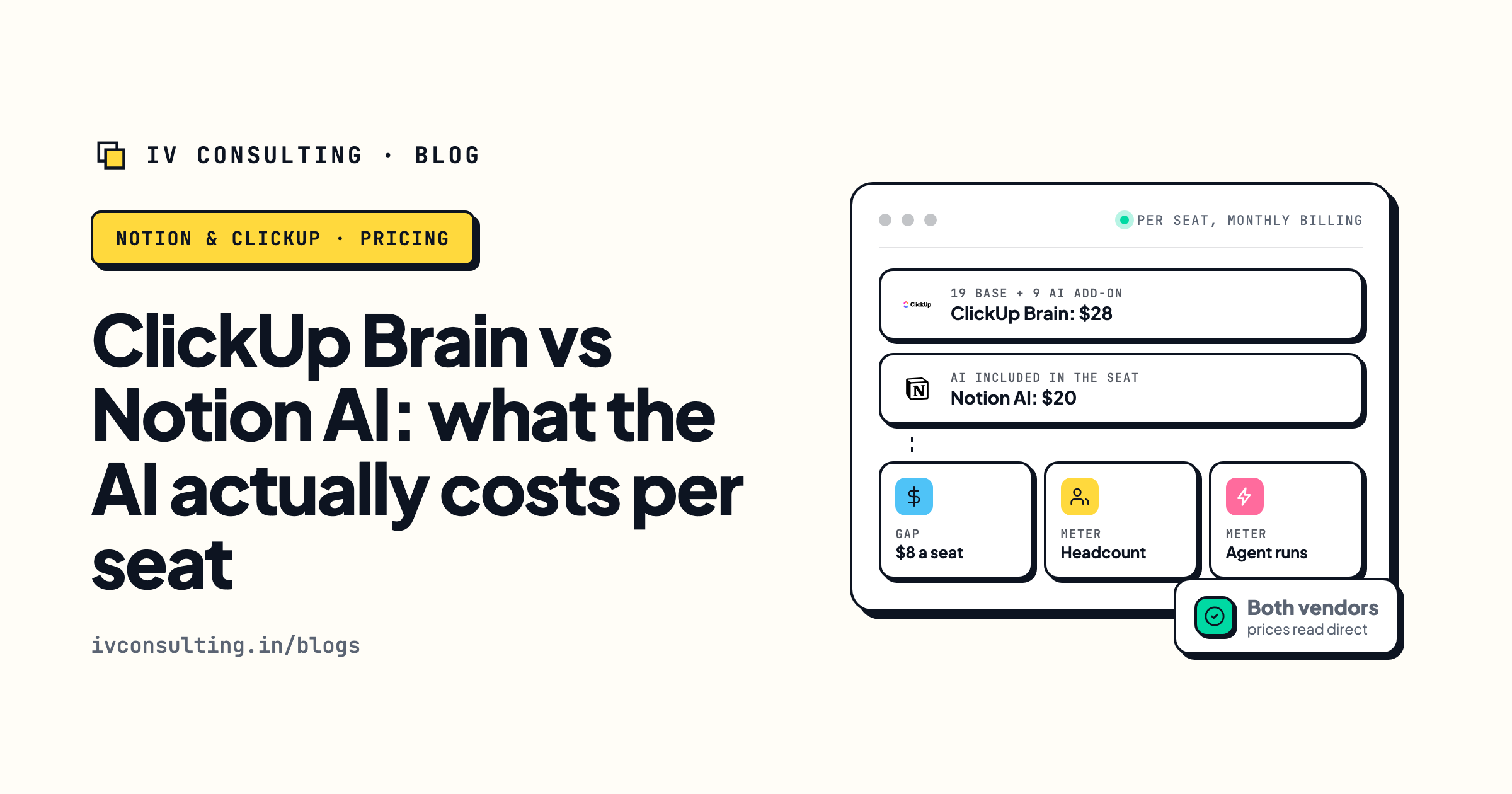
ClickUp Brain vs Notion AI, per seat
The per-seat AI bill when the comparison is ClickUp against Notion instead.
Read the comparison →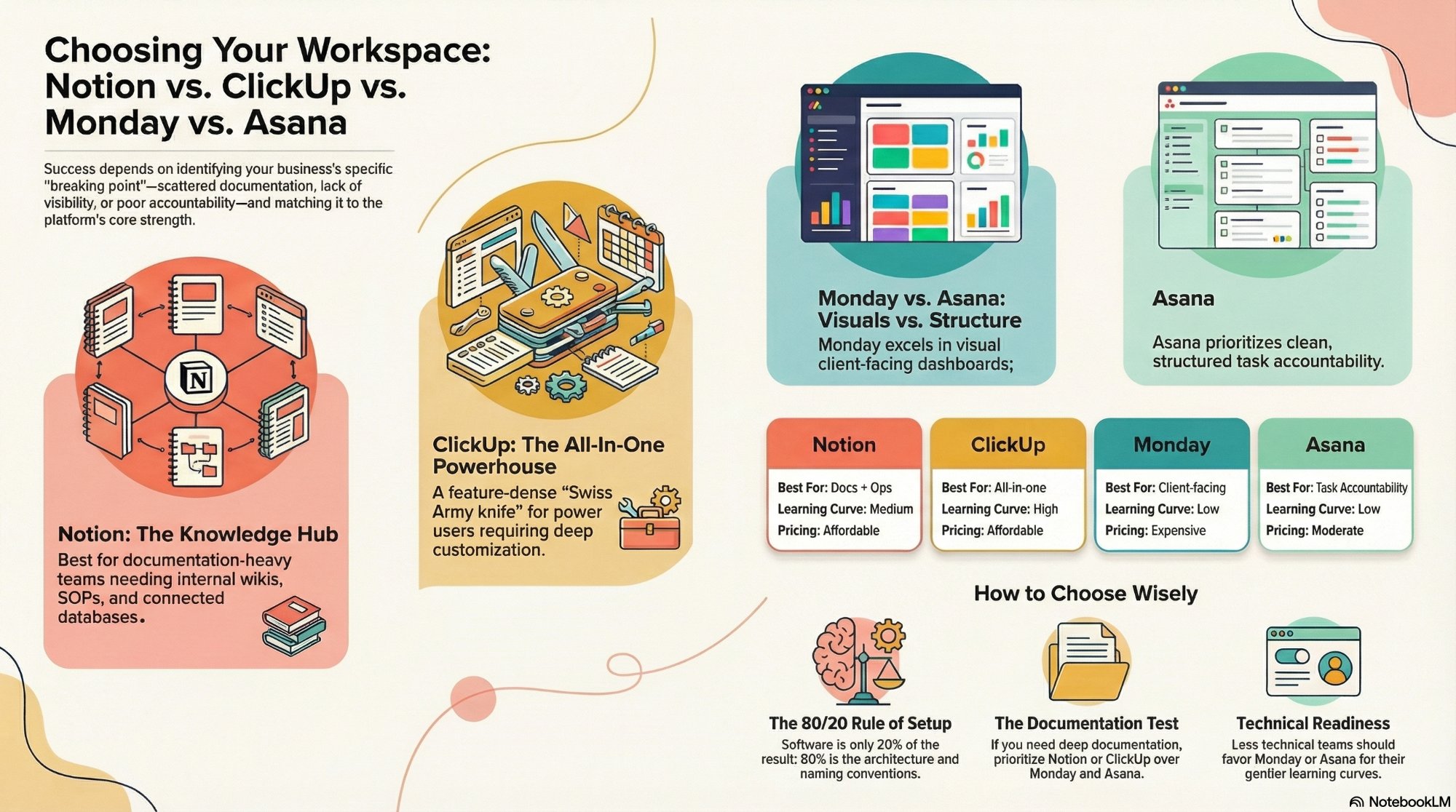
Notion vs ClickUp vs Monday vs Asana
Our 2026 pick between the four, on everything except AI pricing.
Read the comparison →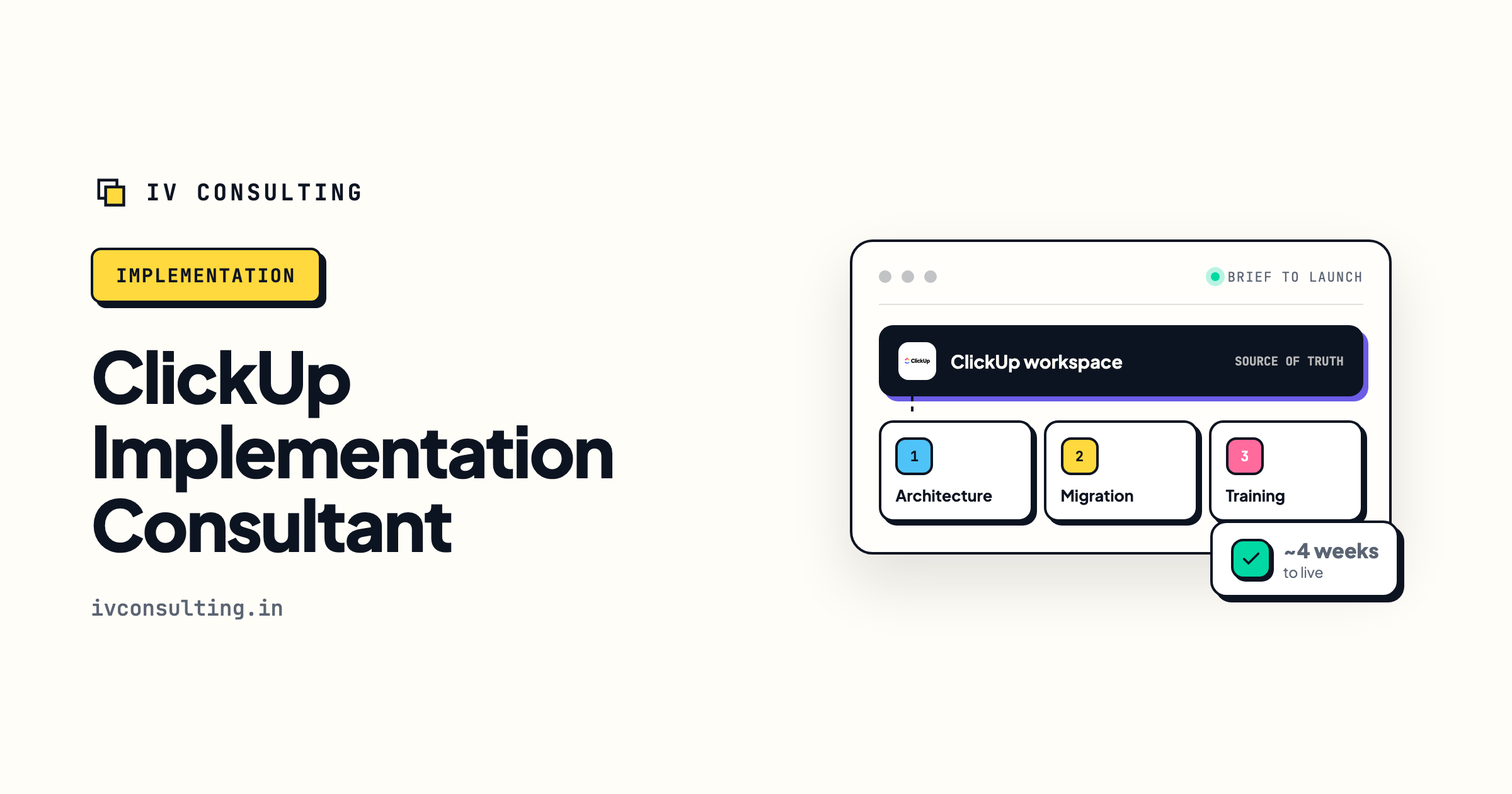
ClickUp implementation
Architecture, agents and adoption, live in about four weeks.
See the service →Want the agent, without the surprise bill?
Book a free 30-minute strategy call. We will look at the job you want an agent for, tell you whether it should be an agent or an automation, and estimate the monthly cost on the tool you already use. If a rule will do, we will say so.
Book a Free Strategy Call →Free 30-minute call. Honest take, even if that means "you do not need us yet."