n8n MCP vs Zapier MCP vs Make MCP: we connected all 3 to Claude.
The question used to be "which automation tool". In 2026 it is "which automation tool do I hand to my AI assistant". We have the n8n, Zapier and Make MCP servers all connected to Claude in IV's own workspace, so we counted exactly what each one lets the model do, then priced the same job through all three at 300 and 1,500 runs a month. The billing models are so different that one of them costs ten times the others for the same work.
 By Ishan Vats · Founder of IV Consulting · builds AI agents & automations for 150+ teams
 MCP clientClaude calls the automation tool
 n8n Cloud1,500 executions, €20 a month
 MakeAbout 6,000 credits, $16 a month
 Zapier MCP12,000 tasks, $189 a month
n8n MCP, Zapier MCP and Make MCP all let Claude or ChatGPT drive your automations, but they bill completely differently. Zapier MCP charges 2 tasks for every successful tool call. n8n bills one execution per workflow run, however many steps it has. Make bills credits, roughly one per module action. For one job that touches four apps, run 1,500 times a month on annual list prices, that is about $189 a month on Zapier, €20 on n8n Cloud Starter and $16 on Make. Our verdict: if you connect one MCP server, connect n8n. Use Zapier MCP as the long-tail adapter for one-off actions in apps you have no workflow for, and connect Make with scenario run scopes only, because its management scope handed our Claude 14 delete tools.
First-hand
n8n MCP vs Zapier MCP vs Make MCP: what does each one let Claude do?
n8n's MCP server lets Claude find, run, build and edit the workflows you opt in. Zapier MCP lets Claude execute individual actions across 9,000+ apps. Make's MCP server runs the scenarios you expose and, with management scopes, can change almost anything in your Make account.
Marketing pages describe these servers in the same breath. Connected to the same client, they are three different products. All three are connected to Claude in IV's own workspace, and on 14 October 2026 we counted the tools each one actually hands the model. Tool count is not a quality score. It is a map of what the model can do without asking you.
| n8n instance-level MCP | Zapier MCP | Make MCP server | |
|---|---|---|---|
| Tools in our connection | 28 | 17 | 111 (management scopes on) |
| Delete-type tools | 1 (a data table column), plus archive and unpublish | 1 (a saved skill) | 14, including scenarios, teams and organizations |
| Unit Claude works with | Your workflows | Single app actions you enable | Your scenarios, plus the whole account |
| Can Claude build automations? | Yes, create and edit with validate and test tools (n8n 2.13.0+) | No, it runs actions; we saw no tool to list or run existing Zaps | Yes, via management tools (paid plans) |
| Reach | Whatever your workflows connect to | 9,000+ apps through one connection | Whatever your scenarios connect to |
| What gets exposed | Only workflows, projects or folders you toggle on | Only actions you enable; reads and writes are separate tools | Scenarios set to active and on-demand, or the account, by scope |
| Billing unit | 1 execution per workflow run | 2 tasks per successful tool call | Credits, about 1 per module action |
| Free to start? | Self-hosted, yes; Cloud from €20 a month | On every plan; Free has 100 tasks, about 50 calls | Scenario run scopes on all plans |
Sources, read 14 October 2026: tool counts are from our own Claude connections to each server; capabilities from n8n's MCP server docs, Zapier's MCP usage article and Make's MCP server help page. Your counts will differ with version, plan and the scopes you grant.
The one-line read: n8n hands Claude your workflows, Zapier hands it every app, and Make hands it your whole account if you let it. That difference drives both the bill and the risk, which are the next two sections.
The comparison
What does it cost when Claude calls each MCP server every day?
For one 4-action job run 1,500 times a month, Zapier MCP needs 12,000 tasks ($189 a month), n8n Cloud needs 1,500 executions (€20 a month on Starter) and Make needs about 6,000 credits ($16 a month), all on annual list prices. This is our arithmetic on published prices, not invoice data, and it leaves out the model's own token cost, which is the same whichever server you use.
The job: a lead comes in and Claude looks up the contact in HubSpot, updates the deal, posts to Slack and logs a row in Google Sheets. Four app actions. On n8n and Make you build that once as one workflow or scenario and Claude calls it. On Zapier MCP, Claude makes the four calls itself, because the server works action by action.
| Volume | Zapier MCP | n8n Cloud | Make |
|---|---|---|---|
| 4-action job, 300 runs a month (10 a day) | 2,400 tasks: 5K tier, $89 | 300 executions: Starter, €20 | ~1,200 credits: 5,000 tier, $9 |
| 4-action job, 1,500 runs a month (50 a day) | 12,000 tasks: 20K tier, $189 | 1,500 executions: Starter, €20 | ~6,000 credits: 10,000 tier, $16 |
| 10-action job, 1,500 runs a month | 30,000 tasks: 50K tier, $289 | 1,500 executions: Starter, €20 | ~15,000 credits: 20,000 tier, $29 |
| Self-hosted option | None | No per-execution charge, you pay for the server | None |
How we priced it: Zapier charges 2 tasks per successful MCP tool call from the same pool as your Zaps, and its Professional plan lists 5K tasks at $89, 20K at $189 and 50K at $289 a month billed annually. n8n Cloud Starter is €20 a month billed annually for 2,500 executions, and n8n defines an execution as a single run of the whole workflow. Make's credit tiers are the ones we verified in Make credits vs operations: $9 for 5,000, $16 for 10,000 and $29 for 20,000 a month billed annually, with most actions at 1 credit. Make's docs do not say whether a run started over MCP costs anything extra, so we assume it bills like any other run.
Three things fall out of the table. Make is the cheapest at small volumes for simple jobs, and that is worth saying plainly. n8n is the only one whose bill does not grow with the number of steps, so it wins as jobs get longer and is flat until you pass 2,500 runs a month. And Zapier MCP is roughly ten times the other two for the same work, because it bills per call and a single job is several calls. The Zapier tasks also come out of the same allowance your Zaps use, so an assistant that gets busy can stop your production Zaps when the pool runs dry.
The table uses two invented volumes. Yours are the ones that matter. Put the jobs you would hand to Claude, how often they run and the hours they replace into our AI agent ROI calculator. It takes about two minutes and tells you whether the automation is worth wiring up at all, before you argue about which MCP server runs it.
The risk
Which MCP server is safest to connect to Claude?
The safest server is the one scoped to the job: n8n exposes only workflows you opt in, Zapier splits reads from writes, and Make is safe only when you connect it with scenario run scopes instead of management scopes.
This is the finding that surprised us. With management scopes granted, Make's server gave our Claude 111 tools, and 14 of them delete something: scenarios, connections, data stores, keys, webhooks, teams and organizations. That is not a bug. Management scopes are designed to let a client manage your account. But it means a single badly worded instruction, or a prompt injected through a document the model reads, is one tool call away from removing production scenarios.
n8n: opt-in by workflow
Instance MCP has to be switched on by an owner or admin, and then each workflow, project or folder is enabled individually. The catch n8n documents: access is not scoped per client, so Claude Desktop and ChatGPT see the same enabled workflows.
Zapier: read and write are separate
Actions are enabled one by one, and reads and writes are different tools, so you can approve writes and let reads run. The exposure is breadth: one connection reaches every app you have authorised.
Make: choose the scope at connect
Scopes are picked on the OAuth screen or the MCP token dialog. Scenario run scopes only expose scenarios that are active and on-demand. Make also recommends toolboxes when you want tighter control of which scenarios a client sees.
The rule we use with clients
Expose finished workflows, not the platform. Claude should call a tested "qualify this lead" workflow, not hold the keys to edit, delete and rebuild the system that runs your business. Build access belongs in a sandbox workspace, not production.
If prompt injection is new to you, our guide to prompt injection for SMBs explains why "the model would never do that" is not a control.
The verdict
Our verdict: which MCP server should Claude use to run your automations?
Connect n8n first, add Zapier MCP for the long tail of one-off actions, and use Make's server only if Make is already where your automations live, with scenario run scopes only. We take that side for three reasons, and only one of them is price.
n8n: the one to connect first
Per-run billing that ignores step count, the option to self-host, opt-in exposure by workflow, and a build loop with validate and test tools that let Claude draft a workflow you then review. It is the server we run with Claude in our own stack and in client builds. The cost is setup: someone has to build the workflows Claude calls.
Zapier MCP: the long-tail adapter
Unbeatable reach and zero build work. Perfect for "add this person to Mailchimp" once a week in an app you will never write a workflow for. Wrong for anything that repeats daily, because 2 tasks per call compounds into the most expensive row in every scenario we priced.
Make: fine if you already live there
Cheapest at low volume for simple scenarios, and scenario-as-tool works on every plan. We would not move to Make for MCP alone, and we would never connect it to a production org with management scopes.
The honest caveat: if you have no workflows yet and no one to build them, Zapier MCP is the fastest way to see what an assistant can do across your apps this afternoon. Start there, notice which calls repeat, and move those into n8n once they do. That is the same build-or-buy line we drew in Zapier Agents vs Make AI Agents vs n8n, one layer down, and it matches the arithmetic in execution-based vs task-based pricing.
Do this next
How do you connect an automation MCP server to Claude safely?
To connect an automation MCP server to Claude safely, build each repeat job as one tested workflow, expose only those workflows, keep writes behind approval, and watch the meter for a week. Whichever server you choose, the setup that keeps it cheap and safe is the same five steps.
List the jobs, not the apps
Write the three to five things you want Claude to do, how often, and which apps each touches. That list decides the server, and the table in section 02 prices it.
Build repeat jobs as one workflow each
In n8n or Make, one tested workflow per job, with clear inputs and outputs. Claude calls one tool and you pay for one run, not four calls.
Expose only those workflows
In n8n, toggle MCP access per workflow or folder. In Make, connect with scenario run scopes. In Zapier, enable only the actions you need.
Keep writes behind approval
Let Claude run reads freely and ask before writes, especially anything that sends, deletes or touches money. Zapier's read and write split makes this easy to set up.
Watch the meter for a week
Zapier shows MCP tasks separately from plan tasks on its MCP dashboard; n8n and Make show executions. If a job fires more than you expected, move it or throttle it before the bill teaches you.
For the standard itself, start with MCP for small businesses, explained. If you want the workflows built and exposed for you, that is what our automation practice does.
FAQ
Questions about n8n, Zapier and Make MCP servers
Is n8n MCP or Zapier MCP better for Claude?
For jobs that repeat, n8n. Its instance-level MCP server lets Claude search, run, build and edit the workflows you expose, and n8n bills one execution per workflow run however many steps it has. Zapier MCP is better for one-off actions in apps you have no workflow for, because it reaches 9,000+ apps, but every successful tool call costs 2 tasks, so repeat jobs get expensive fast.
How much does Zapier MCP cost?
There is no separate MCP fee. Each successful Zapier MCP tool call uses 2 tasks from the same allowance your Zaps use, and failed calls use none. A job that needs 4 app actions is 4 calls, or 8 tasks. At 1,500 such jobs a month that is 12,000 tasks, which needs the 20K tier of Zapier Professional at $189 a month billed annually.
Does the n8n MCP server count against executions?
When Claude runs a workflow through it, yes: n8n defines an execution as a single run of your entire workflow, and that is what you are billed on. Searching workflows or reading their details does not run a workflow. On n8n Cloud Starter, 20 euros a month billed annually, you get 2,500 executions. Self-hosted n8n has no per-execution charge.
Can Make's MCP server run my scenarios on the free plan?
Yes. Make says scenario run scopes are available on all plans, and management scopes, which let a client view and change scenarios, connections, webhooks and data stores, need a paid plan. A scenario has to be active, set to on-demand scheduling, with its inputs and outputs defined before a client can call it. Each run uses credits like any other scenario run, about one per module action.
Which MCP server is safest to give Claude?
The one with the smallest scope that does the job. n8n exposes only the workflows you opt in, and in our connection had 28 tools. Zapier separates read and write actions into different tools. Make with management scopes gave our Claude 111 tools, 14 of them deletes, including deleting teams and organizations. Connect Make with scenario run scopes only unless you truly need management.
Can Claude build automations through these MCP servers?
n8n and Make, yes. n8n's server can create and edit workflows from n8n 2.13.0, with validate and test tools alongside, and Make's management tools include creating scenarios and validating blueprints. Zapier MCP runs individual app actions you enable; in our connection it had no tool to list or run existing Zaps.
Ishan Vats
Founder, IV Consulting · AI & automation consultant
I build automations small teams run on, mostly in n8n with Claude, and I have the n8n, Zapier and Make MCP servers connected to my own Claude workspace. Deciding what an assistant should be allowed to touch is now part of every build. 150+ ops transformations over 10+ years.
Run the AI agent ROI calculator →Keep reading
Related guides and work
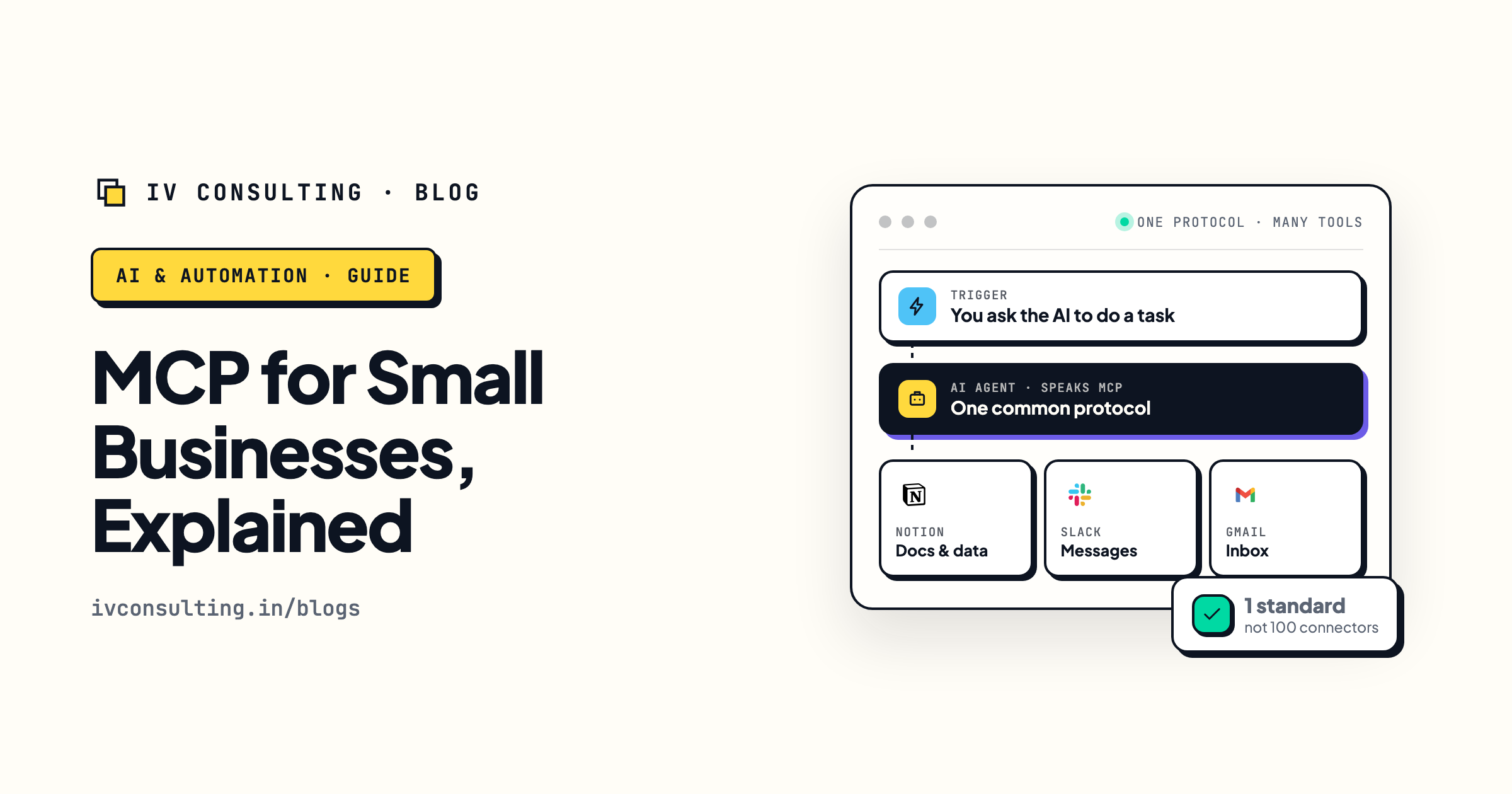
MCP for small businesses
What the Model Context Protocol is and why it matters for your tools.
Read the explainer →
Zapier Agents vs Make vs n8n
The native agent builders in each platform, compared for SMBs.
Read the comparison →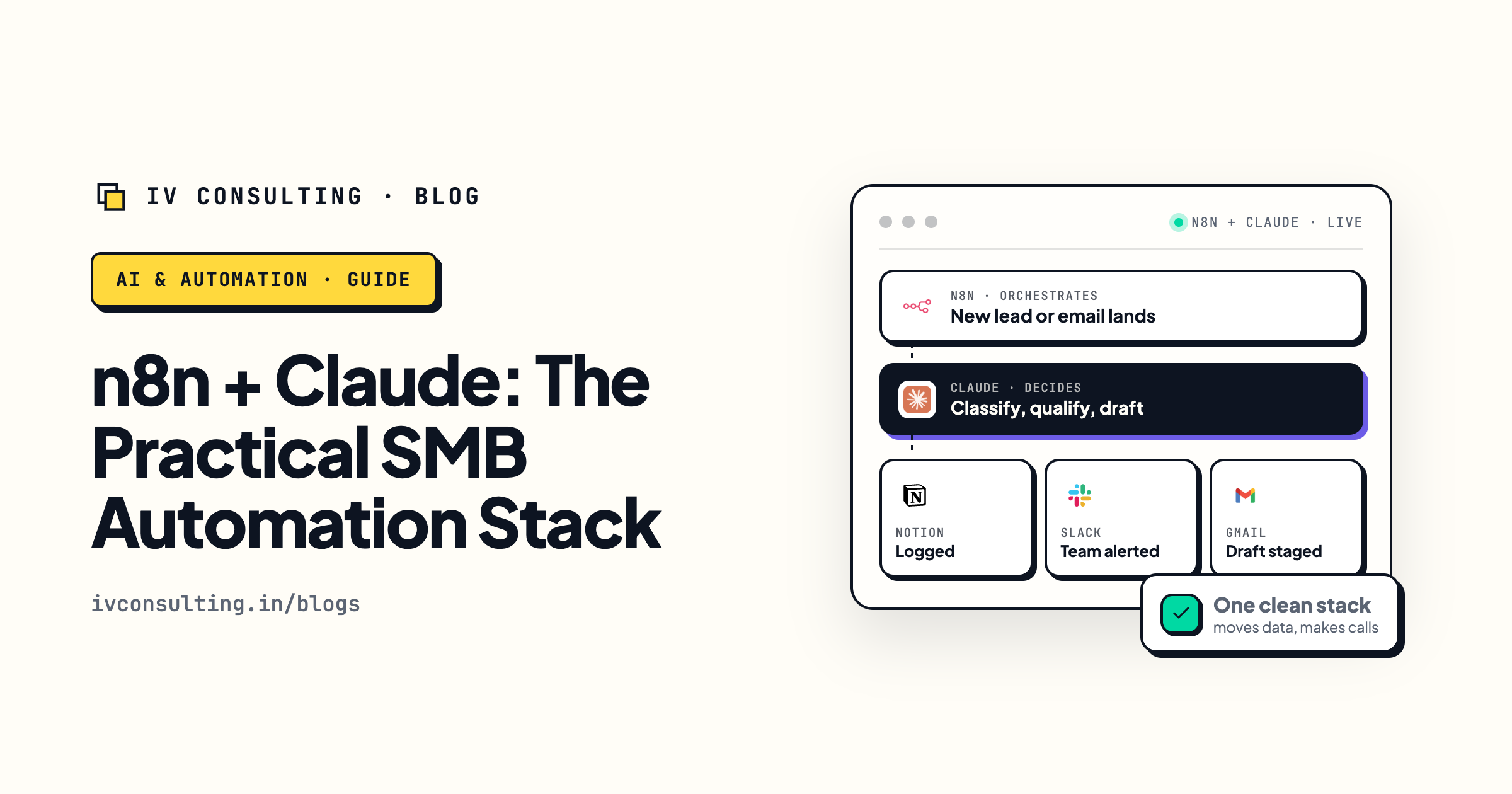
n8n + Claude for SMBs
The practical automation stack we build on, and why.
Read the guide →Want your workflows exposed to Claude, safely?
Book a free 30-minute strategy call. We will look at the jobs you want an assistant to run, pick the server that prices them sensibly, and scope what it can touch.
Book a Free Strategy Call →Free 30-minute call. Honest take, even if that means "just use Zapier for now."