Clay vs FullEnrich vs an n8n waterfall: what one verified email costs
Since Clay split its pricing into Actions and Data Credits, every step in a waterfall has a meter on it, even when you bring your own API keys. We priced the same job three ways from the vendors' own pricing pages: find and verify work emails for 1,000, 3,000 and 5,000 contacts a month in Clay, in FullEnrich, and in an n8n waterfall you run yourself. Then we took a side.
 By Ishan Vats · Founder of IV Consulting · builds outbound systems in Clay, Smartlead and n8n
 Clay Launch~$0.31 per verified email at 1k/mo
 n8n waterfall~$0.024 marginal, you maintain it
For finding and verifying work emails, Clay is the most expensive of the three at every volume we priced. At 1,000 contacts a month and a 60% find rate, a verified email costs about $0.31 on Clay Launch ($185 a month), about $0.21 in an n8n waterfall (n8n Cloud plus LeadMagic plus a verifier), and about $0.09 on FullEnrich ($55 for 1,000 credits, charged only when it finds a result). Clay's March 2026 pricing charges 1 Action for every enriched record, even on your own API keys, and CRM sync needs the $495 Growth plan. Our verdict: buy FullEnrich to find emails, move to an n8n waterfall once volume is steady above a few thousand contacts a month and someone owns the workflow, and buy Clay only for what sits around the email: signals, research and routing.
The meter
How does Clay pricing work in 2026, and what is an Action?
Clay now runs two meters. Data Credits buy data and AI from providers in Clay's marketplace. Actions measure platform usage: Clay's docs say each record enriched or exported counts as 1 Action, whatever the source.
The part that changes the maths is the bring-your-own-key rule. Plugging in your own Prospeo, LeadMagic or Anthropic key used to make a Clay step close to free. Under the current docs it skips the Data Credit charge, and an Action is still consumed. A five-step waterfall (three email providers, one verifier, one push to your sequencer or CRM) is about five Actions per contact, whoever supplies the data. Formulas and filters do not use Actions, so cleaning and routing logic stays free.
| Clay plan | Billed monthly | Billed annually | Included each month | What matters for enrichment |
|---|---|---|---|---|
| Free | $0 | $0 | 500 Actions, 100 Data Credits | Capped at 200 rows a table and no phone enrichment, so not a 1,000-contact tool |
| Launch | $185 ($60 Actions + $125 Data Credits) | $167 | 15,000 Actions, 2,500 Data Credits | Phones, signals and the sequencer. No CRM integrations and no HTTP API |
| Growth | $495 ($205 + $290) | $446 | 40,000 Actions, 6,000 Data Credits | CRM auto-sync, HTTP API, webhooks, web intent signals |
| Top-ups | Buy more at a 30% premium on Launch and Growth; larger Action tiers can be chosen up front | Plan your volume, do not top up | ||
Sources, read 19 October 2026: Clay pricing and Clay University's Actions and Data Credits doc. The "$167 vs $185" and "$446 vs $495" figures quoted around the web are annual vs monthly billing of the same plans, not price changes.
Two consequences most comparisons miss. First, the Launch plan cannot write into HubSpot or Salesforce, so a Clay waterfall that feeds your CRM is a Growth-plan purchase. Second, Clay's own example puts a work email at 0.5 Data Credits, so on Launch you run out of Actions long before you run out of Data Credits. The Action meter is the one to model.
The comparison
Clay vs FullEnrich vs an n8n waterfall: what is the difference?
Clay is a GTM workflow platform that happens to run waterfalls, FullEnrich is a waterfall sold as a finished product, and an n8n waterfall is the same idea built from your own provider accounts. You are choosing how much of the plumbing you want to pay for.
| Clay | FullEnrich | n8n waterfall | |
|---|---|---|---|
| What it is | Spreadsheet-style GTM platform with 150+ data providers, signals, AI research and a sequencer | Email and phone enrichment that queries 25+ sources in sequence for you | A workflow you build: email finder, fallback provider, verifier, write to your CRM |
| Entry price | $185/mo Launch, $495/mo Growth for CRM sync | $55/mo for 1,000 credits (Pro) | €20/mo n8n Cloud Starter, or self-host; plus your providers |
| Work email | About 5 Actions per contact for the waterfall, plus about 0.5 Data Credits per email | 1 credit, only when a verified email is found | LeadMagic: 1 credit per valid email, only on success; verify for about $0.004 each |
| Mobile phone | Launch and up; Clay calls phones "expensive" and lists no flat rate | 10 credits (about $0.55) | LeadMagic: 5 credits per valid mobile |
| Pay on a miss? | Actions are per record enriched | No | No, with pay-on-success providers |
| Who maintains it | Clay, plus whoever builds the table | FullEnrich | You: retries, rate limits, provider API changes |
| Best for | Signal-led outbound where research and routing matter more than the email | Teams that need verified emails and nothing else | Steady volume with an n8n owner already on the team |
Prices read 19 October 2026 from FullEnrich, LeadMagic and n8n (Starter is €20 a month billed annually). MillionVerifier is widely listed at about $37 per 10,000 verifications with credits that do not expire; check its site before you buy. LeadMagic and MillionVerifier stand in for any pay-on-success finder and any bulk verifier.
The arithmetic
What does 1,000 verified contacts cost in Clay, FullEnrich and n8n?
Divide what you actually pay that month by the verified emails you get back. On that measure FullEnrich wins at 1,000 and 3,000 contacts a month, the n8n waterfall wins from about 5,000, and Clay never wins on the email alone.
This is list-price arithmetic, not a bake-off: we did not push the same 1,000 contacts through all three tools for this post. The inputs are each vendor's pricing page on 19 October 2026 and four stated assumptions: a 60% find rate for verified work emails (yours depends on the list, so plug in your own), 5 Clay Actions per contact, 0.5 Clay Data Credits per email found, and monthly billing. Swap any of them and the method still holds.
| Contacts a month (verified at 60%) | Clay Launch | Clay Growth | FullEnrich | n8n + LeadMagic + verifier |
|---|---|---|---|---|
| 1,000 (600 verified) | $185 → $0.31 | $495 → $0.83 | $55 → $0.09 | ~$125 → $0.21 |
| 3,000 (1,800 verified) | $185, at the 15,000-Action ceiling → $0.10 | $495 → $0.28 | ~$99 at the Pro credit rate → $0.055 | ~$129 → $0.07 |
| 5,000 (3,000 verified) | $275 on the 40,000-Action tier → $0.09 | $495 → $0.17 | ~$165 → $0.055 | ~$133 → $0.044 |
| Marginal cost of one more verified email | About $0.06 (5 Actions at $0.004 per contact spread over the 60% found, plus half a Data Credit per email) | $0.055, or $0.048 on the 15,000-credit tier | About $0.024 ($0.0198 LeadMagic + $0.0037 verify) | |
n8n column: LeadMagic Essential $99 a month for 5,000 credits, n8n Cloud Starter at €20 (counted as about $23), and verification of each found email. n8n bills per workflow execution, not per contact, so one scheduled run that loops through a batch stays well inside 2,500 executions. Self-host n8n and that column drops by the n8n fee.
Three things fall out of the table:
Clay's floor is the cost
At 1,000 contacts a month you use a third of Launch's Actions and pay for all of them. Clay only gets competitive when you fill the plan, and even then the per-email price sits above both alternatives.
FullEnrich is flat
About $0.055 per verified email at every volume, with nothing charged for misses. That predictability is the product. It loses only once your volume is high enough to amortise a DIY build.
n8n has the lowest slope
Roughly $0.024 per extra verified email, less than half of FullEnrich. The catch is the $99 provider plan you pay whether you use it or not, and the hours someone spends keeping the workflow healthy.
Phones flip the picture
FullEnrich charges 10 credits (about $0.55) per mobile found; LeadMagic charges 5 credits (about $0.10 on Essential). If direct dials are the point of the list, price the phone column first.
The verdict
Our verdict: Clay, FullEnrich or n8n for a 10-person team?
Do not buy Clay to find emails. Start on FullEnrich, move the email waterfall into n8n once you are steadily above a few thousand contacts a month and someone owns the workflow, and pay for Clay only when signals, research and routing are what you are buying. We take that side for three reasons.
1. The email is a commodity
Every option here is querying overlapping providers. Paying a platform fee on top of that is a bad deal when the only output you need is a verified address.
2. Clay earns its fee elsewhere
Job-change and hiring signals, Claygent research on each account, scoring, and pushing the right contact to the right sequence: that is what a Clay table does better than anything you will build quickly. Price it for that job, and on Growth if it must write to your CRM.
3. DIY only pays with an owner
An n8n waterfall saves a few cents per contact. That is real money at 10,000 a month and a rounding error at 1,000. Without someone who already runs n8n, the first silent failure wipes out the saving.
When we scope outbound for a client, the split usually looks like this. Clay finds and qualifies the accounts and does the research a human would otherwise do. The email lookup either runs on a pay-on-success provider inside that table or moves out to a cheaper waterfall, and the finished rows go to the sequencer and the CRM. Our own prospect pipeline works the same way: Clay prepares the rows and hands them to an n8n webhook that does the sending. Where Clay steps call an AI model, use your own model key so the step skips Data Credits, and remember it still spends an Action.
The cheapest enrichment is the contact you never look up. Most of a Clay bill is spent enriching people who were never going to buy. Start from the buying signals that say an account is in market, then enrich only those. See how we map the buying signals for your ICP and wire Clay, your enrichment and your CRM around them, so you pay for the contacts that matter.
If you are still deciding which signals deserve a lookup at all, start with the buying signals worth acting on.
If you build it
How do you build an email waterfall in n8n?
An n8n email waterfall is five nodes: read the batch, call your first finder, branch to a second finder on a miss, verify whatever came back, and write the verified result to your CRM or sequencer. The build is an afternoon. Keeping it reliable is the real work.
Batch the input
Pull new contacts (name and company domain) from your CRM or a sheet on a schedule. One run per batch keeps you inside n8n's execution count.
Ask the first finder
An HTTP Request node calls a pay-on-success email finder such as LeadMagic. Dedupe first so you never pay twice for the same person.
Fall through on a miss
An IF node sends empty results to a second provider. Order providers by your measured hit rate on your own ICP, not by their marketing.
Verify before you send
Run each found address through a bulk verifier and treat catch-all domains as their own bucket, not as valid.
Write back and alert on failure
Update the CRM record, push to the sequencer, and send failed runs to an error workflow. A waterfall that stops silently costs more than the one you replaced; our guide to silent workflow failures covers the alerting.
Once the waterfall is running, the expensive mistake moves downstream: good emails sent from badly set up inboxes. If LinkedIn is part of the same motion, read what is actually safe after the HeyReach ban before you automate it.
FAQ
Questions about Clay pricing and email enrichment costs
How much does Clay cost per contact in 2026?
It depends on volume more than on the data. Clay Launch is $185 a month billed monthly ($167 billed annually) for 15,000 Actions and 2,500 Data Credits. Every enriched record costs 1 Action, so a five-step email waterfall uses about 5 Actions a contact. At 1,000 contacts a month and a 60% find rate that is about $0.31 per verified email; at 3,000 contacts it falls to about $0.10, because the plan fee is spread wider.
Does bringing your own API key make Clay free?
No. Clay's docs say an enrichment run on your own API key skips the Data Credit charge but still consumes 1 Action per record. The same applies to Claygent or other AI steps on your own model key. Your own key cuts the data bill, not the platform bill.
Is FullEnrich cheaper than Clay for finding emails?
For email-only enrichment at small and mid volume, yes. FullEnrich Pro is $55 for 1,000 credits, a work email costs 1 credit, and you are only charged when it finds verified data, so a found email costs about $0.055. Clay costs more per email because you also pay for the workflow platform around it.
Can n8n replace Clay for waterfall enrichment?
For the email waterfall itself, yes: n8n can call an email finder such as LeadMagic, fall through to a second provider on a miss, and verify the result, at the lowest marginal cost of the three. What it does not replace is Clay's signal tracking, research agents and ready-made provider catalogue, and someone on your team has to maintain the workflow.
What is waterfall enrichment?
Waterfall enrichment means asking several data providers in sequence for the same field, such as a work email, and stopping at the first verified result. It raises the find rate because each provider covers different people, and it keeps cost down when providers only charge for successful finds.
Ishan Vats
Founder, IV Consulting · GTM engineering & automation
I build outbound systems for small sales teams in Clay, Smartlead and n8n, and worked in GTM engineering as a startup co-founder before that. The costs in this post are worked from each vendor's published pricing with the assumptions stated above, not from a side-by-side run of the same list, so treat the find rate as yours to replace.
Read: what GTM engineering is →Keep reading
Related GTM guides
Buying signals worth acting on
Which signals deserve an enrichment, and which are noise.
Read the guide →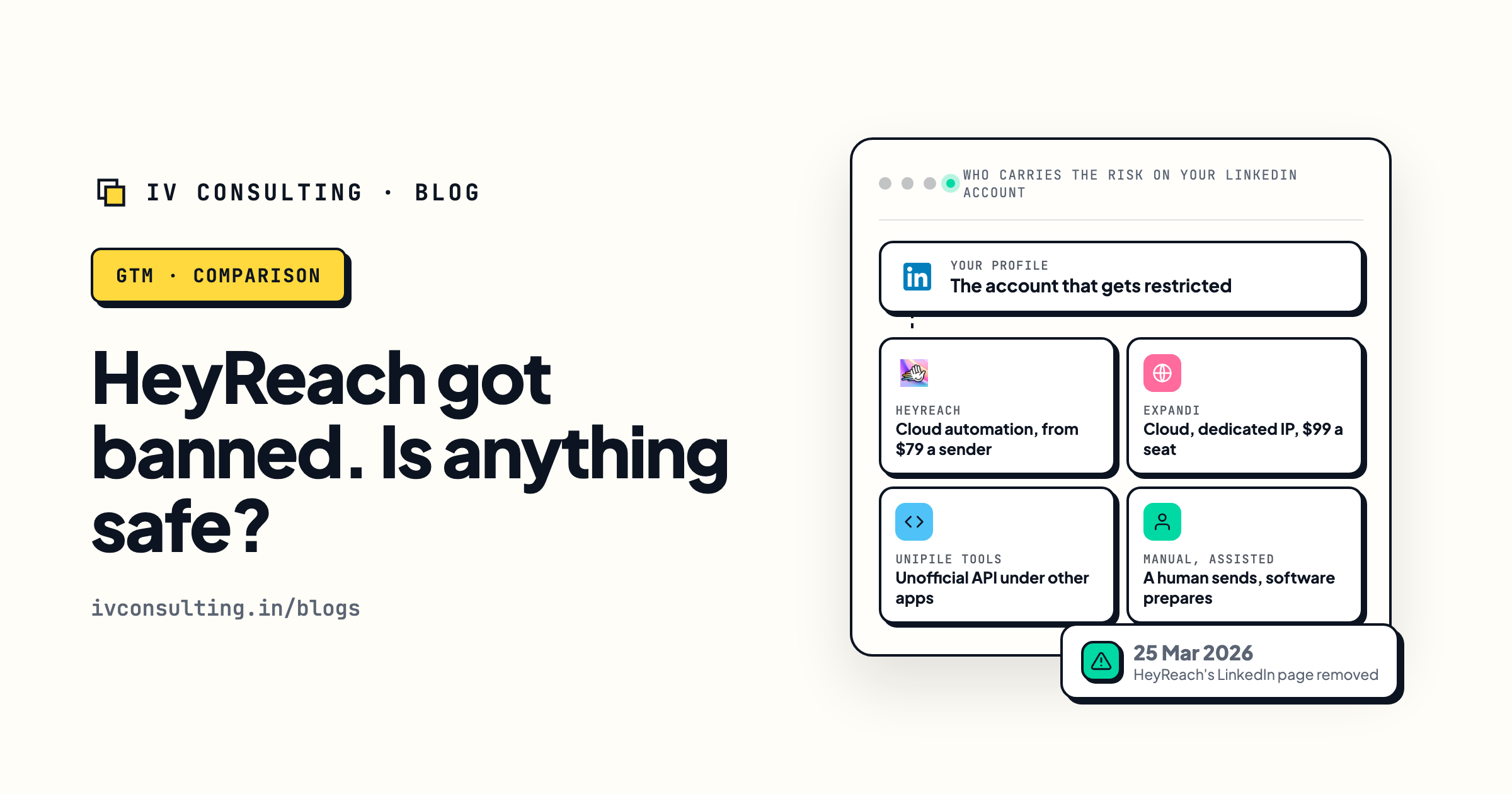
HeyReach banned: what is safe?
LinkedIn automation risk after the ban, and the setup we would defend.
Read the verdict →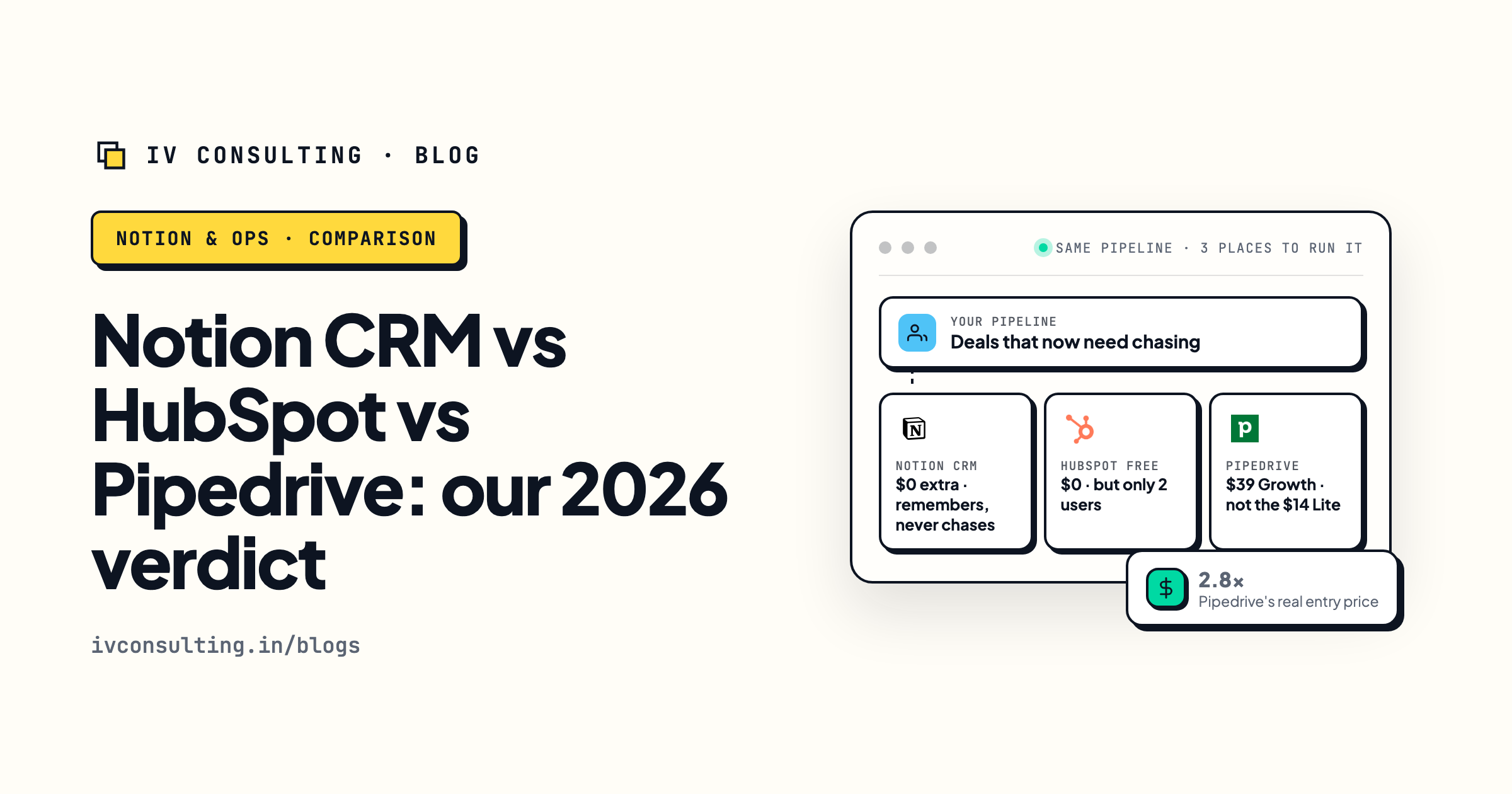
Notion CRM vs HubSpot vs Pipedrive
Where your enriched contacts should land for a small team.
Read the comparison →Paying to enrich contacts who were never going to buy?
In a signal audit we look at your ICP, find the buying signals that actually show up for it, and show you which contacts are worth enriching and the cheapest stack to do it.
Book the signal audit →Free and practical. If your current stack is fine, we will say so.