You can run a one-person company on AI agents. But only if you build it in layers and guard the handoffs.
More agents is not the answer. The setups that survive six months are built in the right order, with a human checkpoint at every handoff and a plan for the three places they quietly break.
 By Ishan Vats · Founder, IV Consulting · builds AI agents & automations for 150+ teams
 Layer 0 · FoundationClean data & written SOPs
 Orchestrator · routes each jobHands work to the right agent
 Single-job agentDrafts the reply
 Single-job agentPosts the one number
Yes, a solo operator can run a real company on AI agents, but not by wiring one big autonomous system and walking away. The setups that last are built in layers: a foundation of clean data and written SOPs, then narrow single-job agents, then a thin orchestration layer that routes work between them, with a human checkpoint at every handoff. A one-person company on AI agents breaks in three predictable places: the handoffs between agents, memory that drifts out of date, and errors that fail silently while the dashboard still shows green. Build for those three failure modes from day one and the system holds. Skip them and it quietly falls apart while looking fine.
The premise
What does it actually mean to run a one-person company on AI agents?
To run a one-person company on AI agents means letting narrow AI agents handle the repetitive middle of your operation, while you stay on the few decisions that need judgment. It does not mean pointing one all-knowing agent at your whole business and disappearing. That version is the pitch, and it is also the version that quietly falls apart. The one that works looks more boring: a handful of small agents, each doing one job, wired together on top of clean data, with you watching the seams. The builders on r/AI_Agents land in the same place, and we collected the five threads that say it best in are AI agents worth it? five Reddit threads, one verdict.
The idea has a following for a reason. A widely-shared r/AI_Agents write-up from a founder who ran a solo company on agents for six months laid out a full framework and, unusually, documented every place it broke. That honesty is the useful part. Most "I automated my whole company" posts stop at the highlight reel. The real operating manual is the failure log, because that is where you learn what to design for before it costs you a customer.
Here is the mental model that keeps you out of trouble. An AI agent is not an employee you hire once and forget. It is a system you build in layers, and each layer only works if the one under it is solid. Skip the foundation and your agents inherit messy data and confidently do the wrong thing. That "runs on systems, not memory" groundwork is exactly the work our Foundation stage exists for, and it is layer zero of everything below. If you are still fuzzy on what an agent even is, start with our plain-English guide to AI agents for business owners, then come back here for the operating system.
The framework
What layers do you build, and in what order?
You run a one-person company on AI agents by building six layers in order: foundation, single-job agents, orchestration, memory, monitoring, and human checkpoints. The order is not optional. Each layer assumes the one under it is solid, so building out of sequence is the single most common way a solo setup collapses. People start at layer two, wiring clever agents on top of messy data, and wonder why it breaks. Start at the bottom.
Layer zero is the foundation: clean data and written SOPs, one source of truth an agent can trust. Then layer one is single-job agents, one narrow agent per repetitive task. Layer two is orchestration, a thin router that hands work between agents once you have more than one. Layer three is memory, the shared context agents read and write so they stop repeating themselves. Layer four is monitoring, alerts on the business outcome rather than a green checkmark. Layer five is human checkpoints, approval gates on anything irreversible. Here is the whole stack, and, more usefully, where each layer breaks.
| Layer | What it is | Build it when | Where it breaks |
|---|---|---|---|
| 0. Foundation | Clean data, written SOPs, one source of truth | Before any agent exists | Agents inherit messy data and confidently do the wrong thing |
| 1. Single-job agents | One narrow agent per repetitive task | Once the SOP for that task is written | Scope creep: one agent asked to do five jobs, none well |
| 2. Orchestration | A thin router that hands work between agents | When three or more agents overlap | Handoffs: context dropped between agents |
| 3. Memory | Shared context agents read and write | When agents need yesterday's decisions | Drift: a stale fact treated as current |
| 4. Monitoring | Alerts on the business outcome, not a green checkmark | Before you stop watching it daily | Silent failure: success logged while the result rots |
| 5. Human checkpoints | Approval gates on irreversible actions | At every money or customer touch | Rubber-stamping: approval becomes a reflex, not a review |
The failure log
Where does a one-person company on AI agents break?
It breaks in three predictable places: handoffs between agents, memory that drifts out of date, and errors that fail silently. Almost every horror story about agents running amok traces back to one of these three. The good news is that all three are designable-for. You do not avoid them by picking a smarter model. You avoid them by building the layer that catches each one. Here is what each failure looks like in a real solo setup, and the fix.
The three failure modes, and why a smarter model does not fix them
These are not bugs in the AI. They are gaps in the system around the AI. A frontier model with no memory layer still forgets; a flawless agent with no monitoring still fails silently; two perfect agents with no clean handoff still drop the ball between them. The fix is always structural, never just a better prompt. Build the catching layer and the failure stops being invisible.
The rule: design for the handoff, the drift, and the silent error before you scale, not after one of them costs you a customer.
1. Handoffs
Agent A finishes and passes work to agent B, but half the context does not travel with it. B acts on a partial picture. Fix: an explicit orchestration layer that carries the full context between agents, and a checkpoint at any handoff that matters.
2. Memory drift
An agent keeps using a fact that was true last month, an old price, a changed policy, a former client name, because nothing told it to update. Fix: a shared memory layer with a single source of truth, and a habit of updating it when the business changes.
3. Silent errors
The workflow logs "success" while the actual outcome quietly rots. The dashboard is green; the customer got nothing. Fix: monitor the business result, not the green checkmark, and alert a human the moment the outcome, not the run, looks wrong.
The checkpoints
Which jobs should stay human?
Every step that is irreversible or customer-facing stays human: sending money, signing anything, replying to an upset customer, publishing in public, and deleting data. The point of a human checkpoint is not that the agent is dumb. It is that the cost of a rare mistake on these actions is high and one-directional. You cannot un-send the money or un-publish the tweet. So you spend a few seconds of human attention to buy back the tail risk. Everything reversible and low-stakes, let the agents run.
The test: is it reversible, and who sees the mistake?
Run every automated action through two questions. Can I undo this in one click if it goes wrong? And does a mistake land in front of a customer or just in my own inbox? If it is reversible and internal, automate it fully. If it is irreversible or customer-facing, put a human on the approval before it fires. Drafting an email is safe to automate; sending it to a client at the end of a bad thread is not. Categorising an invoice is safe; paying it is not.
Keep the checkpoint real, not a reflex
The failure mode of human checkpoints is rubber-stamping. If the agent is right ninety-nine times, you stop reading the hundredth and approve on autopilot, which is the exact moment the one bad output slips through. Fight it by keeping checkpoints rare and meaningful. If you are approving fifty things a day, the checkpoint is in the wrong place, move it to the few actions that actually carry risk, and let the rest run unwatched. A checkpoint you actually read beats ten you skim. This is the same least-privilege, scope-the-risk discipline behind our guide to AI agent governance and guardrails.
The playbook
How do you build it in your first 90 days?
You do not build all six layers at once. You build them in order, one working piece at a time, and you do not add the next until the last one is solid. Here is a realistic 90-day sequence that gets a solo operator from zero to a small, trustworthy agent stack without the collapse.
The four moves at a glance: (1) fix the foundation before touching an agent, (2) ship one single-job agent and watch it, (3) add a second agent plus a human checkpoint, and (4) instrument the outcomes and run a weekly failure review.
Weeks 1 to 2: fix the foundation first
Before a single agent, get your data clean and write the SOPs for your three most repetitive tasks. An agent is only as good as the source of truth it reads, so this unglamorous layer decides whether everything above it works. Pick one place to hold the truth, whether that is Notion, ClickUp, or a database, and make it actually true. This is the Foundation work, and skipping it is the number-one reason solo agent setups do the wrong thing confidently.
Weeks 3 to 6: ship one single-job agent and watch it
Pick the smallest, most repetitive, lowest-risk task you documented, and build one narrow agent for it. Not the impressive job, the boring one. Then run it in shadow mode for a week: let it produce output, but you approve everything before it acts. You are not just building the agent, you are learning how it fails on your real work. Most first agents can be built in a no-code tool in an afternoon, which is exactly the kind of quick win our Automation stage focuses on first.
Weeks 7 to 10: add a second agent and a human checkpoint
Only now do you add a second agent, and only now does orchestration earn its place, because you finally have two things that need to hand work to each other. Wire the handoff explicitly so context travels with the work. At the same time, put a real human checkpoint on any step that touches money or a customer. Two well-connected agents with a clean handoff beats five clever ones that drop context between them.
Weeks 11 to 13: instrument outcomes and review weekly
Add monitoring on the business result, not the green checkmark, so a silent failure pings you the moment the outcome looks wrong. Then start a standing weekly review: fifteen minutes to check what each agent did, where it drifted, and what needs a fix. That review is the habit that keeps the whole thing honest as your business changes underneath it. The deeper orchestration, memory, and monitoring layers are the AI Engineering work, and they are where a partner earns their keep.
FAQ
Questions solo operators ask about running on AI agents
Can you really run a one-person company on AI agents?
What is the first AI agent a solo founder should build?
Why do one-person AI agent setups break?
Do you still need humans if AI agents run the company?
How much technical skill do you need to run a company on AI agents?
Is it actually cheaper to run a one-person company on AI agents?
Ishan Vats
Founder, IV Consulting · AI & automation consultant
I build AI agents and automations for teams from startup to enterprise and solo operators, which means I spend a lot of time on the unglamorous half of this: clean data, single-job agents, human checkpoints, and the monitoring that catches a silent failure before a customer does. 150+ ops transformations over 10+ years. If you want your first agent scoped so it holds instead of quietly breaking, I'll map it with you on a free call.
Book a free strategy call →Keep reading
Related guides and work
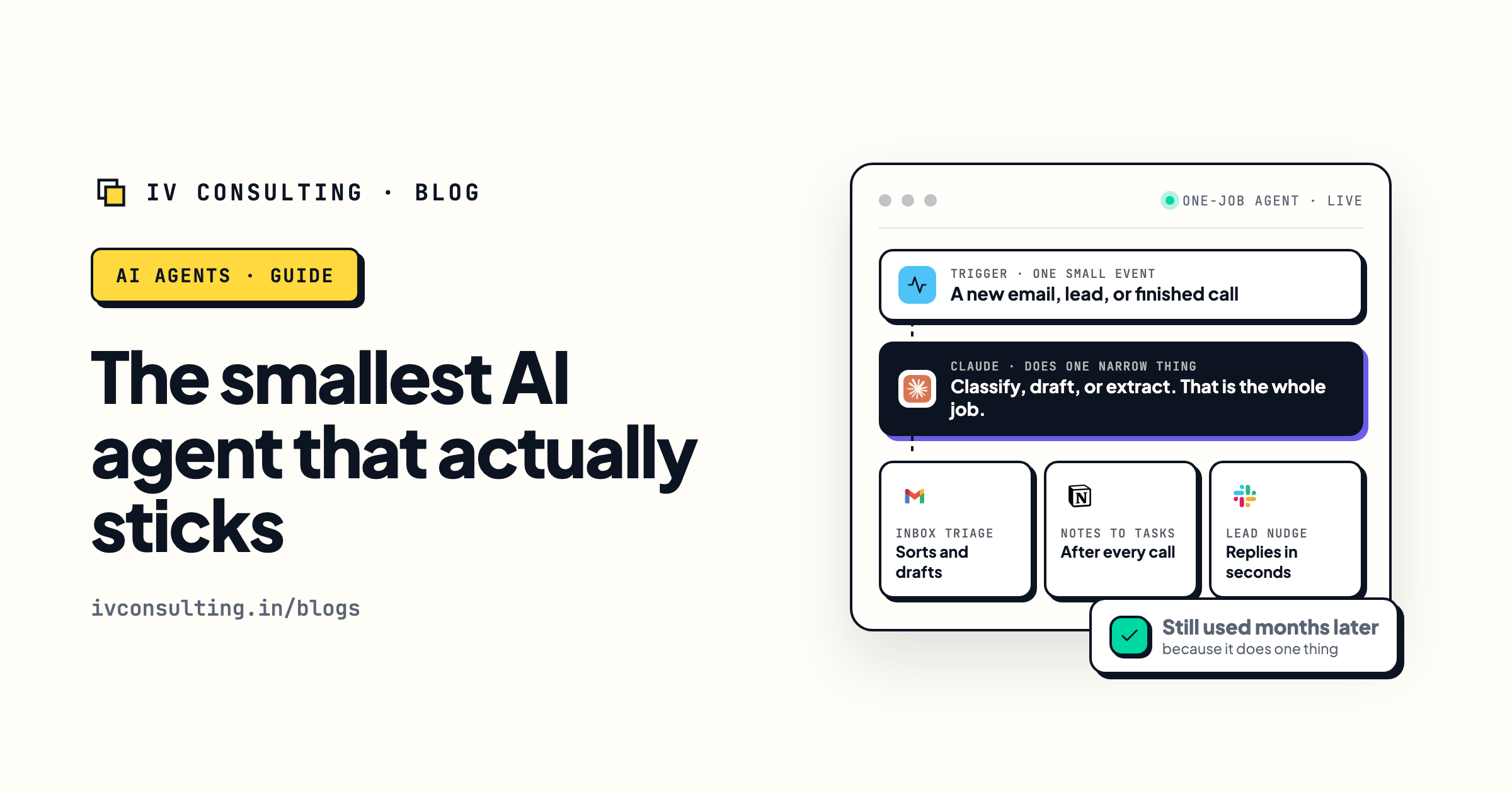
The smallest AI agent that sticks
Layer one, in depth. How to pick the one narrow, boring, single-job agent worth building first, and why the tiny ones survive.
Read the guide →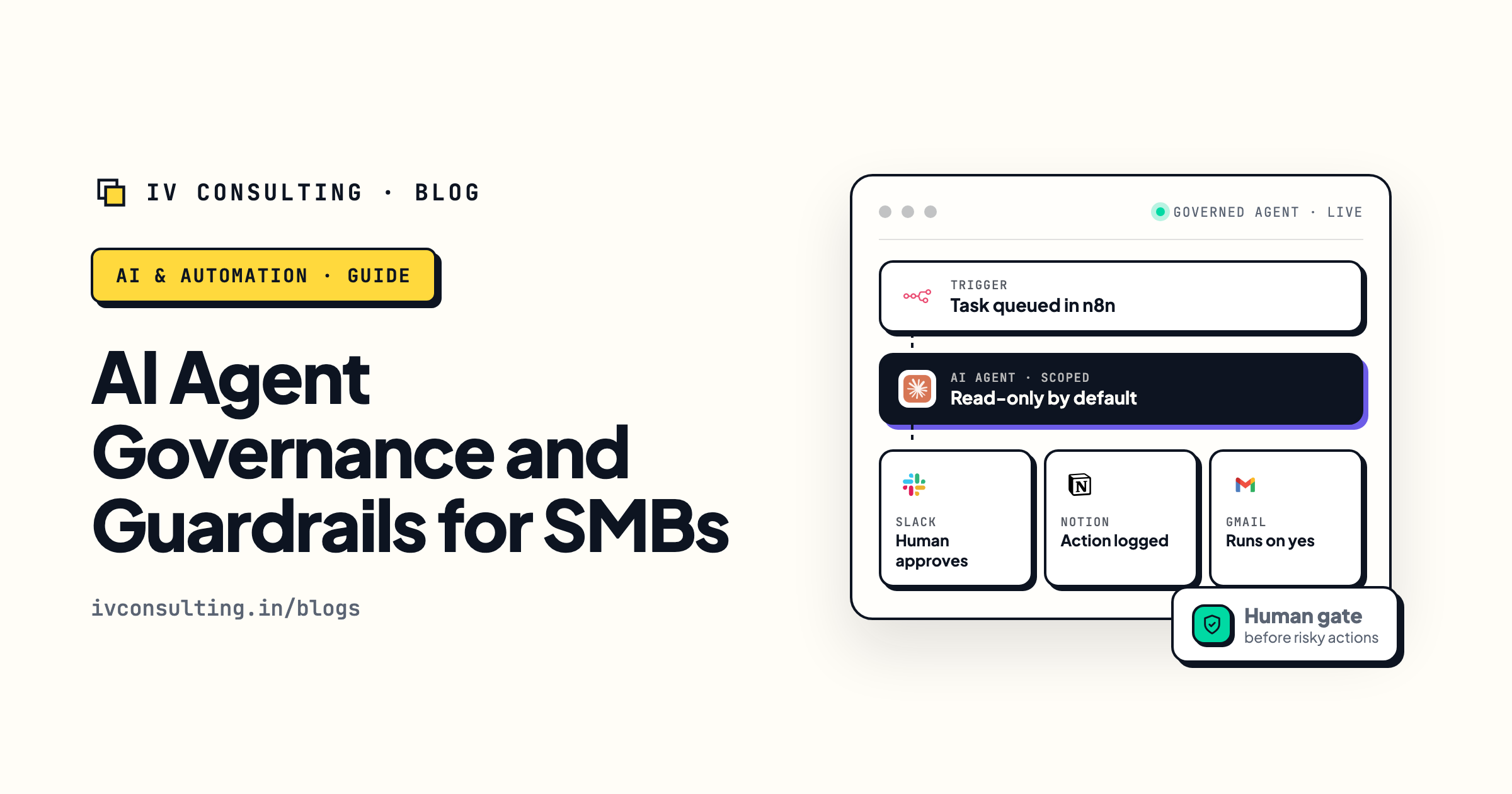
AI agent governance and guardrails
The checkpoints layer, expanded. How to scope and permission agents so they save hours without going off the rails.
Read the guide →
The AI Engineering stage, built for you
The orchestration, memory, and monitoring layers are where a partner earns their keep. We build the stack that holds under real work.
See the offer →Build the agent that actually holds.
Book a free 30-minute strategy call. We will find the one boring, high-frequency job worth automating first, scope a single-job agent that survives contact with your real work, and map the layers you add next so it never quietly breaks.
Map my first agent, free →Free 30-minute call. Honest take, even if that means "you do not need an agent for this yet, you need cleaner data first."