The AI agents that stick are small. Build one boring, single-job agent first.
Ask people which AI agent they actually kept using, and the answer is never the ambitious one. It is a tiny, single-purpose agent that does one narrow, boring task without being asked. That is the one to build first.
 By Ishan Vats · Founder of IV Consulting · builds AI agents & automations for 150+ teams
 Claude · does ONE narrow thingClassify, draft, or extract. That is the whole job.
 Inbox triageSorts and drafts
 Notes to tasksAfter every call
 Lead nudgeReplies in seconds
The AI agents that actually stick are small, single-job, and boring. Across the recurring community threads asking what agent people genuinely kept using, or found most useful, the answer converges on the same shape: not an ambitious assistant that runs your whole business, but a tiny one-job agent that does one narrow task on its own. Inbox triage. Turning a meeting into tasks. Drafting a first reply to a new lead. They survive because you can describe the whole job in one sentence, check the output in seconds, and stop supervising. Ambitious agents get abandoned because you never stop checking them. So do not build the big one first. Pick the most boring task you repeat every week, give it a clear trigger and one output you can verify at a glance, and use Claude only for the step that needs judgment. Small is not the compromise. Small is the reason it lasts.
What it is
What is the smallest AI agent that actually sticks?
A one-job AI agent is a small piece of software that watches for one trigger, uses an AI model to make one judgment or produce one output, and drops the result where you already work. That is the whole thing. Not a general assistant that can do anything you ask. A narrow agent that does a single task, every time, without being told. A new email lands and it gets sorted and a reply drafted. A call ends and the notes turn into tasks. A lead comes in and a first response goes out in seconds. One trigger, one narrow job, one output you can check at a glance.
This is the pattern that keeps showing up when people compare notes on what they actually kept. The recurring community threads on r/AI_Agents that ask what the smallest agent someone still uses is, or the most useful one they ever built, do not converge on an impressive autonomous system. They converge on something almost embarrassingly small: a boring, single-purpose agent that quietly saves a chore a day. The people who built the ambitious "run my whole business" agent tend to be the ones describing why they stopped using it.
The word doing the work here is narrow. A small AI agent survives because you can see the entire job it does. You can describe it in one sentence. You can look at its output and know in a couple of seconds whether it got it right. When those things are true, you stop supervising it, and an agent you have stopped supervising is one that has actually stuck. When they are not true, you keep checking, and checking is the thing that eventually makes you turn it off.
It helps to notice that most agents that stick are barely more than an automation with one smart step. A trigger, a single Claude call that classifies, drafts, or extracts, and an action. You do not need a multi-agent swarm to get real value out of AI. You need one reliable narrow loop that runs without you. That is exactly what our AI Engineering stage builds first: the smallest agent that earns its keep, before anything ambitious.
The honest problem
Why do the ambitious AI agents get abandoned?
Scope is what kills them. A broad agent that is meant to run your whole sales process, or manage every project, has too many ways to be wrong, too many edge cases, and no single moment where you can trust it. Every extra responsibility you hand it multiplies the places it can quietly do the wrong thing. And because you cannot see the whole job at a glance any more, you cannot tell when it has. So you check. You check everything. And checking a big agent is often more work than just doing the task yourself, which is the exact moment it stops being used.
There is a simple reason small wins here, and it is about trust, not capability. Trust in an agent is not built by it being clever. It is built by you watching it get a narrow thing right, over and over, until you stop looking. That loop can only close when the job is small enough to verify quickly. A one-job agent gets there in a week. A ten-job agent never gets there at all, because there is always another path you have not seen it handle, so you never fully let go, so it never becomes a system you rely on.
The demos push people the wrong way. The impressive videos show an agent booking travel, replying to customers, and updating the CRM in one flourish, and it looks like the goal. In a real business, that same breadth is the failure mode. The agents that are still running in someone's ops six months later are the unglamorous ones: the thing that reads incoming emails and tags them, the thing that turns a transcript into three tasks. Nobody makes a demo reel about those. Everybody keeps using them.
The pattern
Agents that stick vs agents that get abandoned
The difference is not the model or the tooling. It is the shape of the job. Every row below is a way of asking the same question: is this small enough that you will stop checking it? The left column is highlighted because that is the one worth building, not because breadth is never useful. If your idea keeps landing in the right column, that is a signal to cut it down, not to build it anyway. For the ground rules on scoping and cost before you commit, our guide on what an AI agent build should cost picks up from here.
| Agents that stick | Agents that get abandoned | |
|---|---|---|
| Scope | One narrow job, said in a sentence | A whole workflow, "and then it also..." |
| Trigger | One clear event fires it | Many entry points, fuzzy conditions |
| Checking the output | A glance, a few seconds | You have to trace what it did |
| Trust curve | Earned in about a week, then you let go | Never fully earned, so you never let go |
| Effort to build | A trigger, one Claude step, an action | Multi-agent, many tools, many edge cases |
| Fails by | Occasionally wrong, cheap to catch | Silently wrong somewhere you did not look |
| Good example | "Tag this email and draft a reply." | "Run my entire sales pipeline end to end." |
The shortlist
The one-job AI agents small businesses actually keep
These are the boring ones that survive. Notice the shape they share: a clear trigger, a single narrow judgment, and an output you can check in seconds. None of them run your business. Each of them saves you a small chore every day, which is exactly why they are still switched on months later.
Inbox and lead triage
The single most common agent people keep. A new email or lead arrives, Claude reads it, tags it by type and urgency, and drafts a first reply for you to glance at and send. You stop starting every message from a blank box, and nothing important slips because it was buried under newsletters.
Trigger: new email or form submission. Job: classify and draft. Check: read the draft, one glance.
Meeting notes to tasks
A call ends, the transcript comes in, and the agent pulls out the two or three action items and creates them as tasks with owners. The follow-ups that used to evaporate now exist by default.
First-reply drafter
For support or sales, it writes the first-pass answer to a common question and leaves it in drafts. A human still sends it, so being wrong is cheap, and the blank-page tax disappears.
Document data extractor
An invoice, receipt, or PDF arrives and the agent pulls the fields you care about into a clean row in a sheet or database. It replaces the copy-paste job nobody wants to own.
Request router
Incoming requests get read, categorized, and sent to the right person or queue. One small judgment call, made instantly, that used to sit in a shared inbox until someone got to it.
Weekly digest writer
Once a week it reads the same few sources and writes a short plain-English summary of what changed. Not a dashboard to open, a paragraph that arrives. Small, scheduled, and genuinely read.
The playbook
How do you pick the one agent worth building first?
You do not need a strategy for this. You need to resist your own ambition for one afternoon and choose the smallest useful thing. Four questions get you to the right first agent, the one you will still be using long after the impressive one would have been switched off.
The four steps at a glance: (1) start with a boring, repeated task, (2) check it has a clear trigger and one output, (3) make sure being wrong is cheap and visible, and (4) use AI only for the step that needs judgment.
Start with a boring, repeated task
Write down the small chores you do many times a week that follow the same shape every time. Triaging an inbox. Turning notes into tasks. Drafting the same kind of reply. Boring and repeated is not the consolation prize here, it is the target, because a task you do fifty times a week is where a tiny agent pays for itself fastest. The exciting once-a-quarter task is exactly the wrong place to start.
Check it has a clear trigger and one output
A good candidate has one obvious moment it should run, a new email, a finished meeting, a form submission, and one output you can name in a single sentence. If you cannot say "when X happens, it produces Y" without adding an "and also," the job is too big to stick, and you should split it. One trigger in, one result out, is the whole test.
Make sure being wrong is cheap and visible
Pick a task where a mistake is easy to notice and cheap to undo. A draft you read before it sends is perfect: if the agent gets it wrong, you see it and fix it in seconds, and nothing bad shipped. Avoid anything where an error is expensive and hard to spot, like silently moving money or changing records nobody re-checks, because you will never trust it enough to stop supervising, and an agent you supervise forever has not really saved you anything.
Use AI only for the judgment step
Most of a good agent is not AI at all. Let plain rules handle the trigger and the action, and reach for Claude only where the step genuinely needs judgment: reading messy text, classifying something fuzzy, drafting a reply, pulling structured data out of unstructured input. If the task is "when X happens, always do Y," that is just automation and needs no model. The best one-job agents are boring rules with one small pocket of AI where a human decision used to sit.
FAQ
Questions people ask about small AI agents
What is a one-job AI agent?
Why do most ambitious AI agents get abandoned?
What is the first AI agent a small business should build?
Is a one-job agent just an automation with an LLM in it?
How do I know if an AI agent will actually stick?
Do small agents still need Claude, or can plain rules do the job?
Ishan Vats
Founder, IV Consulting · AI & automation consultant
I build AI agents and automations for small teams, and the ones I am proudest of are almost always the smallest. The single narrow agent that quietly saves a chore a day beats the ambitious one nobody keeps. I have built these for 150+ teams. If you want help choosing the one-job agent with the fastest payback for your business, I'll map it with you on a free call.
Book a free strategy call →Keep reading
Related guides and work
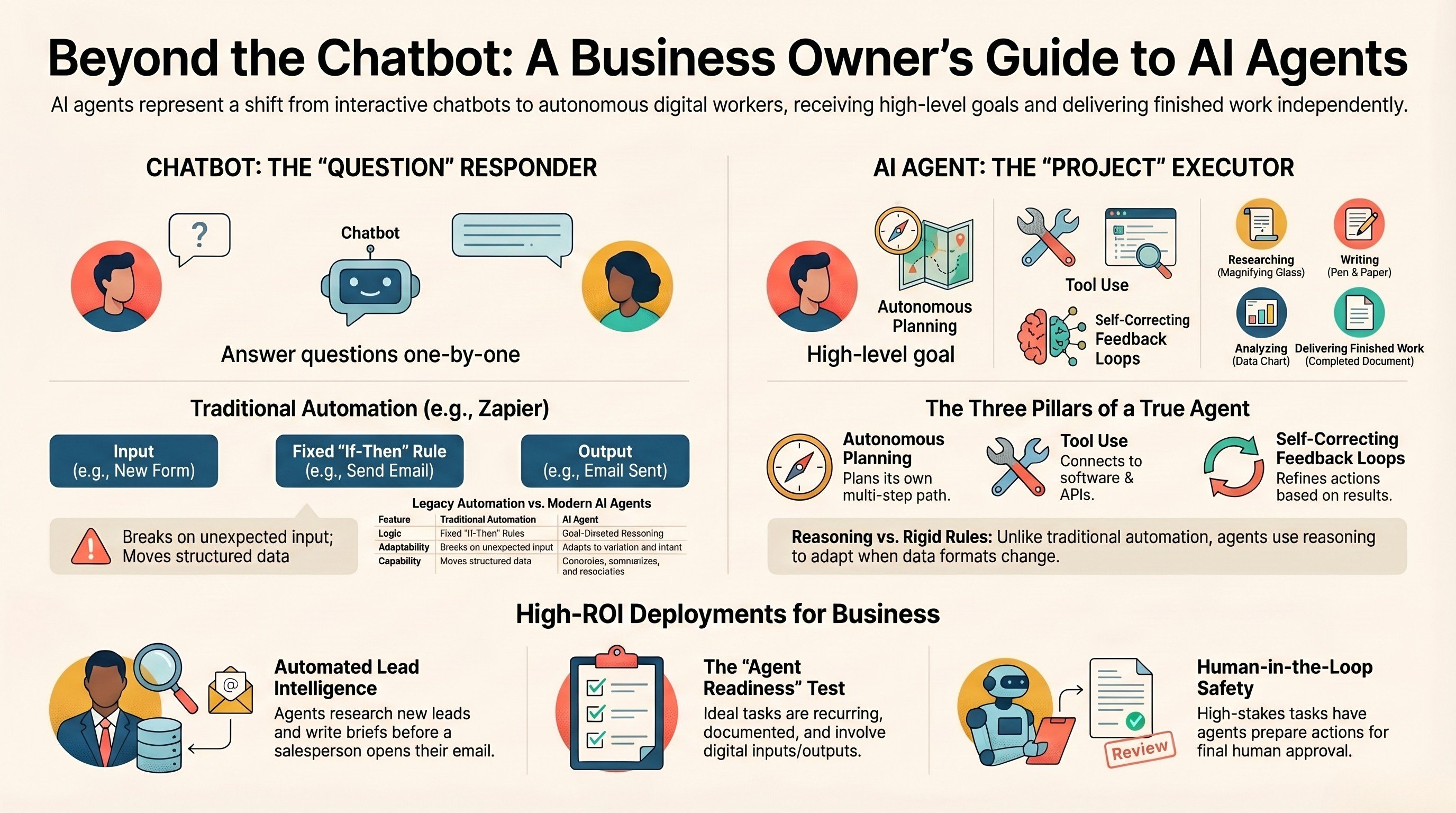
What is an AI agent, in plain terms
Before you pick your first one, the plain-English guide to what an agent actually is and is not.
Read the guide →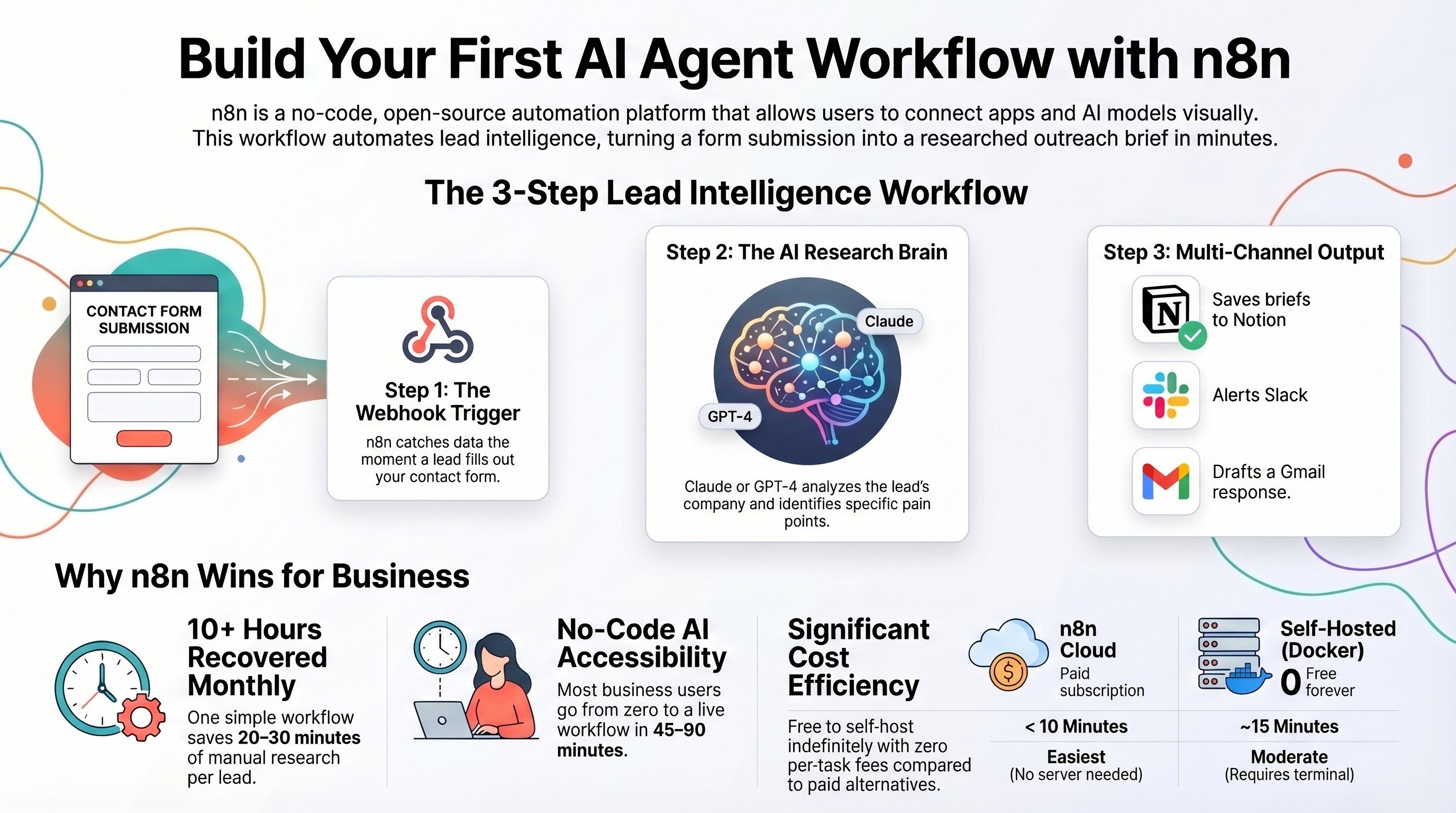
Build a one-job agent in n8n
The plumbing end to end: trigger, one Claude step, and an action. This is the small loop.
Read the guide →
The AI Engineering stage, built for you
We start with the smallest agent that earns trust in a week, then build out from there.
See the offer →Build the small agent that sticks, not the big one nobody keeps.
Book a free 30-minute strategy call. We will look at the boring tasks you repeat every week, pick the single one-job agent with the fastest payback, and scope the trigger, the one AI step, and the output so it runs without you.
Find my first one-job agent →Free 30-minute call. Honest take, even if that means "this one is a plain automation, no AI needed."