Google's Search agents: what they mean for your small business
Google's AI Mode now runs always-on agents that watch the web for you. Here is what changes for how customers find you, and how to put agents to work in your own operations.
 By Ishan Vats · Founder of IV Consulting · builds AI agents & automations for 150+ teams
 AI Mode · GeminiScans the web 24/7
 SlackTeam pinged
 NotionLogged
 GmailDigest sent
Google's Search agents are always-on AI assistants inside Google's AI Mode that monitor the web around the clock for a question you care about, then send you a synthesized update when something changes. For a small business this matters two ways: it changes how customers find you, because more answers now happen inside AI before anyone clicks a website, and it gives you a new way to run operations, because you can put an agent on competitor pricing, new leads, or brand mentions instead of checking by hand. Google's version is rolling out now, and you can also build a monitoring agent you fully control with n8n and Claude.
The news
What are Google's Search agents?
Google's Search agents are always-on AI assistants built into Google's AI Mode, announced at Google I/O 2026. They are information agents that monitor the web 24/7 for a question you give them, instead of making you run the same search again and again. The agent watches in the background and tells you when something actually changes.
Here is what one does, in plain terms. You ask it to keep track of something. It looks across the open web, including blogs, news sites, and social posts, plus fast-moving data like finance, shopping, and sports. When it finds a meaningful change, it sends you a synthesized update by push notification, and it can tee up a follow-up action rather than just dumping links on you.
This is part of a much bigger change. At I/O 2026, Google called it the biggest upgrade to the Search box in more than 25 years. Alongside the agents came Gemini 3.5 Flash as the default model for AI Mode, generative interfaces that build a custom answer layout on the fly, agentic booking, and a Universal Cart for shopping. The short version: Search is moving from a list of blue links to an assistant that does work for you.
Why it matters
Two shifts every small business should plan for
Agentic search hits a small business from two directions at once. Most owners only think about the first. The second is where the real advantage is.
Shift 1: How customers find you changes
More buying questions get answered inside AI before anyone clicks a website. The job shifts from ranking a page to being the answer the AI gives. That is the discovery side, and it is largely defensive.
If an AI agent is the one comparing options for a customer, your business has to be easy for that agent to find, understand, and recommend.
Shift 2: You can run agents too
The same always-on pattern works for your operations. Put an agent on the watching and chasing your team does by hand, and free those hours.
Defense and offense
Shift 1 protects revenue you already have. Shift 2 creates new leverage. You need both.
Speed is the prize
Whoever notices first wins the lead, the price change, the unhappy review. Agents make first cheap.
Shift 1
How customers find your business is changing
For two decades the playbook was simple: rank a page, earn the click, win the customer. Agentic search bends that. When someone asks AI Mode "who is the best bookkeeper for a small agency near me," the answer can be assembled, compared, and even acted on without a single visit to your site. This is the zero-click reality, and it grows as AI answers more of the question up front.
That sounds like a threat, and ignored, it is. But it is really a change in what you optimize for. The discipline is answer engine optimization (AEO): making your business and your content the thing an AI confidently recommends. In practice, for a small business, that means a few concrete moves.
- Answer real questions plainly. Pages that state a clear, self-contained answer near the top are easy for an AI to lift and cite. Burying the answer under fluff makes you invisible to an agent.
- Keep your Google Business Profile accurate. Hours, services, location, and reviews are exactly the structured facts an AI leans on to recommend a local business.
- Make the facts liftable. Price ranges, service areas, specialties, and proof of results should be stated as facts, not hidden in a brochure PDF.
- Earn third-party mentions. Agents weigh what other credible sources say about you, not just your own marketing.
The mindset shift is the hard part. You are no longer only competing for a ranking. You are competing to be the answer. If you want the deeper version of this, our guide on what an AI agent actually is explains how these systems decide what to surface.
Shift 2
Put your own monitoring agents to work
This is the part most owners miss. The exact capability Google just shipped, an agent that watches the web and tells you what matters, is something you can run on your own operations today.
Think about how much of your week is spent watching and chasing. Checking a competitor's pricing page. Scanning for new tenders or leads in your niche. Refreshing review sites. Watching for a supplier price change or a new regulation. None of that is strategic work. It is exactly what an always-on agent is good at.
Good candidates for a monitoring agent share a pattern: high value, time sensitive, and currently done by a human refreshing a tab.
- Competitor moves. Pricing changes, new offers, hiring sprees, product launches.
- New leads and tenders. Job boards, marketplaces, and tender portals that match your services.
- Brand and reputation. Mentions, reviews, and social posts about you, so you reply within minutes instead of weeks.
- Supply and compliance. Supplier prices, stock, and rule changes that affect your costs or obligations.
The test is simple. If being slow to notice costs you money or a customer, it belongs to an agent. We built exactly this kind of always-on lead watcher for a client, documented in our lead monitoring case study, and the pattern generalizes to almost any niche.
The comparison
Google's built-in agents vs an agent you control
Google's Search agents are great for watching the open web for general questions. A monitoring agent you build with n8n and Claude trades convenience for control: your sources, your rules, your data, and real actions inside your stack. Most businesses end up using both.
| What matters | Google Search agents | Your own agent (n8n + Claude) |
|---|---|---|
| What it watches | The open web, chosen by Google | The exact sources you pick, public or private |
| Who sets the logic | Google's model decides relevance | You define the rules and thresholds |
| Where alerts land | Google push notifications | Slack, email, Notion, or anywhere you route them |
| Ability to act | Limited follow-up actions | Yes, it can update records, draft replies, trigger workflows |
| Data ownership | Stays inside Google's ecosystem | Stays in systems you own |
| Access | AI Ultra now, AI Pro later this summer | Available today on tools you run |
| Best for | Personal, general "keep me posted" watches | Operational watches tied to real actions |
Do this
Your 30-day plan for agentic search
You do not need Google AI Ultra to start. You need to defend your discovery and stand up your first agent. Here is a sequence that fits a busy small team.
Audit how AI describes you
Ask a few AI assistants what your business does and who they would recommend for your service in your area. Note where they get it wrong or skip you entirely. That gap is your AEO to-do list.
Fix the liftable facts
Make sure your top pages answer the real questions plainly, your Google Business Profile is complete and current, and your services, areas, and proof are stated as clear facts an AI can quote.
Pick one watch that costs you money
Choose the single piece of monitoring where being slow hurts most: a competitor's price, a lead source, your reviews. One watch, one owner, one action.
Stand up the agent
Build it with n8n and a model like Claude so it watches your chosen source, applies your rule, logs to Notion, and alerts the right person. Our guide to building an AI agent workflow with n8n walks the build end to end.
Measure, then expand
Track what the one agent caught that you would have missed, and the hours it saved. Once it earns its keep, add the next watch. This is how a real AI Engineering capability grows: one reliable agent at a time, not a big-bang rollout.
FAQ
Questions small business owners are asking
What are Google's Search agents?
Is Google's Search agent feature available to everyone right now?
Will Google's AI Mode hurt my small business website traffic?
Can I build my own monitoring agent that I control?
What should a small business monitor with an agent?
Do I need Google AI Ultra to benefit from this shift?
Ishan Vats
Founder, IV Consulting · AI & automation consultant
I build production AI agents, automations, and MCP servers for teams from startup to enterprise. 150+ ops transformations over 10+ years. If you want this mapped to your own stack, I'll do it with you on a free call.
Book a free strategy call →Keep reading
Related guides and work
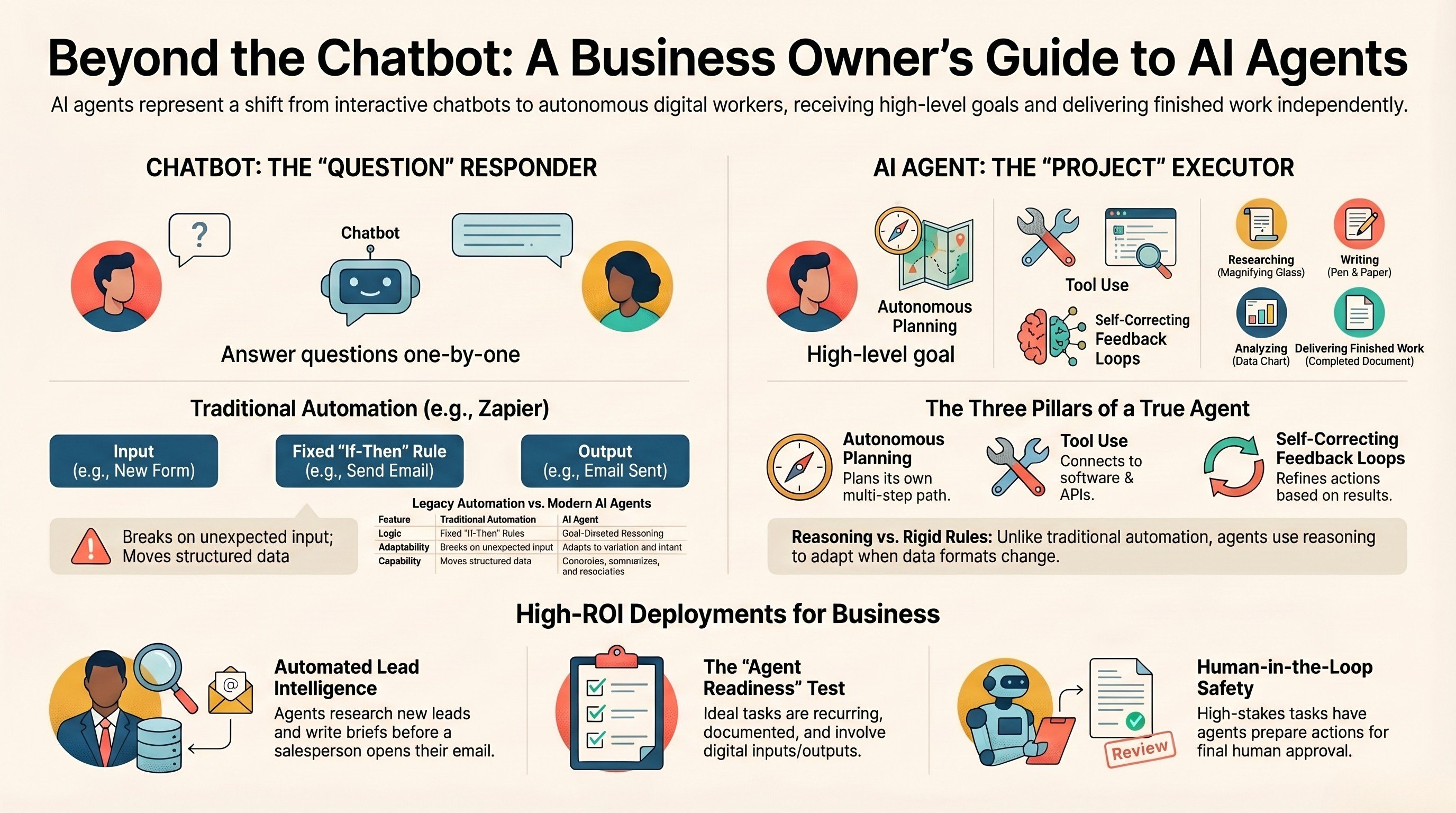
What is an AI agent? A guide for business owners
The plain-English version of what an agent actually is, and where it pays off.
Read the guide →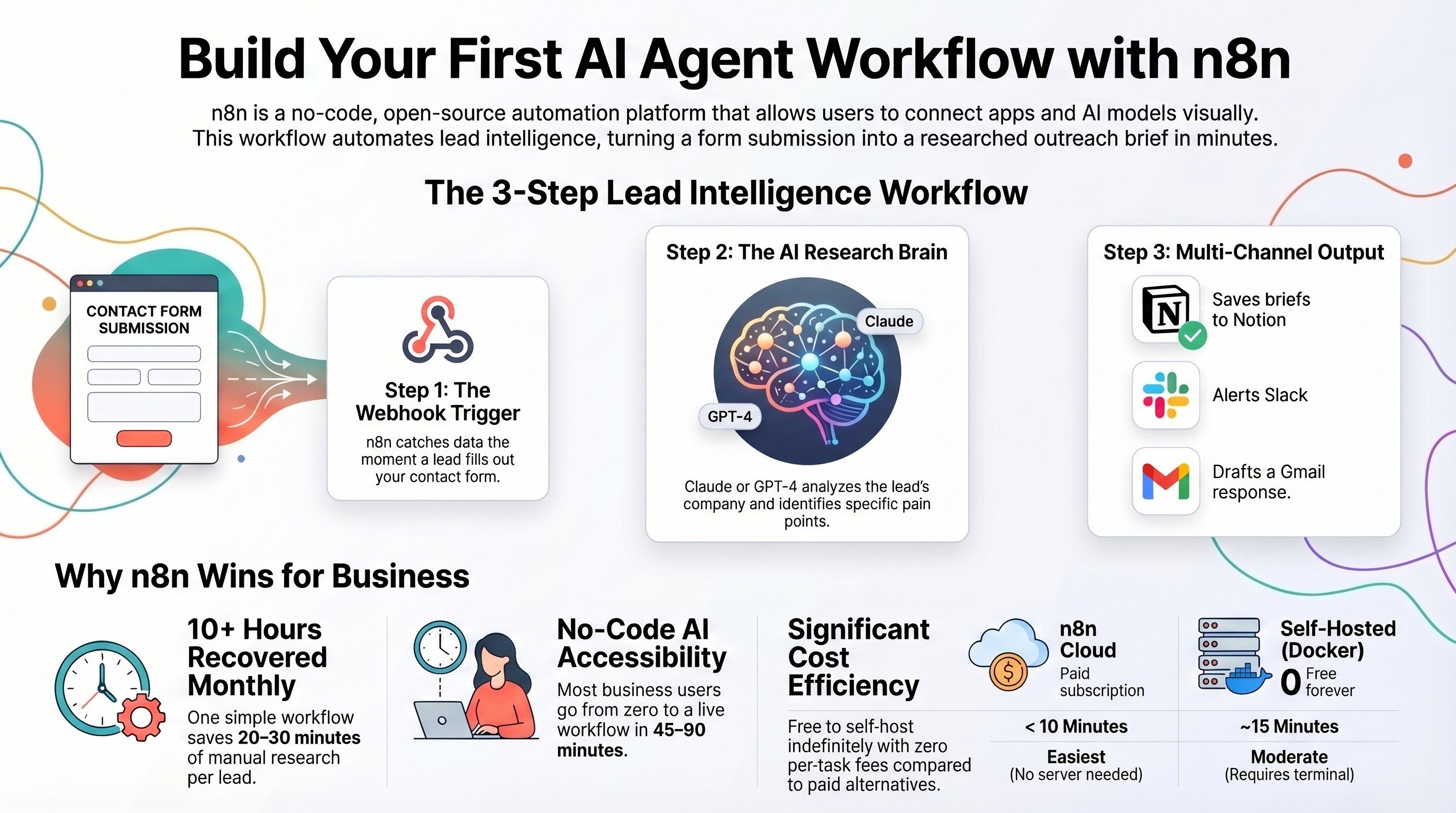
Build an AI agent workflow with self-hosted n8n
Stand up your own agent end to end, on infrastructure you own.
Read the guide →
The AI Engineering stage, built for you
Production agents wired into your real stack, from idea to live in about a month.
See the offer →Want agents working in your business, not against it?
Book a free 30-minute strategy call. We will map where agentic search affects you and which monitoring agent to build first, with a roadmap on the spot. If we are not the right team for you, we will say so and point you somewhere better.
Book a Free Strategy Call →Free 30-minute call. Honest take, even if that means "you do not need us yet."