Deliver projects on time without hiring a project manager
A lightweight stack, three simple cadences, and a few automations replace most of what a full-time PM does for a small team.
 By Ishan Vats · Founder of IV Consulting · 150+ ops transformations over 10+ years
Some links below are affiliate links. If you buy through them we may earn a commission, at no extra cost to you.
 Best for task-driven teamsClickUp
 Best for docs + tasks togetherNotion
 Best for visual deadlinesmonday.com
 AutoInvoices
 AutoClient email
 AutoStandups
Yes. A small team can deliver on time without a full-time project manager by combining one lightweight tool such as ClickUp or Notion, three simple meeting cadences, and a handful of automations that handle status updates, task creation, and billing. Most of what a PM does for a small team is structure, and structure can be installed once and run by the team itself.
The problem
Why small teams miss deadlines
For small and growing businesses, delivering projects on time can feel like an uphill battle. Founders juggle multiple roles, deadlines slip through the cracks, and hiring a full-time project manager looks financially out of reach.
The good news is that the deadline problem is rarely a talent problem. It is almost always a structure problem. Small teams miss deadlines for a short, predictable list of reasons:
- Unclear ownership. Tasks exist but nobody knows who is actually responsible.
- Ad hoc tracking. Projects live in email threads, chat apps, and scattered spreadsheets.
- No escalation path. When something is blocked, there is no protocol for flagging it fast.
- Scope creep. Requirements expand informally with no change management process.
- Manual status updates. Founders spend hours chasing updates instead of moving work forward.
Research from the Project Management Institute shows projects typically run around 11% over budget and miss deadlines regularly. That is a significant cost for a small team where every dollar and every week matters.
The tools
Choose the right lightweight stack
You do not need enterprise PM software. You need one tool the whole team actually opens every day. Three options cover almost every small team.
| Tool | Best for | Strength | Watch out |
|---|---|---|---|
| ClickUp | Task-driven teams that need automation and dependencies | Strong built-in automations cut manual overhead | More features than a tiny team may use at first |
| Notion | Documentation-heavy teams where wiki and tasks live together | Highly flexible with excellent AI integration | Best under 10 people without complex dependencies |
| monday.com | Visual, deadline-focused, client-facing boards | Approachable for non-technical team members | Less depth for advanced automation logic |
For most small teams, ClickUp gives the best balance of automation capability and ease of use. Notion wins if your team already lives in it for docs, and monday.com is a strong pick when visual, deadline-first boards matter most to clients.
The rhythm
An operational playbook in three cadences
You do not need a PM if you have the right rhythm. These three recurring touchpoints replace most day-to-day project management.
15-minute daily standup
Each team member answers three questions: what did I complete yesterday, what am I working on today, and what is blocking me?
Keep it to 15 minutes maximum. Use a ClickUp check-in form or a Notion standup database to capture responses asynchronously if your team is remote or spread across time zones.
Weekly planning session (45 min)
Every Monday, review last week's incomplete tasks, assign this week's priorities, and confirm ownership on every active project milestone.
Use a simple RACI matrix template to clarify who is Responsible, Accountable, Consulted, and Informed for each workstream. Ambiguous ownership is the single biggest driver of missed deadlines, and this is where you remove it.
Biweekly review (60 min)
Every two weeks, assess project health against milestones, identify scope changes, and recalibrate timelines.
This is where risks get surfaced early, before they become deadline misses. A 60-minute review every fortnight catches the slippage a daily standup is too close to see.
The leverage
Three automation recipes that save time
Cadences give you structure. Automations give you back the hours a PM would otherwise spend on admin. Start with these three.
Recipe 1: Meeting notes to ClickUp tasks
After your standup or planning session, paste notes into a Notion page and let a Notion AI button extract the action items. Zapier watches for new action items tagged with an owner, then creates tasks in ClickUp automatically assigned to the right person.
Time saved: 20 to 30 minutes per meeting on manual task creation.
Recipe 2: Milestone done to client status email
When a milestone task is marked Done in ClickUp, n8n triggers an email to the client contact from a pre-written template, pulling the milestone name and the next expected deliverable straight from ClickUp fields.
Time saved: Eliminates the "did you see we finished X?" follow-up. Clients feel informed without anyone manually writing an update.
Recipe 3: Project completion to invoice trigger
When a milestone tagged Billable is marked complete in ClickUp, Make creates a draft invoice in your accounting tool such as QuickBooks or Xero, pre-filled with client name, service, and amount from ClickUp custom fields.
Time saved: Prevents revenue leakage from forgotten invoices. Billable milestones trigger billing automatically.
The economics
Full-time PM, fractional, PMaaS, or DIY
The right answer depends on your project volume, not your ambition. Here is how the four common options compare.
Full-time PM
Roughly 75,000 to 150,000 dollars a year. Justified when you have 10+ concurrent projects and a dedicated delivery team that needs daily coordination.
Fractional PM
Around 3,000 to 8,000 dollars a month. Good for established small teams with consistent project volume that need strategic oversight, not a full headcount.
PMaaS
Structured delivery support without a long-term hire. Best for teams that need the system and the oversight but not a permanent salary on the books.
DIY with the right tools
Roughly 100 to 500 dollars a month in tools. Viable for teams under 10 with a disciplined operations lead willing to run the cadences above.
The proof
Case snapshot: 50% faster delivery
A digital marketing agency was consistently missing project deadlines by around 30%. The work itself was not the problem. Nothing was tracked, escalated, or reviewed consistently, so timelines drifted with no early warning.
We implemented a structured meeting cadence of daily standups and weekly planning, a shared ClickUp workspace with milestone tracking, and the three automation recipes above. Within 90 days they reduced time to delivery by 50%. No new hires. No expensive PM software. Just structure and automation applied consistently.
FAQ
Questions small teams ask first
Can a Notion template really replace a project manager for small projects?
Which automations give the fastest ROI for small teams?
Do I need paid plans to connect ClickUp or Notion to automation tools?
How much does a fractional project manager cost compared to a full time hire?
How small a team can run this without a dedicated PM?
What results can a small team realistically expect?
Ishan Vats
Founder, IV Consulting · operations & systems consultant
I build operating systems and automations for teams from startup to enterprise. 150+ ops transformations over 10+ years. If you want yours mapped and built right, I'll do it with you on a free call.
Book a free strategy call →Keep reading
Related guides and work
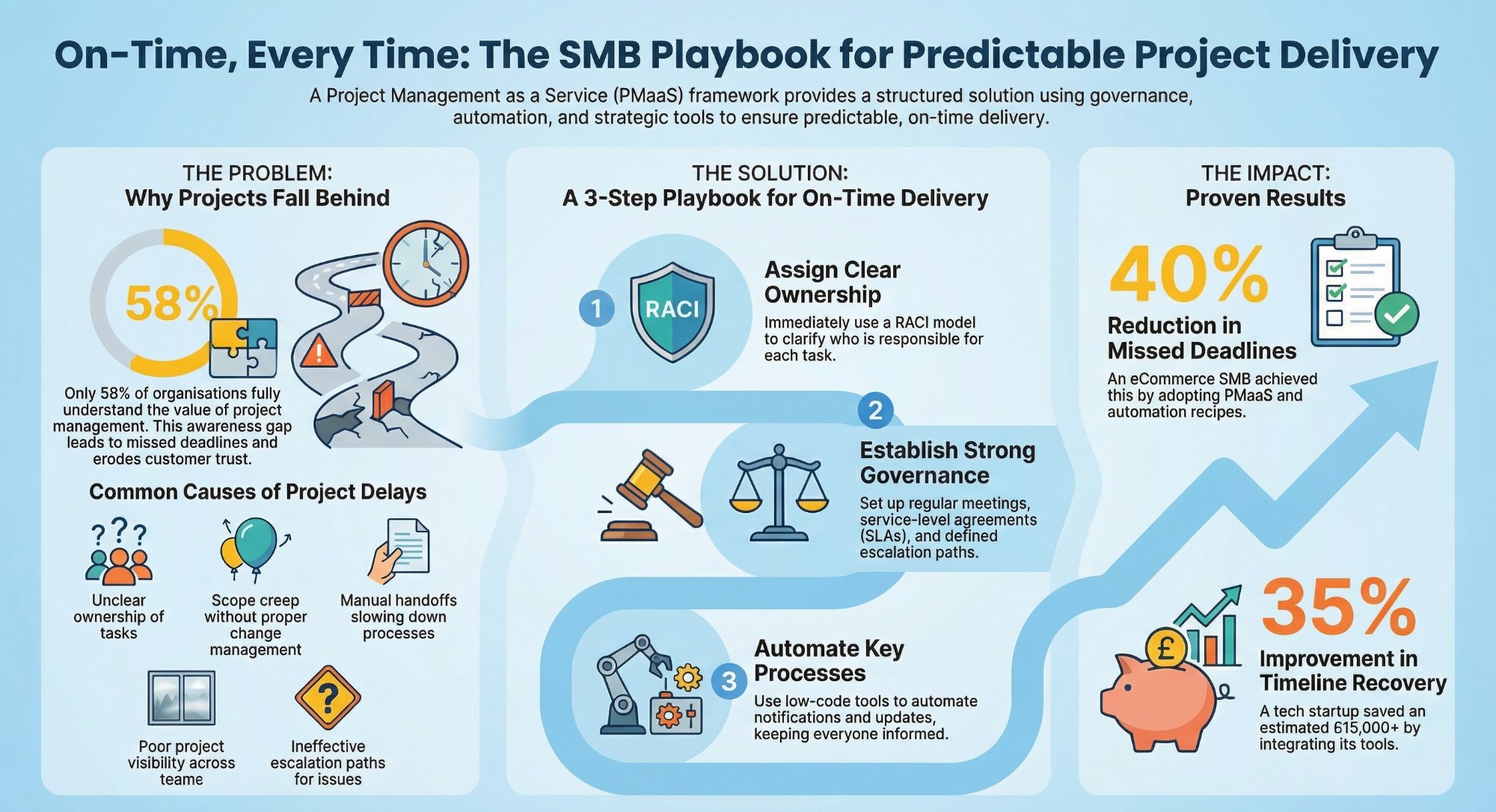
Why small teams miss deadlines, and how PMaaS fixes it
The root causes of slipping delivery and the structure that closes the gap.
Read the guide →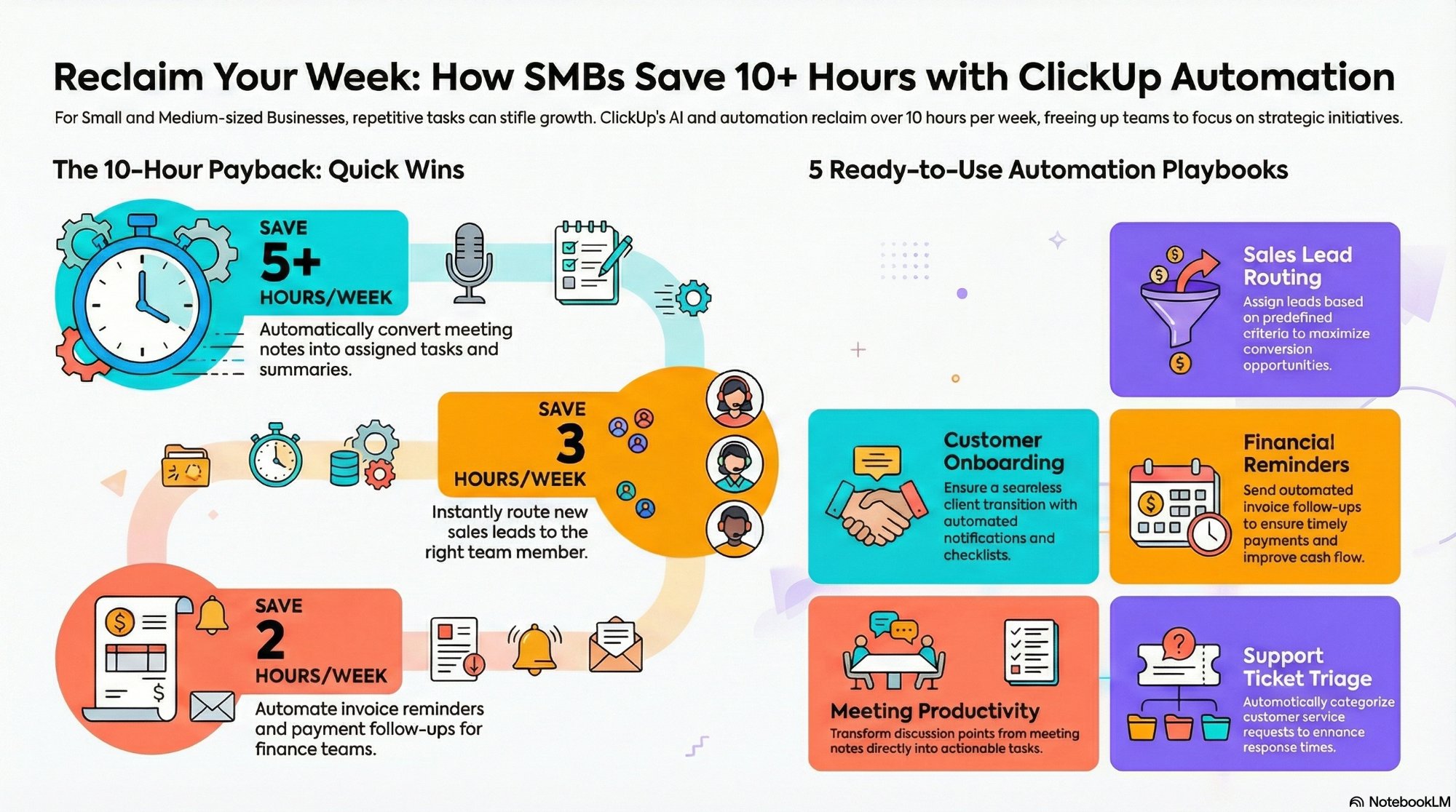
Use ClickUp automations and AI to save 10 hours a week
The ClickUp automations that take admin off your team's plate for good.
Read the playbook →
The Foundation stage, built for you
Your delivery system installed: clear ownership, one source of truth, a rhythm that holds.
See the offer →Want your delivery system built for you?
Book a free 30-minute strategy call. We will map your highest-ROI workflows and give you a build roadmap on the spot. If we are not the right team for you, we will say so and point you somewhere better.
Book a Free Strategy Call →Free 30-minute call. Honest take, even if that means "you do not need us yet."