Why SMBs miss deadlines, and how PMaaS fixes it
Missed deadlines are rarely a people problem. They are a system problem. Here is the playbook that restores on-time delivery.
 By Ishan Vats · Founder of IV Consulting · 150+ ops transformations over 10+ years
Some links below are affiliate links. If you buy through them we may earn a commission, at no extra cost to you.
 WorkspaceClickUp tasks + RACI
 AutomationDeadline + risk alerts
 NotionGovernance hub
 SlackEscalation ping
 QuickBooksInvoice trigger
SMBs miss deadlines because of unclear ownership, unmanaged scope creep, manual handoffs, and poor project visibility, not a lack of effort. Project Management as a Service (PMaaS) fixes this by layering in clear RACI ownership, governance cadence, SLAs, and automated alerts. Most teams see measurable on-time delivery gains within the first month.
The root cause
Why SMBs keep missing deadlines
For small and medium-sized businesses, missing a project deadline is more than an inconvenience. It costs revenue, burns promotional windows, and erodes the customer trust you worked hard to earn. In a market where reliability is a differentiator, hitting dates consistently is a competitive advantage.
The misses are rarely about lazy people or impossible timelines. They trace back to a handful of system gaps:
- Unclear ownership of tasks, so nobody is certain who is responsible for what.
- Scope creep without change management, where requirements expand informally and the timeline never adjusts.
- Manual handoffs that slow work down and create gaps where things fall through.
- Poor project visibility, so leadership cannot see what is behind schedule until it is too late.
- Ineffective escalation paths, so a blocked task has no clear way to surface quickly.
A PMI study indicates that, on average, only 58% of organizations fully understand the value of project management. Without that awareness and the execution discipline that follows, SMBs risk prolonged project cycles and dissatisfied clients.
The fix
What PMaaS actually delivers
Project Management as a Service is a managed, outcome-focused way to run delivery without hiring a full-time PM. It bundles the structure that keeps projects on track.
Clear roles and RACI
Every task has a named owner. A simple RACI matrix maps who is Responsible, Accountable, Consulted, and Informed, so nothing is silently dropped.
SLAs that hold
Service-level agreements create accountability for turnaround times on your most common task types.
Regular cadence
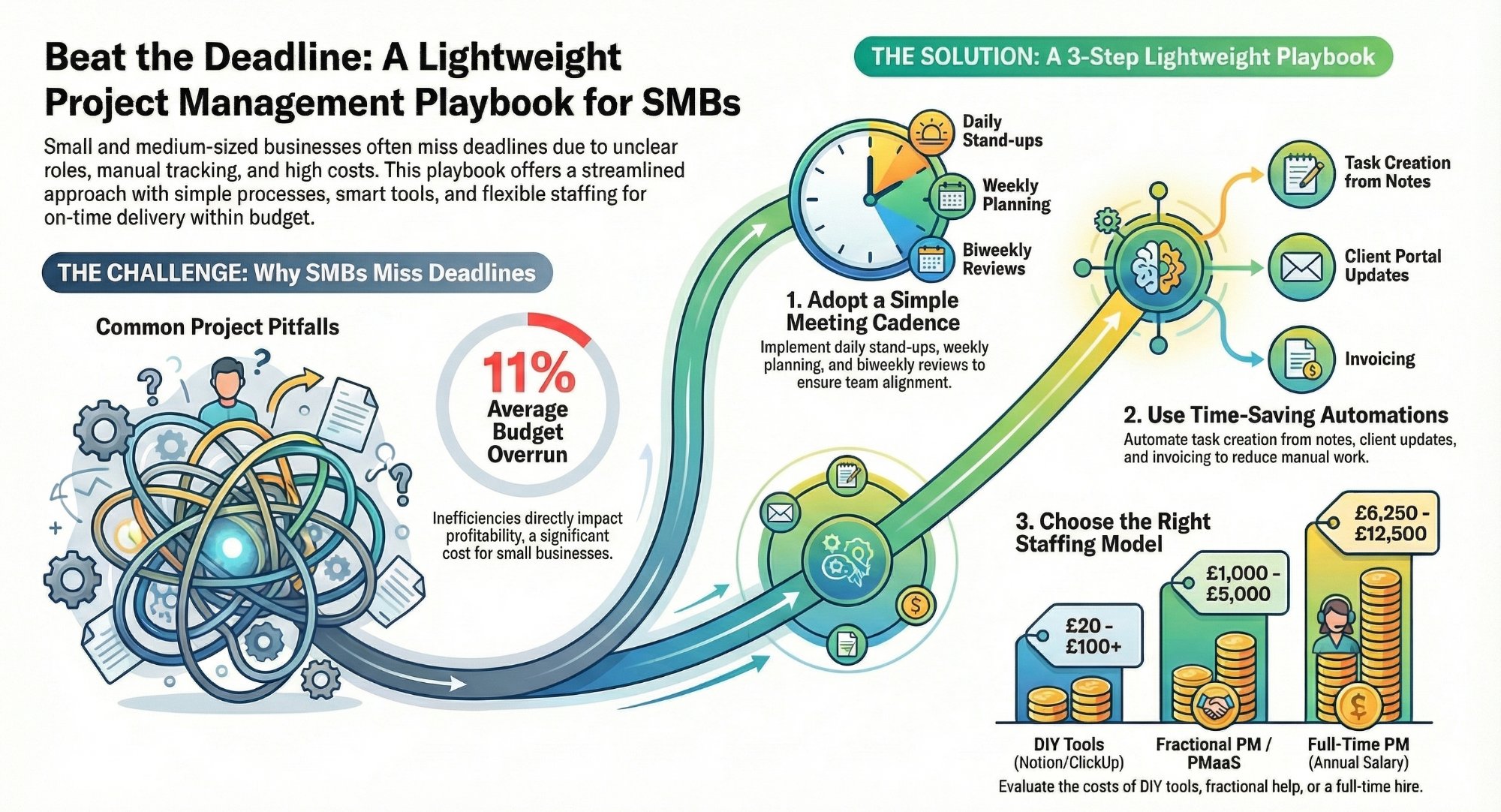
Daily standups, weekly planning, and biweekly reviews surface blockers early, before they become missed dates.
Real-time dashboards
Milestone status, blockers, and delivery health, visible at a glance, so leadership is never surprised.
Governance artifacts
Scope documents, change logs, and escalation frameworks that keep informal requests from derailing timelines.
These elements work together to create clear accountability. The result is a team that meets deadlines consistently because the system, not heroics, is doing the heavy lifting.
Tool choices
When to use Notion, ClickUp, or monday.com
The right tool depends on your complexity. Pick one platform and commit, rather than scattering work across three.
| Tool | Best for | Standout strength | Who it suits |
|---|---|---|---|
| Notion | Lightweight knowledge + wikis | AI meeting summaries and action-item extraction | Teams new to structured PM tooling |
| ClickUp | Complex projects + dependencies | Advanced task automation and milestone tracking | Teams with multi-stage delivery |
| monday.com | Visual workflow management | Approachable boards for non-technical stakeholders | Cross-functional teams who want clarity fast |
If you only need a knowledge base and simple task lists, Notion is the lowest-overhead starting point. For dependency-heavy delivery with goals and automation, ClickUp is the stronger backbone. monday.com shines when buy-in from non-technical stakeholders matters most.
The playbook
3 steps to stop missing deadlines
Triage with an emergency RACI
In the first week, assign an owner to every active task and project. Use a simple RACI matrix: who is Responsible (does the work), Accountable (signs off), Consulted (provides input), and Informed (needs to know the outcome).
This single move eliminates the most common cause of missed deadlines: nobody knowing they owned something.
Establish governance and cadence
Set up three recurring meetings: a 15-minute daily standup (blockers only), a 45-minute weekly planning session (priorities and assignments), and a 60-minute biweekly review (milestone health, scope changes, risk assessment).
Document SLAs for your most common task types: feature development, client deliverables, approvals, and responses. When an SLA is breached, escalation happens automatically rather than waiting for someone to notice.
Automate notifications and updates
Replace manual status chasing with automated notifications:
- Task overdue by 24 hours triggers a Slack message to the assignee and PM.
- Milestone marked "Done" sends an auto-email to the client with the next expected deliverable.
- A "blocker" tag added to a task pings the project lead immediately for triage.
Tactical recipes
4 automation recipes that protect deadlines
Recipe 1: Deal at risk triggers an immediate task and alert
When a deal in Close CRM moves to "At Risk" status, n8n automatically creates a ClickUp task assigned to the account manager, posts to the #client-success Slack channel, and updates the client health dashboard. No risk goes untracked.
Recipe 2: Automated end-of-week summary
Every Friday at 4pm, n8n pulls all task completions and status changes from ClickUp for the week, formats a plain-English summary, and posts it to a Slack channel while emailing key stakeholders. Leadership stays informed without anyone writing a report.
Recipe 3: Milestone complete triggers an invoice draft
When a milestone tagged "Billable" is marked complete in ClickUp, Make creates a draft invoice in QuickBooks or FreshBooks, pre-filled with client name, service, and amount. No billable milestone gets forgotten.
Recipe 4: Recurring deadline alerts
Using ClickUp native automation: 3 days before any task's due date, send an email reminder to the assignee and post a Slack notification. 1 day before, escalate to the project lead if status is not "In Review" or "Done."
The results
What changes, and what it returns
Mini case studies
eCommerce SMB. An online retailer consistently missed product launch deadlines, costing them promotional windows. After implementing PMaaS with RACI matrices, a weekly planning cadence, and automated milestone alerts, they reduced missed deadlines by 40% in 60 days. Launch predictability went from 60% to 95%.
Tech startup. A 12-person startup improved its timeline recovery rate by 35% after adopting ClickUp for task management and automating CRM-to-task updates via n8n. The estimated recovery was $20,000 in potential lost revenue from avoided project delays.
Pricing approaches and quick ROI
PMaaS pricing models typically include:
- Fixed monthly: $1,500 to $5,000 per month depending on project complexity and volume.
- Per-project: a fixed fee per engagement based on scope and duration.
- Success-based: a base fee plus a bonus tied to on-time delivery metrics.
Run the math. If your team misses 2 deadlines per month, each costing $5,000 in penalties, lost upsells, or delayed revenue, that is $10,000 per month at stake. A $2,000 per month PMaaS engagement that eliminates those misses pays back 5 to 1 in the first month alone.
Even recovering just 10 hours of founder time per month from project management overhead, at a $200 per hour opportunity cost, more than covers most PMaaS engagements.
FAQ
Questions SMBs ask before starting
How quickly can PMaaS stop missed deadlines for a 10-person SMB?
Which tool is best if we only need a lightweight knowledge base and basic task tracking?
Can IV Consulting connect my CRM to project management so sales risk flags create tasks automatically?
What governance documents should every SMB start with to prevent scope creep?
What does a PMaaS engagement typically cost, and how fast does it pay back?
Ishan Vats
Founder, IV Consulting · operations & systems consultant
I build operating systems and automations for teams from startup to enterprise. 150+ ops transformations over 10+ years. If you want yours mapped and built right, I'll do it with you on a free call.
Book a free strategy call →Keep reading
Related guides and work
Can your small team deliver projects on time without hiring a PM?
How lean teams stay on schedule with systems instead of headcount.
Read the guide →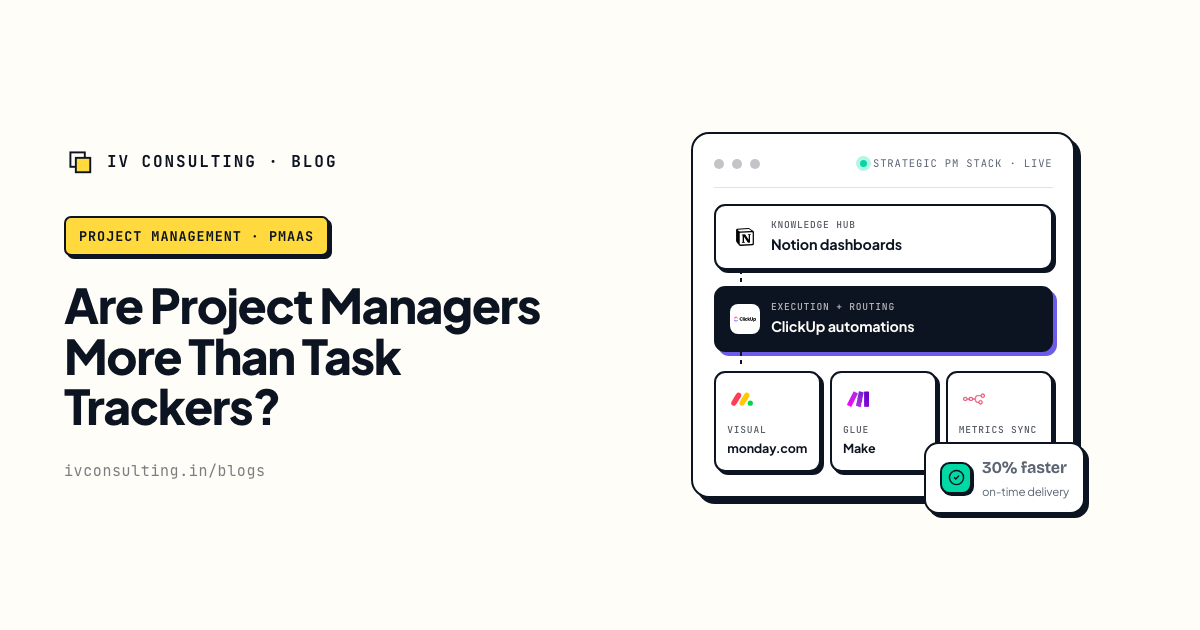
Are project managers more than task trackers?
How SMBs unlock growth with PMaaS, automation, and AI.
Read the article →
The Automation stage, built for you
Your tools connected, deadlines protected, the busywork gone.
See the offer →Want your automation stack built for you?
Book a free 30-minute strategy call. We will map your highest-ROI workflows and give you a build roadmap on the spot. If we are not the right team for you, we will say so and point you somewhere better.
Book a Free Strategy Call →Free 30-minute call. Honest take, even if that means "you do not need us yet."