Why Agile does not always mean faster projects, and what SMBs should do
Agile is not a speed switch. Its real payoff is predictable, reliable delivery. Here is how to get there.
 By Ishan Vats · Founder of IV Consulting · 150+ ops transformations over 10+ years
Some links below are affiliate links. If you buy through them we may earn a commission, at no extra cost to you.
 Best for velocity trackingClickUp
 Best for sprint docsNotion
 BacklogJira
 Capacitymonday
 MetricsMake
No, Agile does not automatically make projects faster. It optimizes for adaptability, quality, and predictable delivery, not raw velocity. Done well, it makes your delivery cadence reliable enough to plan around. For SMBs, the win comes from measuring cycle time and lead time, committing to realistic sprint goals, and automating the reporting busywork, not from sprinting harder.
What it really does
What Agile actually optimizes
Agile is often misunderstood as a guarantee of faster delivery. Its real value is somewhere more useful: better adaptability, higher quality, and dependable delivery. The goal is not to look fast. It is to be reliable enough that the rest of the business can plan around you.
Many leaders assume adopting Agile will speed projects up by default. It will not. Once you understand what Agile is actually tuned for, you can stop chasing velocity and start improving the metrics that change business outcomes.
- Velocity vs throughput: Velocity counts story points finished per sprint. Throughput counts the customer-valuable items you actually deliver. Many teams optimize velocity (looking busy) at the expense of throughput (delivering value).
- Cycle time: The duration from when a task starts to when it is done. Short cycle times indicate efficient flow through your system.
- Lead time: From the moment a request is made to delivery. This is what customers and stakeholders actually feel, and what matters most to business outcomes.
- Predictability: Agile's true superpower is not speed. It is making your delivery cadence reliable enough that stakeholders can plan around it.
The myth
Why teams think Agile equals speed
Three habits create the illusion of acceleration while quietly building debt, rework, and burnout.
- Over-commitment in sprints: Teams pack too much into each sprint, creating a feeling of progress while building technical debt and burnout. When sprint goals are consistently missed, velocity numbers stop meaning anything.
- Ambiguous "definition of done": Without clear acceptance criteria, teams mark tasks complete too early. That creates false progress and rework cycles that extend the real delivery timeline.
- Tool misuse: A 2022 survey found 34% of Agile teams struggled with tool misalignment. Using ClickUp, Notion, or Jira as simple to-do lists, without sprint planning, dependency tracking, or velocity charts, throws away most of Agile's benefits.
Where it breaks
How Agile can actually slow projects down
Implemented poorly, Agile can be slower than what it replaced. These are the four failure modes we see most, each with the fix.
Frequent scope creep
Requirements change mid-sprint because there is no change management protocol. Fix: require written acceptance criteria for every user story before the sprint starts.
Technical debt accumulation
Skipping code reviews and testing to "go faster" creates fragile systems that slow future delivery. Fix: dedicate 15 to 20% of each sprint to debt reduction.
Inadequate team training
Teams using Agile vocabulary without the underlying principles create process theater. Fix: invest in a two-day Agile fundamentals workshop before rolling out to new teams.
Communication gaps
Daily standups that become status reports instead of blocker-clearing sessions waste time without creating alignment.
Measure this
The metrics that actually matter
For SMBs, four practical metrics tell you everything you need. Track these, not story points.
| Metric | What it tells you | Target / signal |
|---|---|---|
| Cycle time | How long a task takes from start to done | Under 2 weeks. Longer means your stories are too large, so break them down. |
| Lead time | From request made to delivered to customer | This is your customer's experience of your speed. Trend it down. |
| Throughput | Items of real value completed per sprint | Count items, not points. Are you delivering more value each sprint? |
| Escaped defects | Bugs found in production, missed in dev | A rising rate signals quality is being traded for speed. |
Review these in your biweekly retrospective. Do not track more than four or five metrics, or you will create reporting overhead that consumes the very time you are trying to save.
The plan
SMB playbook: a 6 to 12 week adoption plan
Week 0: establish baseline metrics
Before changing anything, measure your current cycle time, lead time, and throughput for two weeks. This baseline is critical. Without it, you cannot prove improvement later or know which changes actually worked.
Weeks 1 to 4: stabilize processes
- Define and document your "definition of done" for the team's most common work types.
- Set sprint goals that commit to 70% of estimated capacity, not 100%.
- Run daily standups that are strictly blocker-clearing: what is blocking you, and how do we unblock it?
- Introduce a lightweight RACI for each sprint so ownership is never ambiguous.
Weeks 5 to 8: integrate automation
- Automate sprint reporting with ClickUp dashboards or Notion AI summaries.
- Set up blocker alerts: when a task is blocked for more than 24 hours, trigger a Slack notification to the PM.
- Automate velocity and cycle time calculations with n8n or Make, pulling from your project tool into a live metrics dashboard.
Weeks 9 to 12: refine and iterate
- Compare current metrics against your Week 0 baseline.
- Identify the two or three biggest remaining bottlenecks and address them in the next cycle.
- Run a retrospective on the Agile adoption itself: what worked, what did not, and what you adjust next.
The stack
Tools that improve predictability
The tool is never the strategy, but the right stack removes the manual work that hides your real cycle time.
ClickUp
Automation for task status changes, dependency alerts, and sprint progress notifications, with built-in velocity tracking. Our default for teams that want metrics and execution in one place.
Notion
Sprint documentation, templates, and AI-powered meeting summaries. Best for knowledge-heavy teams that live in their docs.
monday.com
Visual boards for capacity planning and cross-team coordination. Easy for non-technical stakeholders to read at a glance.
Make and n8n
Connect your tools so metrics stay current automatically. Cross-platform workflows kill manual data entry and keep cycle time honest.
Case 1, cycle time reduction: A mid-sized tech firm struggled with three-week average cycle times. By redefining their "definition of done" and adding acceptance criteria for every user story, they reached 11 days in 8 weeks. That is a 46% improvement with zero new tools or hires.
Case 2, throughput increase: A marketing SMB suffering from scope creep adopted clear sprint goals and a mid-sprint change request process. Throughput rose 20% over a quarter, and client satisfaction climbed because delivery dates finally became reliable.
FAQ
Questions teams ask before they adopt Agile
Why does not Agile make projects faster?
How long until SMBs see measurable Agile benefits?
What single metric should I track first for predictability?
Can automation and integrations make Agile faster?
Is Agile the right fit for a small team?
Ishan Vats
Founder, IV Consulting · operations & systems consultant
I build operating systems and automations for teams from startup to enterprise. 150+ ops transformations over 10+ years. If you want yours mapped and built right, I'll do it with you on a free call.
Book a free strategy call →Keep reading
Related guides and work
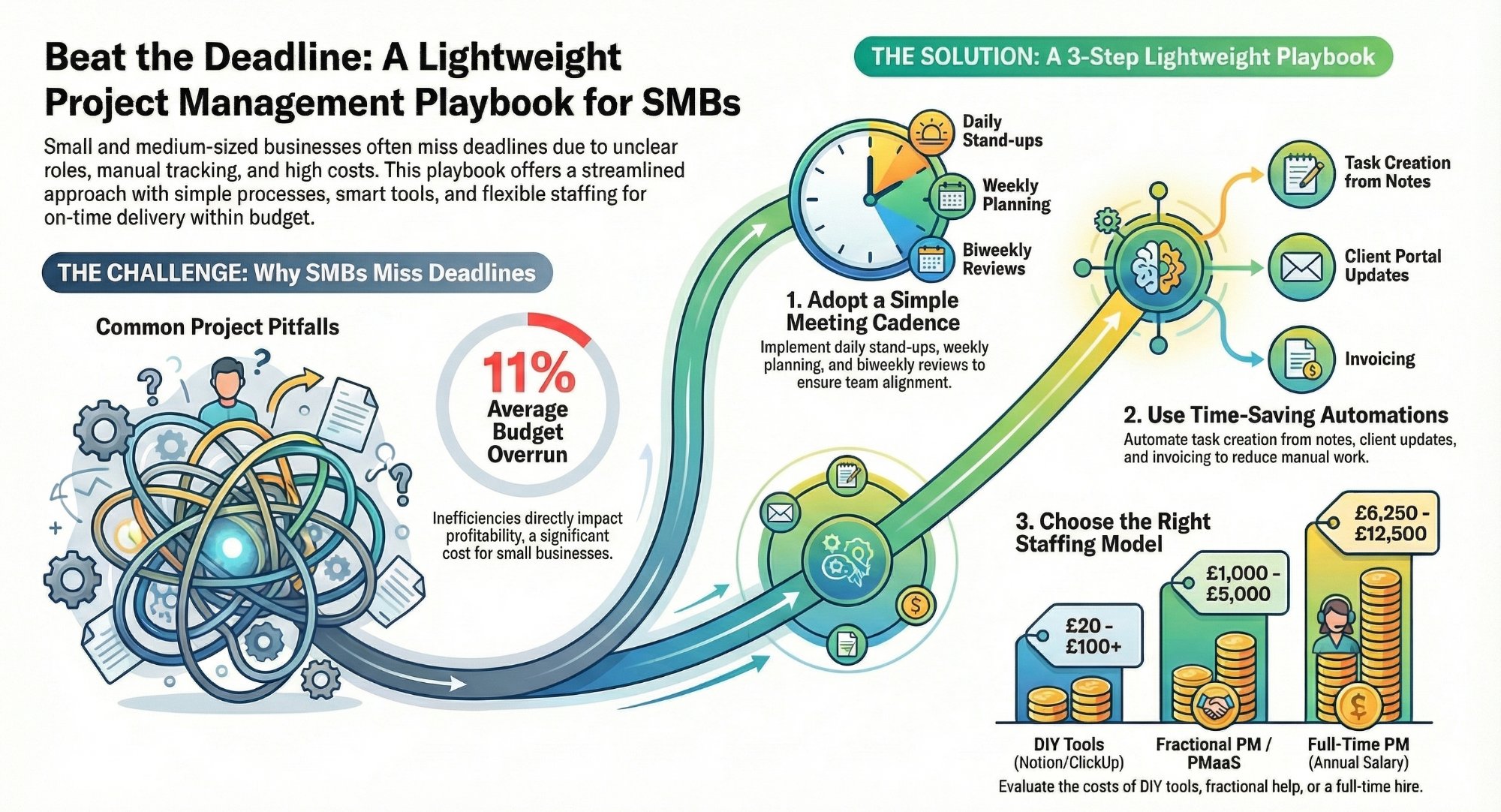
Can your small team deliver on time without hiring a PM?
How lean teams hit deadlines with systems instead of headcount.
Read the guide →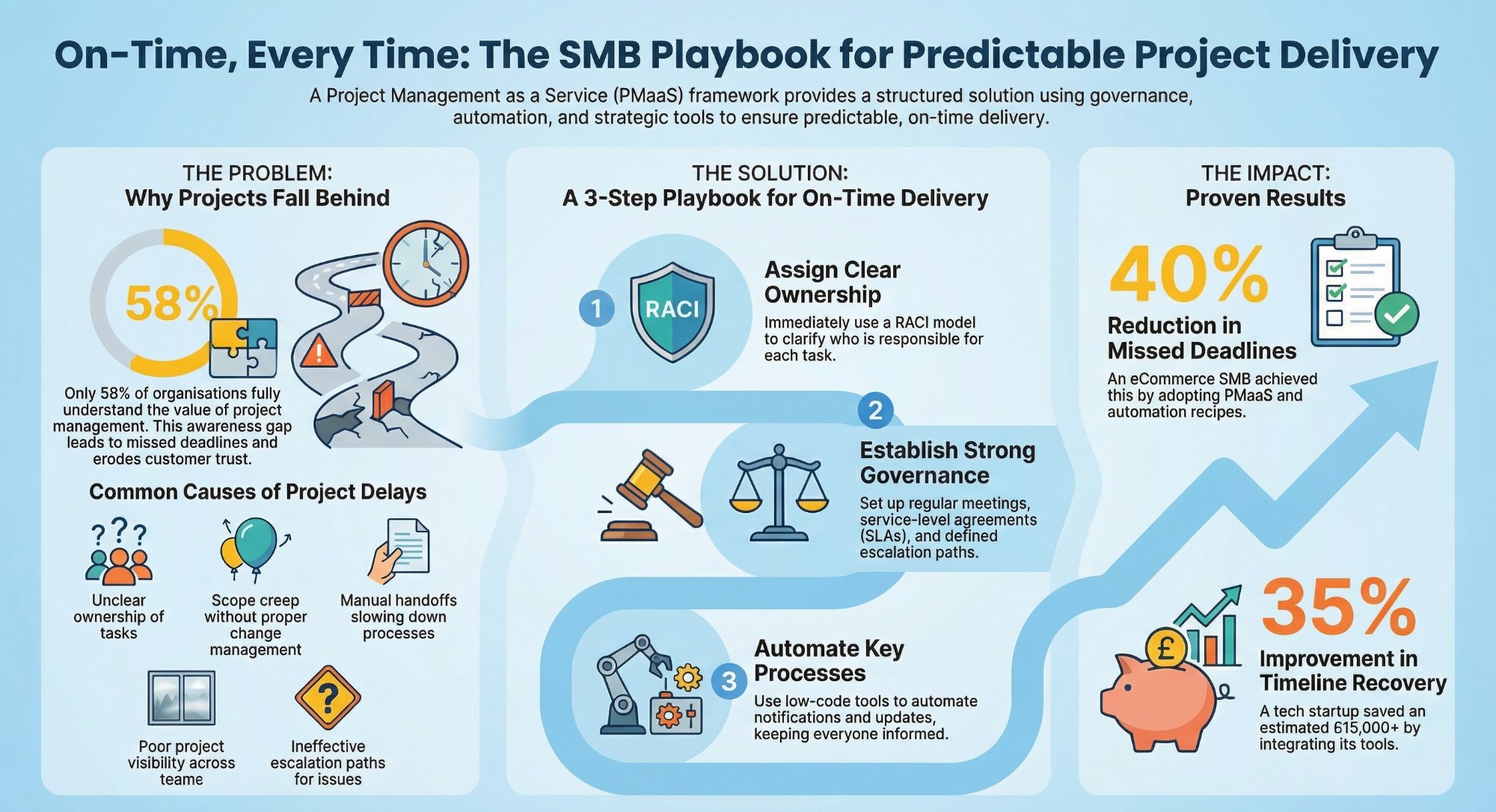
Why are SMBs missing deadlines, and how can PMaaS fix it?
The root causes of slipped dates and the model that makes delivery reliable.
Read the playbook →
The Foundation stage, built for you
A clean, metric-driven operating system so delivery becomes predictable by design.
See the offer →Want your automation stack built for you?
Book a free 30-minute strategy call. We will map your highest-ROI workflows and give you a build roadmap on the spot. If we are not the right team for you, we will say so and point you somewhere better.
Book a Free Strategy Call →Free 30-minute call. Honest take, even if that means "you do not need us yet."