Answer Engine Optimization: how to get your small business cited by AI search
AI now answers your customer before they ever click. Answer Engine Optimization is how you become the source it quotes instead of the link it skips.
 By Ishan Vats · Founder of IV Consulting · 150+ ops transformations over 10+ years
 ChatGPTCites you
 GeminiCites you
 ClaudeCites you
Answer Engine Optimization (AEO) is the practice of structuring your content so AI answer engines like ChatGPT, Perplexity, Google AI Overviews, and Claude quote your business directly in their answers. Unlike traditional SEO, which competes for a click on a results page, AEO competes to be the source the AI cites before the user ever clicks. You win it by giving one clear, self-contained answer per question, marking up your pages with schema, keeping your business facts consistent everywhere, and earning mentions across the third-party sources AI models already trust.
The shift
What is answer engine optimization?
Answer Engine Optimization (AEO) is the practice of structuring your content so AI answer engines quote your business directly when they answer a question. The answer engines that matter for a small business are ChatGPT, Perplexity, Google AI Overviews, Google Gemini, and Claude. When a potential customer asks one of them a question in your space, AEO is what decides whether your business is the source it cites or the result it never mentions.
You may also see it called generative engine optimization (GEO), answer engine optimization, or LLM optimization. The labels differ, the goal is the same: be the answer, not just a blue link buried on page one.
Here is why this is suddenly urgent. Search used to end on a results page, where ten links competed for a click. Now the answer often appears at the top, written by an AI, with a handful of cited sources and nothing else. If your business is not one of those cited sources, you are invisible at the exact moment someone is looking for what you sell.
The zero-click problem
Why do AI answers change the game for small businesses?
Because the AI answers the question before your customer ever reaches your website. This is the zero-click search shift, and it hits small businesses hardest, since you cannot outspend a big brand on ads to buy back the visibility you lost.
Think about how your own customers now search. They no longer type three keywords and scan a list. They ask a full question in plain language: "what is the best way for a small agency to automate client onboarding" or "who does Notion setup for consultancies." The answer engine reads the web, synthesizes a response, and cites two or three sources. That is the new shelf space, and there are far fewer slots than a traditional results page.
The good news for a focused small business: these engines do not rank by domain size. They rank by which page gives the clearest, most trustworthy, most specific answer to the exact question. A sharp answer from a small operator can beat a vague paragraph from a household name. That is the opening AEO exists to capture.
The comparison
How is AEO different from SEO?
They overlap, and you should do both. But the target is different: SEO competes for a click on a results page, AEO competes to be the source an AI quotes in its answer. Here is how the two line up.
| What matters | Traditional SEO | Answer Engine Optimization |
|---|---|---|
| The goal | Rank a page, earn the click | Be the cited source in the answer |
| Where you win | The search results page | Inside the AI answer, before the click |
| Content shape | Long pages built around keywords | Clear, self-contained answers per question |
| What the machine wants | Relevance and backlinks | Extractable answers, schema, consistent facts |
| How trust is judged | Domain authority and links | Entity clarity plus mentions on trusted sites |
| How you measure it | Rankings and organic clicks | Citations and mentions in AI answers |
| Best for | Capturing clicks that still happen | Staying visible as clicks move to AI |
The playbook
How do you get your small business cited by AI?
Six moves, in order of impact. None require a big budget. They require discipline about structure and honesty about your facts.
Answer the question in the first two sentences
For every important question in your space, publish a page or section that answers it directly in the opening two sentences, then explains. Lead with a self-contained answer a model can lift word for word. If the answer only makes sense after three paragraphs of setup, the AI will skip it for a cleaner source.
Write the way people ask. Use the real question as a heading, then answer it plainly underneath. That is exactly the pattern this page uses.
Mark up your pages with schema
Structured data is how you hand a machine your facts without ambiguity. The high-value types for a small business are FAQPage for question and answer blocks, Article for guides and posts, and Organization or LocalBusiness for who you are. It confirms your answer, your author, and your business details in a format models and search engines parse instantly.
Schema is a strong supporting move, not a magic switch. A clear answer with schema beats a clear answer without it, but schema alone will not rescue a vague page.
Keep your entity facts consistent everywhere
Answer engines build a picture of who you are from every mention of your business across the web. If your name, what you do, your location, and your specialties are described differently on your site, your LinkedIn, your directory listings, and your social profiles, the model trusts you less. Pick one clear description of your business and use the same wording everywhere. This entity clarity is what lets an AI confidently say what you do.
Structure content around real questions
Organize your site around the questions customers actually ask, not around your service names. Use question-style headings, short paragraphs, and clear lists and tables. A comparison table, like the one above, is easy for a model to quote because the structure carries the meaning. The more scannable your page is for a human, the more extractable it is for a machine.
Stay fresh and cite your own sources
Answer engines favor content that is current and grounded. Put a visible published or updated date on your key pages and keep them accurate. When you state a fact or figure, attribute it to a credible source. Models are trained to prefer content that behaves like a trustworthy source, and showing your own working is part of that. Never invent a statistic to sound authoritative, because a fabricated number is a fast way to lose trust with readers and engines alike.
Earn mentions on sources the models trust
AI models lean on high-trust third-party sources: established publications, respected directories, and active communities like Reddit and industry forums where real people discuss tools. Being mentioned and discussed in those places raises the odds an answer engine treats you as a credible entity worth citing. A guest post, a genuinely helpful forum answer, an accurate directory listing, and real customer reviews all compound. You are building a reputation the machine can read.
llms.txt file at your site root that lists your key pages and a short description of each, so AI crawlers get a clean map of what you offer. Adoption is still early and it is not a guaranteed ranking factor, but it is quick to add and signals that your site is built to be read by machines.
Where to start
Which pages should a small business optimize first?
You do not need to redo your whole site. Start where a citation turns into a customer. These four are the highest-leverage places to apply the playbook.
Your top customer questions
List the ten questions prospects ask before they buy or hire. Give each a clear, self-contained answer on your site, with a question heading and the answer up front. This is the single highest-return AEO move, because these are the exact prompts your buyers type into an answer engine. Every one you answer cleanly is a chance to be the cited source at the moment of intent.
Your About and service pages
Make who you are and what you do unmistakable, in consistent wording, backed by Organization schema.
Comparison and alternative pages
Clear side-by-side pages are magnets for AI citations, because the structure hands the model a ready answer.
Your blog and guides
Each post should target one real question, answer it in the opening, add a comparison or list, and close with a short FAQ. That is the AEO shape, and it is exactly how this post is built.
Proving it works
How do you measure AEO?
You measure AEO by citations and mentions, not just rankings and clicks. The metric that matters is simple: when someone asks an answer engine a question in your space, does your business show up in the answer or its sources?
A practical monthly routine any small business owner can run:
- Test your questions. Type your ten core customer questions into ChatGPT, Perplexity, Google AI Overviews, and Claude. Note where you appear and where a competitor does instead.
- Check the sources. Perplexity and Google AI Overviews show their cited sources, so they are the easiest place to confirm a citation and see who is beating you.
- Watch referral traffic from AI tools. In your analytics, look for visits coming from ChatGPT, Perplexity, and similar. It is usually small but growing, and it tends to convert well because the visitor arrived pre-informed.
- Track your brand in answers. Ask the engines directly about your business and see whether the facts they return are accurate. Wrong facts are an entity-clarity problem to fix at the source.
FAQ
Questions owners ask about AEO
What is answer engine optimization in simple terms?
Is AEO replacing SEO?
How do I know if AI is already citing my business?
Do I need schema markup for AEO?
How long does AEO take to work?
Can a small business compete with big brands in AI answers?
Ishan Vats
Founder, IV Consulting · operations & systems consultant
I build operating systems and automations for teams from startup to enterprise. 150+ ops transformations over 10+ years. If you want yours mapped and built right, I'll do it with you on a free call.
Book a free strategy call →Keep reading
Related guides and work
Google Search Agents: what they mean for small businesses
How AI-driven search is changing where your customers find you, and what to do about it.
Read the guide →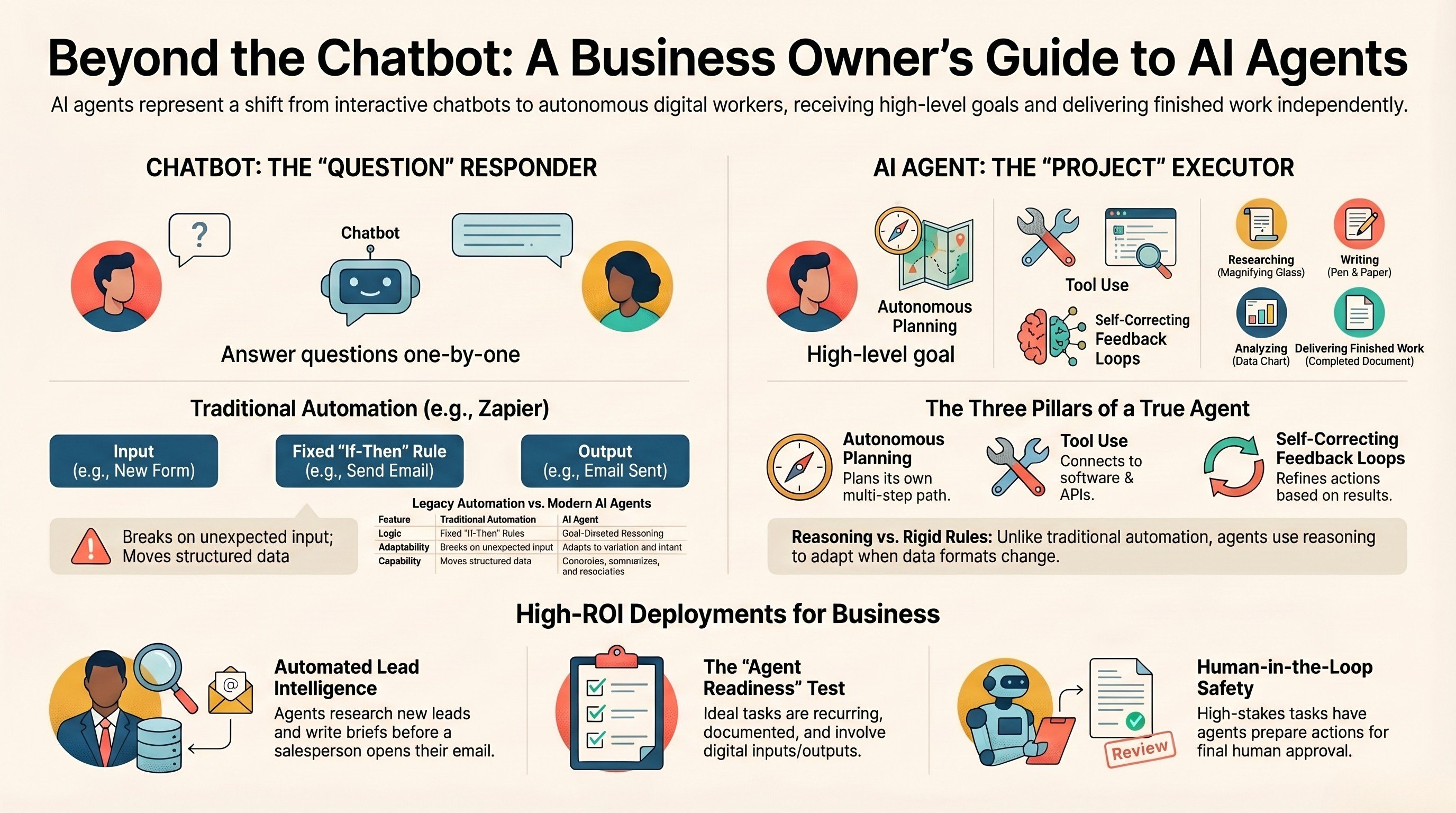
What is an AI agent? A guide for business owners
The plain-English version of what an agent actually is, and where it pays off.
Read the guide →
The AI Engineering stage, built for you
Structured, machine-readable content and systems that get your business cited and found.
See the offer →Want your business to be the answer AI cites?
Book a free 30-minute strategy call. We will look at the questions your customers ask, show you where you are and are not being cited, and map the moves that get you quoted. If we are not the right team for you, we will say so and point you somewhere better.
Book a Free Strategy Call →Free 30-minute call. Honest take, even if that means "you do not need us yet."