An AI SDR should augment your reps, not replace them.
The teams getting real pipeline from AI SDRs point them at the grunt work: research, list building, first touch, and follow-up, while humans own the conversations that close. Here is where an AI SDR actually earns its place, and where it quietly churns.
 By Ishan Vats · Founder of IV Consulting · builds AI agents & automations for 150+ teams
 AI SDR · research & first touchEnriches, drafts, follows up
 Personalized touchSent & sequenced
 CRMEverything logged
An AI SDR is an AI sales development representative: software that automates the top-of-funnel work a human rep does, such as researching accounts, building lead lists, writing first-touch messages, sequencing follow-ups, and booking meetings. For almost every small business, an AI SDR should augment your reps, not replace them. It is genuinely good at the repetitive grunt work, and genuinely bad at the live conversations that build trust and close deals. The teams that win use it for research, enrichment, first touch, and follow-up, while humans own the replies. The teams that churn set it loose to spray generic outreach, wreck their domain reputation, and get ignored. Augment first, protect your sending reputation, and expand its scope only once it earns it.
What it is
What is an AI SDR?
An AI SDR is an AI sales development representative: software that automates the top-of-funnel prospecting work a human SDR does. That means researching accounts, building and enriching lead lists, writing personalized first-touch messages, sending and sequencing follow-ups, and booking meetings onto a rep's calendar. Some are all-in-one products with a named persona, like Artisan's Ava or 11x's Alice. Others are pieces you assemble yourself from tools like Apollo, Clay, and a language model. Either way, the promise is the same: hand the repetitive outbound tasks to software so your people spend their hours on live conversations.
It helps to be clear about what an SDR actually is. A sales development representative sits at the very top of the funnel. They do not close deals. Their whole job is to find likely buyers, reach out, start a conversation, and hand a warm, qualified prospect to an account executive. That job is a mix of two very different things: high-volume repetitive work (research, list building, first touch, follow-up) and human work (reading a reply, adjusting the pitch, building enough trust to earn a meeting). An AI SDR is genuinely strong at the first half and genuinely weak at the second.
So picture it correctly. An AI SDR is not a robot salesperson that replaces your team. It is a tireless assistant that does the parts of prospecting no one enjoys and no one has time for, at a volume a human cannot match. Point it at the right work and it is a real lever. Point it at the whole job and expect it to be a rep, and you get the disappointment and the churn that so many teams have run into. It is the kind of connected, tool-using automation our AI Engineering stage is built to get right.
The capability
What is an AI SDR actually good at?
An AI SDR is good at exactly one thing: doing the repetitive top-of-funnel grunt work at a volume and consistency no human can match. That is not a knock. It is the whole reason to use one. The parts of prospecting that are pure effort, the research, the list building, the personalization, the follow-up that always slips, are the parts humans hate, do inconsistently, and drop when they get busy. An AI SDR does them the same way every single time, for every single lead, without getting bored. Here is where that lands:
- Research and enrichment. Pulling context on a company and a contact, filling in missing fields, and surfacing a reason to reach out. This is slow, mind-numbing work for a person and near-instant for software.
- List building at scale. Finding accounts that match your ideal customer profile and assembling clean, deduplicated lists, so your reps are not spending mornings in a spreadsheet.
- Personalization on volume. Writing a first-touch message that references something real about the prospect, across hundreds of leads. A human can write ten great emails. Software can write the same quality across a much larger list.
- Follow-up that never gets dropped. Most deals die in the gap between the first email and the follow-ups that never get sent. An AI SDR sequences follow-ups on schedule, which is often where the actual pipeline comes from.
Notice what is not on that list: reading a nuanced reply, handling an objection, reading the room on a call, and building the trust that turns a curious prospect into a booked meeting with intent. That is human work, and it stays human work. The value of an AI SDR is that it clears the repetitive load off your reps' plates so they can spend their time on the conversations that actually move deals.
The decision
Should an AI SDR augment or replace your sales reps?
For a small business, the real question is not "AI SDR or human SDR." It is how much of the job you hand to the software. Augment means the AI does the grunt work and your rep owns the conversation. Replace means the AI runs the whole motion, from first touch to booked meeting, with no human in the loop. This table maps the two approaches. The augment column is highlighted because, for almost every small team, it is the approach that actually produces pipeline instead of burning your domain and your brand.
| Dimension | Augment (AI does the grunt work) | Replace (AI runs the whole motion) |
|---|---|---|
| What the AI owns | Research, list building, first touch, follow-up | Everything, including replies and qualification |
| What the human owns | Conversations, objections, the close | Nothing, until something breaks |
| Message quality | Reviewed, on-brand, personalized | Generic at volume, drifts toward spam |
| Domain and deliverability | Protected: volume is paced and monitored | At risk: high-volume spray tanks your reputation |
| How buyers react | Reads as a real, if assisted, human | Increasingly recognized and ignored as a bot |
| Typical outcome | Reps cover more pipeline, book more meetings | Early volume, then churn in a few months |
The shortlist
Where does an AI SDR actually pay off for a small business?
An AI SDR earns its place when the sales motion is high-volume and repeatable, and when research and admin are eating hours your reps should spend selling. It earns nothing, and often costs you, when every deal is different and trust is the actual product. Here are the four situations where it is worth wiring in for a small team.
1. Lower-priced, higher-volume deals
The lower your average deal size and the more prospects you need to touch, the better an AI SDR fits. Self-serve products, sub-five-figure deals, and anything with a repeatable pitch are exactly where automated research, first touch, and follow-up compound. On a high-volume motion, the AI covers ground a small team simply cannot, and each individual conversation matters less, so a missed nuance is not fatal.
2. Standardized, repeatable messaging
If your outreach follows a consistent structure, same value proposition, same handful of pain points, same objections, an AI SDR can reproduce it reliably across a big list. Where the message is genuinely templatable, software does it faster and more consistently than a rushed human. The more your pitch changes from prospect to prospect, the less this holds.
3. Research and admin offload for your existing reps
This is the safest, highest-return use, and it is pure augmentation. Let the AI do the pre-call research, the enrichment, the CRM updates, and the list hygiene, and give your reps back the hours they lose to it. You are not replacing anyone. You are making the reps you already have meaningfully more productive, which is usually the fastest ROI on the whole idea.
4. Top-of-funnel prospecting and follow-up
The very top of the funnel, finding likely accounts, making the first touch, and keeping the follow-up cadence alive, is where most SMB pipeline leaks. An AI SDR is well suited to keeping that engine running so nothing falls through the cracks, then handing the warm reply straight to a human. For a fuller picture of how this connects to your other sales and marketing work, see our guide on AI use cases for sales and marketing teams.
You do not have to buy an AI SDR seat to run that engine. The same two jobs, building the list and warming it, can be split across a scraper and a messaging tool, which is the no-code version of the same motion. We walk through one such build in the Browse AI and ManyChat lead gen stack.
The playbook
How do you run an AI SDR without torching your pipeline?
Most AI SDR failures are not the model's fault. They are deployment failures: too much scope, too much volume, no human on the replies, and no one watching deliverability. Here are the five steps that keep an AI SDR an asset instead of the thing you cancel in three months.
The five steps at a glance: (1) start with augmentation, not replacement, (2) protect your domain and deliverability before you scale volume, (3) keep a human on every real reply, (4) measure meetings held, not emails sent, and (5) set the guardrails before you point it at your CRM.
Start with augmentation, not replacement
Give the AI the grunt work first: research, enrichment, list building, drafting the first touch, and sequencing follow-ups. Keep your reps on the conversations. Only expand the AI's scope once it has proven it produces quality at a given step. The teams that try to replace a rep on day one are the ones that get burned. The teams that augment and expand slowly are the ones still using it a year later.
Protect your domain and deliverability before you scale volume
This is the step that gets skipped and it is the step that kills AI SDR projects. Before you turn up volume, get the sending basics right: authentication set up properly, sending warmed up gradually, volume paced, and messages that do not read as mass-generated. Deliverability is the whole ballgame in outbound. A tool that sends more but lands in spam is worse than a human sending less, and a burned domain can take months to recover.
Keep a human on every real reply
The moment a prospect replies, a human should be in the loop. Automated first touch and follow-up are fine. Automated handling of a live conversation is where trust breaks and deals die. Route replies to a rep, let them own the back-and-forth, and let the AI go back to feeding the top of the funnel. This is the exact seam that separates augment from replace, and it is where most of the value lives.
Measure meetings held, not emails sent
An AI SDR makes vanity metrics trivial. It can send enormous volume and generate impressive-looking activity that produces zero pipeline. Ignore emails sent and open rates. Track the metrics that actually matter: qualified replies, meetings booked, and meetings that were actually held and turned into opportunities. If those are not moving, more volume is not the answer, and it is probably the problem.
Set the guardrails before you point it at your CRM
An AI SDR usually touches your CRM, your calendar, and your sending infrastructure. Give it least-privilege access to only what it needs, keep a human approval step on anything that writes to a customer record or sends at scale, and log what it does so you can audit it. These are the same guardrails any AI agent needs, and they are cheap to set up before launch and painful to bolt on after something goes wrong.
FAQ
Questions people ask about AI SDRs
What is an AI SDR?
Should an AI SDR augment or replace your sales reps?
Do AI SDRs actually work?
Where does an AI SDR pay off for a small business?
How much does an AI SDR cost?
Why do AI SDRs churn or get cancelled?
Can you build an AI SDR into your existing stack instead of buying one?
Ishan Vats
Founder, IV Consulting · AI & automation consultant
I build AI agents and automations for teams from startup to enterprise, and I spend a lot of time helping owners tell the useful automation from the hype, especially in sales, where the wrong setup quietly burns your domain and your brand. 150+ ops transformations over 10+ years. If you want your sales workflow mapped to what an AI SDR should and should not touch, I'll do it with you on a free call.
Book a free strategy call →Keep reading
Related guides and work
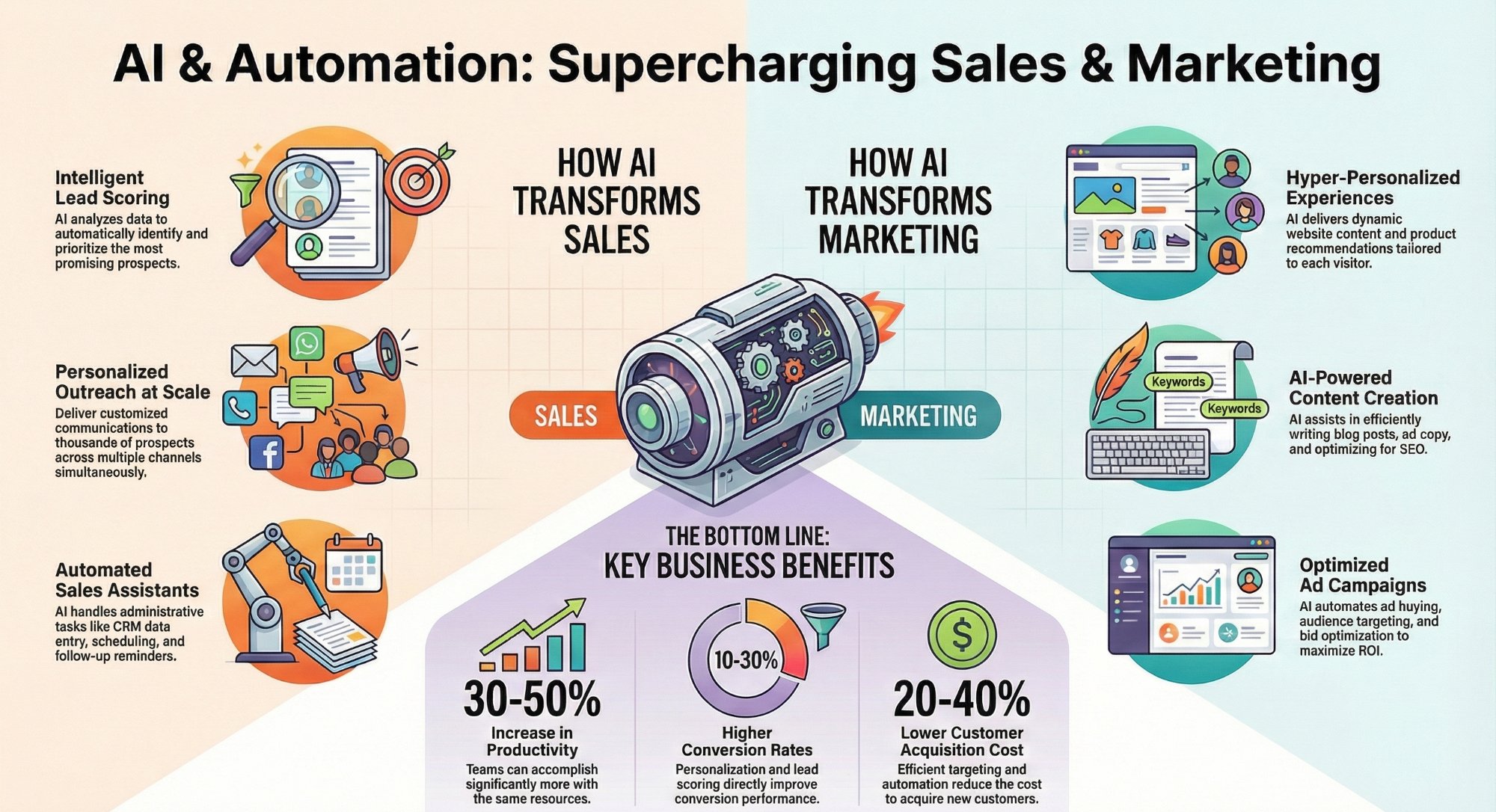
AI use cases for sales and marketing teams
Where an AI SDR fits in the bigger picture: the real jobs AI and automation do across your sales and marketing.
Read the guide →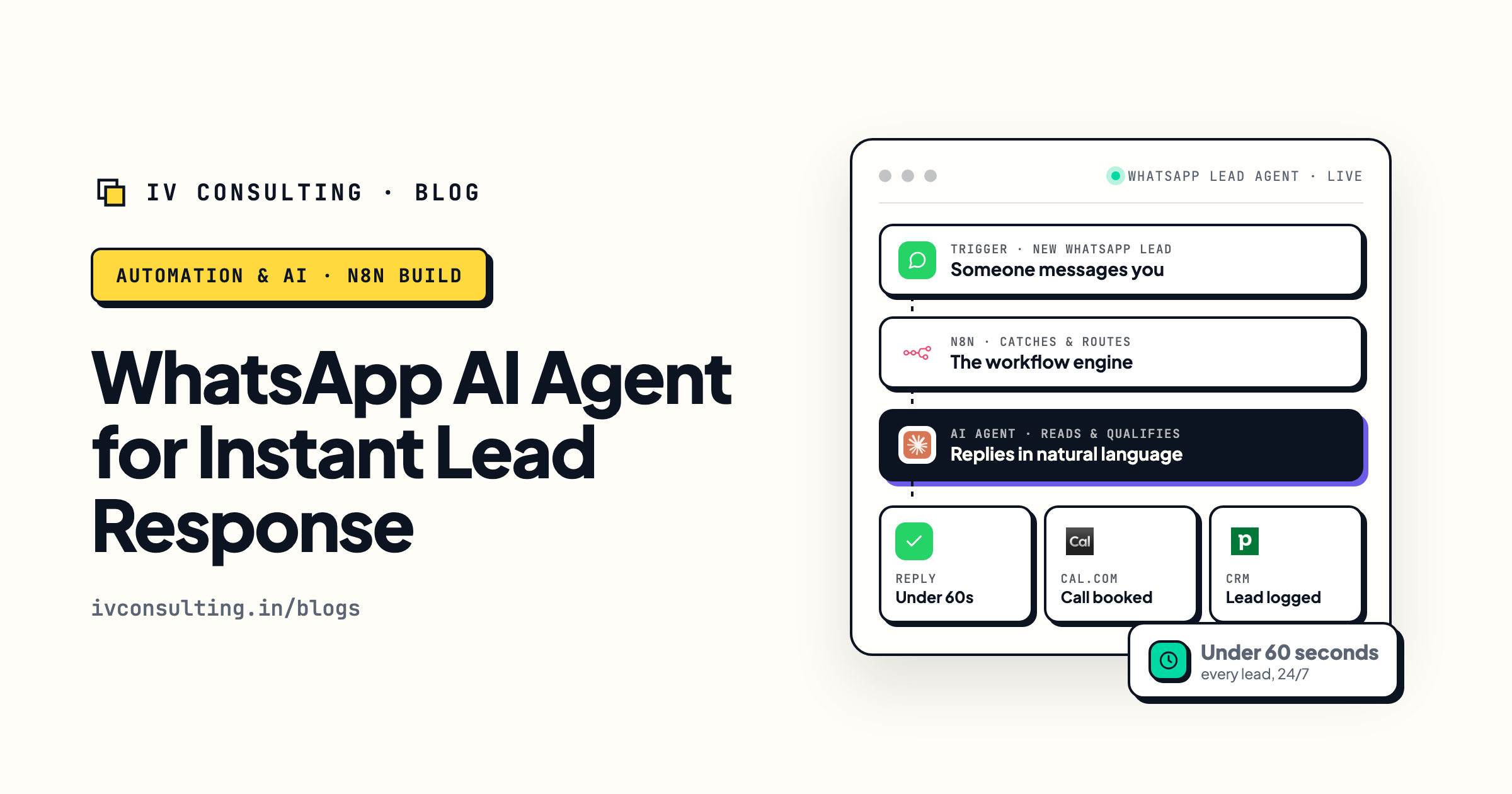
WhatsApp AI agent for instant lead response
The augment idea applied to inbound: let an agent answer and qualify in under 60 seconds, then hand off to a human.
Read the guide →
The AI Engineering stage, built for you
We wire AI SDR steps into your stack, with a human on the replies, so you get the leverage without the churn.
See the offer →Put an AI SDR on the grunt work, not the closing.
Book a free 30-minute strategy call. We will look at your sales motion, decide what an AI SDR should and should not touch, and map an augment-first setup that gives your reps more pipeline without burning your domain or your brand.
Map my highest-ROI sales workflow →Free 30-minute call. Honest take, even if that means "keep your reps on this one."