Startup operations systems: from chaos to a well oiled machine
A chaotic startup is not destiny. It is a phase. This is the exact diagnostic and the 5 stage overhaul that gets you out of it.
 By Ishan Vats · Founder of IV Consulting · 150+ ops transformations over 10+ years
Some links below are affiliate links. If you buy through them we may earn a commission, at no extra cost to you.
 NotionSOPs and CRM
 ClickUpDelivery + cadence
 SlackAsync clarity
Transforming a chaotic startup into a well oiled machine is not a 3 year journey. It is a 90 to 150 day operational overhaul, executed in the right sequence. You start with the CHAOS Audit to find the real root causes, then run a 5 stage roadmap from quick wins to a self improving organisation. A 23 person agency did it in 14 weeks and cut founder decision load by 74 percent.
The diagnosis
The 8 signs your startup is operating in chaos mode
You started the week with a clear plan. By 9:30 AM it is already gone. An urgent client issue needs your personal attention. A team member is waiting on a decision only you can make. A process that worked last month is inexplicably breaking under the new volume. This is not a particularly bad Monday. This is just Monday.
If this resonates, you are not running a startup. You are managing a chaos system that has a revenue line attached to it. And the chaos does not resolve itself as the business grows. Every new hire makes it louder. Every new client makes it more expensive. Every week you operate this way, you pay a compounding operational tax that most founders have never quantified, because it is spread across a thousand small inefficiencies rather than sitting on a single line of the P&L.
Startup chaos is rarely dramatic. It presents as constant low grade friction that talented, motivated people absorb through heroic individual effort, until they cannot anymore. These eight signs indicate that compensatory heroics, not operational systems, are holding the business together. Heroics are not a scalable operating model.
- The same decisions get made repeatedly because they were never documented as a policy. Every edge case triggers a new conversation with the same outcome as the last one.
- Quality is a function of who did the work. Your best operator produces excellent output, a newer hire produces inconsistent output. The difference is the absence of a quality standard embedded in a process.
- Onboarding is improvised. Each new hire gets a different version of how the company works depending on who happens to be available in the first two weeks.
- The founder is the last line of defence for a category of decisions that should have been delegated months ago. Hires with 6+ months of tenure still escalate decisions the founder made at launch.
- Information lives in people's heads. When those individuals are unavailable or leave, the knowledge is either inaccessible or permanently lost.
- Meetings multiply as coordination fails. The team runs more meetings to compensate for the absence of asynchronous clarity that documented processes and visible status would provide.
- Growth creates problems rather than solving them. Each new hire or client adds complexity rather than capacity. The business is harder to run at 20 people than it was at 10.
- Nobody can answer: what are the 3 most important things happening operationally this week? Without a shared operating rhythm, the answer is different for every person in the room.
The target state
What a well oiled machine actually looks like at startup stage
A well oiled startup machine is not a corporate machine scaled down. It is lean enough to move fast, structured enough to move consistently, and resilient enough to keep moving when individual contributors change.
The phrase well oiled machine conjures images of enterprise bureaucracy that founders instinctively resist: process heavy, slow moving, innovation averse. That is a false picture. A well oiled machine has five observable characteristics.
- Decisions flow at the right speed to the right level without bottlenecking at the founder or mis firing into chaos at the team level.
- New team members reach full productivity within 3 to 4 weeks because the knowledge, processes, and expectations are documented and accessible.
- Core delivery quality is consistent regardless of which operator does the work, because quality is embedded in process, not dependent on individual excellence.
- The leadership team spends more than 60 percent of its time on strategic and growth activities, not firefighting and coordination work that systems would handle.
- The business can absorb a planned or unplanned departure without an operational crisis, because critical knowledge is externalised and processes are documented for continuity.
Notice that this definition says nothing about the number of processes or the sophistication of the tool stack. A well oiled startup machine can be 12 people with 6 core processes and a simple Notion workspace. What makes it a machine is not complexity, it is intentionality. Every critical operational activity is designed, owned, documented, and measured. Nothing important is left to improvisation.
The hidden tax
The real cost of startup chaos
Most founders have a rough intuition that chaos costs them something. Very few have done the calculation. When IV Consulting completes a pre engagement diagnostic, the gap between the founder's estimate of the chaos cost and the actual calculated cost is almost always a factor of 3 to 5. The cost is much larger than it feels, because it is distributed across dozens of people and hundreds of daily interactions, none individually large enough to trigger an alarm.
The decision tax: every repeated decision is money spent twice
In a chaotic startup, decisions that should have been made once and documented as policy are made fresh each time a similar situation arises. How do we handle a scope extension without extra budget? What is the approval threshold for discretionary spending? What is our refund policy? Each reactive decision costs 15 to 45 minutes of senior time per occurrence. Across 20 to 30 recurring decision types and 3 to 5 occurrences per month per type, the decision tax runs to 15 to 25 hours of senior time per month, for decisions that documented policies would handle in zero minutes.
The talent drain: why great people leave chaotic startups
The most expensive consequence of chaos is not productivity loss, it is talent departure. High performing operators, the people who could build the systems that would transform the business, are disproportionately sensitive to operational chaos. They join expecting to build something. They leave when they discover the job is indefinitely managing entropy rather than creating order. Replacing a mid senior operator at a startup costs 1.5 to 2 times their annual salary in recruitment, onboarding, and ramp time.
The investor cost: chaos closes doors at the worst moments
The fundraising context of 2026 is unforgiving for startups whose operational house is not in order. Series A investors are conducting deeper operational diligence than at any point in the previous decade. A founder who cannot articulate unit economics, who has no documented processes for core delivery, whose team is visibly founder dependent in every Q&A response, is presenting a risk profile sophisticated investors increasingly decline.
The framework
The CHAOS Audit: diagnose before you build
The most expensive mistake in startup transformation is building solutions before accurately diagnosing problems. The CHAOS Audit maps the root causes of operational chaos before a single process is built. It examines five domains.
| Domain | What it tests | The root cause question |
|---|---|---|
| C - Clarity | Are roles, responsibilities, and priorities understood by everyone? | Ask 5 people who makes the final call on an out of contract scope change. More than 2 different answers means clarity is a root cause. |
| H - Handoffs | Where does work fall between functions? | For each critical handoff: what information transfers, in what format, who confirms receipt, and what happens if it is incomplete? |
| A - Accountability | Do outcomes have named owners? | For every significant outcome, is there a single named person who would be the first conversation if it deteriorated? |
| O - Operating Rhythm | Does the business have a heartbeat? | What is the standard weekly structure of meetings and checkpoints? Is current status visible without asking? |
| S - Systems | Are core processes documented, deployed, and followed? | For each of the 5 to 7 most critical activities, does a current, accessible, used process exist, or just a folder nobody opens? |
The five operational activities that most urgently need documented systems at every growth stage startup: new client onboarding, core service delivery, new team member onboarding, escalation and exception handling, and performance and quality review. If any of these five are undocumented or documented but not followed, the Systems domain is a root cause.
The overhaul
The 5 stage transformation roadmap
The transformation from chaotic to well oiled is a staged journey, not a simultaneous overhaul. The roadmap deploys change in the order that produces the highest early wins, builds team confidence, and ensures each stage creates the foundation the next requires.
Stop the bleeding (Days 1 to 30)
Before building anything new, eliminate the top 3 sources of chaos consuming the most senior time right now. Not the biggest strategic problems, the most viscerally disruptive daily friction. Stage 1 delivers a documented decision framework for the top 5 recurring decisions, a fixed handoff protocol for the most failure prone junction, and a 30 minute weekly standup that replaces 6 to 8 ad hoc update requests per week.
Build the foundation (Days 31 to 75)
With the most acute chaos addressed and founder time partially reclaimed, Stage 2 builds the four process pillars of every well oiled machine: a core delivery process built with the operators who do the work, client facing exception handling for the 5 to 7 most common scenarios, a 30-60-90 onboarding playbook that cuts ramp time by 50 to 70 percent, and an accountability architecture that maps every significant outcome to a single named owner, metric, and review cadence.
Connect the parts (Days 76 to 105)
Individual processes do not produce a machine. The machine is created by the connections between them. Stage 3 builds an operating cadence (weekly standup, weekly leadership review, monthly performance review, quarterly planning, each with a defined purpose, owner, and output), a shared operational dashboard as a single source of truth, and cross function handoff protocols for the 3 to 4 highest volume junctions.
Measure and improve (Days 106 to 135)
A machine that is not measured cannot improve. Stage 4 installs two layers. Operational health metrics (time to onboard clients, rework rate, ramp time, decision resolution time, meeting action completion) catch process degradation early. Business performance metrics (gross margin per client, NPS, productivity per head, retention, revenue per employee) confirm the operational gains translate into results. A 60 minute monthly retrospective is the continuous improvement engine.
Compound the advantage (Day 136+)
The final stage is not a project with a completion date. It is a cultural shift in how the organisation relates to its own operational infrastructure. The machine becomes self improving when team members flag process failures proactively rather than working around them silently, retrospectives produce improvements that are actually implemented, and new problems produce new systems rather than new workarounds. The gap between the well oiled machine and competitors still running on chaos widens every quarter.
The mindset
What has to change in how leaders lead
The most technically complete operational transformation will fail if the founder's leadership behaviour does not change in parallel. The system is only as stable as the leader's commitment to operating through it rather than around it.
Shift 1: from heroic responder to system designer
Heroic founders are celebrated for saving situations. That heroism signals to the team that the system is optional and that escalating to the founder is the right response to difficulty. When a problem arises that the founder would have solved personally, the new response is: what process would prevent this from needing me next time? That question, asked under pressure, is the change that makes transformations stick.
Shift 2: from knowledge keeper to documentation sponsor
Founders hold enormous institutional knowledge in their heads. In the machine phase it is systematically externalised. When a founder says "let me write that down in our knowledge base" rather than just telling you, they model the culture they want. Teams adopt documentation in proportion to how visibly their leader practices it.
Shift 3: from firefighter to architect
A founder who spends 70 percent of their time responding to today has no capacity to design the systems that prevent tomorrow's fires. The transformation reclaims time through Stage 1 quick wins. The critical question is what the founder does with it: build the next layer of infrastructure, or refill the window with growth work that re creates the chaos.
The transformation trap
The most dangerous moment is when Stage 1 frees up 4 to 5 hours of founder time per week. The temptation is to immediately fill it with growth activities. The right move is to protect that time for Stage 2 process building for at least 6 weeks. If the founder fills the window with growth work, the Stage 1 improvements erode as growth pressure re creates chaos.
The proof
A 23 person agency, founder dependent to self managing in 14 weeks
A 23 person digital marketing agency, strong client relationships and a talented team. The founding partners were working 60+ hours per week and still felt behind. Every significant client situation required one of them. New hires took 8 to 12 weeks to reach productive output. The agency had won a prestigious new account requiring 4 new team members, and both partners dreaded the onboarding. Client NPS had slipped from 71 to 54 over 18 months as the team grew but quality consistency did not.
The CHAOS Audit revealed: Clarity, no documented decision authority matrix, causing 34 founder required decisions per week; Handoffs, 4 failure prone junctions between strategy, creative, and client management; Accountability, 11 significant outcomes with no named owner; Operating Rhythm, no structured weekly cadence; Systems, 0 of 5 critical processes documented at a deployable standard.
| Metric | Before | After 90 days | Change |
|---|---|---|---|
| Founder decisions per week | 34 | 9 | -74% |
| Founder hours per week (each partner) | 62 | 44 | -29% |
| New hire average ramp time | 9.5 weeks | 2.8 weeks | -71% |
| Client NPS | 54 | 73 | +19 pts |
| Delivery rework rate | 18% | 6% | -12 pts |
| Senior team retention (12 months) | 71% | 92% | +21 pts |
| Revenue per employee | baseline | +31% | headcount flat |
The new account with 4 hires was onboarded in 3 weeks versus the historical 10 to 12 week standard. Six months after the transformation, one of the founding partners took a 3 week holiday, the first in 4 years, with no operational disruptions and no emergency client calls. That outcome, more than any metric, represents what the transformation produced: a business that could function at full capacity without the founders holding every thread.
FAQ
Questions founders ask before they start
How long does it take to transform a chaotic startup into a well oiled machine?
Will building processes slow down our startup?
How do I get my team to follow new processes?
What is the CHAOS Audit for startups?
How do I know when my startup has successfully transformed?
Can we do the transformation ourselves or do we need outside help?
Ishan Vats
Founder, IV Consulting · operations & systems consultant
I build operating systems and automations for teams from startup to enterprise. 150+ ops transformations over 10+ years. If you want yours mapped and built right, I'll do it with you on a free call.
Book a free strategy call →Keep reading
Related guides and work
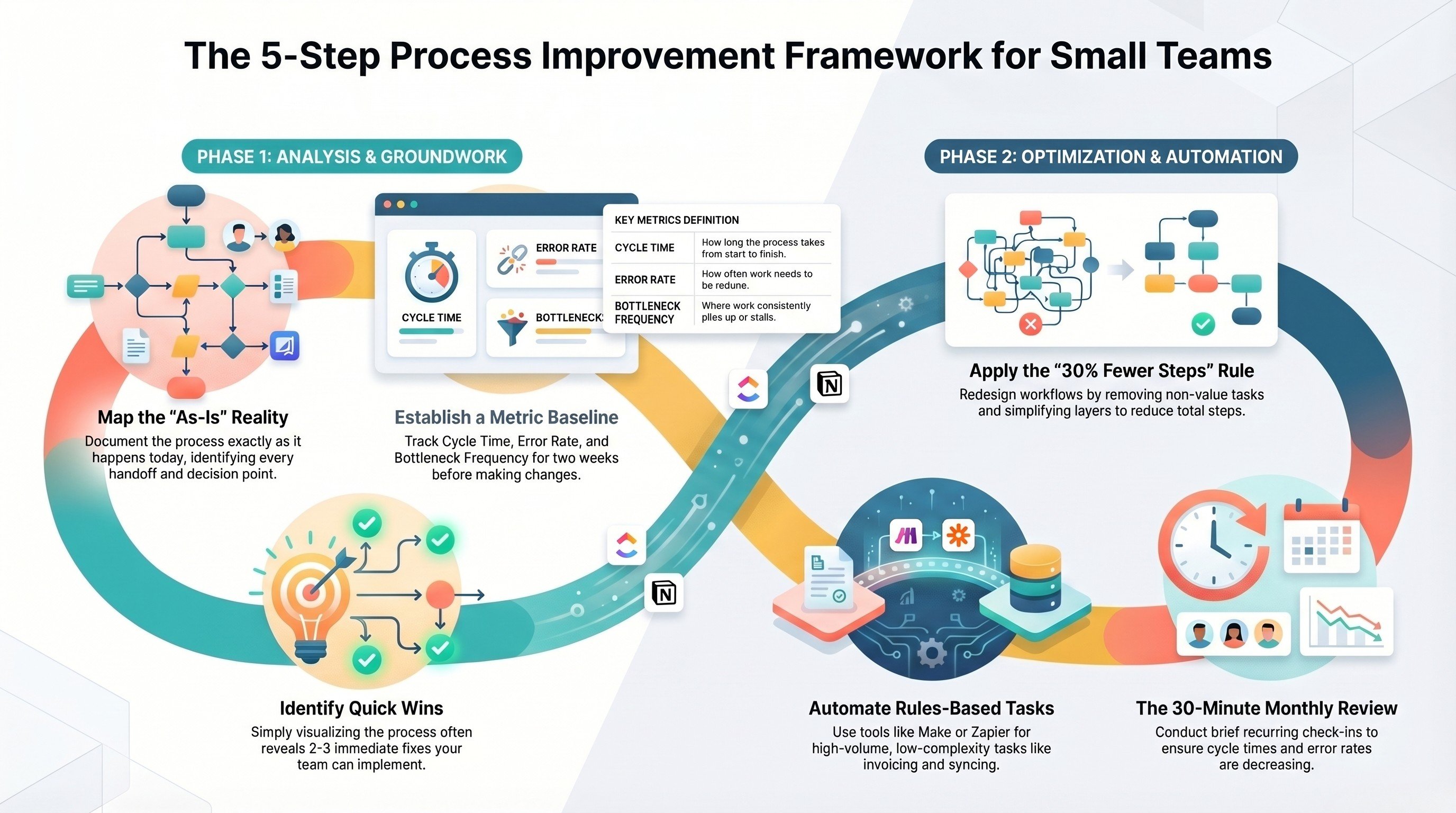
A process improvement framework for small teams
The repeatable way to fix broken processes without grinding the business to a halt.
Read the framework →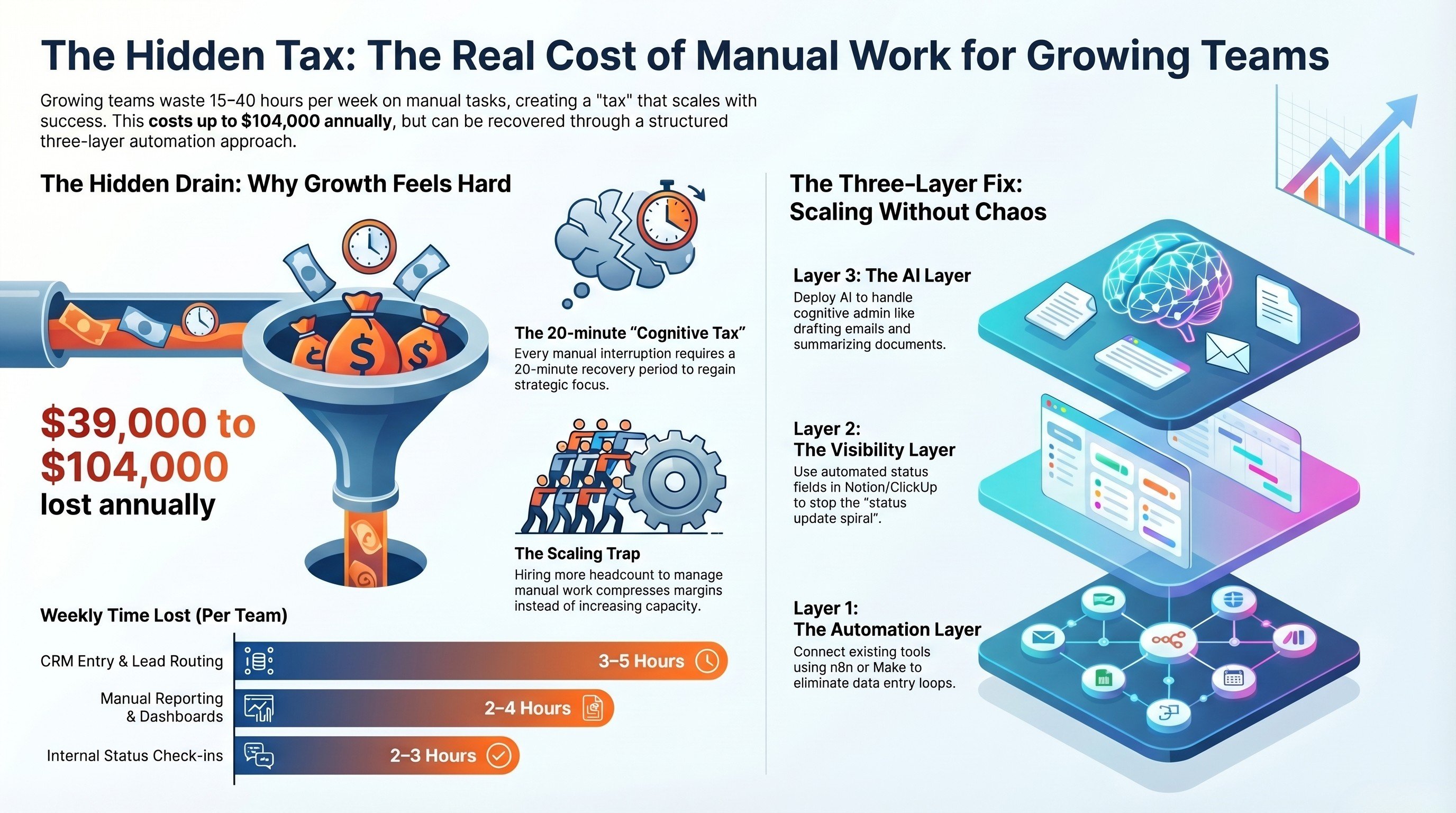
The real cost of manual work for growing teams
How to quantify the operational tax most founders never put on the P&L.
Read the analysis →
The Automation stage, built for you
Your operating system designed, built, and handed over: chaos out, predictable systems in.
See the offer →Want your automation stack built for you?
Book a free 30-minute strategy call. We will map your highest-ROI workflows and give you a build roadmap on the spot. If we are not the right team for you, we will say so and point you somewhere better.
Book a Free Strategy Call →Free 30-minute call. Honest take, even if that means "you do not need us yet."