SMB operational excellence stories: five transformations, in real numbers
Five SMBs that turned chaotic, inefficient operations into scalable, profitable businesses. What they changed, and what it returned.
 By Ishan Vats · Founder of IV Consulting · 150+ ops transformations over 10+ years
Some links below are affiliate links. If you buy through them we may earn a commission, at no extra cost to you.
 NotionTrackers and CRM
 ClickUpWorkflow checklists
 SlackReview cadence
Operational excellence is not a Fortune 500 concept. It is the decision to stop tolerating what is costing you. These five SMBs, spanning design, logistics, professional services, IT, and manufacturing, each diagnosed one core problem honestly, fixed it precisely, and measured it consistently. The results: a 45% effective rate gain, an 81% error reduction, margins climbing from 12% to 21%, and a blended 20.5x return. None needed a rebuild. They needed the truth about their own numbers.
The premise
What operational excellence actually means for SMBs
Operational excellence is not a six-sigma certification programme or a multi-year enterprise transformation with a six-figure retainer. It is the decision, made by a business owner, a managing director, or an operations lead, to stop tolerating what is costing them. The companies in this collection are proof that the decision can be made at any size.
For an SMB, operational excellence is the state in which a business delivers its product or service consistently, at or above the quality standard, within the cost and time it has committed to, without requiring heroic effort from its people to compensate for broken processes. It is not perfection. It is predictability: the ability to make a commitment and keep it, at a margin that makes the business viable.
What follows are five stories from SMBs that IV Consulting worked with directly. Each started in a different place and faced a different core problem. Each ended with a business that operated measurably better, with lower costs, higher margins, faster delivery, or stronger client retention. None of them required a complete rebrand, a new leadership team, or a wholesale technology overhaul. They all required one thing: a clear-eyed diagnosis of what was actually broken, followed by disciplined execution of the fixes.
The framework
The five levers that appear in every transformation
Not every business needs all five. But every business that achieved sustainable operational excellence pulled at least three.
1. Visibility
You cannot improve what you cannot measure. Every transformation starts with making the real numbers visible, cost per unit, hours per project, error rate per process, before any intervention is designed. In most engagements we build this layer in Notion or ClickUp so the truth updates daily, not quarterly.
2. Accountability
Every process needs a single named owner. Not a team, not a department, not everyone. One person whose job it is to ensure the process runs correctly, with the authority to fix it when it does not.
3. Rhythm
Consistent cadences replace reactive heroics. Weekly reviews, daily stand-ups, monthly margin checks. The discipline of regular review cycles is what converts a one-time fix into a permanent improvement.
4. Integration
Systems and processes that connect, not silo. Data entered once, visible everywhere it is needed. Handoffs that are documented and tracked rather than assumed and forgotten.
5. Margin discipline
Operational excellence always has a financial test. Every process change must eventually show up in the numbers. If it does not, it was not an improvement, it was reorganisation for its own sake.
The transformations
Five real SMBs, five core problems, five fixes
The design studio that stopped losing money on every project
Graphic design and branding, 14 people. After six years, the studio had never once tracked the profitability of an individual project. Jobs were priced on estimated hours, but nobody tracked actual hours in real time. The founder knew the business was not as profitable as it should be. She did not know why.
The diagnosis was stark: the average project was delivering well below its quoted effective rate, and the gap was entirely attributable to untracked scope expansion. Clients requested changes, the studio absorbed them to protect the relationship, and nobody flagged when hours had exceeded the estimate. The studio was not losing clients. It was losing money on them.
What changed. A real-time project cost tracker tied to time entry, showing estimated versus actual hours updated daily. A scope change protocol where any request adding more than two hours triggered a written notice and an absorb-or-bill decision. A weekly project profitability review of the effective rate across all active jobs.
"We were essentially donating a day and a half of work per project to clients who did not know they were receiving it. They were not asking us to do free work. We were just not telling them when the scope had changed."
The logistics company that cut delivery errors by 81%
Courier and last-mile distribution, 28 people, 14 active routes. A regional courier was running a 7.1% delivery error rate, roughly 1 in 14 deliveries involving a wrong address, a missed window, a damaged item, or a failed handover. The owner blamed driver quality and had cycled through staff. The real cause was a dispatch process that relied entirely on verbal briefings and driver memory.
Drivers left with a printed manifest but received route changes, priority overrides, and delivery instructions verbally, with no confirmation that anything had been received correctly and no real-time visibility for the dispatcher until a driver called in.
What changed. A structured digital dispatch workflow built on a low-cost tool the company already owned. Every route change confirmed in writing. A departure checklist before leaving the depot. A real-time exception monitor flagging at-risk deliveries. Monthly error-rate reviews replaced ad hoc performance conversations.
The professional services firm that grew revenue without adding headcount
Management consulting, 19 people. The firm was at capacity, turning down enquiries because the team was fully deployed. But a time audit revealed that 34% of billable staff time was going to non-billable administration or low-value work that could be systematised: chasing approvals, reformatting deliverables to match client templates, manually compiling status reports.
What changed. A client portal that moved approvals, document sharing, and status reporting out of email chains, cutting the average approval cycle from eight days to two. A standardised deliverable template library covering 80% of common output types, eliminating reformatting overhead. A weekly time allocation review with a target of holding non-billable admin below 15% of total time.
The IT services business that turned around its client satisfaction
IT managed services, 31 people, 47 active contracts. With an NPS of 31 and a renewal rate of 67%, the firm was losing roughly one in three clients at contract end. Exit interviews revealed a consistent pattern: clients did not feel informed. They experienced the firm as reactive, finding out about issues after the fact, and the escalation process felt unpredictable.
What changed. A proactive monitoring protocol with a weekly automated health summary sent to every client every Monday morning, whether or not anything had gone wrong. A formal communication cadence with a monthly 30-minute review for every contract above a defined threshold, often coordinated through Notion and Slack. A tiered escalation playbook with defined SLAs for client notification at each severity level, removing the ad hoc judgment calls.
The manufacturing SMB that found hidden operational waste
Contract manufacturing, 42 people. Margin had fallen from 18% to 12% over three years despite revenue growing. The owner assumed material costs had risen. A cost-per-unit audit revealed the real picture: materials had risen modestly, but three other cost lines had grown significantly, rework and quality failures up 61%, production scheduling inefficiency with idle time and overtime present on the same days, and supplier contract drift across three key contracts unrenegotiated in four years despite volume increases that should have triggered lower per-unit rates.
What changed. A cost-per-unit tracking system attributing actual cost at the batch level, making rework visible in real time. A scheduling review that found the root cause of the simultaneous idle-and-overtime pattern: capacity allocated by machine rather than by workflow sequence. Three supplier contracts renegotiated on actual volume data. A quality checkpoint protocol at three stages of the production flow.
"I thought we had a revenue problem. We needed to sell more to make the margins work. We actually had a cost problem. We were making the margins and then losing them before they hit the bottom line."
The scoreboard
The five stories: combined impact
Different industries, different problems, different levers. One consistent pattern: diagnose honestly, fix precisely, measure relentlessly.
| Business | Core problem | Primary lever | Headline result |
|---|---|---|---|
| Design studio (14) | Untracked scope creep destroying project margin | Visibility + Margin discipline | Effective rate +45%, margin 18% to 41% |
| Courier company (28) | Verbal dispatch process causing 7.1% error rate | Accountability + Integration | Error rate down 81%, complaints down 74% |
| Consulting firm (19) | 34% of billable time lost to non-billable admin | Rhythm + Integration | Utilisation 54% to 71%, same headcount |
| IT services (31) | Reactive comms, NPS 31, 67% renewal | Visibility + Accountability | NPS +33 points, renewal +17 points |
| Manufacturer (42) | Margin declining despite revenue growth | Visibility + Margin discipline | Margin 12% to 21%, on-time +22 points |
The common thread
What every one of these stories has in common
Every single one of these transformations started with an honest diagnostic, a structured look at what the actual numbers were, not what the owner assumed them to be. In four of the five cases, the owner's hypothesis about the root cause was wrong or only partially correct. The design studio thought it had a pricing problem. The courier company thought it had a people problem. The manufacturer thought it had a revenue problem. The diagnostic corrected the hypothesis before any money was spent on the wrong fix.
The second common element: every intervention was specific and measurable. Not "improve client communication" but "send a written health summary to every client by 9am every Monday." Not "reduce rework" but "implement a quality checkpoint at stages 2, 5, and 7 of the production flow, with a named checker and a signed-off acceptance criterion at each." Specificity is what converts an intention into a process.
What your story could look like
The design studio founder, the courier owner, the managing partner, the IT director, and the manufacturing MD had one thing in common before their engagements: they knew something was wrong, but they did not know precisely what. They were making decisions based on assumptions that had never been tested against real data.
Operational excellence does not start with a transformation programme. It starts with an honest look at the numbers. What does your effective hourly rate actually say? What percentage of your team's time is genuinely billable? What is your real cost per unit, per project, per delivery? The answers to those questions are the starting point for every story in this collection. See how we sequence that work across our Foundation, Automation, and AI Engineering stages.
FAQ
SMB operational excellence, answered
What does operational excellence look like for a small business?
How long does it take an SMB to achieve operational excellence?
What are the most common operational problems in SMBs?
Can operational excellence be achieved without expensive software?
What is the first step in improving SMB operations?
What industries benefit most from operational excellence programmes?
Keep reading
Related guides and work
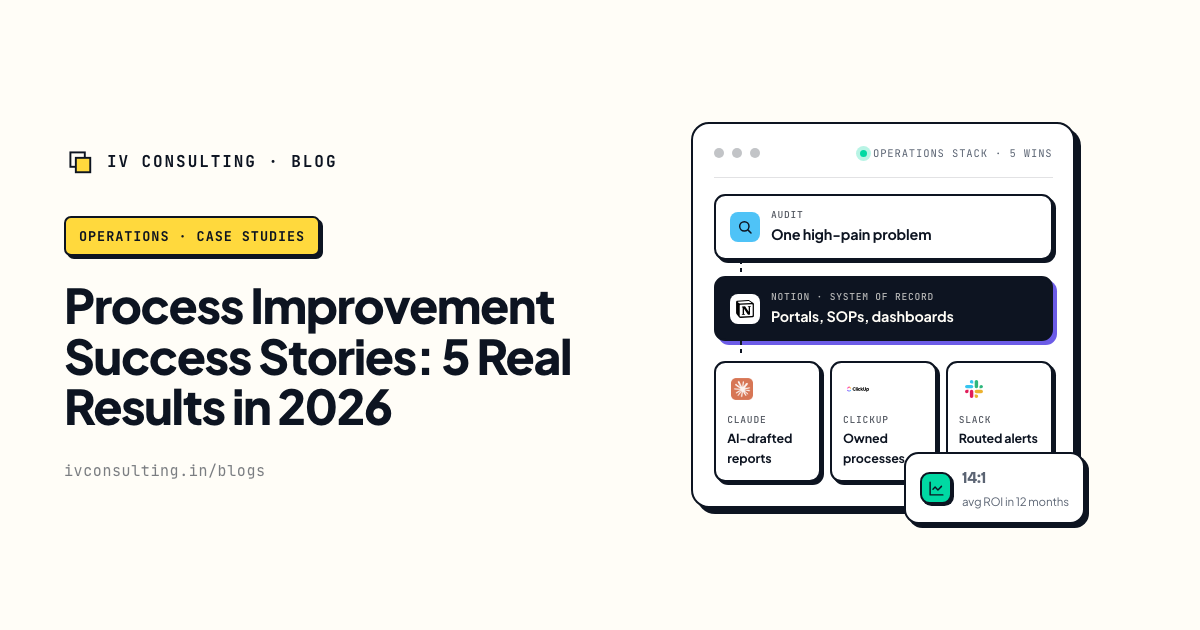
Process improvement success stories
More before-and-after transformations, with the specific changes that drove the numbers.
Read the stories →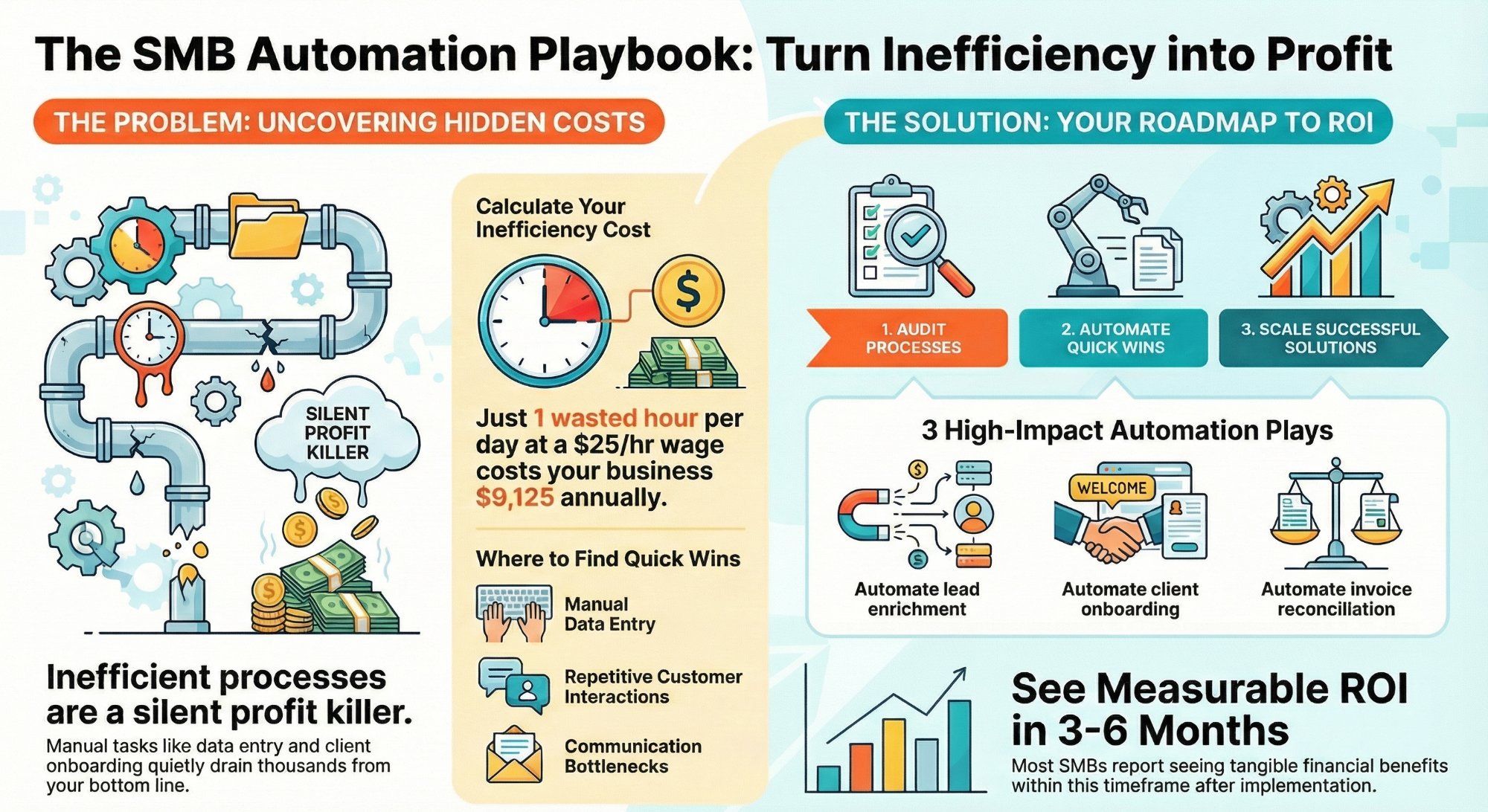
How much are inefficient processes costing your SMB?
The hidden cost of broken processes, and how to quantify and fix them fast.
Run the numbers →
The Foundation stage, built for you
The honest diagnostic and operating system that every story in this collection started with.
See the offer →
Ishan Vats
Founder, IV Consulting · operations & systems consultant
I build operating systems and automations for teams from startup to enterprise. 150+ ops transformations over 10+ years. If you want yours mapped and built right, I'll do it with you on a free call.
Book a free strategy call →Want your automation stack built for you?
Book a free 30-minute strategy call. We will map your highest-ROI workflows and give you a build roadmap on the spot. If we are not the right team for you, we will say so and point you somewhere better.
Book a Free Strategy Call →Free 30-minute call. Honest take, even if that means "you do not need us yet."