Building scalable processes for startup success
The exact 5-pillar operations framework IV Consulting deploys to cut founder bottlenecks and make growth repeatable.
 By Ishan Vats · Founder of IV Consulting · 150+ ops transformations over 10+ years
Some links below are affiliate links. If you buy through them we may earn a commission, at no extra cost to you.
 Source of truthSOPs and knowledge hub
 Execution layerDelivery + projects
 CommsDecisions logged
 KPIsPulse tracked
 Onboarding30-60-90 plan
Scalable processes for startups are documented, repeatable systems that handle more volume and more people without consuming more founder time. Build them in sequence: decision architecture first, then core delivery SOPs, talent systems, communication architecture, and measurement systems. The startups that scale cleanly through Series A build this infrastructure before it becomes a crisis, not after.
The problem
The growth that kills you is the growth you were not ready for
You have found product-market fit. Customers are coming. The team is growing. Then something quietly breaks. Sales close deals the delivery team cannot execute on schedule. Onboarding a new hire takes six weeks instead of one. Three people give three different answers to the same customer question. The founder is somehow busier than ever despite hiring people to handle that work.
This is not a talent problem, a product problem, or even a hiring problem, though more hiring will make it worse if you do not fix the root cause first. This is a process infrastructure problem, and it is costing you more than you know.
The hidden cost most founders underestimate by 10x
Most founders have a rough sense that broken ops are a problem. Very few have calculated the actual cost, because it hides across line items that are never aggregated.
- Founder time trapped in operations. In a pre-systems startup, the founder is the decision node for 25 to 40 operational decisions per week. The strategic ones need founder input. The automatable ones do not, but without documented processes, both kinds land on the same calendar. Five hours a week on decisions that documented processes would eliminate is 250 plus hours a year of misallocated senior time.
- Slow onboarding compounding the hiring investment. Average time-to-productivity without structured onboarding is 6 to 10 weeks. IV Consulting clients consistently reduce this to 2 to 3 weeks. Every avoidable week of ramp is salary spent on sub-productive output, plus the senior time lost to informal knowledge transfer.
- Error and rework without quality standards. When quality lives only in the heads of your best operators, it becomes a function of who did the work rather than how the work was designed. Startups without documented quality standards typically carry 15 to 25% rework rates on core delivery. With standards and checkpoints, that drops to 4 to 8%.
The framework
The 5-pillar startup process framework, in build order
Not all processes are equal. The mistake is documenting everything at once and producing a 200-page manual nobody reads. The right approach is sequenced, high-leverage, and deployment-tested before moving to the next layer.
Pillar 1: Decision architecture
The first infrastructure a startup needs is not a SOP. It is a decision framework, a documented logic for how decisions get made, by whom, and at what thresholds. A functional decision architecture has a RACI model defining who is Responsible, Accountable, Consulted, and Informed; a tiering system from team-member-decides to leadership-decides; and an escalation protocol with clear triggers. Get this right and the founder's operational calendar clears by 30 to 50% in the first month.
Pillar 2: Core delivery SOPs
Your core delivery process turns a signed contract into a delivered, invoiced outcome. For SaaS that is activation-to-retention. For a logistics operator it is order-to-delivery. This is the process most directly connected to revenue and the one most likely to degrade under growth. A delivery SOP does not need to be comprehensive on day one. It needs to answer five questions consistently: what triggers the start, what are the steps and time targets, who owns each step and what a clean handoff looks like, what quality checkpoints exist, and what triggers escalation.
Pillar 3: Talent systems
Hiring a great person into a process-less environment is like pouring quality ingredients into a broken container. The talent leaks. Three components produce the most measurable impact: a structured 30-60-90 day onboarding playbook (reduces ramp time 55 to 70% in IV Consulting deployments), continuous performance signal in place of annual reviews, and knowledge transfer protocols that eliminate key-person dependency in a 2 to 3 hour exercise per role.
Pillar 4: Communication architecture
Nothing kills startup productivity faster than bad communication architecture: decisions made in Slack that nobody documented, context missing from handoffs, status updates requested because nobody knows where to find them. A high-functioning setup has four elements: a deliberate meeting cadence, async-first channel discipline, decision documentation (even a one-sentence Notion entry or pinned message), and visibility infrastructure that answers the three questions every leader asks: are we on track, what is at risk, and what needs a decision. This typically cuts unplanned interruptions by 40 to 60%.
Pillar 5: Measurement systems
You cannot improve what you cannot measure, but most startups measure too many things poorly. A system that drives decisions needs three layers: leading indicators that preview your results 4 to 8 weeks out, lagging indicators like ARR and churn that confirm outcomes, and process health metrics like SOP compliance and handoff SLA adherence that most startups never track. The ones that do can diagnose operational degradation weeks before it reaches client metrics.
The sequencing
What to build at each growth stage
Not all five pillars need full deployment on day one. The right sequencing depends on where you are in the growth curve. Here is the IV Consulting deployment map by company stage.
| Stage | Team size | Primary bottleneck | Process priority |
|---|---|---|---|
| Seed / Early | 5 to 12 people | Founder bottleneck | Decision framework + core delivery SOP |
| Growth | 12 to 25 people | Tribal knowledge / onboarding | Talent systems + communication architecture |
| Scale | 25 to 50 people | Cross-team coordination | Measurement systems + inter-team SLAs |
| Series A ready | 40 to 80 people | Investor credibility / repeatability | Full 5-pillar + KPI reporting infrastructure |
The most common sequencing mistake: Growth-stage startups try to deploy measurement systems before they have stable delivery SOPs. You cannot measure process performance before you have defined the process. Fix the process first, then instrument it. For execution-heavy teams running concurrent projects, ClickUp is the stronger home for the delivery layer; for most teams under 40, Notion handles SOPs, wikis, and knowledge in one place.
The build
The 90-day startup process sprint
Most founders assume building operational infrastructure takes 6 to 12 months. It does not, if you build in the right sequence and resist over-engineering before deployment. IV Consulting typically completes the first two pillars within 6 to 8 weeks.
Days 1 to 14: Diagnostic and prioritisation
Before building anything, diagnose what is actually broken, not what feels broken. Run structured interviews with 5 to 8 key team members across functions to surface where decisions stall, where handoffs fail, where quality wobbles, and where onboarding breaks. Map findings to the five pillars and rank gaps by revenue impact and build time. This is often the highest-value two weeks of the entire engagement.
Days 15 to 45: Core process build
Build the top 3 to 5 processes from the diagnostic. Not perfect processes: 70% processes that can be deployed and tested immediately. Draft each SOP with the operator who runs it, not the founder who thinks they know how it runs. Validate against a real scenario, build in checkpoints for the 2 to 3 most likely failure modes, and deploy to a single team for live testing.
Days 46 to 75: Testing, iteration, and propagation
Run each deployed process through 3 to 5 real cycles. Track the failure modes you anticipated and the ones you did not. Run a structured retrospective with the operators who used each process, revise the SOPs on real-world data, then propagate to the full team with a short training session focused on the why before the how. Skipping this propagation session is the single most common reason process deployments fail.
Days 76 to 90: Measurement and next-quarter plan
For each deployed process, define the 1 to 2 metrics that indicate whether it is working and build the lightest tracking mechanism that gives you that signal. Set a 30-day review checkpoint for each. By day 90 you have 3 to 5 processes deployed and running, a team that understands them and helped refine them, and a clear view of the next quarter of process work.
The proof
How a 14-person SaaS startup cut delivery time 68%
Context: a B2B SaaS startup in HR tech, 14 people, growing but operationally strained. The two founders spent 60 to 70% of their time on operational decisions. Customer onboarding had slipped from a promised 10 days to an average of 22. NPS had dropped 18 points over six months, and two enterprise deals were at risk due to implementation delays.
The diagnostic identified three failure modes: no decision framework, no documented customer onboarding process, and no cross-functional handoff protocol between sales and implementation. Over a 10-week build, IV Consulting deployed a tiered decision framework, a 7-step onboarding playbook with quality checkpoints, a sales-to-implementation handoff protocol, a weekly operational pulse meeting, and a Notion operations hub with documentation and a KPI dashboard visible to the whole team.
| Metric | Result at 90 days |
|---|---|
| Average customer onboarding time | 22 days to 7 days (down 68%) |
| Founder operational decision touchpoints per week | 38 to 11 (down 71%) |
| NPS score | Up 22 points over 90 days |
| ARR growth, quarter over quarter | Up 34% |
| At-risk enterprise deals | Both retained and expanded |
| Series A closed, 6 months later | Yes, operational maturity cited by lead investor |
The lead investor cited the operational infrastructure, specifically the documented processes, measurement systems, and decision clarity, as a significant positive factor in their investment thesis. Not the product. Not the market size. The operations. That is an outcome most founders do not anticipate when they start building SOPs, and it is increasingly the norm at Series A and above.
The payoff
How to know your startup is process-ready for Series A
Series A investors are underwriting your team's ability to deploy capital at 3 to 5x current scale without proportionally increasing headcount or founder involvement. That is an operational bet.
Repeatable delivery at consistent quality
Demonstrate it with your delivery SOP and the last six months of customer satisfaction data. Investors want proof that quality is designed into the work, not dependent on which operator happened to run it.
Founder independence
Show your decision framework and delegation structure, not just an org chart. The evidence is what the team is empowered to decide without you.
Predictable growth levers
Show your leading indicators and how they correlate to revenue outcomes. Predictability is what lets an investor underwrite the next stage with confidence.
Team that scales with capital
Show your onboarding playbook and time-to-productivity data for recent hires. None of this requires a 50-person team or a VP of Operations.
FAQ
Questions founders ask before they build
What are scalable processes for startups, and why do they matter?
When should a startup start building formal processes?
How do you build startup processes without slowing down the business?
What tools work best for startup process documentation in 2026?
What is the most important process to build first at a startup?
How long does it take to build scalable processes for a startup?
Ishan Vats
Founder, IV Consulting · operations & systems consultant
I build operating systems and automations for teams from startup to enterprise. 150+ ops transformations over 10+ years. If you want yours mapped and built right, I'll do it with you on a free call.
Book a free strategy call →Keep reading
Related guides and work
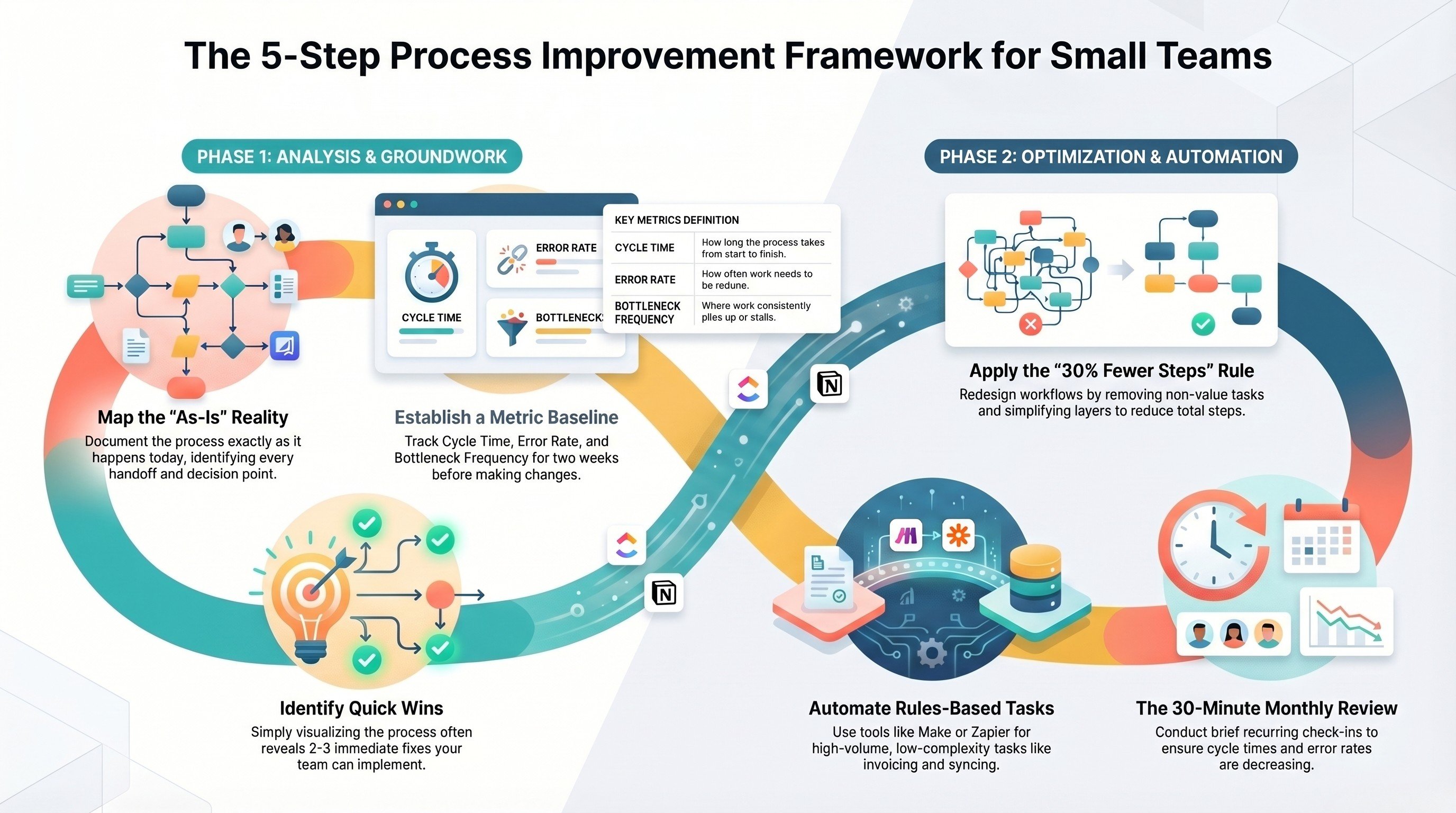
A process improvement framework for small teams
How lean teams fix the broken handoffs that quietly bleed hours every week.
Read the guide →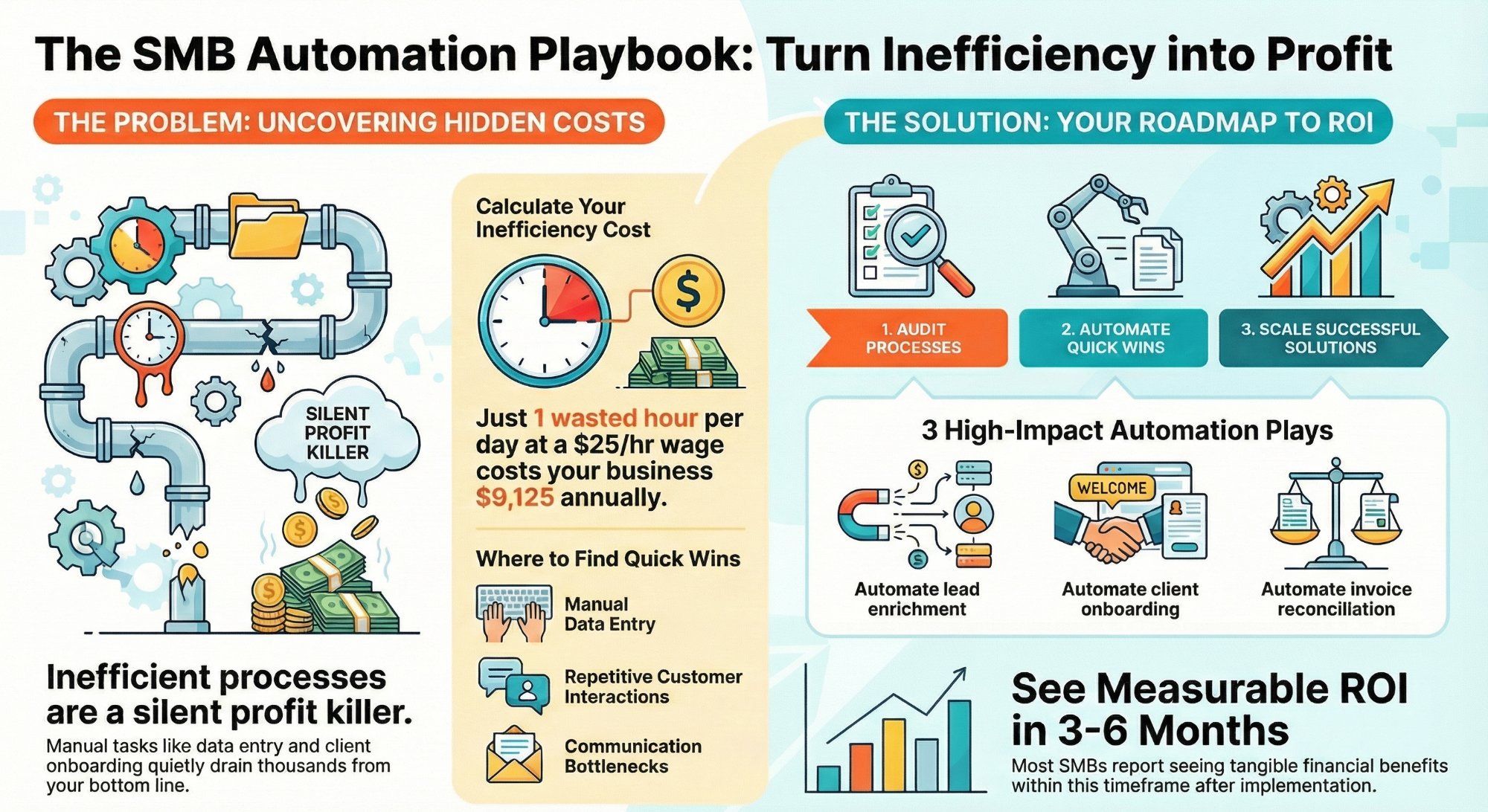
How much are inefficient processes costing your SMB?
Quantify the hidden cost of broken ops and the fastest ways to claw it back.
Read the breakdown →
The Foundation stage, built for you
Your decision framework, delivery SOPs, and operating system, designed and deployed.
See the offer →Want your automation stack built for you?
Book a free 30-minute strategy call. We will map your highest-ROI workflows and give you a build roadmap on the spot. If we are not the right team for you, we will say so and point you somewhere better.
Book a Free Strategy Call →Free 30-minute call. Honest take, even if that means "you do not need us yet."