Process management for operational excellence in growing businesses
Stop firefighting. Start scaling. The 4-pillar framework, the metrics that matter, and the 6-step build plan that turns chaotic operations into a competitive advantage.
 By Ishan Vats · Founder of IV Consulting · 150+ ops transformations over 10+ years
Some links below are affiliate links. If you buy through them we may earn a commission, at no extra cost to you.
 Process wiki · NotionSOPs, metrics dashboard
 ClickUpExecution tracking
 MakeAutomate the repeatable
 ClaudeSOP drafting layer
Process management for operational excellence means your business delivers consistent, high-quality outcomes without depending on any single person's memory or heroic effort. For a 10 to 60 person business it rests on four pillars: standardisation, measurement, continuous improvement, and culture. Build them in sequence, standardise first, then measure, improve, and only then automate, and operations stop being a cost centre and become a genuine competitive advantage.
The core distinction
What operational excellence actually means
Operationally excellent businesses do not have fewer problems than their competitors. They have better systems for preventing the same problems from happening twice. The gap between a market-leading business and an operationally average one is not intelligence, talent, or funding. It is whether the business runs on documented, measured, continuously improving processes, or whether it runs on the founder's memory, informal habits, and daily improvisation.
Operational excellence sounds impressive in a strategy deck and means almost nothing in practice until you define it precisely. Most definitions reference large enterprise frameworks: Toyota's production system, Six Sigma, Lean manufacturing. These are genuinely powerful methodologies. They are also designed for organisations with hundreds of employees, dedicated process engineers, and manufacturing environments where every defect can be quantified to four decimal places.
For a 10 to 60 person growing business, operational excellence means something more achievable and more specific: your business delivers consistent, high-quality outcomes to customers without depending on any single person's memory, heroic effort, or tribal knowledge. That is it. Not perfection. Not zero defects. Consistent, documented, measured, improvable delivery that does not break when someone goes on holiday or a new hire joins.
The businesses that achieve this at the SMB scale share one common trait: they treat their operational processes with the same rigour they apply to their product, their sales, and their finances. They measure them. They own them. They improve them deliberately rather than reactively.
Clear the misconceptions
The 3 myths that stall operational excellence
Myth 1: Operational excellence is for large businesses
The belief that process management is a later-stage problem, something to think about at 100 people not 20, is the single most expensive misconception in growing business operations. The optimal window to build the infrastructure is precisely between 10 and 40 employees: large enough that informal coordination is already causing friction, small enough that change is fast. Businesses that wait until they are large consistently spend 3 to 4x more time, money, and cultural capital fixing the problems that accumulate than they would have spent building the foundations early.
Myth 2: Operational excellence requires complex systems
The enterprise software market has convinced many leaders that operational excellence requires an ERP, a BPM suite, or a workflow tool with an enterprise price tag. It does not. The businesses we have worked with that run the cleanest operations use a combination of Notion, ClickUp, and a handful of light-touch integrations. The discipline of operational excellence is organisational, not technological. Systems support the discipline; they do not create it.
Myth 3: Process management slows teams down
This is the most persistent objection, and it is almost always disproved within the first 30 days. Teams that believe process management will slow them down are confusing it with bureaucracy. Bureaucracy creates steps that add no value. Process management eliminates the unplanned steps, the status chasing, the rework, the "how do we do this again?" conversations, that were already slowing the team down invisibly. A well-designed process is faster than the informal alternative, not slower.
The foundation
The 4 pillars of process management
Every operationally excellent business is strong on the same four dimensions. Weakness in any one limits the other three. Think of them as load-bearing pillars: you need all four to hold weight at scale.
1. Standardisation
Every critical process has one documented, agreed way to be executed, and that documentation lives somewhere accessible, not in someone's memory. It is the foundation the other three pillars rest on: you cannot measure, improve, or build culture around a process that is done differently by every person.
The minimum viable standard for any critical process: a documented sequence of steps, a defined output (what does done look like?), a named owner, and a review date. Those four elements are not optional.
2. Measurement
You cannot manage what you do not measure. Most growing businesses measure outcomes, revenue and churn, but not the operations that produced them. A shared dashboard in Notion or a weekly metric review is enough to begin. What matters is that measurement is consistent, reviewed, and used to drive decisions.
3. Continuous improvement
Operational excellence is a direction, not a destination. A process built for 15 people needs redesigning at 35. A quarterly review cycle is the minimum, but an informal monthly conversation that the team takes seriously beats a formal quarterly review that nobody does.
4. Culture
The hardest pillar, because it requires changing how people think about their work, not just what tools they use. An operational excellence culture is one where team members own the processes they run, feel safe to flag when one is breaking down, and where leadership models the discipline they expect. Culture is built through consistent behaviour over time, not a kick-off meeting. Start with visible, high-impact improvements that make daily work easier, and let the evidence do the cultural work.
Where are you now
The operational excellence maturity ladder
Most growing businesses sit somewhere on a five-rung ladder. Knowing which rung you are on tells you exactly what to build next.
| Maturity level | What it looks like | What to build next |
|---|---|---|
| Level 1: Reactive | No documented processes. All knowledge in people's heads. Every problem is a surprise. | Identify your top 3 pain points and document the current best practice for each. Nothing else first. |
| Level 2: Defined | SOPs exist but live in a folder nobody opens. The team asks colleagues instead of reading docs. | Move documentation into your project management tool so following the process is the path of least resistance. |
| Level 3: Managed | Consistent execution, but no operational metrics. You cannot prove what is working or where it degrades. | Establish 3 to 5 core process metrics and a weekly review ritual. |
| Level 4: Optimised | Processes documented, followed, measured, and regularly improved. Ownership is clear and team-held. | Introduce automation for the most repeatable steps and an AI layer for documentation and synthesis. |
| Level 5: Excellence | Operations as competitive advantage. Clients choose you partly because of how consistently you deliver. | Scale the model, codify the culture, and use your ops advantage to enter new markets or segments. |
The implementation
The 6-step process management framework
The sequence we use across IV Consulting engagements. Designed to produce measurable improvement within 30 days while building sustainable infrastructure for long-term excellence.
Map your critical process inventory (Days 1 to 5)
A critical process is any repeating activity that, if done inconsistently, would materially impact customer experience, revenue, or team performance. Run a 90-minute session with leadership and key contributors. List the 20 activities the business does repeatedly where execution quality affects outcomes, then mark the top 8 to 10 as critical.
Categorise each into one of four domains: Revenue (sales, onboarding, renewal), Delivery (core product or service), People (hiring, onboarding, development), and Operations (finance, reporting, tooling). This guides your build sequence.
Audit current state vs desired state (Days 5 to 10)
For each critical process, document how it currently runs (warts and all) and what it should produce (the output standard). The gap is where your operational debt lives. The fastest way to capture current state accurately: record your most experienced team member executing the process with Loom, then transcribe and structure it. This captures the real process, workarounds included, not the idealised version in someone's head.
Rate each gap on frequency (how often it causes a problem) and severity (the impact when it does). High frequency plus high severity gaps are your first build priorities, regardless of complexity.
Build minimum viable SOPs for your top 5 (Days 10 to 25)
An SOP does not need to be comprehensive to be effective. A minimum viable SOP contains: the process name and owner, the trigger, the 5 to 10 key steps in sequence, the output standard, and a link to any tools or templates required. A one-page SOP that gets followed every time is worth more than a ten-page manual nobody reads.
Build SOPs in the tool your team already uses, not a separate documentation system. If they live in ClickUp, the SOP lives in ClickUp. If they use Notion, it lives in Notion. Involve the process owner in building it, not just reviewing it. Co-design produces dramatically higher adoption than top-down documentation.
Assign ownership and build in accountability (Days 25 to 30)
Every process needs one named owner, not the founder, not "the team", not "whoever is available". A specific person responsible for ensuring the process is followed, updating it when it degrades, and training new team members on it.
Process ownership is a leadership development opportunity. The most effective owners are the people closest to the execution. Build accountability into your operating rhythm with a brief process health check in your monthly management meeting, 5 minutes per process. The discipline matters more than the duration.
Instrument the metrics that matter (Days 30 to 45)
For each critical process, define one primary metric. Not five. One. Directly observable, updated at least weekly, and unambiguous. Common examples: for revenue, time from qualified lead to first contact; for delivery, on-time completion rate; for people, days to full productivity for new hires; for operations, percentage of weekly recurring tasks completed on schedule.
Build a simple process dashboard, a single view of all critical process metrics. A Notion page with manually updated numbers is a perfectly valid starting point. What matters is that it is reviewed weekly and that deviations trigger an investigation, not just a note.
Establish your improvement cadence (Ongoing)
The final step is a rhythm, not a task. The minimum viable cadence for a growing business:
- Weekly: dashboard review (15 minutes). Any off-target metric triggers an owner investigation before the next week.
- Monthly: process health check (30 minutes in the management meeting). Each owner reports status and flags degradation.
- Quarterly: process review cycle (2 to 3 hours). Review all critical processes against current reality and update SOPs.
- Annually: strategic ops review (half day). Evaluate your maturity level and identify the next stage of investment.
The tools
The operational excellence tech stack by stage
The right stack is the one that eliminates friction from the improvement cycle, not the most feature-rich platform. Here is what works at each growth stage.
| Stage | Recommended tools | Primary purpose |
|---|---|---|
| Foundation (10 to 20) | Notion, ClickUp, Google Workspace | SOP library and process wiki, task and execution tracking, shared operating calendar. |
| Scaling (20 to 40) | Above plus Make, Loom, Slack | Automate high-frequency triggers, record processes for async training, structured team communication and a metrics dashboard. |
| Optimised (40 to 60) | Above plus Claude, structured HRIS, API integrations | An AI layer for SOP generation and synthesis, people process automation, and eliminating manual data transfer between systems. |
| Advanced (60+) | Above plus formal process governance | A dedicated ops function, structured BPM tooling if warranted, a data warehouse, and a quarterly ops review at board level. |
The AI layer deserves specific attention. In 2026, AI tools, primarily Claude for document-heavy workflows, are reducing the documentation overhead of operational excellence programmes by 60 to 70 percent. The most time-consuming part of building SOPs has historically been the writing: structuring a Loom recording into a clear step-by-step document, updating a process guide after a retrospective, synthesising feedback from multiple team members. These tasks now take 10 to 15 minutes with AI assistance instead of 60 to 90 manually. The bottleneck shifts from documentation production to the human judgement work: deciding what to change and whether the change is correct.
Avoid these
Why most operational excellence initiatives fail
The majority produce visible results for 4 to 8 weeks and then quietly die. The docs sit untouched, the metrics stop being updated, and the team reverts to old habits. Here are the five failure modes.
Failure 1: Building without buying
The founder or ops lead builds the entire infrastructure without involving the team. The documentation is thorough, the logic is sound, and nobody uses it. Process initiatives need team buy-in at the design stage, not just implementation. When team members contribute to building the processes they will follow, adoption is baked into the design.
Failure 2: Optimising before standardising
A business builds an automation to speed up an inconsistent onboarding process. The automation speeds up an inconsistent process and produces inconsistent results faster. Optimisation before standardisation amplifies problems rather than solving them. The sequence is non-negotiable: standardise, measure, improve, automate.
Failure 3: Measuring everything, acting on nothing
A business builds an impressive dashboard covering 20+ metrics, reviews it quarterly, and acts on nothing between reviews. Measurement without a response protocol is a vanity exercise. Every metric needs a named owner and a defined threshold that triggers an action, an immediate investigation, not a review meeting.
Failure 4: No improvement cadence
A business completes a thorough documentation project and treats it as done. Twelve months later the SOPs no longer reflect how the business operates. Operational excellence requires a recurring cycle built into the operating calendar. Without it, documentation becomes stale and eventually irrelevant.
Failure 5: Founder ownership of everything
The founder personally owns all critical processes and is the only person who can update or improve them. This recreates the exact bottleneck process management was supposed to eliminate. Operational excellence requires distributed ownership. Founder-owned operations are not operationally excellent; they are operationally dependent.
FAQ
Questions leaders ask before they start
What is the difference between process management and operational excellence?
How is this different from Lean or Six Sigma?
How long does it take to build the foundation for operational excellence?
How do I get my leadership team aligned on investing in operational excellence?
What is the role of AI in process management and operational excellence?
Can operational excellence coexist with a fast-moving, innovation-oriented culture?
Ishan Vats
Founder, IV Consulting · operations & systems consultant
I build operating systems and automations for teams from startup to enterprise. 150+ ops transformations over 10+ years. If you want yours mapped and built right, I'll do it with you on a free call.
Book a free strategy call →Keep reading
Related guides and work
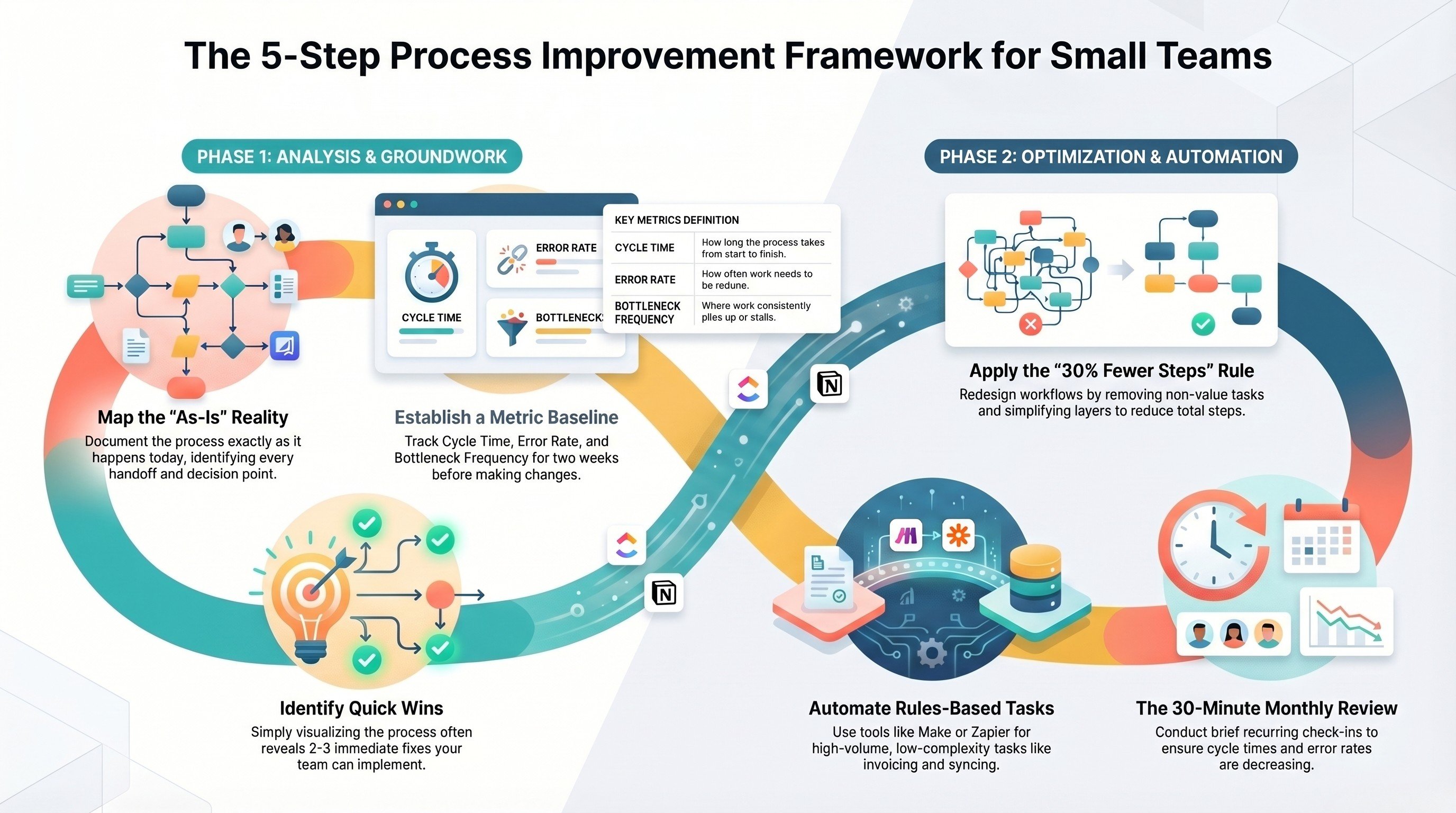
A process improvement framework for small teams
The lean version of fixing broken processes when you do not have a dedicated ops function.
Read the guide →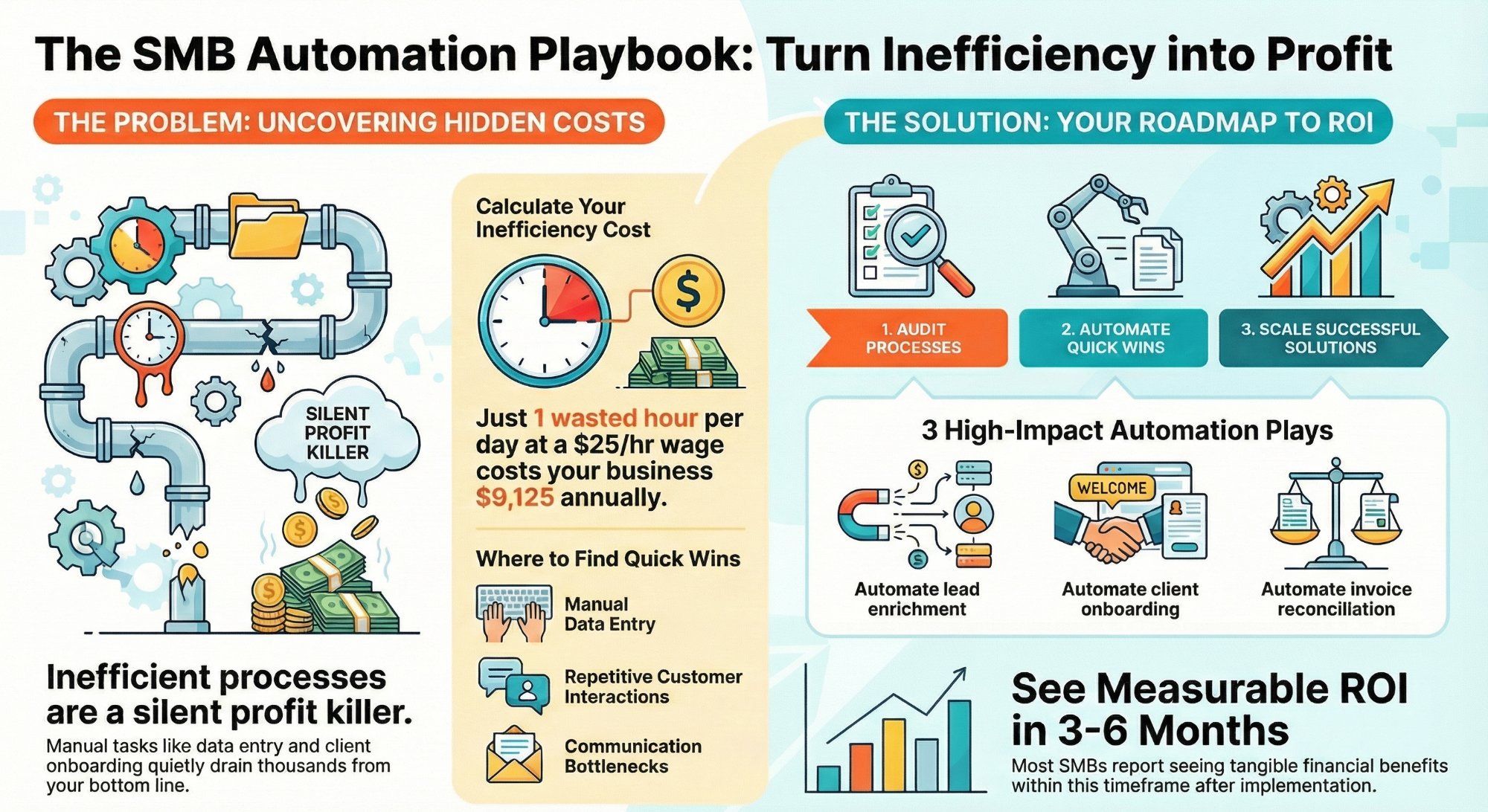
How much are inefficient processes costing your SMB?
Quantify the cost of chaos before you build the case for fixing it.
Read the breakdown →
The Foundation stage, built with you
Your processes documented, owned, and measured, the operating system your scale depends on.
See the offer →Want your automation stack built for you?
Book a free 30-minute strategy call. We will map your highest-ROI workflows and give you a build roadmap on the spot. If we are not the right team for you, we will say so and point you somewhere better.
Book a Free Strategy Call →Free 30-minute call. Honest take, even if that means "you do not need us yet."