Process management challenges and the solutions that actually stick
The 7 process failures that break growing businesses, and the SOLVE Framework that fixes them at the root, not the symptom.
 By Ishan Vats · Founder of IV Consulting · 150+ ops transformations over 10+ years
Some links below are affiliate links. If you buy through them we may earn a commission, at no extra cost to you.
 NotionSOPs documented
 ClickUpOwners assigned
 SlackHandoffs confirmed
Process management challenges are the recurring failures in how work flows through an organisation: accountability gaps, handoff failures, tribal knowledge, rework cycles, scope drift, moving bottlenecks, and improvement fatigue. The fix is not a better document. It is a method that surfaces the real cause, assigns a named owner, measures the result, and embeds the change so it does not revert. IV Consulting calls that method the SOLVE Framework.
The pattern
What process management challenges actually are
Every growing business reaches a point where the processes that worked at 10 people start failing at 25. The informal coordination that held things together, the shared understanding, the quick desk conversations, the single person who knew how everything worked, stops scaling. And when it stops scaling, it does not stop quietly.
It stops in missed deadlines, rework cycles, client escalations, and team members who spend more time compensating for broken processes than delivering value. By the time most organisations recognise they have a process management problem, the problem has been compounding for six to eighteen months. Every broken process runs its cost every single day until it is fixed.
Why process problems are different from other business problems
Most business problems have a visible cause. A sales shortfall, a cost overrun, a client complaint: these are events with a traceable origin. Process management problems are different. They are systemic: the same failure mode recurring across different projects, different teams, and different time periods. The rework happens again. The handoff drops again. The bottleneck reappears. Because the problem recurs, it is easy to treat it as normal, as an unavoidable feature of the business rather than a fixable flaw in the system.
The method
The SOLVE Framework for permanent process fixes
IV Consulting developed SOLVE after a recurring pattern in ops engagements: fixes that addressed the visible symptom but not the underlying cause held for two or three months, then the same problem re-emerged in a slightly different form. SOLVE produces permanent fixes, not temporary patches.
S: Surface the Real Cause
Trace every failure back to its origin, not the person closest to it. The visible symptom is rarely where the problem starts. Most root causes sit upstream of where the failure shows up.
O: Optimise the Flow
Redesign the sequence, not just the speed. Make handoffs explicit, parallelise where possible, and remove steps that consume capacity without adding value.
L: Link Accountability
Assign one named owner to every step. Not a team, not a role, one person, with a defined standard and the authority to enforce it.
V: Validate with Data
Review process execution on a cadence. Are steps being followed? Are delivery times drifting? Drift is a data problem you cannot see without measurement.
E: Embed and Sustain
Build a named owner, a measurement, and a review cadence into every change. A new process without these reverts within 60 days. The change needs a guardian, not just a design.
The breakdown
The 7 most common process challenges, and how to fix each
Challenge 1: The accountability gap
The most common process failure IV Consulting identifies is the accountability gap: a step that has no named owner. The step is understood as everyone's responsibility, which in practice means no one's. When it fails, there is no clear person who missed it and no clear person with the authority to fix it. The gap is usually invisible until a failure makes it visible.
SOLVE solution (S + L): Surface the gap by mapping the process end to end and marking every step where no single named person owns the outcome. Then Link Accountability by assigning one owner, not a team and not a role, to every step. Define what "done correctly" looks like and give the owner the authority to enforce it.
Challenge 2: The handoff black hole
The handoff black hole is the gap between when one team finishes their part of a process and when the next team starts theirs. In IV Consulting process audits, handoffs account for 34% of total process delay, not because the steps take too long, but because work sits in the gap between them. The handoff is assumed to be automatic, but in practice it depends on the sender remembering to notify the receiver and the receiver knowing what to do with it.
SOLVE solution (O + L): Optimise the Flow by making handoffs explicit: a defined trigger, a defined output format, and a defined acknowledgement from the receiver. Link Accountability by making the sender responsible until the receiver confirms receipt. A handoff that is unacknowledged is not complete.
Challenge 3: Tribal knowledge dependency
Tribal knowledge dependency is the process that lives in a person's head rather than in a documented system. It works perfectly, as long as that person is available. When they are on holiday, sick, or leave the business, the process fails. The organisation discovers in the worst possible moment that what they thought was a robust workflow was actually one person's unwritten expertise.
SOLVE solution (S + E): Surface the dependency by asking: "If this person were unavailable for three weeks, which processes would fail?" Then Embed and Sustain by documenting those processes in a tool like Notion, not in exhaustive detail, but to the level a competent colleague needs to execute them without asking for help. The standard is not perfection. It is transferability.
Challenge 4: The rework cycle
Rework is the most measurable process failure. It has a direct cost, the hours spent doing work twice, and an indirect cost in delayed delivery, client dissatisfaction, and the demoralisation of a team that produces quality work only to be told it needs redoing. In IV Consulting audits, rework rates above 12% of total output are almost always traceable to a single upstream cause: an unclear quality standard at the point where work is initiated.
SOLVE solution (S + O): Surface the real cause by tracking rework backwards, not to the person who produced the work, but to the point where the requirement was first communicated. In 78% of IV Consulting rework analyses, the root cause is upstream: an incomplete brief, an ambiguous standard, or an approval that was assumed rather than confirmed. Fix the upstream clarity and the downstream rework resolves itself.
Challenge 5: Scope and process drift
Scope and process drift is the gradual expansion of what a process is expected to do beyond what it was designed to handle. It happens in two forms. Scope drift: the deliverable quietly expands through client requests or internal additions until it bears no resemblance to the original brief. Process drift: the steps gradually expand as individuals add their own sub-steps, workarounds, and preferences until the process is different for every person who runs it.
SOLVE solution (O + V): Optimise the Flow by defining the process at a level of specificity that makes drift visible: step by step, with defined inputs, outputs, and time expectations. Then Validate with Data by reviewing execution monthly inside a tool like ClickUp or Monday. Drift is a data problem. You cannot see it without measurement.
Challenge 6: The bottleneck that moves
A bottleneck is a constraint that limits throughput. The most frustrating variant is the bottleneck that moves: you fix the slowest step, and a different step immediately becomes the constraint. This happens when fixes are applied locally to the step that is currently slow, rather than systemically. The constraint was not that step. It was the process architecture: a sequence that creates a single-file flow through multiple capacity-limited steps.
SOLVE solution (S + O): Surface the real cause using a throughput map, plotting the actual capacity of each step against the volume passing through it. The bottleneck is not always where the queue is longest; it is where capacity is lowest relative to demand. Optimise the Flow by redesigning the sequence: parallelise where possible, buffer where necessary, and eliminate steps that consume capacity without adding value.
Challenge 7: Improvement fatigue
Improvement fatigue is the most demoralising challenge. The organisation has attempted fixes, workshops, new tools, updated SOPs, and the improvements held for a month or two before the old patterns returned. The team has been through this cycle enough times to be sceptical of the next initiative. The processes have not been fixed. The belief that they can be fixed has been damaged.
SOLVE solution (E + V): Improvement fatigue is almost always caused by changes designed without embedding mechanisms. A new process without a named owner reverts. A new standard without a measurement cadence drifts. A new tool without a usage requirement gets ignored. Embed and Sustain means building three things into every change: a named owner, a measurement that shows whether it is working, and a defined review cadence that catches drift before it becomes a backslide.
The diagnostic
Which challenges are active in your business right now
The early warning signs are observable today. You do not need a formal audit to recognise them. Use this table to match each challenge to its root cause, its warning sign, and the SOLVE stage that fixes it.
| Challenge | Root cause pattern | Early warning sign | SOLVE priority stage |
|---|---|---|---|
| Accountability gap | No single named owner for a step or outcome | Same failure recurs with different people blamed each time | Link Accountability |
| Handoff black hole | Handoffs assumed, not confirmed | Work reappears "lost" between teams; repeated chasing | Optimise the Flow |
| Tribal knowledge | Process lives in one person's head, not a system | Business slows when a specific person is unavailable | Embed and Sustain |
| Rework cycle | Unclear quality standard at the point of initiation | Rework rate above 10%; same types of errors recur | Surface the Real Cause |
| Scope and process drift | No defined boundaries or drift measurement | Process takes longer each cycle; outputs vary by person | Validate with Data |
| Moving bottleneck | Local fixes applied to symptoms, not architecture | Fixing one queue creates another; throughput stays flat | Surface the Real Cause |
| Improvement fatigue | Changes made without ownership or measurement | Previous improvements have regressed; team is sceptical | Embed and Sustain |
Avoid these
5 mistakes organisations make when fixing process problems
Understanding the challenges is only half the picture. These are the five most common ways organisations make their process problems worse while trying to fix them.
Fixing the symptom, not the cause
The delivery is late, so the fix is a deadline reminder. The rework happens, so the fix is a review stage. These interventions address the visible failure without identifying the upstream cause that created it. Three months later, the same symptom appears despite the fix.
Adding complexity to compensate for broken basics
Every additional step, approval layer, or quality check added to compensate for a broken upstream process adds friction to the entire system. IV Consulting regularly encounters processes with seven approval steps that exist because step two was not done correctly. Fix step two. Remove six approvals.
Deploying technology before fixing the process
A new project management tool, a new CRM, a new workflow platform deployed onto a broken process architecture automates the broken process. The same failures now happen faster and more visibly. Technology reveals process quality. It does not create it.
Changing the process without changing the measurement
A process that is redesigned but not measured will drift back to its original form within 60 days. If the new standard is not tracked, there is no mechanism to detect drift, no evidence to show whether the change worked, and no signal to trigger correction before the regression is complete.
Assigning improvement to people without authority
Process changes require someone with the standing to enforce new standards, resolve cross-team conflicts, and hold owners accountable. Assigning process improvement to a junior operations role without senior sponsorship and decision authority almost always results in a well-documented process that nobody follows.
The proof
How a 26-person firm fixed 4 active process challenges
A 26-person professional services firm came to IV Consulting with a pattern it had been unable to break: four to five major process failures per quarter, missed deliverables, client escalations, and rework cycles, despite two previous attempts to improve their processes. The team was frustrated. The partners were embarrassed. And everyone had a different explanation for why the same problems kept recurring.
The SOLVE diagnostic identified four active challenges simultaneously: an accountability gap in the client brief sign-off step, a handoff black hole between delivery and quality review, tribal knowledge dependency in two senior consultants whose onboarding and setup processes existed only in their heads, and improvement fatigue from two prior initiatives that had failed to stick.
The SOLVE implementation
IV Consulting implemented the framework across an eight-week engagement. For the accountability gap, every step in the core delivery workflow was assigned a named owner, with a defined completion standard and a weekly review cycle. For the handoff black hole, the brief sign-off and QA trigger steps were converted from assumed handoffs to confirmed handoffs: the receiving step could not start until the sender marked the handoff complete and the receiver acknowledged receipt.
For tribal knowledge, the two senior consultants documented their onboarding and setup processes in four structured sessions over three weeks, targeted at the 12 steps that most commonly required their personal intervention. For improvement fatigue, the new processes were embedded with a monthly performance review, a named process owner for the overall workflow, and a 90-day re-baseline that formally assessed whether the changes had held.
Results at 90 days
| Metric | Before SOLVE | After SOLVE |
|---|---|---|
| Major process failures per quarter | 4 to 5 | 0.8 (83% reduction) |
| Rework rate | 19% | 3% (down 84%) |
| Client escalations per month | 3.1 | 0.6 (down 81%) |
| Average handoff delay (delivery to QA) | 4.3 days | 0.4 days (down 91%) |
| Junior staff onboarding time | 11 weeks | 4 weeks (down 64%) |
| Process compliance rate at 90 days | 0% (prior initiatives) | 87% |
| Employee satisfaction score | 5.4 out of 10 | 7.7 out of 10 (up 2.3 points) |
| Project margin | 23% average | 32% average (up 9 points) |
FAQ
Questions people ask about process management
What are the most common process management challenges?
What causes process management to fail?
How do you fix an accountability gap in a business process?
What is the SOLVE Framework for process management?
How do you prevent process improvements from reverting?
What is the difference between a process problem and a people problem?
Ishan Vats
Founder, IV Consulting · operations & systems consultant
I build operating systems and automations for teams from startup to enterprise. 150+ ops transformations over 10+ years. If you want yours mapped and built right, I'll do it with you on a free call.
Book a free strategy call →Keep reading
Related guides and work
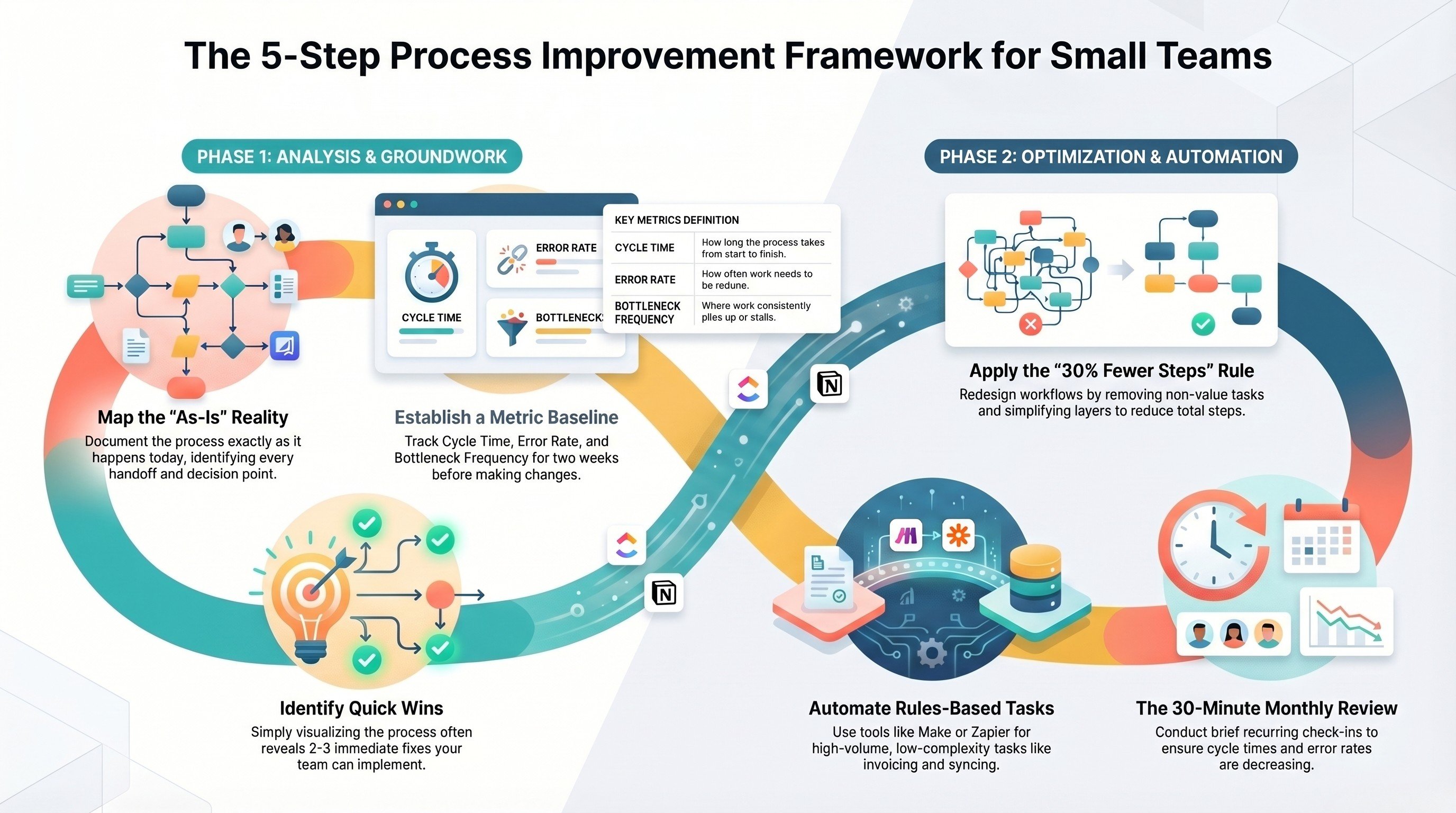
A process improvement framework for small teams
The practical steps for tightening processes when you do not have a dedicated ops hire.
Read the framework →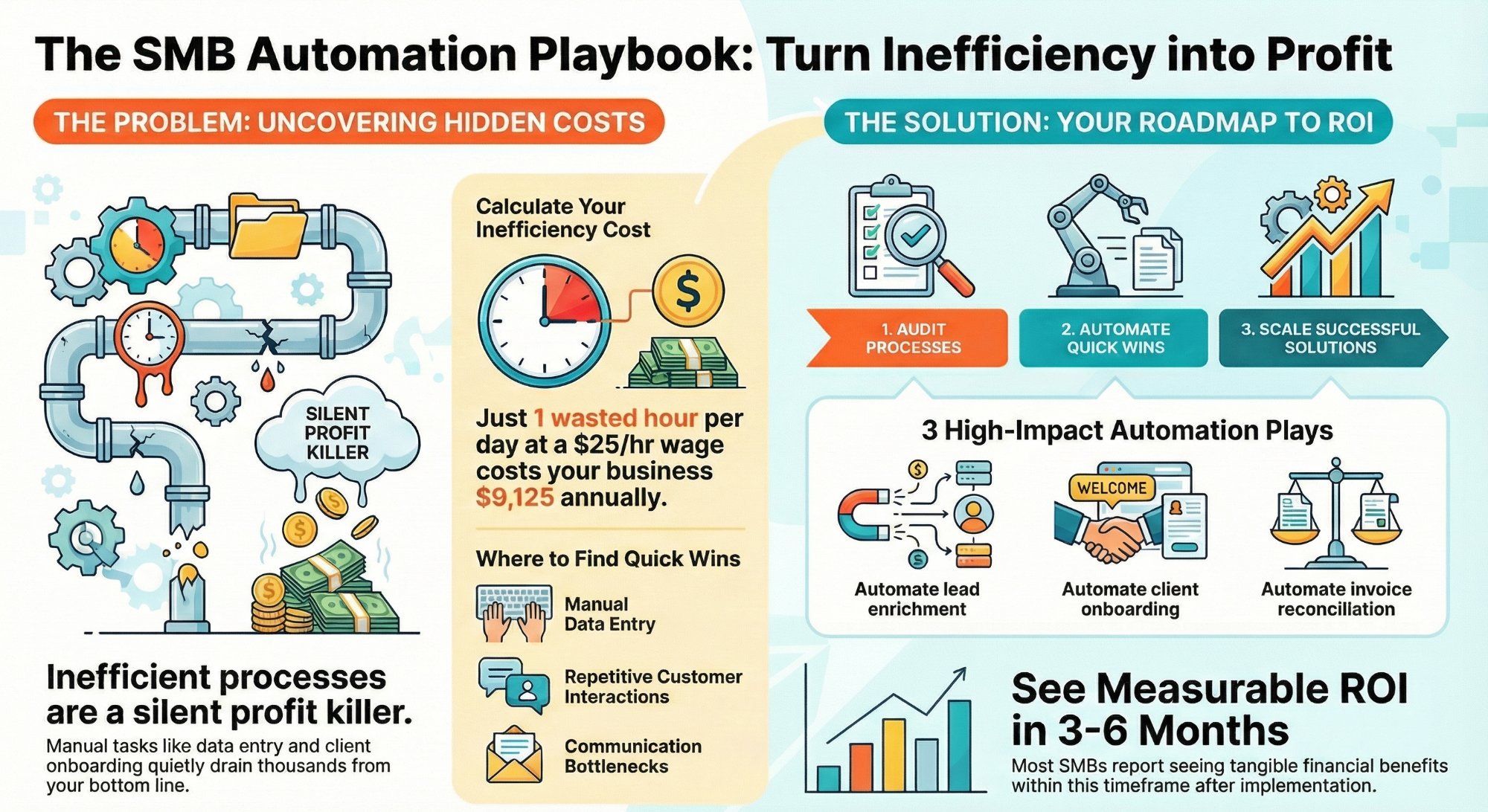
How much are inefficient processes costing your SMB?
Put a real number on process failure cost, then fix the most expensive leaks first.
Read the diagnostic →
The Foundation stage, built for you
Your processes mapped, owned, and documented so they hold under real growth.
See the offer →Want your automation stack built for you?
Book a free 30-minute strategy call. We will map your highest-ROI workflows and give you a build roadmap on the spot. If we are not the right team for you, we will say so and point you somewhere better.
Book a Free Strategy Call →Free 30-minute call. Honest take, even if that means "you do not need us yet."