How we helped a logistics company standardize processes and scale without chaos
A 38-person, 3-depot last-mile operator went from 71% to 94% on-time delivery in 12 weeks. Here is the exact build.
 By Ishan Vats · Founder of IV Consulting · 150+ ops transformations over 10+ years
Some links below are affiliate links. If you buy through them we may earn a commission, at no extra cost to you.
 ClickUpDispatch board
 NotionFleet + SOP library
 SlackComplaint protocol
A regional last-mile logistics company, 38 staff across 3 depots, was winning contracts and losing clients because its operations had not scaled with its growth. Over a 12-week standardization engagement we replaced WhatsApp dispatch, paper proof of delivery, and reactive maintenance with documented, tool-enforced, owned processes. On-time delivery moved from 71% to 94%, client churn fell from 31% to 9%, and dispute resolution dropped from 6.2 days to same day. The fix was not more headcount. It was standardization.
The trigger
The growth that was breaking the business
When Riverside Logistics (name anonymised) came to IV Consulting, the managing director opened with a sentence we hear in some form from almost every growing operations business: "We are winning more contracts than ever and losing more clients than ever, and I cannot figure out why."
The surface-level answer was obvious to anyone who spent a day in their depots. The business had grown 35% in 18 months and its operations had not grown with it. What worked with 22 employees and 2 depots had not been rebuilt for 38 employees and 3 depots. The informal coordination that held everything together at smaller scale, the WhatsApp groups, the verbal briefings, the "just ask Darren" culture, was now generating daily failures at a scale the founding team could no longer absorb.
The business was not failing. Revenue was climbing. But the gap between what they were winning commercially and what they were delivering operationally was widening. Clients who signed 12-month contracts were not renewing. The operations team was reactive, exhausted, and beginning to lose the experienced drivers who had held the informal systems together.
The managing director's instinct was to hire: a second operations manager, more driver supervisors, additional admin. Our first task was to show him that headcount was not the fix. The fix was standardization, and the results of getting it right would be worth far more than any hire.
Who they were when we arrived
A regional last-mile and freight coordination operator: 38 employees (24 drivers, 8 depot staff, 4 ops management, 2 commercial), 3 depot locations, 34 active client contracts across retail, e-commerce, and B2B freight, growing 35% year on year. On paper, a success story. In the depots, a business running on systems built for half its size.
The audit
7 operational failures found in the first 2 weeks
The first two weeks of any IV Consulting engagement are audit-only. No recommendations. No solutions. Just an evidence-based diagnosis of where the operation is actually breaking, not where leadership thinks it is breaking.
Failure 1: Dispatch by WhatsApp (zero system integrity)
Route assignments, load changes, and priority updates were communicated through a patchwork of WhatsApp groups, one per depot, plus a general ops group, plus individual driver threads. On a busy morning a driver could receive conflicting instructions from three threads. There was no single source of truth, no timestamp record, and no way to verify a driver had received a change. The measurable impact: an average of 4.2 route failures per week traced directly to dispatch miscommunication.
Failure 2: Inconsistent driver briefings across depots
The primary depot ran a structured morning briefing. Depot 2 briefed informally when the supervisor remembered. The newly opened depot 3 had no structured briefings at all. The result was three different service standards under one company name. Two of the three largest churned clients in the previous 12 months were depot 3 accounts.
Failure 3: Paper-based proof of delivery
Drivers collected paper receipts and returned them at shift end to be logged and filed manually. Disputed deliveries, where a client claimed non-delivery, took an average of 6.2 days to resolve because locating physical paperwork across three depots was genuinely difficult. In the 30-day audit, 34 disputes were logged, and several were resolved in the client's favour despite the delivery having occurred, simply because the paper trail was inadequate.
Failure 4: Reactive vehicle maintenance
The fleet of 19 vehicles had no scheduled preventive maintenance. Vehicles were serviced when they broke down. During the audit period the fleet ran 8 to 11 in-route breakdowns per month, each generating a failed delivery run, emergency recovery, a replacement scramble, and an SLA breach. Almost entirely preventable with a scheduled programme.
Failure 5: No SLA tracking dashboard
The business had committed to a 95% on-time delivery rate in 31 of its 34 contracts. Nobody knew the actual rate on any given day. The 71% figure was calculated retrospectively for the audit. Clients had better data on the company's performance than the company did, and were quietly building a case for penalties or non-renewal while the ops team remained unaware a problem existed.
Failure 6: Ad-hoc customer complaint handling
Complaints arrived by email, phone, and WhatsApp to whichever team member the client happened to know. There was no central log, no resolution SLA, and no follow-up process. The operations manager estimated that 40% of complaints were never formally acknowledged. They either resolved themselves, or the client stopped raising them and started looking for an alternative supplier.
Failure 7: Unstructured driver onboarding (22-day ramp)
New drivers shadowed an experienced driver for one to two days, then were assigned routes with minimal guidance. There were no written route guides, no client-specific handling instructions, and no structured first-week check-ins. The average time to full productivity was 22 working days, during which the business paid a full rate for below-average output and elevated error rates.
The build
5 standardization workstreams over 12 weeks
Five parallel workstreams, sequenced to produce visible operational improvement within the first 30 days, building team confidence before the more complex infrastructure landed in weeks 5 to 12.
Digital dispatch and route management
WhatsApp was replaced with a ClickUp-based dispatch board visible to all three depots simultaneously. Every driver had a named task card per shift containing their route, priority deliveries, client-specific requirements, and vehicle assignment. Route changes were updated with a timestamp and a required driver acknowledgement before the change went live. A 10-minute pre-shift standup using a fixed checklist ensured briefing quality at depot 3 matched the primary hub, regardless of who ran it.
Digital proof of delivery
Paper POD was replaced with a mobile capture flow: a photo of the delivered package plus a recipient signature, synced immediately to a central log and, via a client portal, to the client in real time. Clients received an automated confirmation within five minutes of delivery, including timestamp, driver name, and image. Dispute resolution time dropped from 6.2 days to same day, because every disputed delivery could be settled in minutes by pulling the timestamped record.
Preventive vehicle maintenance programme
A Notion-based fleet tracker covered all 19 vehicles, each with a card showing last service, next scheduled service, current mileage, and flagged issues. A 15-minute pre-shift inspection SOP, conducted by the assigned driver on a standardised form, escalated any flagged item automatically to the depot manager. Compliance required no extra headcount: the check was built into the existing start-of-day routine, and the scheduler needed about 20 minutes a week of the depot manager's time.
SLA dashboard and customer communication
A live SLA dashboard pulled data from the dispatch system: real-time on-time delivery by depot, route, and driver, with a 7-day trend and a red, amber, green status per contract. For the first time the team could see performance against commitments and catch underperformance before a client raised it. A tiered complaint protocol was documented, all complaints acknowledged within 2 hours, initial response within 24 hours, final resolution within 48, with every case logged centrally and a weekly review added to the Monday agenda.
Driver onboarding SOP and role cards
A structured 10-day onboarding programme replaced shadowing: day 1 covered standards, safety, and the digital tools; days 2 to 3 supervised route familiarisation; days 4 to 7 independent delivery with daily check-ins; days 8 to 10 full independent operation with a day-10 review. Laminated role cards for every route type covered standard routes, client handling requirements, escalation contacts, and vehicle procedures, removing the single-point-of-knowledge problem that had slowed ramp time and created inconsistency.
The numbers
Before and after, at 12 weeks and 6 months
Every metric below was measured against the audit baseline. The before column is what we found in week one. The after column is week 12, with churn tracked to the 6-month point.
| Metric | After | Before (baseline) |
|---|---|---|
| On-time delivery rate | 94% (vs 95% SLA) | 71% |
| Annual client churn | 9% | 31% |
| Dispute resolution time | Same day (under 4 hours) | 6.2 days average |
| Disputed deliveries per month | 4 | 34 |
| Vehicle breakdowns per month | 1 to 2 | 8 to 11 |
| New driver ramp to full productivity | 8 working days | 22 working days |
| Dispatch errors per week | 0.3 | 4.2 |
| Depot 3 on-time delivery | 91% (now tracked) | Unknown |
Why this worked when previous attempts had failed
Riverside had tried before. In the prior two years the business trialled two logistics management platforms (both abandoned within three months), hired a consultant who produced a 40-page report that was never implemented, and ran a driver training day that changed nothing structurally. Three failed attempts before we arrived. Four differences defined the outcome:
- Diagnosis before solution. The platforms were bought without a clear audit of what was broken. We spent two full weeks on audit before recommending anything.
- Sequenced for early wins. Drivers felt fewer miscommunications from day three. Managers had a cleaner morning picture from day five. That momentum carried the harder changes.
- Built into existing tools and habits. The dispatch board replaced WhatsApp with the same mental model. The vehicle check slotted into the start-of-shift routine. Low friction meant high adoption.
- Owned by the team, not the consultant. Every process had a named internal owner before we left. When IV Consulting walked away, nothing required our continued involvement.
Transferable
5 lessons for any logistics operation
1. Measure what you have committed to
Riverside had committed to 95% on-time delivery in 31 contracts and was not measuring its actual rate. Without measurement, underperformance is invisible until a client raises it, by which point trust is already damaged. Start this week with a simple daily spreadsheet per client, then move to a live dashboard once the discipline is established. What matters is that someone in your business knows, every day, whether you are meeting your commitments.
2. Dispatch is your highest-leverage process
A poorly communicated 6am route change cascades into failures all day. A clear, acknowledged, timestamped dispatch system reduces failure rates across every other part of the operation at once.
3. Proof of delivery is a commercial asset
Real-time digital POD is rare in the market and a genuine differentiator. The enterprise contract Riverside won in month 4 cited the POD portal as a deciding factor. The same capability that cut wrongly-resolved disputes also won new revenue.
4. Preventive maintenance pays for itself fast
A scheduled service that prevents a breakdown costs a fraction of the breakdown it prevents, once you account for recovery, the failed delivery, and the SLA impact. Build the programme early and you maintain fleet reliability as you scale.
5. Consistent depot standards are your brand
For a multi-depot operation, the weakest depot defines the client experience. A client whose freight runs through your lowest-standard depot does not know your primary hub runs beautifully. Standardisation across depots is not bureaucracy. It is brand protection.
Score yourself
Does your operation have the same problems?
The seven failures we found at Riverside appear, in some combination, in most logistics businesses at the 20 to 60 employee stage. Score 1 point for each that applies to your operation.
| Operational check | What a yes means |
|---|---|
| Dispatch runs on WhatsApp, SMS, or phone calls | No audit trail and no consistent acknowledgement mechanism |
| Driver briefings vary by depot or by who is on shift | Your service standard is person-dependent, not system-dependent |
| POD is paper-based or digitised only at end of day | Disputes take days to resolve and client confidence is low |
| You fix vehicles only when flagged or broken down | You are paying breakdown costs you do not need to |
| No live on-time delivery dashboard per client | You are flying blind on SLA compliance |
| Complaints handled by whoever the client contacts | Resolution is inconsistent and complaints are under-logged |
| New drivers take more than 10 days to full productivity | Onboarding is verbal and your ramp cost is high |
- 0 to 1: Strong operational foundation. Focus on automation and capacity expansion.
- 2 to 3: Moderate risk. One or two targeted fixes will produce measurable improvement within 60 days.
- 4 to 5: High risk. You are likely already seeing churn and team fatigue from the same root causes. A structured intervention will have significant ROI.
- 6 to 7: Critical. Your infrastructure is not built for your current size, and every month of delay compounds the cost.
If you scored 4 or higher, the right next step is a structured look at what your operation is actually costing you. Not what you think it is costing you. What an evidence-based, two-week audit would find if it started tomorrow. That is exactly what our Foundation stage delivers.
FAQ
Questions operators ask before they start
How disruptive is a process standardization engagement to day-to-day operations?
Do drivers resist moving away from informal systems like WhatsApp?
What technology investment does a logistics standardization build require?
How long did the improvements last after the engagement ended?
Does this approach apply to logistics businesses smaller or larger than 38 people?
What was the most surprising finding from the audit?
Ishan Vats
Founder, IV Consulting · operations & systems consultant
I build operating systems and automations for teams from startup to enterprise. 150+ ops transformations over 10+ years. If you want yours mapped and built right, I'll do it with you on a free call.
Book a free strategy call →Keep reading
Related guides and work
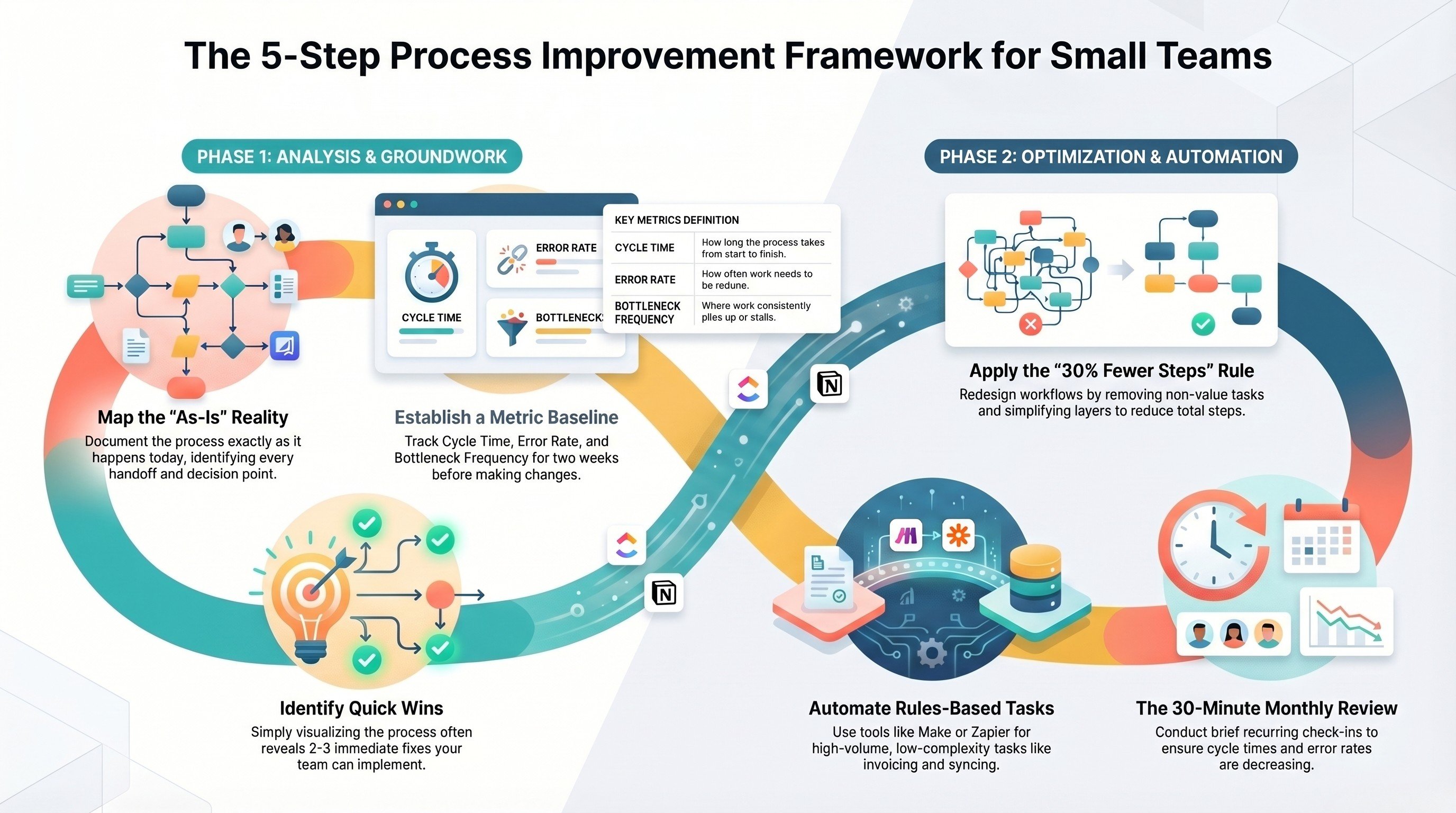
A process improvement framework for small teams
The step-by-step method behind engagements like this one, ready to apply yourself.
Read the framework →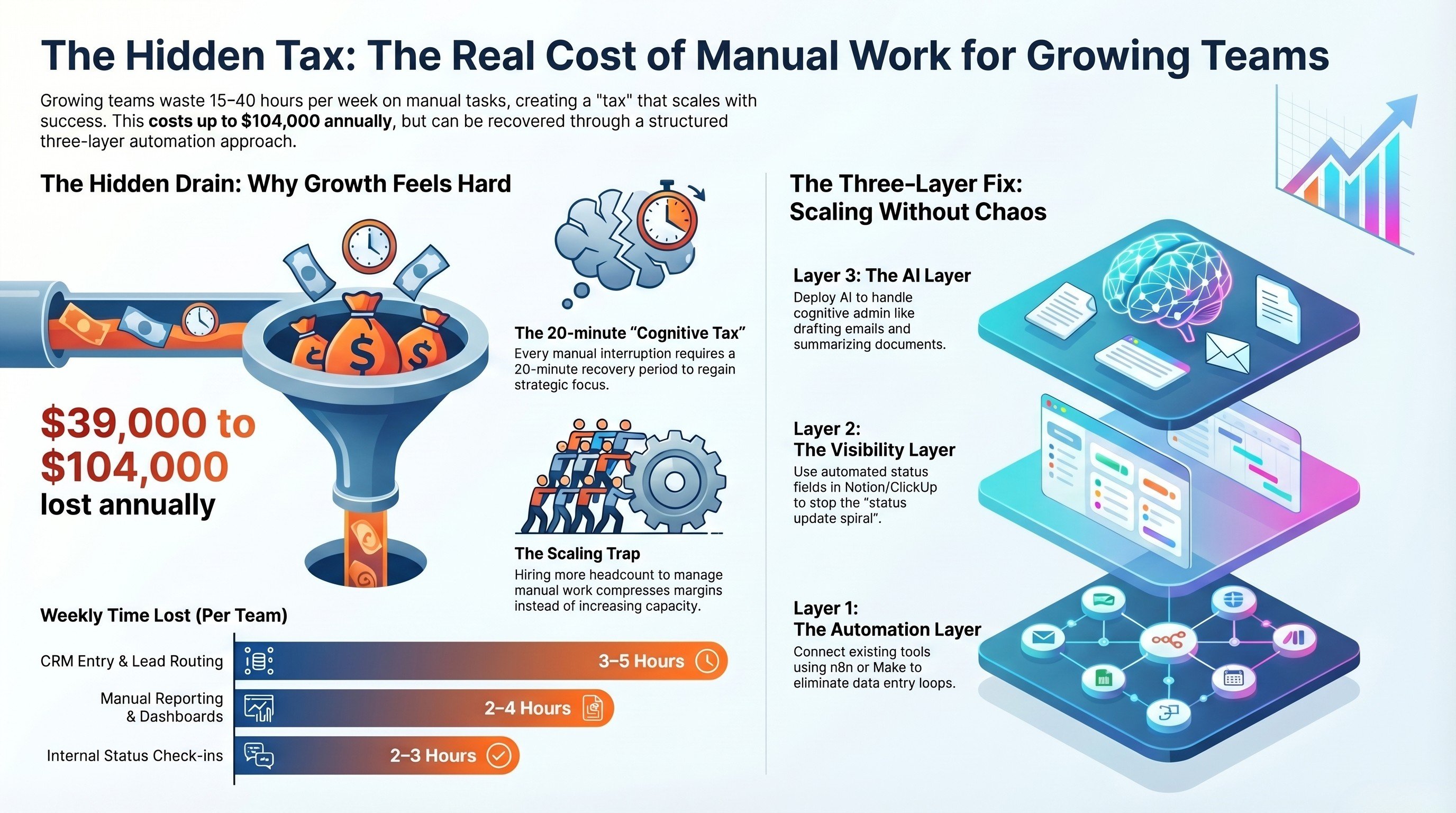
The real cost of manual work for growing teams
How to put a number on the operational waste that informal systems quietly create.
Read the analysis →
The Foundation stage, built for you
The two-week audit and standardization build that turns growth into profit, not chaos.
See the offer →Want your automation stack built for you?
Book a free 30-minute strategy call. We will map your highest-ROI workflows and give you a build roadmap on the spot. If we are not the right team for you, we will say so and point you somewhere better.
Book a Free Strategy Call →Free 30-minute call. Honest take, even if that means "you do not need us yet."