Most owners can't run n8n. The fix is done-for-you automation, not DIY.
Learning Make or n8n and keeping it alive is a real job. If that is not your job, the answer is not a better tutorial. It is someone who scopes, builds, and runs the automation for you. Here are your five real options, side by side.
 By Ishan Vats · Founder of IV Consulting · builds AI agents & automations for 150+ teams
 Done-for-you · scoped, built, runWe build it in n8n
 You get the resultPushed to you
Done-for-you automation means a partner scopes, builds, and runs your workflows for you, so you get the hours back without learning a tool like n8n, Make, or Zapier. A popular r/automation thread put it bluntly: most small businesses cannot realistically use these tools, and pasting prompts into ChatGPT is not automation. That is the honest starting point. You have five real options: learn a tool yourself (DIY), buy a pre-built template, hire a freelancer, pay for a one-off done-for-you build, or bring on a fractional automation partner who scopes one workflow, builds it, and keeps it running. For most non-technical owners, the last two win, because the goal is the outcome, not a new skill. Match the option to how technical you are and how much you want to own.
What it is
What is done-for-you automation?
Done-for-you automation means someone scopes, builds, and runs your workflows for you, instead of you learning an automation tool and building them yourself. You describe the messy manual process, chasing invoices, routing new leads, compiling the same weekly report by hand. They turn it into a reliable automation, usually built in a tool like n8n, Make, or Zapier, and hand you back the result, not the tool. You never open the builder. You just get the invoice matched, the lead routed, the report in your inbox on Monday.
That is the whole difference from DIY. DIY automation means you pick a platform, learn it, wire the workflow together, and own it forever, including every time it breaks. Done-for-you automation moves all of that off your plate. The building, the connecting, the fixing, the maintaining, someone else carries it. You keep the outcome.
It matters because most owners do not actually want an automation tool. They want their evenings back. They want the follow-up to happen without them remembering. The tool is a means to an end, and for a lot of small teams, learning that means is a bigger cost than the problem it solves. Done-for-you automation is how you skip the means and buy the end. It is the core of what our Automation stage does: connect your tools, kill the busywork, and hand you the time back.
The honest problem
Why can't most small businesses use n8n or Make?
Most small businesses can't use n8n or Make on their own because, powerful as these tools are, real workflows need things most owners have never touched: connecting APIs, handling authentication, mapping data between systems, catching errors, and maintaining all of it as your tools change. A widely shared r/automation thread, 126 upvotes and 115 comments, argued the uncomfortable version out loud: most small businesses cannot realistically use Make or n8n, and pasting prompts into ChatGPT is not automation. It is an opinion, not a measured statistic. But it resonated because it is largely true.
Here is what the demos never show you. A tutorial makes n8n look like snapping a few boxes together. A production workflow is different. You have to authenticate every app, understand how data is shaped as it moves, handle the lead that comes in with a missing field, decide what happens when an API is down, and keep the whole thing alive when a tool you rely on changes its login next quarter. That is developer-adjacent work. It is not hard because owners are not smart. It is hard because it is a different job than running a business.
And the ChatGPT point matters. Asking a chatbot to draft an email is useful, but it is not automation. Automation is the thing that runs on a schedule, moves data between your systems, and does the work while you are asleep, without you in the loop. A chatbot waits for you to prompt it. An automation does not wait for anything. Confusing the two is why a lot of owners think they have "automated" something when they have really just found a faster way to do it manually.
The decision
DIY, templates, freelancer, or done-for-you: which fits you?
You actually have five real ways to get a workflow automated, not two. They trade off how much effort falls on you, how fast you see value, who maintains it, and how you pay. This table lays them out. The fractional automation partner row is highlighted because, for most non-technical owners who want the outcome and none of the upkeep, it is where this usually lands.
| Option | Effort from you | Time to value | Who maintains it | Cost shape | Best for |
|---|---|---|---|---|---|
| DIY (learn a tool) | High, ongoing | Slow: weeks to months | You, forever | Tool subscription plus your time | Technical, curious owners with time to spare |
| Pre-built template | Medium: setup and wiring | Medium | You, and it breaks when tools change | Low one-off or subscription | Standard use cases, some tech comfort |
| Hire a freelancer | Low to build, high to manage | Medium | You after handoff, or pay again | Hourly or per project | A one-off build with a clear spec |
| Done-for-you build | Low | Fast | You after handoff | Fixed project fee | One specific, stable workflow done right once |
| Fractional automation partner | Lowest | Fast | Them, on an ongoing basis | Retainer or scoped engagement | Owners who want the outcome and zero upkeep |
The shortlist
When is done-for-you automation the right call?
Done-for-you automation is the right call when you are short on technical time, the workflow actually matters, and you want it to keep working without becoming your problem. It is the wrong call when the process is tiny and low-stakes, or when you genuinely want to learn the tool. Here is how to tell which side you are on.
1. You are non-technical or short on time
If connecting APIs and debugging a broken workflow sounds like a bad afternoon, that is a signal, not a failing. Your time is better spent on the parts of the business only you can do. Hand the building to someone who does it every day, and spend your hours where they actually compound.
2. The workflow touches revenue or real hours
When the automation handles leads, invoices, customer follow-up, or anything that costs you money when it silently breaks, get it built and monitored properly. A fragile DIY build on a workflow that matters is a liability. This is exactly where a done-for-you build or a partner earns its fee, because reliability is the whole point.
3. You want it to keep running, not just get built
Building an automation is the easy 20 percent. Keeping it alive as your tools update, your process shifts, and edge cases appear is the other 80. If you do not want that maintenance landing on your desk, you want someone who runs it, not just someone who hands it over. That is the difference between a one-off build and an ongoing partner.
4. You would rather own the outcome than the tool
Some owners want to learn n8n. Most just want the result. If you have no desire to become fluent in an automation platform, there is no prize for forcing it. Buy the outcome, keep your attention on the business, and let the tooling be someone else's craft. For the deeper systems work behind bigger automations, our AI Engineering stage is built exactly for this.
The playbook
How do you buy automation without becoming an engineer?
You do not need to understand n8n to get the value of it. You need a way to hand off a workflow that does not turn into a second job. Here is the five-step path we use so owners get the outcome without ever touching the builder.
The five steps at a glance: (1) pick the one workflow that costs you the most time or money, (2) scope it with someone who has built these before, (3) let them build it and connect your real tools, (4) get it handed back running, with monitoring, and (5) only then add the next one.
Pick the one workflow that hurts most
Do not try to automate everything. Find the single process that eats the most hours or costs the most money and runs the same way every time. Lead intake, invoice handling, follow-ups that keep slipping, the report someone rebuilds by hand every week. One clear, high-value workflow is the right size to start. It is easy to scope, easy to prove, and gives you a real win before you spend on the next one.
Scope it with someone who has built these before
A good scope is where the value is decided. Someone who has built these workflows will spot the edge cases you cannot: the lead with no email, the invoice in a weird format, the step that needs a human to approve it. Thirty minutes of honest scoping saves weeks of a build that solves the wrong problem. This is also where you find out if it is even worth automating yet, which is a favor, not a loss.
Let them build it and connect your real tools
This is the part you were dreading, and it is the part you now skip entirely. They build the workflow, connect it to the tools you already use, your inbox, your CRM, your spreadsheets, your calendar, and handle all the authentication and data plumbing. You are not in the builder. You are reviewing the result and saying "yes, that is what I wanted," or "actually, route it here instead."
Get it handed back running, with monitoring
A workflow that works on day one and quietly dies in month two is worse than no workflow, because you stop checking. Insist on monitoring: someone watching that it actually runs, catching failures, and fixing them before they cost you. This is the single biggest reason to have automation run for you rather than dumped on you. The outcome is not "it was built." The outcome is "it keeps working."
Only then add the next one
Once the first workflow is reliably saving hours and you trust it, add the next highest-value one. Automation compounds when you stack proven wins, not when you try to boil the ocean on day one. One workflow that people trust beats ten half-built ones nobody does. The same stacking logic applies if you are moving off another platform: rebuild the highest-value workflow first, which is exactly the order the Zapier to n8n migration guide lays out.
FAQ
Questions owners ask about done-for-you automation
What is done-for-you automation?
Why can't most small businesses use n8n or Make themselves?
Is it worth learning n8n or Zapier myself?
What is the difference between a done-for-you build and a fractional automation partner?
How much does done-for-you automation cost?
What is the first workflow I should automate?
Ishan Vats
Founder, IV Consulting · AI & automation consultant
I build AI agents and automations for teams from startup to enterprise, and I spend a lot of time helping owners who do not want to become automation engineers get the outcome anyway. The honest truth: most owners should not be learning n8n. 150+ ops transformations over 10+ years. If you want one high-value workflow scoped, built, and run for you, I'll map it with you on a free call.
Book a free strategy call →Keep reading
Related guides and work
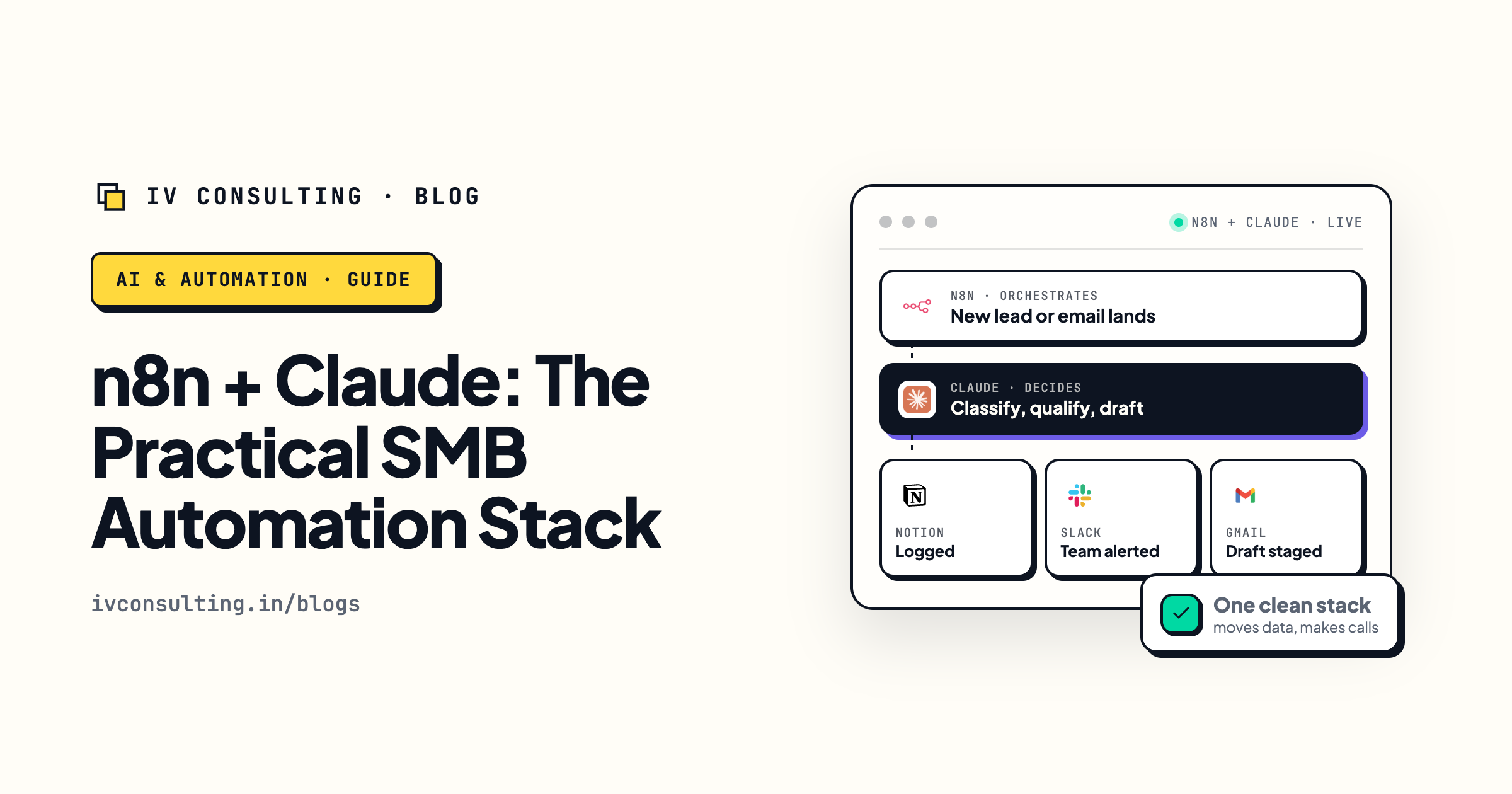
The practical n8n plus Claude stack
What the DIY path actually involves: the tools, the wiring, and where each one earns its place.
Read the guide →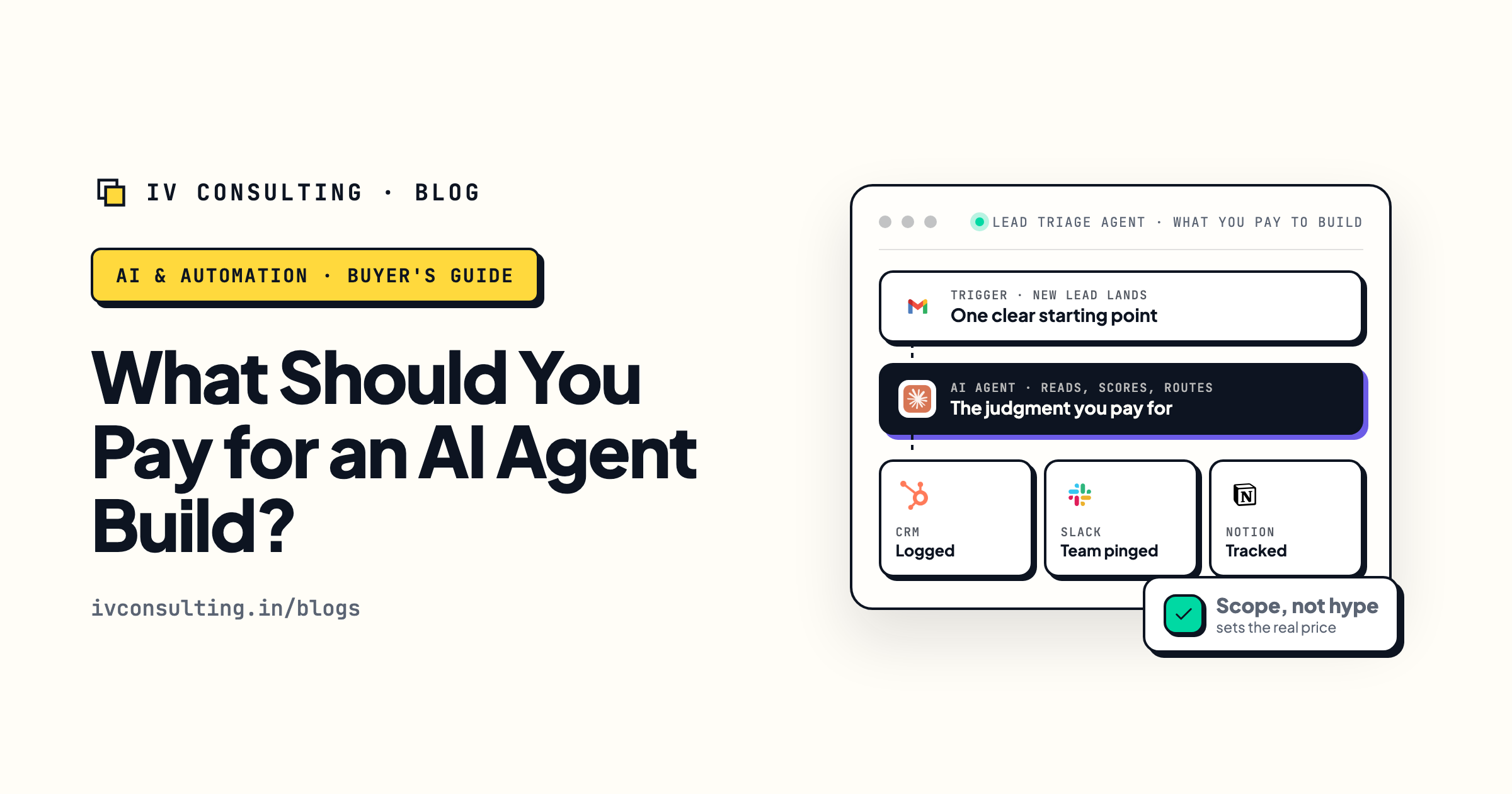
What should you pay for an AI agent build?
A buyer's cost guide so you can weigh done-for-you against DIY without getting fleeced.
Read the guide →
The Automation stage, built for you
We scope one workflow, build it, and run it, so you get the hours back without learning a tool.
See the offer →Hand off the workflow that eats your week.
Book a free 30-minute strategy call. We will find the one process costing you the most time, decide whether to automate it at all, and if it is worth it, scope a done-for-you build we build and run for you, so you never touch n8n.
Map my highest-ROI workflow →Free 30-minute call. Honest take, even if that means "you don't need to automate this yet."