Enhancing client satisfaction through improved project management
68% of clients who leave never raise a complaint. The CREST Framework closes the gap that costs you the renewal.
 By Ishan Vats · Founder of IV Consulting · 150+ ops transformations over 10+ years
Some links below are affiliate links. If you buy through them we may earn a commission, at no extra cost to you.
 NotionProject agreement
 ClickUpStatus cadence
 SlackRisk flags
Client satisfaction is decided by the experience of being managed through a project, not just the quality of the deliverable. Most clients who leave do so quietly because they felt uninformed, surprised by scope changes, or not prioritised. The CREST Framework, Clarity, Rhythm, Escalation Design, Scope Discipline, and Transition Excellence, designs that experience on purpose so retention, expansion, and referral become a system, not a personality trait.
The silent problem
The dissatisfaction that drains revenue without an alarm
The most dangerous client dissatisfaction is not the angry email, the escalated call, or the formal complaint. Those are recoverable. The most dangerous kind is quiet: the client who politely receives your deliverable, thanks your team for their hard work, and does not renew. They do not explain why. They do not answer your follow-up. They simply stop. And on the way out, they tell six colleagues exactly why.
In service and professional services firms, this pattern is the leading cause of revenue plateaus. The business keeps winning new clients at roughly the same rate it loses existing ones. Growth looks like a pipeline and sales problem. The real problem sits in how projects are managed, specifically in the gap between what clients experience during delivery and what they expected when they signed.
Client satisfaction is a process outcome, not just a delivery outcome
Client satisfaction in project management is the degree to which a client's experience of being managed through a project matches or exceeds their expectations of how they would be kept informed, included in decisions, protected from surprises, and acknowledged for their investment. A project can be delivered on time, on scope, and on budget and still produce a dissatisfied client if the process of getting there was opaque, reactive, or disorganised from the client's perspective.
That is why this is an operations discipline, not a relationship management discipline. A useful way to hold it: Client Satisfaction = (Perceived Value Delivered / Expected Value at Signing) x Quality of Experience During Delivery. All three variables are manageable through how you design project delivery. Most businesses only actively manage the first. The third, experience quality, is where most satisfaction points are won and lost.
The failure modes
5 project management failures that silently destroy satisfaction
Most of these never produce an immediate complaint. They produce a gradually worsening experience that surfaces at the renewal conversation, or the non-renewal one.
Failure 1: the expectation gap at kickoff
The most expensive failure happens before work begins. When a client signs, they carry expectations about how often they will be updated, who their main contact is, what the decision points are, and what good progress looks like. When those expectations are not explicitly surfaced and aligned at kickoff, the project starts with a gap. It does not surface immediately. It surfaces the first time an expectation is violated, and the client silently recalibrates their trust downward.
Failure 2: the communication silence
The second most common cause is the silence: the period when a client has no update, no status visibility, and no proactive contact. For the delivery team, silence means the project is progressing normally. For the client, the same silence means uncertainty, anxiety, and a dawning concern that they are not a priority. The silence is asymmetric. The team does not notice it because they are busy. The client experiences it acutely.
Failure 3: the surprise, when problems surface too late
Every project hits problems. The question is not whether, it is when the client learns about them. In poorly managed projects, problems surface at the worst possible moment: when they have become critical, when options are limited, and when the client has no time to contribute to the solution. Clients kept informed of emerging risks early consistently rate their experience higher than clients who receive perfect news until something breaks.
Failure 4: scope creep mismanagement
Scope creep is the silent relationship killer. It begins with a reasonable request, a small addition, an extra revision, which the team absorbs without acknowledgment. It happens twice, then five times, and the project is materially larger than contracted. The paradox is that accommodating it short-term damages the relationship long-term: clients who push scope without pushback often read it as a signal that the original scope was overpriced.
Failure 5: the anticlimactic close
The project close is the highest-leverage moment in the satisfaction cycle and the most consistently wasted. Most businesses end projects with a final deliverable and an invoice. The account goes inactive, and the next contact is a renewal conversation months later when the emotional connection to the value has faded. A designed close converts the highest-satisfaction moment in the cycle into a business development asset.
The framework
The CREST Framework for client-obsessed delivery
Five domains, each one addressing a failure mode directly. Applied together they produce the engagement clients describe as the best-managed one they have ever been part of.
C - Clarity
Define what success looks and feels like before work begins. A structured kickoff documents the client's definition of success, the communication expectations (frequency, format, primary contact, decision authorities), and a shared milestone map so the client can see the shape of the project from day one.
Quick win: add three questions to every kickoff. What would make this a 10/10 experience beyond the deliverables? What has frustrated you about past project delivery? How do you prefer to receive updates, email summary, live call, or dashboard?
R - Rhythm
Build a communication cadence the client can set their watch to. Proactive, consistent touchpoints owned by the project lead, delivered whether the news is good or bad. The cadence makes client-initiated status requests unnecessary.
E - Escalation Design
Surface problems fast, when options are still available. A weekly risk trigger, a fixed escalation format, and named resolution owners on both sides. Teams that flag bad news early score higher than teams that protect clients from it.
S - Scope Discipline
Protect the relationship by protecting the agreement. Acknowledge within 48 hours, assess transparently, present at least two options, and document the decision. A clear process demonstrates more respect than silently absorbing and resenting changes.
T - Transition Excellence
Turn the highest-satisfaction moment into a business development asset. A designed close: outcomes celebration, results documentation, structured feedback, NPS capture within 24 hours, and a natural next-step bridge.
The cadence
The master communication cadence table
The Rhythm domain made operational. Every touchpoint is initiated by the delivery team, not triggered by a client question. This is the standard cadence for a 4 to 12 week engagement.
| Communication type | Frequency | Format | Owner |
|---|---|---|---|
| Weekly status update | Every Friday by 5pm | 1-page summary: progress, next week plan, questions for client | Project Lead |
| Milestone completion notice | At each milestone | Email plus optional 15-min call: what was completed, what it means, what comes next | Project Lead |
| Mid-project check-in call | At project midpoint | 30-min call: satisfaction pulse, emerging concerns, scope confirmation | Project Lead + Account Owner |
| Risk / change flag | Within 24hrs of identification | Email or call: the risk, impact if unaddressed, proposed resolution options | Project Lead |
| Project close review | Final week of engagement | 60-min close: outcomes review, lessons learned, next steps discussion | Project Lead + Account Owner |
The weekly status update is the non-negotiable baseline. It runs every week even when the update is "this week progressed as planned." The IV Consulting standard format has three sections: DONE THIS WEEK, UP NEXT, and FLAG. The Flag section is never empty. If there is no risk or decision pending, it reads "All clear, no items require your attention this week." That active confirmation of no issues is itself a trust signal most teams never send.
The systems we build to run this cadence live in Notion and ClickUp, with status updates templated and scheduled so the Friday note is a two-minute task rather than a dreaded chore. Risk flags route to Slack so the 24-hour commitment is structurally easy to keep.
Beyond individual projects, run a portfolio-level cadence: a monthly or quarterly non-project touchpoint with every active client. It maintains relationship warmth between engagements, especially during the gap periods when there is no project reason to be in contact and most relationships quietly atrophy. And hold an exception standard for client-initiated contact: acknowledge within 4 business hours, even if the full answer takes longer. A one-line "received and on it, full response by [time]" eliminates the anxiety spiral and costs 30 seconds.
Scope in practice
Handling scope creep without losing the relationship
The Scope Discipline protocol meets reality in three common scenarios. The CREST-aligned response strengthens the relationship instead of straining it.
The small addition (low impact, high frequency)
An extra page in a report, a minor revision, one more data point. Absorb it this time, acknowledge it explicitly, and use it to establish the principle. The language: "We are happy to include this, it is within the spirit of the scope. For future reference, additions like this typically fall under a scope adjustment if they become recurring, and we will flag if we approach that threshold." Most clients hear this once and calibrate accordingly.
The significant addition (medium impact)
A new deliverable, a major revision cycle, rework of completed elements. The protocol applies in full: acknowledge within 48 hours, assess transparently, present options. "The addition would require roughly [X days] of additional work, which would [extend the timeline / require additional investment / require us to deprioritise element W]. We have three options for you. Which would you prefer?" This positions the team as a partner presenting options, not a vendor defending a price list.
The direction change (high impact)
A strategy pivot, a redefinition of the target outcome, a request to restart elements. This needs a reset conversation, not a scope memo. Arrange a dedicated call to understand the reasons, assess the full impact, and co-create a revised project agreement both sides explicitly endorse. The contract may need an addendum, the milestone map needs redrawing, and the kickoff process should be run again for the new direction. Handled well, a hard moment handled as partnership builds more trust than a smooth, uncomplicated project ever could.
Self-assessment
The client satisfaction health check
Rate each statement 0 (never true) to 3 (consistently true). Higher scores reflect greater satisfaction-design maturity. Maximum score is 30.
- Clarity: every project begins with a structured kickoff that documents the client's success criteria, communication preferences, and decision authorities.
- Clarity: clients can describe the shape of the project from kickoff day, including the milestone map and what is asked of them at each stage.
- Rhythm: every active project has a consistent weekly status update delivered proactively, without the client requesting it.
- Rhythm: the status update always has the same DONE, NEXT, FLAG structure, so clients know exactly where to look.
- Escalation: risks are surfaced within 24 hours of identification, with a proposed resolution and options analysis.
- Escalation: clients are never surprised by a missed deadline, scope impact, or quality issue they did not know was coming.
- Scope: every scope change request, regardless of size, is acknowledged within 48 hours with a transparent impact assessment.
- Scope: clients receive at least two options for every scope change, and their decision is documented in a change record.
- Transition: every project ends with a structured close that celebrates outcomes, captures results, and explores the next engagement.
- Transition: we capture NPS after every project and use the data to improve our process quarterly.
| Total score | Assessment |
|---|---|
| 25 to 30 | Client-obsessed delivery. Your project management design is a competitive differentiator. Focus on measurement refinement and scaling the model as you grow. |
| 17 to 24 | Good foundation, clear gaps. Two or three CREST domains are underdeveloped. Targeted improvements in the lowest-scoring domains produce significant NPS and renewal gains within 60 to 90 days. |
| 9 to 16 | Reactive delivery model. Multiple domains are missing or inconsistent. A structured CREST rollout produces measurable NPS improvement within 30 days of the first domain going live. |
| 0 to 8 | Satisfaction at risk. Delivery relies on individual relationship quality, not systematic design. Client retention is likely underperforming its potential by 20 to 35%. |
The proof
A 31-person IT firm: NPS 38 to 71 in 6 months
A 31-person IT and managed services firm had strong technical capability and a loyal core of long-term clients. The founders were personally known to most clients, and satisfaction was historically high when they were directly involved. As the business scaled and more projects ran through non-founding team members, scores started declining. NPS had dropped from a historical 62 to 38 over 18 months. Renewal rate had fallen from 79% to 61%. The founders were spending more and more time on client management the project team should have handled independently.
The diagnostic revealed a clear pattern: the founders had been delivering informal versions of all five CREST domains through their personal style, none of it documented or taught. The project team was delivering technically excellent work through a satisfaction-destroying process. The fix was a six-month rollout, one domain at a time, turning the founders' instincts into templates the whole team could run.
| Metric | Result at 6 months |
|---|---|
| Client NPS | 38 to 71 (+33 points) |
| Annual renewal rate | 61% to 81% (+20 percentage points) |
| Scope creep incidents per quarter | 14 to 4.5 (-68%) |
| Client-initiated complaint contacts | 8.2 to 2.1 per month (-74%) |
| Referral-sourced new revenue | 12% to 34% of new client pipeline |
| Average project delivery time | -22% from reduced rework and coordination overhead |
| Founder time on client management | 18 to 6 hrs/week (-67%) |
| Gross margin per project | +14% from recovered scope discipline |
The most striking outcome was not any single metric. It was the structural shift from founder-dependent satisfaction to system-dependent satisfaction. Six months after rollout, scores were equally high whether the founder was involved or not. The experience was consistent because it was designed, not because it was personal. That is what a client-obsessed operating model produces: satisfaction that scales with the business rather than capping at the founder's bandwidth.
FAQ
Questions teams ask about client satisfaction
What is the CREST Framework for client satisfaction?
How does project management directly impact client satisfaction?
How do you measure client satisfaction in project delivery?
How often should you communicate with clients during a project?
How do you handle scope creep without damaging the client relationship?
How long does it take to see NPS improvement after implementing CREST?
Ishan Vats
Founder, IV Consulting · operations & systems consultant
I build operating systems and automations for teams from startup to enterprise. 150+ ops transformations over 10+ years. If you want yours mapped and built right, I'll do it with you on a free call.
Book a free strategy call →Keep reading
Related guides and work
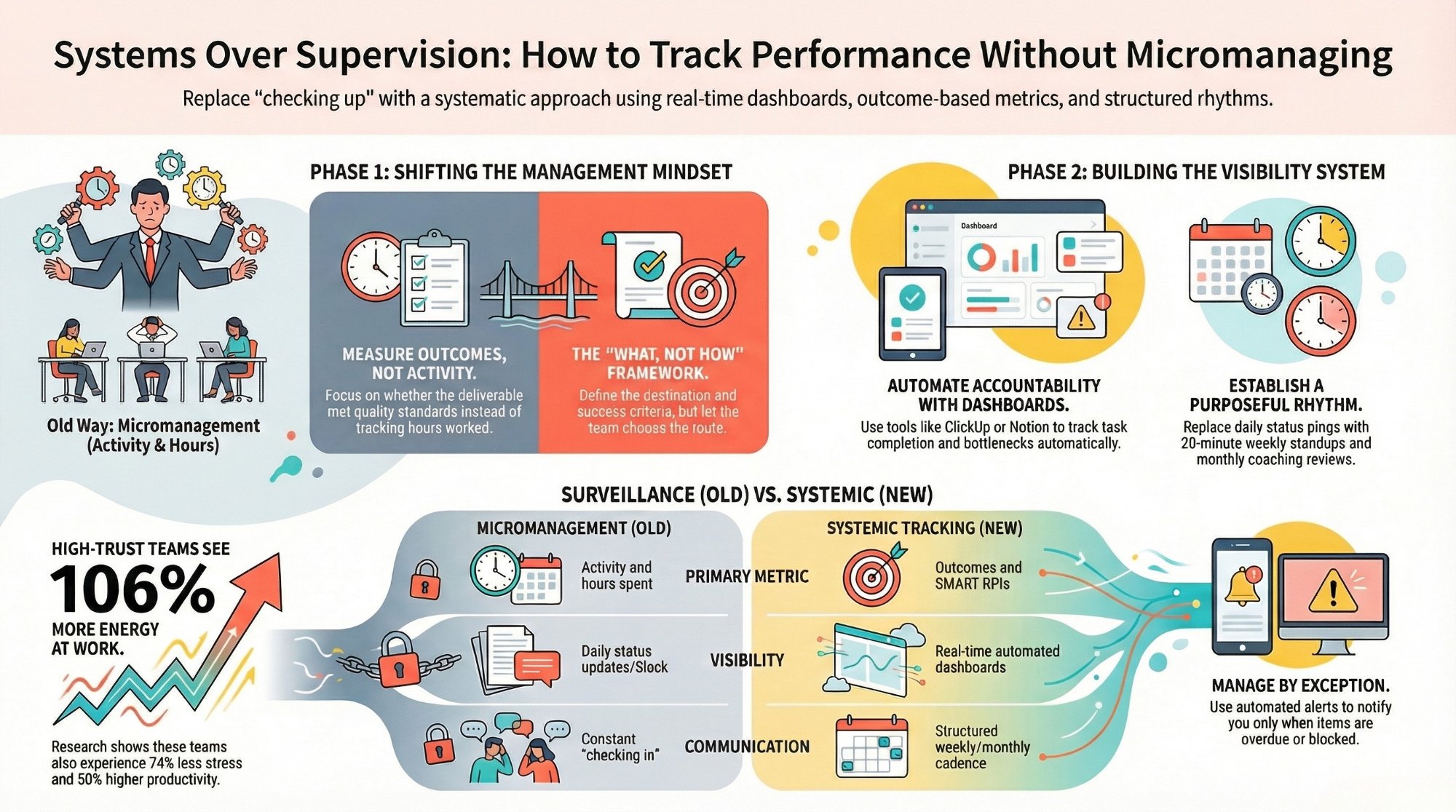
How to track team performance without micromanaging
The visibility systems that keep delivery on rhythm without hovering over the team.
Read the guide →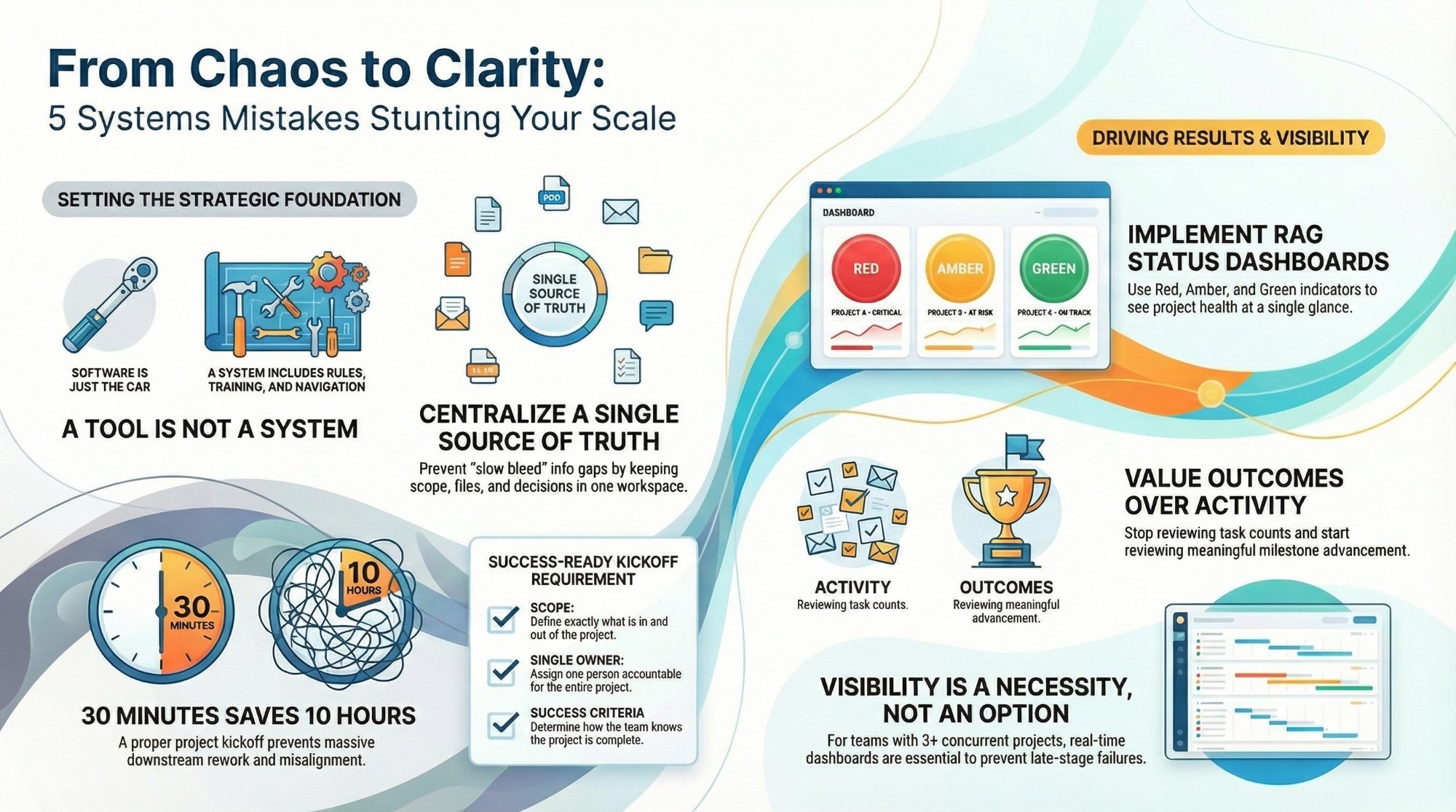
Top 5 project management mistakes CEOs make
The delivery errors that quietly erode trust, and the fixes that protect the renewal.
Read the playbook →
Agency OS, built for you
The full client delivery operating system: kickoff to close, designed for satisfaction.
See the offer →Want your automation stack built for you?
Book a free 30-minute strategy call. We will map your highest-ROI workflows and give you a build roadmap on the spot. If we are not the right team for you, we will say so and point you somewhere better.
Book a Free Strategy Call →Free 30-minute call. Honest take, even if that means "you do not need us yet."