Claude Fable 5 is the flagship you reach for on the hardest jobs, not the daily ones.
Anthropic redeployed Claude Fable 5 globally on July 1, 2026. It can plan and work for days at a time, and it is priced like it. For most small business automations, Claude Sonnet 5 is still your default. Here is exactly when the flagship earns its price.
 By Ishan Vats · Founder of IV Consulting · Claude Partner Network member
 n8n · agent harnessHands off the task
 Claude Fable 5 · plans & delegatesWorks across stages, for days
Claude Fable 5 is Anthropic's flagship, fifth-generation AI model, redeployed globally on July 1, 2026. It can plan and work for days at a time, delegating to sub-agents and checking its own work, which makes it the strongest model for large migrations and complex multi-step builds. It is also priced like a flagship at $10 per million input tokens and $50 per million output tokens, roughly five times Claude Sonnet 5. For a small business, that means Sonnet 5 should stay your default for everyday automations, and Fable 5 is the model you escalate to only for the rare, genuinely hard job that Sonnet 5 cannot finish in one clean pass. Right model, right job, and your automation bill stays sane.
What it is
What is Claude Fable 5?
Claude Fable 5 is Anthropic's flagship, fifth-generation AI model, built for the hardest knowledge work and coding problems. Anthropic describes it as the next generation of intelligence for the most ambitious, long-running projects. Run inside an agent harness like Claude Code, it can work for days at a time: planning across stages, delegating to sub-agents, and checking its own work. That is a real step up from a model that answers one prompt and stops.
The launch had a bumpy start. Anthropic first released Fable 5 on June 9, 2026, then US export controls landed on June 12 and forced it to restrict access. Those controls were lifted at the end of June, and on July 1, 2026 Fable 5 was redeployed globally. It is now available on Claude.ai for Pro, Max, Team, and Enterprise plans, through the Claude API as claude-fable-5, and on AWS, Google Cloud, and Microsoft. So as of this month, any small business can reach it.
What should you actually picture? A model that treats a big job the way a senior engineer would: it plans, splits the work, runs sub-agents, writes its own tests, and even uses vision to check its output against the goal, reading diagrams, charts, and tables nested inside files and PDFs. That is why Anthropic positions it for large migrations, complex implementations, and multi-day autonomous sessions. It is the connected, tool-using work our AI Engineering stage is built for.
The capability
What can Claude Fable 5 actually do?
The headline capability is stamina: Claude Fable 5 can work for days at a time on a single job, planning across stages, delegating to sub-agents, and checking its own work. Most models are sprinters, great for one prompt and one answer. Fable 5 is built to be a marathon runner that holds context and intent across a long, multi-step task without drifting off course. For a small business, that is the difference between a model that helps you write one function and a model that can take on a whole build.
Anthropic calls it their most capable model for ambitious coding projects, including large migrations, complex implementations, and multi-day autonomous sessions. Four things make that possible:
- It plans, then delegates. Given a big job, it breaks the work into stages and hands pieces to sub-agents, then coordinates the results. That is closer to how a team works than how a single prompt works.
- It checks itself. Fable 5 can write its own tests to verify its work, so it is not just producing output and hoping it is right.
- It sees. It uses vision to compare its output against the goal, and it understands diagrams, charts, and tables nested inside files and PDFs, not just plain text.
- It runs in a harness. Its long-run behavior shows up when it is deployed in an agent framework like Claude Code, not in a one-off chat window. The harness is what lets it keep going.
None of this is magic, and it does not remove the need for a human to scope the work and review the result. But it does mean that a genuinely hard, multi-day task, the kind you would normally not even attempt with an AI model, is now on the table. The question is not whether Fable 5 is impressive. It is whether your automation actually needs that much horsepower.
The decision
Claude Fable 5 vs Claude Sonnet 5: which should you use?
For a small business, the real choice is not Fable 5 versus some rival. It is Fable 5 versus Claude Sonnet 5, the cheaper, faster model that shipped a couple of weeks earlier and handles the bulk of everyday automation. This table maps the two side by side. The Sonnet 5 column is highlighted because, for the vast majority of your workflows, it is the right default, and Fable 5 is the exception you escalate to.
| Dimension | Claude Sonnet 5 (your default) | Claude Fable 5 (the flagship) |
|---|---|---|
| Best for | Everyday automation: triage, drafting, extraction, classification | The hardest jobs: large migrations, complex multi-step builds |
| How long it runs | Single tasks and short chains | Days at a time, planning across stages |
| Sub-agents and self-testing | Not the point | Delegates to sub-agents, writes its own tests, reviews with vision |
| Token price | About $2 / $10 per million (introductory) | $10 / $50 per million |
| Speed and cost per job | Fast and inexpensive | Slower and far pricier |
| Reach for it when | Almost every workflow you run | The rare job Sonnet 5 cannot finish in one clean pass |
The shortlist
When should a small business use Claude Fable 5?
Use Fable 5 when the job is genuinely hard and long, and Sonnet 5 would stall or need too much hand-holding to get there. That is a narrow set of situations, and that is the point. Here are the four where the flagship actually earns its price for a small team.
1. A large code migration or rebuild
Moving a legacy app to a new framework, untangling years of accumulated logic, or rebuilding a system from the ground up. These are multi-day jobs with a thousand interlocking decisions, exactly what Fable 5 was built for. It can hold the whole plan in view, work through it in stages, and test as it goes, instead of producing a plausible-looking change that breaks three things elsewhere.
2. A complex, multi-step build that has to hold together
A new internal tool, an integration that touches five systems, a data pipeline with real edge cases. When the work is too big to fit in one prompt and every step depends on the last, a model that can plan, delegate to sub-agents, and keep the pieces consistent is worth the premium. A lighter model tends to lose the thread on jobs like this.
3. A long autonomous run that plans across stages
Some tasks are not hard so much as long: process this entire backlog, reconcile a year of records, work through a large research or analysis job end to end. If it needs to run for hours or days without a human babysitting each step, Fable 5 is the model that stays coherent over that distance. Just wire in checkpoints so you can see progress.
4. Deep document or codebase reasoning with self-checking
Reading a dense contract set, a large codebase, or a stack of technical PDFs and reasoning across all of it, then verifying its own conclusions. Fable 5's vision and self-testing shine here: it can check diagrams and tables against the text and catch its own mistakes before they reach you. For a one-off summary, a cheaper model is fine. For a high-stakes read where being wrong is costly, the extra rigor pays.
The playbook
How do you use Claude Fable 5 without overspending?
Fable 5 is a scalpel, not a daily driver. Used deliberately, it takes on jobs you could not touch before without blowing your budget. Used lazily as your default model, it quietly triples your AI bill. Here are the five steps that keep it an asset, not a leak.
The five steps at a glance: (1) make Sonnet 5 your default and Fable 5 a deliberate branch, (2) give Fable 5 a real agent harness, (3) turn on prompt caching to cut the input bill, (4) keep a human on the checkpoints of long runs, and (5) know the guardrails before you point it at sensitive data.
Make Sonnet 5 your default and Fable 5 a deliberate branch
In your automation stack, route everyday tasks to Claude Sonnet 5 and add a separate Fable 5 branch only for the jobs that clearly need it. In an n8n plus Claude setup, that is a routing step: most work goes to the cheap model, and a condition sends the rare heavy job to the flagship. The default should never be the expensive model. For which tier each job belongs on, and what every model costs as a multiple of Sonnet 5, see our 11-model price table.
Give Fable 5 a real agent harness
Fable 5's long-run strengths, planning across stages and delegating to sub-agents, only show up inside an agent framework like Claude Code or a managed agent, not in a single chat prompt. If you throw a huge job at it as one message, you are paying flagship rates without getting the flagship behavior. Put it in a harness that lets it plan, act, and check over multiple steps, and let it do the job it was designed for.
Turn on prompt caching to cut the input bill
Fable 5 supports a 90% discount on cached input through prompt caching. On long jobs that reuse the same context, a large codebase, a rulebook, a document set, that is a big lever, because you are not paying full input price for the same tokens over and over. If you are running Fable 5 on anything with a stable, reused context, caching is not optional. It is the difference between a sane bill and a shocking one.
Keep a human on the checkpoints of long runs
A model that runs autonomously for days needs visible checkpoints. Break the job into stages, have it report progress at each one, and keep a human approval on anything that spends money, ships code to production, or commits the business. Fable 5 checks its own work, which is excellent, but "checks its own work" is not the same as "never needs review." You get the speed of a long autonomous run with a safety net.
Know the guardrails before you point it at sensitive data
A few facts worth knowing up front. Fable 5 ships with strong safeguards, and Anthropic automatically routes certain sensitive requests, like cybersecurity and biology queries, to Claude Opus 4.8, without charging Fable pricing for them. Anthropic also applies a 30-day data retention window on Fable 5 for safety monitoring, and a US-only inference option is available at 1.1 times the standard price if data location matters to you. Factor those into any workflow that touches regulated or sensitive information.
FAQ
Questions people ask about Claude Fable 5
What is Claude Fable 5?
How much does Claude Fable 5 cost?
When should a small business use Claude Fable 5?
What is the difference between Claude Fable 5 and Claude Sonnet 5?
Can you use Claude Fable 5 inside an n8n automation?
Is Claude Fable 5 safe to point at business data?
Ishan Vats
Founder, IV Consulting · Claude Partner Network member
I build AI agents and automations on Claude for teams from startup to enterprise, and I spend a lot of time helping owners pick the right model for the job instead of overpaying for the flashiest one. 150+ ops transformations over 10+ years. If you want your automation stack mapped to the right models, I'll do it with you on a free call.
Book a free strategy call →Keep reading
Related guides and work
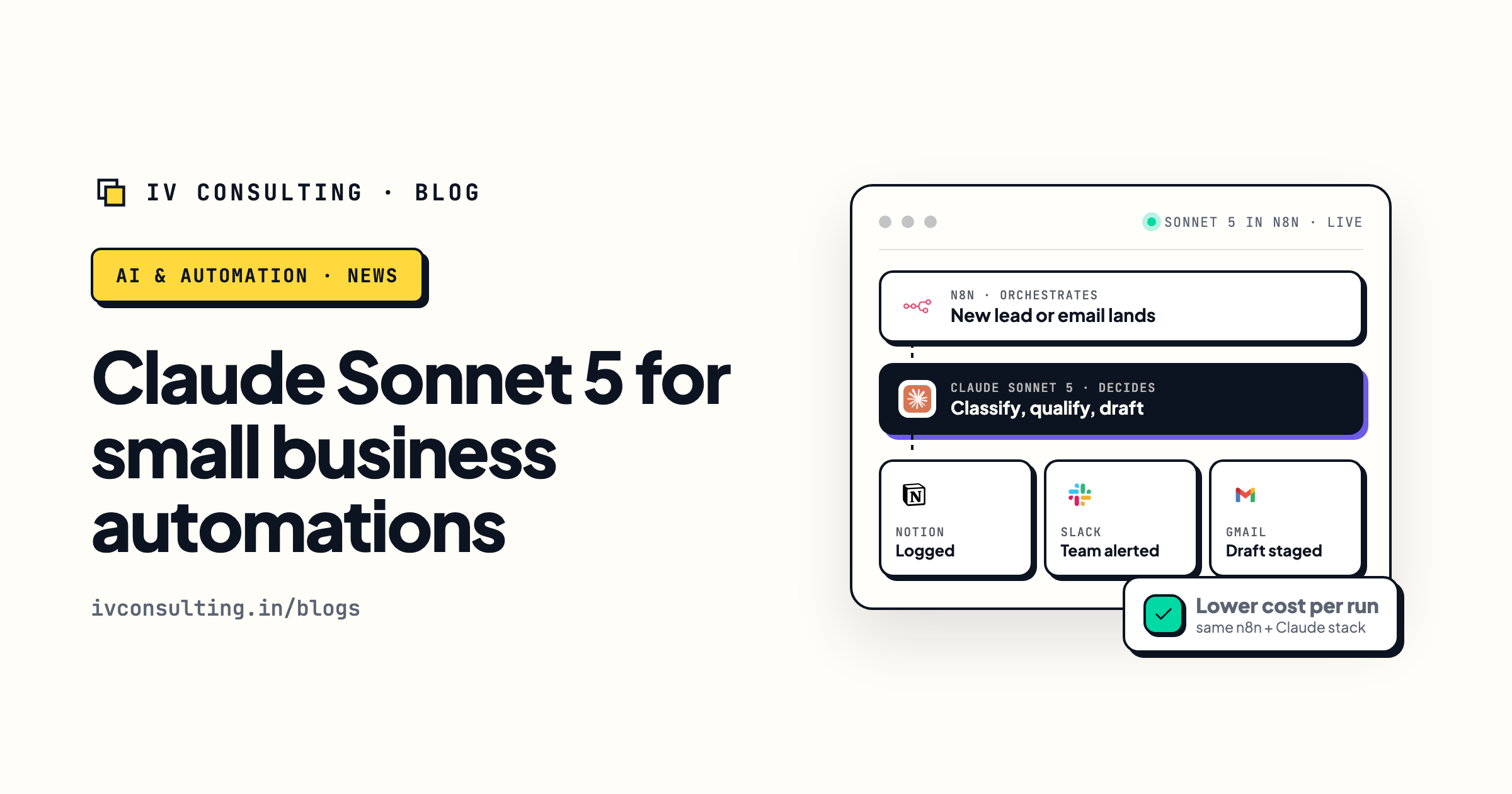
Claude Sonnet 5 for small business automations
The cheaper, faster model that should be your default. When to use it, and how it fits the n8n plus Claude stack.
Read the guide →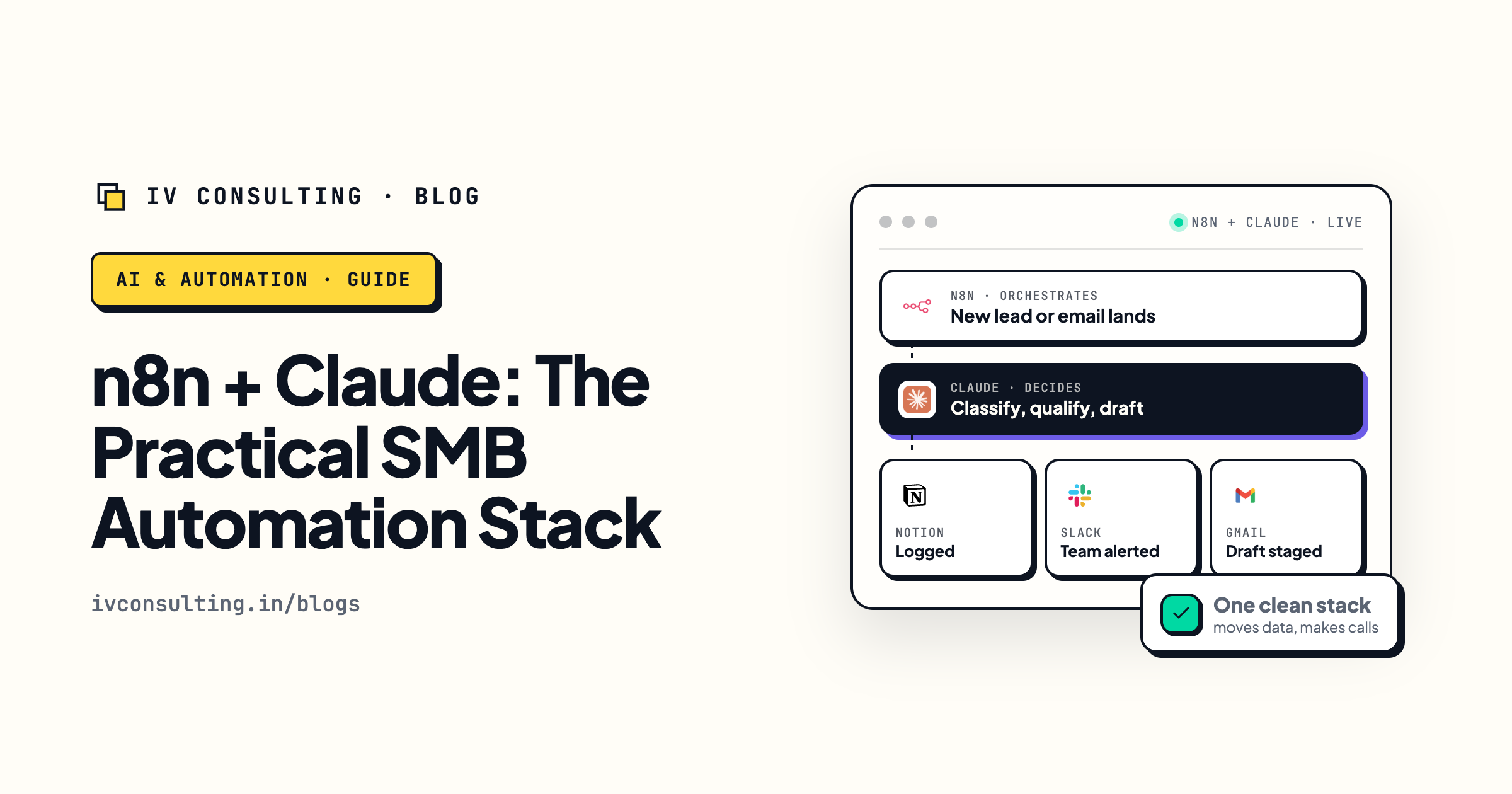
The n8n plus Claude automation stack
Where Fable 5 and Sonnet 5 actually live: n8n handles the routing, Claude handles the reading and judgment.
Read the guide →
The AI Engineering stage, built for you
We build production AI agents on the right model for each job, so your automations are capable and your bill stays predictable.
See the offer →Put the right Claude model on the right job.
Book a free 30-minute strategy call. We will look at what you are automating, pick the model that fits each workflow, Sonnet 5 for the daily queue and Fable 5 for the rare hard build, and map it so your automations stay capable and your bill stays predictable.
Map my automations to the right models →Free 30-minute call. Honest take, even if that means "Sonnet 5 is all you need."