Streamlining agency workflows for better client outcomes
The faster your agency grows, the worse the client experience gets, unless you fix your workflows first. Here is the 5-stage system.
 By Ishan Vats · Founder of IV Consulting · 150+ ops transformations over 10+ years
Some links below are affiliate links. If you buy through them we may earn a commission, at no extra cost to you.
 Automation layer · MakeRoutes the delivery loop
 ClickUpProject hub
 NotionClient portal
 ClaudeBrief synthesis
Streamlining agency workflows means giving your five core delivery stages, onboarding, scope lock, the delivery loop, review and approval, and project close, one documented and repeatable process each. Agencies that do this cut delivery friction, stop scope creep, and lift client retention. The work is operational, not a talent upgrade: most see results within 30 to 45 days and full transformation in 60 to 90.
The problem
The issue every growing agency rarely names correctly
You landed the client. You have the team. The work is genuinely good. But somewhere between the kickoff call and the final deliverable, things go sideways. Deadlines slip. Feedback rounds multiply. The client is not quite unhappy enough to leave, but they are not raving either. Your team is working harder than ever and somehow producing less.
This is not a talent problem. It is a workflow problem, and it is the most expensive, least-diagnosed issue in agency operations. Most agency owners are not failing because they lack talent. They are failing because they are delivering talented work through broken systems. The gap between what you promise clients and what they actually experience lives entirely in your operations.
Across 60+ agency engagements at IV Consulting, we have found that the average agency loses 19 hours per week per team member to workflow friction: handoff confusion, unclear approval chains, duplicated status updates, and reactive scope management. The agencies that scale well, the ones with 80%+ client retention and teams that actually want to stay, all share one trait. They treat their operational workflows with the same rigour they apply to their creative work.
Why agency workflows break: the 6 root causes
Before you can fix your workflows, you need to understand why they degrade. These six root causes are almost universal across agency types:
- Tribal knowledge delivery. Your best project manager holds the entire process in their head. When they leave, or go on holiday, everything slows down. Workflows that live in people rather than systems cannot scale.
- Scope managed by memory. When scope changes happen verbally or in Slack threads, there is no single truth. By delivery, nobody agrees on what was agreed, and every revision round becomes a negotiation.
- Client approval without structure. Feedback arrives in emails, WhatsApp, Google Doc comments, Loom videos, and verbal calls all at once. Your team spends 3 hours synthesising feedback that should take 20 minutes.
- Status updates by interrogation. Your account manager sends quick check-in messages to 6 people every morning because there is no live project dashboard. That is not communication, it is a tax on your most expensive people.
- Onboarding recreated from scratch. Every kickoff is slightly different because there is no standardised playbook. You spend 4 to 6 hours per new client doing work that should take 45 minutes.
- Delivery-to-billing disconnect. Work gets completed but invoicing lags because nobody officially tracked project closure. Cash flow suffers for operational, not business, reasons.
The hidden cost
What workflow chaos is actually costing you
Workflow breakdown has five distinct cost types. Most agency owners only ever count the first one.
| Cost type | What it actually costs you |
|---|---|
| Time cost | Hours lost to coordination, status chasing, and rework. Roughly 19 hours per team member per week of invisible waste. |
| Client retention cost | The average agency loses 2 to 3 clients a year to ops friction, not output quality. That is recurring revenue walking out the door. |
| Opportunity cost | New business you could not take because capacity felt full. Most agencies could absorb 20 to 30% more revenue with the same team if workflows were streamlined. |
| Team burnout cost | Staff turnover driven by operational chaos, not workload. Every departure takes institutional knowledge with it and resets ramp-up time. |
| Scope leakage cost | Unbilled work done to keep clients happy after mismanaged scope. Typically 8 to 12% of project revenue given away for free. |
The system
The 5 core workflow stages every agency must own
High-performing agencies do not have perfect workflows. They have consistent ones. The difference between an agency that grows profitably and one that stalls is a documented, repeatable process for each of these five stages.
Client onboarding (days 1 to 5)
Onboarding sets every expectation that shapes the relationship. Most agencies treat it as an admin task. Top agencies treat it as a trust-building operation. It must include a welcome sequence with clear next steps, a structured intake form covering goals, constraints, communication preferences, and success metrics, access provisioning to shared tools, and a kickoff agenda sent 48 hours in advance.
Common failure: the intake is verbal, the kickoff has no agenda, and the client arrives at week two still unclear on who owns what.
Project kickoff and scope lock (week 1)
Scope lock is not a document, it is a shared understanding both parties have signed off on. The kickoff exists to build that understanding and make it explicit, not to confirm what the agency has already decided. It must include a written brief with deliverables, timelines, dependencies, and revision rounds defined, a RACI matrix (Responsible, Accountable, Consulted, Informed), and a change request protocol both parties have read and agreed to.
Common failure: the scope is defined in a proposal PDF nobody re-reads, the RACI is assumed rather than documented, and one more round of revisions becomes the norm from month two onwards.
The delivery loop (ongoing)
The delivery loop is the engine of your agency: the repeating cycle of build, review, approve, and deliver that runs across every project, every week. Most workflow problems happen here because the loop is informal, driven by individual habits rather than shared standards. It must include a task system where every piece of work has an owner, due date, and status, a fixed weekly cadence for internal reviews before client-facing submissions, and a standardised handoff protocol when work moves between people.
The agencies that get this right share one habit: nothing goes to the client without passing through a quality gate. The gate does not need to be lengthy. A 10-minute internal review against the brief is enough. But it needs to be consistent.
Review and approval management
This is where most agency-client relationships deteriorate. Unstructured feedback creates unlimited revision loops. Clients who give feedback via six different channels make consolidation nearly impossible. Without a formal approval process, final never really means final. It must include a single feedback channel (one tool, one thread, one format), a maximum revision round policy written into the contract, a recorded sign-off mechanism, and a revision log tracking every change request with date and requestor.
Project close and client renewal
Most agencies treat project completion as the end. Top agencies treat it as the beginning of the next engagement. A structured close creates the conditions for renewal, referral, and expansion revenue. It must include a close-out call covering what was delivered versus scoped, an internal retrospective to capture what to improve, a structured off-boarding document with all assets and access handed over, and a proactive renewal conversation triggered at project close, not 30 days later when the client is already talking to a competitor.
Before versus after: what streamlined operations look like
The contrast between an agency running broken workflows and one running clean ones is not subtle. It shows up in every interaction.
| Before: broken workflow | After: streamlined workflow |
|---|---|
| Onboarding takes 4 to 6 hours of manual setup per client | Onboarding is 80% automated; human touches are high-value, not admin |
| Project status requires asking 4 people to get one answer | A single dashboard shows live status to everyone at a glance |
| Scope creep is accepted to avoid difficult conversations | Change requests are logged, priced, and approved before execution |
| Client feedback arrives in 5 different formats and channels | All feedback captured in one structured tool with clear deadlines |
| Revision rounds are unlimited in practice, even if capped in contract | The revision cap is enforced; out-of-scope work is quoted and billed |
| Project close triggers a scramble to gather files and invoice | The close protocol is pre-built; final package and invoice go out within 24 hours |
| Renewal conversations happen when the client starts asking around | Renewal is triggered at project close as part of standard workflow |
The stack
The agency workflow stack: tools that work together
The right tool stack is not the most expensive one. It is the one your team actually uses consistently. The cleanest agency operations all share a similar four-layer architecture.
Layer 1: Project hub
The central source of truth for all tasks, timelines, and deliverables. ClickUp is best for agencies with complex project structures; Notion is best for agencies prioritising flexibility and documentation. Pick one and mandate it. The biggest mistake here is letting two hubs coexist so nobody knows where truth lives.
Layer 2: Client communication
One channel for client-facing updates and feedback. Loom for async walkthroughs, plus a client portal in ClickUp or a Notion page per client. Never Slack for approvals.
Layer 3: Automation layer
Handles repetitive triggers: onboarding sequences, status reminders, invoice triggers, handoff notifications. Zapier or Make connected to your project hub. Saves 4 to 6 hours a week per project manager.
Layer 4: AI layer
Used for brief synthesis, first-draft SOP generation, feedback consolidation, and meeting note processing. Claude for document-heavy work, ChatGPT for rapid iteration. Not for replacing human judgement.
The plan
The 90-day agency workflow overhaul
Fixing agency workflows does not happen in a weekend workshop. It happens through a structured 90-day programme that moves through three phases.
Month 1: audit and map (days 1 to 30)
Before you build anything, understand exactly how work currently moves through your agency. Most agencies are surprised by what they find: typically 6 to 8 undocumented handoff points, 3 to 4 approval bottlenecks running through the same person, and at least 2 tools that duplicate the same function.
- Interview your 3 most experienced people about how they actually work, not how they are supposed to.
- Map every client touchpoint from first contact to invoice paid.
- Identify the 3 workflow steps that consume the most unplanned time each week.
- Survey 3 to 5 current clients on where they experience friction.
- Audit your tool stack: list every tool, who uses it, and what for.
Output: a workflow map with annotated friction points, a tool audit, and a prioritised problem list.
Month 2: build and standardise (days 31 to 60)
Month two is about building the standard processes and templates that replace tribal knowledge. The goal is not perfection, it is having one documented, agreed way to do each critical workflow.
- Build your client onboarding playbook: intake form, welcome sequence, kickoff agenda template.
- Create brief and scope lock templates for your 3 most common project types.
- Set up your project hub with standardised task structures per project type.
- Define and document your feedback and approval process, and write it into your contracts.
- Build your project close checklist and automate the invoice trigger.
Output: documented SOPs for each of the 5 core stages, configured project templates, and a client-facing workflow guide.
Month 3: automate and optimise (days 61 to 90)
Month three is where automation removes the remaining manual work from your standardised processes. Automate only after you have standardised. Automating a broken process just makes it break faster.
- Connect your onboarding sequence to your CRM so new sign-offs trigger the workflow automatically.
- Set up automated weekly status reports to clients from your project tool.
- Automate revision round tracking so round 2 triggers a reminder that round 3 is the contractual final.
- Integrate AI into your delivery loop for brief synthesis and first-draft generation.
- Run a team retrospective: what is working, what still creates friction, what to adjust.
Output: a partially automated stack saving 8 to 12 hours a week across the team, a month-3 retrospective, and a baseline metric set to track improvements.
Proof
How a 12-person brand agency rebuilt its retention
A brand strategy agency came to IV Consulting with a problem that sounded like a people problem but turned out to be a workflow problem. They were losing clients at the 3 to 6 month mark consistently, not because clients were unhappy with the work, but because the experience of working with the agency felt chaotic.
Exit interviews revealed three recurring complaints: clients never knew where their project stood, feedback was hard to give in a structured way, and deliverables sometimes arrived without clear context on what had changed since the last version.
The intervention was 100% operational. We built a client portal in Notion for every active engagement, with live project status, all deliverables, and all feedback threads in one place. We standardised their brief and scope process with a formal scope lock document at kickoff, built a three-round revision policy into all contracts going forward, and automated their weekly client update using ClickUp status reports.
10 warning signs your workflows need urgent attention
Score yourself honestly. Each yes is one point.
- Your best PM is a single point of failure.
- You accept revision requests beyond your contractual cap.
- Client status questions come via text, email, and Slack.
- Your onboarding process varies significantly per client.
- Scope changes are discussed verbally and not documented.
- You have lost a client for reasons you still do not fully understand.
- New team members take 6+ weeks to become productive.
- Your team regularly works evenings or weekends to hit deadlines.
- You have no structured renewal conversation at project close.
- You have added headcount to solve a problem that still exists.
0 to 2: strong foundation, focus on automation. 3 to 5: moderate risk, 2 to 3 fixes yield real ROI within 90 days. 6 to 8: high risk, churn and burnout are likely already costing more than you realise. 9 to 10: critical, your growth is constrained by operational fragility, not market demand.
Several of these, particularly documentation, delegation, and the evenings-and-weekends item, are owner-habit problems as much as workflow problems. If your own week is the bottleneck, the seven productivity systems for entrepreneurs cover the time blocking, batching, and document-before-you-delegate habits that make workflow fixes stick.
FAQ
Questions agency owners ask before they start
How long does it take to see results from agency workflow improvements?
Do I need to invest in new tools to improve my agency workflows?
How do I get my team to actually follow new workflow processes?
Can I streamline workflows without disrupting active client projects?
What is the most common mistake agencies make when fixing their workflows?
At what agency size does workflow management become critical?
Ishan Vats
Founder, IV Consulting · operations & systems consultant
I build operating systems and automations for teams from startup to enterprise. 150+ ops transformations over 10+ years. If you want yours mapped and built right, I'll do it with you on a free call.
Book a free strategy call →Keep reading
Related guides and work
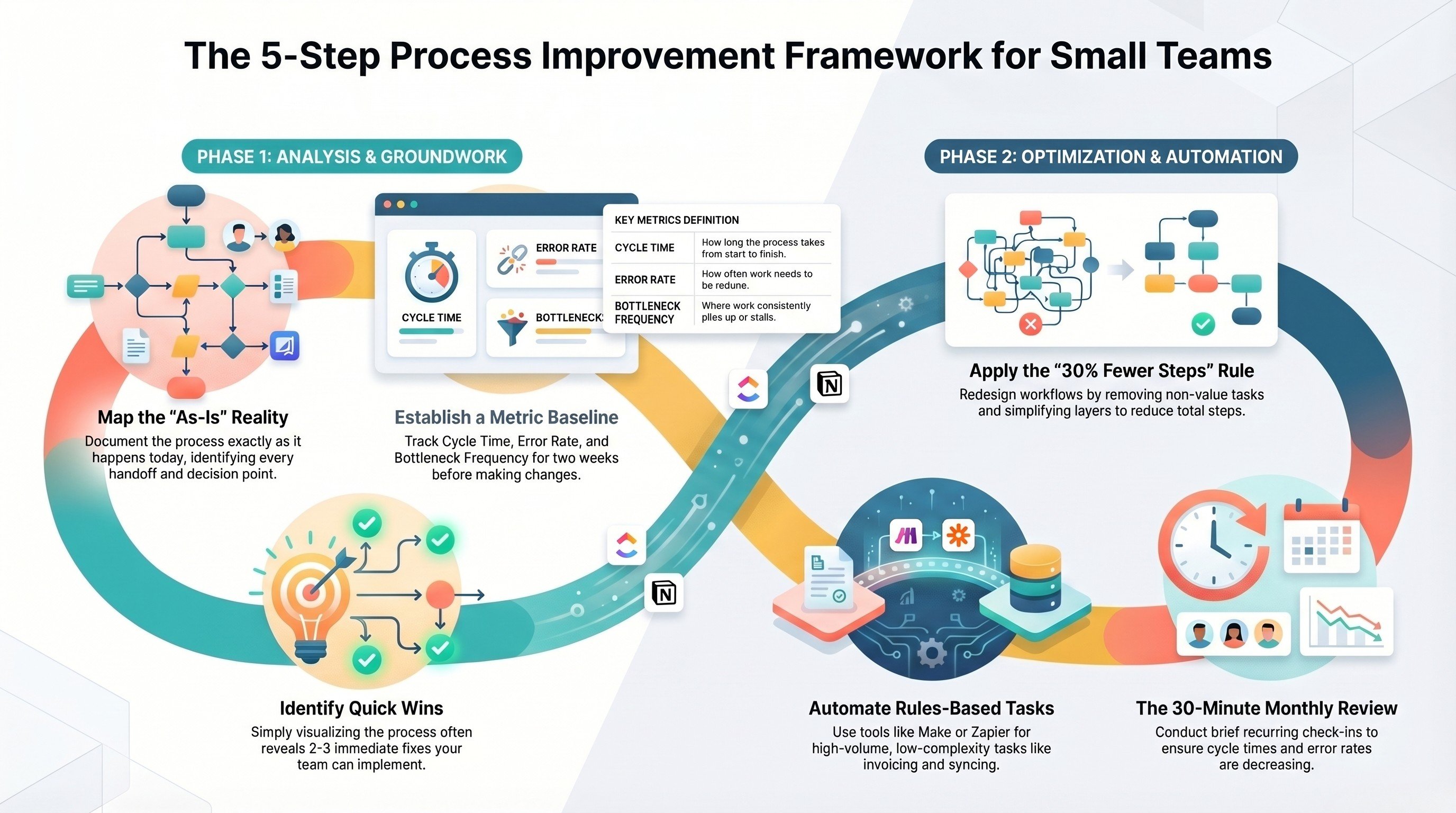
A process improvement framework for small teams
The structured way to find friction and fix it before it costs you clients.
Read the guide →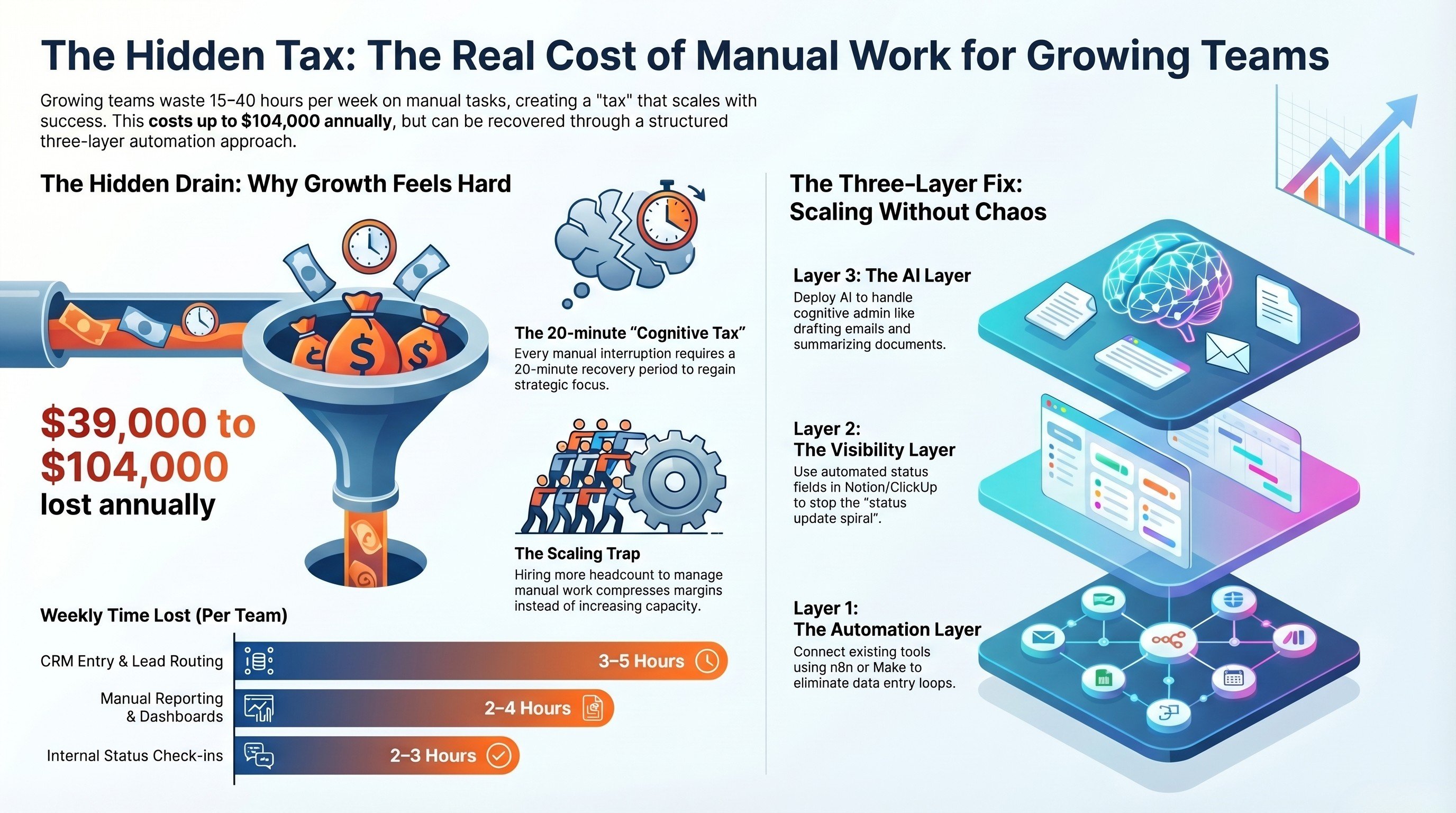
The real cost of manual work for growing teams
What unstandardised, manual delivery is quietly costing your margins every month.
Read the analysis →
The Foundation stage, built for you
We document and standardise your five core workflows so delivery stops depending on heroics.
See the offer →Want your automation stack built for you?
Book a free 30-minute strategy call. We will map your highest-ROI workflows and give you a build roadmap on the spot. If we are not the right team for you, we will say so and point you somewhere better.
Book a Free Strategy Call →Free 30-minute call. Honest take, even if that means "you do not need us yet."