Advanced project management for SMBs that actually scales
Most SMBs outgrow basic to-do lists by the time they hit 15 people. Here is what replaces them: seven techniques, an honest tool verdict, and an AI augmented PM stack.
 By Ishan Vats · Founder of IV Consulting · 150+ ops transformations over 10+ years
Some links below are affiliate links. If you buy through them we may earn a commission, at no extra cost to you.
 ExecutionClickUp for projects
 Docs · SOPsNotion for knowledge
 VisibilityAsana
 SprintsLinear
 Dashboardsmonday
Advanced project management for SMBs is not enterprise PM methodology adopted wholesale. It is selecting the specific techniques from mature PM practice that fix your exact failure modes: dependency blindness, resource invisibility, and scope entropy. Layer critical path mapping, WIP limits, and weekly capacity planning onto your existing tool, pair the right platform with an AI augmented workflow, and a 10 to 60 person team can deliver on time without hiring a dedicated PM.
The SMB PM problem
Why SMBs outgrow basic project management
Your team is not failing at projects because they lack talent or effort. They are failing because the tools and techniques you are using were designed for teams half your current size, or ten times it. Basic task lists do not handle cross-team dependencies. Simple Gantt charts do not manage resource constraints. And none of the introductory PM advice accounts for the reality that your project manager is also your account lead, your ops coordinator, and the person who runs the Tuesday standup.
There is a specific moment in most growing businesses when the current approach stops working. It usually arrives somewhere between 12 and 25 employees. Projects start running late not because the team is working less hard, but because the coordination complexity has grown faster than the coordination system. One missed handoff cascades into three delayed deliverables. A single resource constraint that was easy to see on a 6 person team becomes invisible on a 20 person one. Scope creep that the founder used to catch personally now slips through because no one owns the scope document.
The response most SMBs reach for first is a new tool: a platform with more features than the last one. This occasionally helps. More often, it adds a layer of complexity to the same underlying problem, which is not a tool problem but a technique problem. Sophisticated tools configured around unsophisticated PM habits produce sophisticated-looking chaos.
Advanced project management for SMBs is about selecting and applying the specific techniques from mature PM practice that address the exact failure modes your business is experiencing, without the overhead, certification requirements, or complexity that makes enterprise PM inappropriate for a 20 to 40 person team.
The failure modes
The 3 points where basic PM breaks down
Understanding the specific failure modes tells you exactly which advanced techniques to prioritise. There are three.
Failure point 1: dependency blindness
Basic task management treats every task as independent. In reality, most project work involves chains of dependencies: Task B cannot start until Task A is complete, and Task D is blocked until Tasks B and C are both done. When teams use task lists without dependency mapping, they discover blockers only when they hit them. A simple board with 40 items and no dependency visibility will routinely produce week-2 surprises that were visible, but unseen, in the project structure since week one.
The cost: at IV Consulting, we estimate that dependency-driven delays account for 38% of all project timeline overruns in SMBs that have not implemented dependency tracking. Most of these delays were structurally predictable at project kickoff.
Failure point 2: resource capacity invisibility
Basic PM tools show you what needs to be done. They rarely show you who has capacity to do it. When your team members are allocated across multiple concurrent projects, decisions about what to start next are made on gut feel rather than data. The result: your three most capable people are consistently over-allocated, your less-loaded team members are under-utilised, and projects slip because the people assigned to them did not actually have the hours the plan assumed.
Resource invisibility is the single largest cause of team burnout in growing businesses. It is not that the team has too much work. It is that the work is distributed without visibility, producing pockets of overwhelm alongside pockets of slack that management cannot see.
Failure point 3: scope entropy
Scope creep in SMBs rarely arrives as a large, obvious request. It arrives as a series of small, reasonable additions, each individually justified, collectively transformative. By the time the project is 70% complete, it is 40% larger than the original scope. The team is behind schedule on a project that should have been on track because the scope they are delivering is not the scope they planned for.
The playbook
7 advanced PM techniques every growing SMB should use
Sequenced from highest to lowest immediate ROI. These produce the fastest measurable impact when layered onto an existing PM practice.
Dependency mapping with critical path
The Critical Path Method identifies the longest sequence of dependent tasks: the chain that, if any task slips, pushes the project end date. For an SMB, a simplified version delivers 80% of the value at 10% of the overhead.
At every kickoff, spend 20 minutes mapping the three to five longest dependency chains. Mark these as critical path tasks. Any delay on one triggers an immediate impact assessment on the project end date. Non-critical tasks can slip without alarm. Teams that implement basic critical path identification reduce late delivery by an average of 31% within the first 60 days.
Rolling wave planning
Most SMB projects are planned either fully upfront (a detailed 12 week plan that bears no resemblance to reality by week 4) or not at all. Rolling wave planning is the middle path: plan the next 2 to 3 weeks in high detail, the following 4 to 6 weeks in moderate detail, and everything beyond that in outline only.
Replace your full upfront plan with a 3-2-1 structure: 3 weeks of detailed tasks, 2 weeks of high-level milestones, 1 month of outcome-level markers. Update the detail window every Monday as part of your weekly review.
Kanban with WIP limits
Most SMBs use Kanban boards as sophisticated to-do lists with no constraint on how many items sit In Progress at once. This misses the most powerful feature of Kanban: Work In Progress limits. A WIP limit caps the number of tasks in any column. A common start: no more than 3 items per person In Progress.
WIP limits force the team to finish things before starting new ones, which reduces context-switching, accelerates throughput, and makes bottlenecks visible immediately. Teams that implement them consistently report 25 to 35% faster task completion because they stop starting and start finishing.
Structured risk register
Most SMBs address risk reactively, when a risk becomes a problem. A risk register formalises risk management into a proactive discipline: at kickoff, identify the top 5 to 8 things that could go wrong, score each on probability (1-5) and impact (1-5), and assign a mitigation owner for anything scoring above 12.
The SMB version does not need to be elaborate. A 6-column Notion table works perfectly: Risk Description, Probability, Impact, Risk Score, Mitigation Action, Owner. The act of building it at kickoff surfaces assumptions the team did not realise they were making.
Stakeholder communication architecture
In basic PM, the volume of updates is determined by stakeholder anxiety rather than actual project need. A communication architecture defines, at kickoff, exactly who receives what information, in what format, and at what frequency.
The standard SMB template: a weekly async status update (what was completed, what is coming, any blockers), a bi-weekly 30 minute review call, and an exception alert triggered within 24 hours whenever a risk crosses threshold. This reduces ad-hoc stakeholder interruptions by 60 to 70% in the first month.
Resource capacity planning
Resource capacity planning gives you a weekly view of how many hours each team member has available versus how many your active projects are demanding from them. Create a simple weekly grid: columns are team members, rows are projects, each cell shows hours allocated this week.
Compare to available hours (typically 30 to 35 productive hours per week after meetings and admin). Any team member over 90% capacity gets a flag, and any project with a flagged resource gets a conversation before the week starts, not after it ends. This 30 minute Monday exercise prevents the most common cause of slippage in SMBs.
OKR-to-project alignment
Advanced PM is not just about delivering projects on time. It is about delivering the right projects. Add a single field to every project record: Strategic Objective. Each quarter, review your active list. Any project that cannot be clearly linked to a current objective is either mis-framed or genuinely misaligned.
SMBs that run this quarterly check consistently find 15 to 25% of their active portfolio is work that does not directly serve their stated priorities.
The 2026 comparison
The SMB project management tool verdict
The right tool amplifies good technique. The wrong tool imposes overhead that good technique cannot overcome. Here are the honest verdicts for the 10 to 60 person range.
| Tool | Best for | Honest limitation |
|---|---|---|
| ClickUp | All-rounder for complex, multi-team projects. Handles dependencies, resource views, custom fields, and automation in one platform. | Significant configuration overhead upfront. Budget 6 to 8 hours of setup before it is usable. |
| Notion | Knowledge-intensive businesses where project work is tightly integrated with documentation. Databases link directly to SOPs and client info. | Weaker native automation and timeline view. Best paired with a dedicated task manager for execution tracking. |
| Asana | Cross-functional coordination where non-technical stakeholders need clear visibility. Portfolio and workload features are best-in-class for SMBs. | Becomes expensive at scale, with fewer customisation options than ClickUp. |
| Linear | Tech and product-led businesses running sprint-based development. Extremely fast, opinionated, excellent developer experience. | Not suitable for non-engineering work. Use as part of a two-tool stack. |
| monday | Visually-oriented and sales-led teams where adoption ease matters more than PM depth. Strong automations and colourful dashboards. | Limited depth on dependency tracking and resource management. Higher price point for equivalent feature access. |
Agile vs Waterfall vs Hybrid
Choosing the right methodology for your SMB
The methodology debate is one of the most reliably unhelpful conversations in PM. It is not an ideological choice. It is a practical one: which approach fits the nature of this specific work?
| Methodology | Best suited to | SMB application |
|---|---|---|
| Waterfall | Work with stable, well-defined requirements and predictable dependencies. Infrastructure projects, compliance, fixed-scope launches. | Use for any project where the full scope can be defined at kickoff and mid-project changes carry high cost. |
| Agile / Scrum | Work where requirements will change as you learn. Software, product design, content strategy, test-and-learn campaigns. | 2 week sprints work well for teams of 4 to 8. Avoid daily standups under 8 people; weekly async updates achieve the same with less overhead. |
| Hybrid | The most practical choice for most SMBs. Mixed project portfolios with both fixed-scope and evolving-scope work. | Define phases using Waterfall logic, execute within each phase using Agile sprints. Best for client delivery and transformation projects. |
The implementation heuristic is one question at kickoff: can we define the full scope of this project now with confidence? If yes, use Waterfall phasing. If no, use Agile sprints within phases. If partially, use Hybrid. This decision takes 5 minutes and sets the entire approach correctly from the start.
2026 shift
The AI augmented PM stack for lean teams
The most significant shift in SMB PM is the integration of AI into the workflow, enabling lean teams to manage complexity that previously required a dedicated PM function.
Project brief synthesis
Pass the kickoff call transcript to Claude with a structured prompt requesting a formatted brief: objectives, deliverables, timeline, success metrics, out-of-scope items, open questions. The first draft arrives in 3 minutes. The PM spends 15 minutes refining rather than 2 hours writing from scratch, and quality goes up because the same structured template is applied every time.
Status report generation
Pass the week's task completions, blockers, and milestones to Claude with a template. A draft is generated in under 2 minutes and reviewed in 5. For a PM managing 4 projects, that is 2 hours recovered every week.
Risk identification
Pass the brief and current plan to Claude asking for the 8 to 10 highest-probability risks based on project type, team size, and timeline. What previously took 45 minutes of risk-storming takes 15 minutes of review.
Retrospective analysis
Feed completed project data (planned vs actual timeline, scope changes, risk outcomes, team feedback) into Claude for a structured retrospective identifying root causes and specific process recommendations, drawn from this project's data rather than generic PM wisdom.
No PM department needed
Building a PM culture without a dedicated PM department
Most SMBs do not need a full-time project manager until 40 to 60 employees. What they need is a distributed PM culture. Four practices build it.
Practice 1: the 20 minute project kickoff standard
Every project, regardless of size, starts with a 20 minute kickoff where four questions are answered in writing: what is the scope (and what is explicitly out of scope)? Who owns what deliverable? What are the three biggest risks? What does done look like? Teams that adopt this see scope creep and ownership confusion drop significantly within the first month.
Practice 2: the Friday five-minute project update
Every active project receives a Friday async update: three sentences covering what was completed, what is blocked, and what is planned for next week. This is not a status report. It is a habit that keeps projects visible and surfaces problems 3 to 4 days earlier than scheduled status meetings.
Practice 3: the weekly PM pulse (15 minutes)
A 15 minute weekly meeting focused exclusively on project health: which projects are green, which are amber, which are red. No detail, just status and flag. Red projects get a dedicated 30 minute slot later in the week.
Practice 4: the scope change protocol
Every scope change request, regardless of how small, follows three steps: the change is documented, the impact is assessed, and the change is approved before execution begins. A 5 minute conversation ending with a message saying "change approved, timeline extended by 3 days" is sufficient. What matters is that scope changes are visible and deliberate rather than invisible and accumulated.
| Before: basic PM SMB | After: advanced PM SMB |
|---|---|
| Projects slip because dependencies are discovered mid-execution | Critical path mapped at kickoff; dependency delays caught before they cascade |
| Scope creep absorbed silently until the timeline collapses | Every change documented, impact-assessed, and approved before execution |
| Best people over-allocated; nobody knows until a deadline is missed | Weekly capacity grid flags over-allocation Monday morning, not Friday afternoon |
| Status updates happen when stakeholders ask, which means constantly | Proactive weekly async update eliminates 60 to 70% of inbound status requests |
| PM knowledge lives in one person; capacity is a single point of failure | PM culture distributed; every member applies kickoff and update standards |
Proof
How a 19 person agency cut late delivery from 43% to 8%
A digital marketing agency running 8 to 12 concurrent client projects had been managing a problem for two years rather than solving it: 43% of deliverables arrived late. Not catastrophically, usually 2 to 5 days, but consistently and reputationally damagingly.
The audit identified three root causes. First, dependency blindness: the team used ClickUp as a task list, not as a dependency management tool, so blockers were discovered only when someone was ready to start. Second, resource invisibility: the 4 person strategy team was assigned across all 11 active projects, with plans assuming 6 to 8 hours per project per week when strategists actually had under 2.5 hours each to give. Third, scope entropy: client feedback was absorbed without documented impact assessment, so the average project grew 28% beyond original scope with no timeline extension.
The 10 week intervention: dependency tracking enabled in ClickUp with critical path at every kickoff; a weekly capacity grid reviewed every Monday as a team ritual; a formal scope change protocol written into every client contract; and an AI-assisted status report workflow replacing the ad-hoc weekly emails that consumed 3+ hours per account manager.
| Metric | Before to after (10 weeks) |
|---|---|
| Late delivery rate | 43% to 8% |
| Average days late on overdue deliverables | 4.2 days to 1.1 days |
| Scope creep per project | 28% to 7% |
| Account manager time on status updates per week | 3.1 hrs to 0.9 hrs |
| Client satisfaction score (post-project NPS) | 51 to 74 |
| Strategist over-allocation incidents per week | 6 to 8 down to 0 to 1 |
| Client contract renewal rate at 12 months | 61% to 82% |
FAQ
Questions SMBs ask before they upgrade their PM
Do we need a dedicated project manager to implement advanced PM techniques?
Which single technique produces the fastest visible improvement?
How do WIP limits work in practice when urgent tasks keep appearing?
Should we use the same PM methodology for all project types?
How do we get the team to actually use the project management tools we set up?
Is ClickUp or Asana better for a 25 person mixed service and product team?
Ishan Vats
Founder, IV Consulting · operations & systems consultant
I build operating systems and automations for teams from startup to enterprise. 150+ ops transformations over 10+ years. If you want yours mapped and built right, I'll do it with you on a free call.
Book a free strategy call →Keep reading
Related guides and work
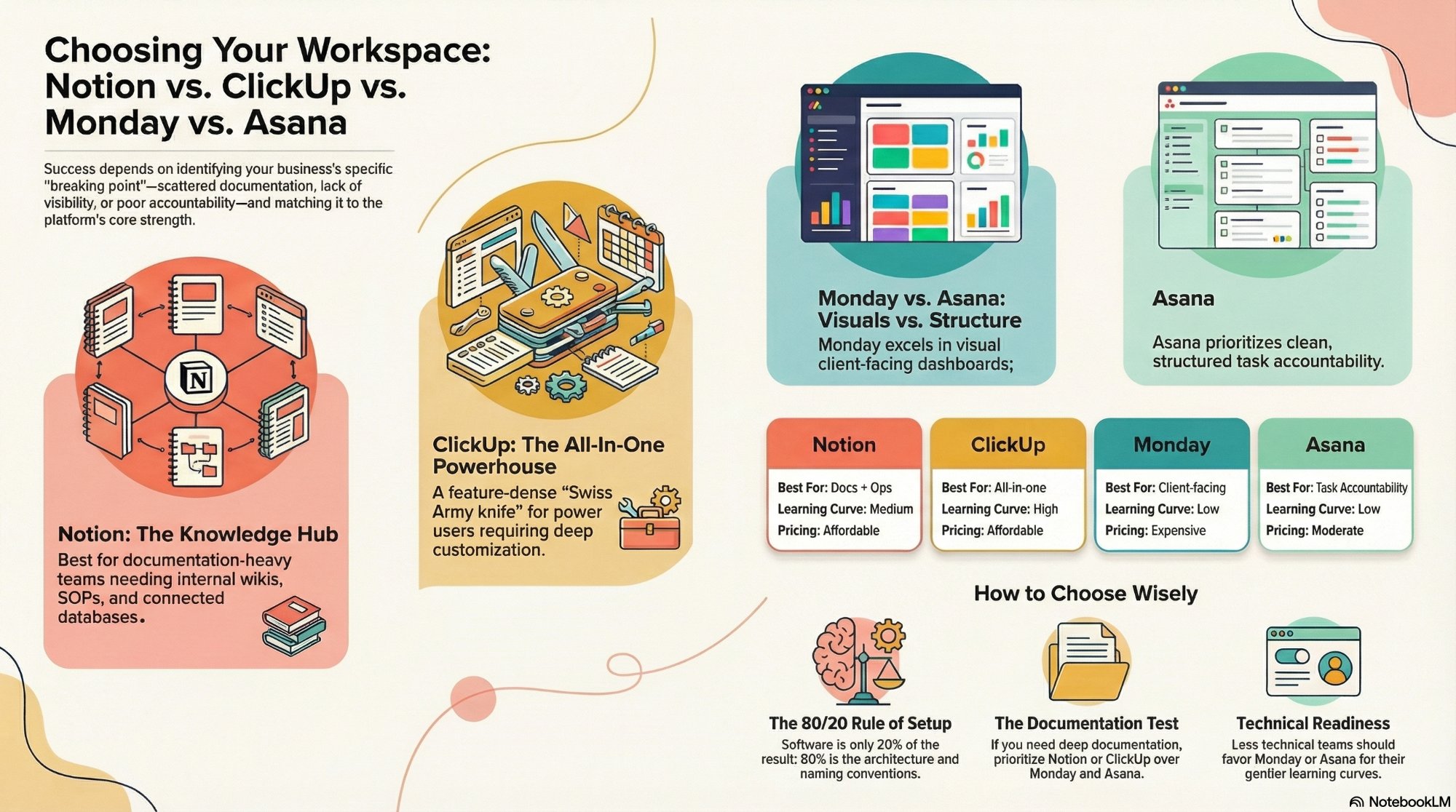
Notion vs ClickUp vs monday vs Asana
The honest head-to-head on the four tools every growing SMB shortlists.
Read the comparison →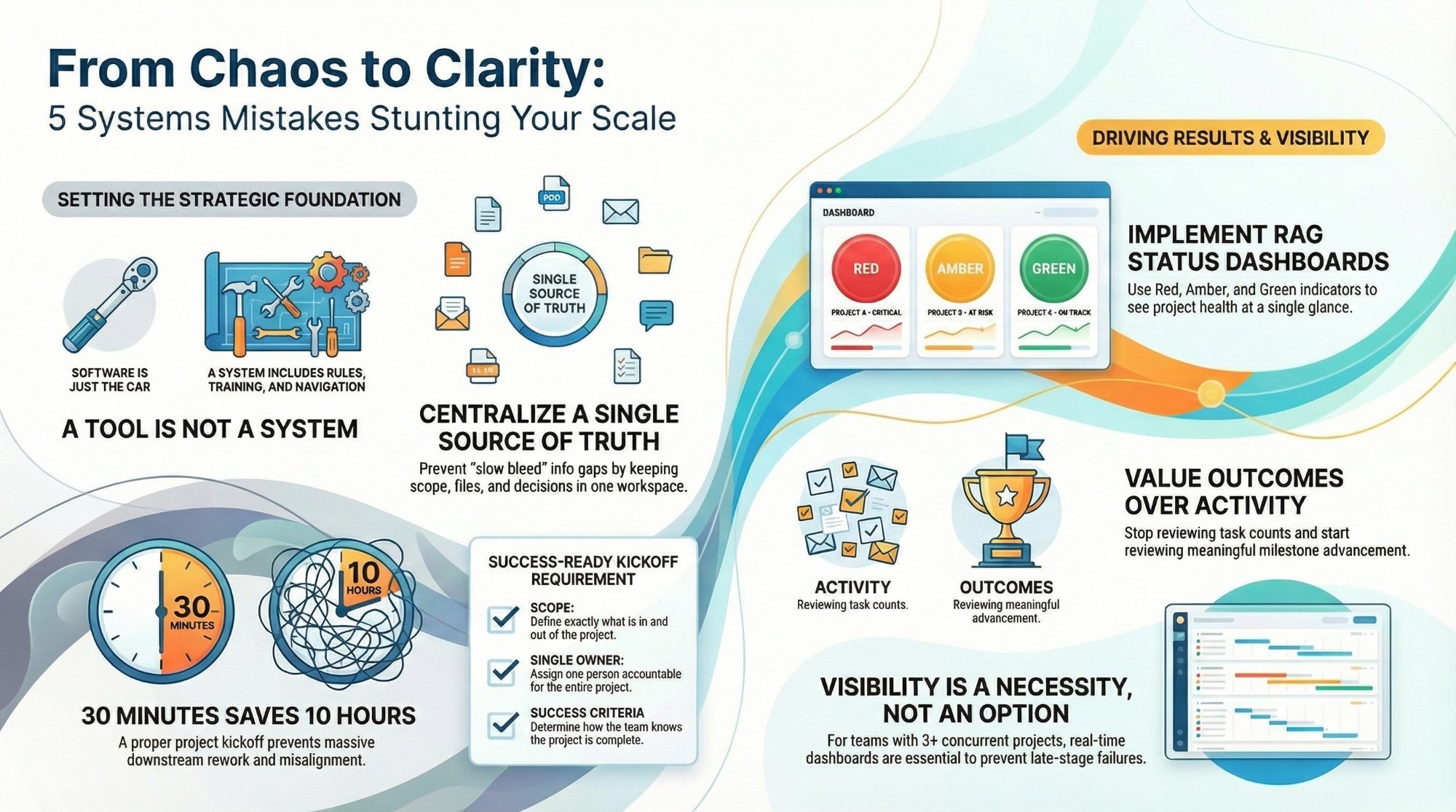
Top 5 project management mistakes CEOs make
The patterns that quietly sink delivery, and how to fix each one this quarter.
Read the guide →
The Foundation stage, built for you
Your PM stack designed, configured, and adopted: the system behind on-time delivery.
See the offer →Want your PM stack built for your team?
Book a free 30-minute strategy call. We will map your highest-ROI techniques and the right tool stack, and give you a build roadmap on the spot. If we are not the right team for you, we will say so and point you somewhere better.
Book a Free Strategy Call →Free 30-minute call. Honest take, even if that means "you do not need us yet."