7 productivity systems every entrepreneur should have running this week
You are not short on ambition. You are short on systems. Here are the exact seven we install for clients to win back time.
 By Ishan Vats · Founder of IV Consulting · 150+ ops transformations over 10+ years
Some links below are affiliate links. If you buy through them we may earn a commission, at no extra cost to you.
 Plan + trackClickUp
 Docs + SOPsNotion
 AutomateMake
 Automaten8n
 ConnectZapier
The fastest way for an entrepreneur to win back time is to replace willpower with systems: time block your calendar, automate any task you repeat more than three times a week, batch similar work, build one dashboard, delegate with documented SOPs, and protect deep focus. Run all seven consistently and most SMB teams reclaim 10 to 20 hours a week per person, with the biggest wins coming from automation.
The real problem
You are not short on ambition, you are short on systems
Most entrepreneurs work 50 to 60-hour weeks and still feel behind. The problem is not effort. It is how that effort gets spent. Context switching, manual follow-ups, scattered tools, and zero documentation eat your time alive.
These seven productivity systems fix that. They are not theory. They are the exact moves we implement for clients at IV Consulting every week. Each one stands on its own, and each one compounds: the more of them you run together, the more time comes back. Work through them in order, or start with the one that hurts most today.
System 1
Time block your calendar like a CEO
Most entrepreneurs run their day by reacting. A Slack ping here, an email there, a quick call that turns into 45 minutes. By 5 PM, nothing on the actual to-do list got done.
Time blocking fixes this. Assign every hour of your workday a purpose before the day starts. Group deep work, strategy, writing, and product development into uninterrupted 90-minute blocks. Stack meetings back to back in a separate window so they do not fragment the rest of your day.
Tools like ClickUp or Notion let you build daily planners that link directly to your task list. Your calendar should reflect your priorities, not everyone else's.
System 2
Automate every repetitive task under 5 minutes
If you do the same task more than three times a week, automate it. Full stop. A new lead comes in? Auto-assign, send a welcome email, create a CRM entry. A client completes onboarding? Trigger project creation in ClickUp with pre-built templates. An invoice goes out? Auto-log it in your finance tracker.
Tools like Make, n8n, and Zapier connect your apps so data flows without you lifting a finger. At IV Consulting, we routinely save clients 10+ hours a week just by mapping out their repetitive workflows and building automations around them.
If you are still copy-pasting data between tools, you are the bottleneck. This is the single highest-ROI system on this list, which is why we tell most owners to start here.
Systems 3 and 7
Batch similar tasks and protect your focus
Batch similar tasks into focused blocks
Context switching kills productivity by up to 40%. Every time you jump from writing a proposal to answering emails to reviewing a report, your brain needs time to re-engage. Task batching is the antidote. Group similar activities together: all client calls on Monday mornings, content creation on Tuesday afternoons, financial reviews on Fridays.
Inside ClickUp, custom views filter tasks by type so you only see work relevant to your current batch. In Notion, filtered database views do the same. The goal is to reduce decision fatigue and keep your brain in one mode for longer.
Protect your focus time like revenue
Your attention is your most valuable asset. Block at least two hours of uninterrupted focus time every workday. Turn off Slack notifications. Close your email tab. Use this time exclusively for work that moves the needle: strategy, high-value client work, product development, system building.
If your team needs you for everything, that is a systems problem, not a you problem. Build escalation rules in ClickUp so only true emergencies reach you during focus time, and set up automated status updates so your team gets progress without pinging you. The entrepreneurs who scale are not the ones who work the most hours. They are the ones who protect their best hours for their best work.
System 4
Build dashboards that show you what matters
Your weekly numbers should not require 20 minutes of clicking across five tools to compile. Build one dashboard that pulls everything together. ClickUp dashboards can show project health, workload distribution, and task completion rates in real time. Notion dashboards with linked databases surface your weekly KPIs and pipeline on a single page.
The rule: if your dashboard requires explanation, it is too complex. Strip it down to the 5 to 7 metrics that actually drive your business forward. You want decisions in under 60 seconds.
Systems 5 and 6
Delegate with systems and document before you forget
Delegate with systems, not just instructions
Most delegation fails because the entrepreneur says "handle this" without providing context, standards, or a clear process. The task comes back wrong, you redo it, and you stop delegating altogether.
Fix it by delegating with systems. Create a Standard Operating Procedure for every recurring task before you hand it off. Record a 3-minute Loom video. Build a ClickUp task template with subtasks, due dates, and reference links. Set up an automated checklist in Notion that guides the team member through each step. When you delegate with documentation, quality stays consistent even when you are not involved.
Document your processes before you forget them
Every entrepreneur has institutional knowledge trapped in their head. How to onboard a client. How to handle a refund. How to set up a new project. When that knowledge lives only in your brain, you become the single point of failure.
Document your top 10 recurring processes using Notion or ClickUp Docs, with screenshots, links, and decision trees where needed. This is the foundation of every other system on this list. Once your processes are documented, you can optimise them, automate parts of them, or hand them off entirely. None of that happens if the process only exists in your head.
The tool choice
Which tool runs which system
The systems matter more than the tools, but the right tool removes friction. Here is how we usually map the stack for a growing team.
| System | Best tool | Why | Time back |
|---|---|---|---|
| Time blocking and planning | ClickUp or Notion | Daily planners that link straight to your task list | 2 to 4 hrs/wk |
| Task automation | Make or n8n | Connect apps so data flows with no manual copy-paste | 5 to 8 hrs/wk |
| Dashboards | ClickUp or Notion | One page for the 5 to 7 metrics that drive decisions | 1 to 2 hrs/wk |
| SOPs and documentation | Notion or ClickUp Docs | Wiki-style structure or docs linked to live tasks | 3 to 5 hrs/wk |
| Light app-to-app connections | Zapier | Fastest to set up for simple linear handoffs | 1 to 2 hrs/wk |
FAQ
Questions entrepreneurs ask before they start
Which productivity hack should I implement first?
How do I time block when my schedule is constantly interrupted?
What tools work best for documenting SOPs?
How many hours a week can these productivity hacks realistically save?
Do I need a team to implement these systems, or can I do it solo?
Ishan Vats
Founder, IV Consulting · operations & systems consultant
I build operating systems and automations for teams from startup to enterprise. 150+ ops transformations over 10+ years. If you want yours mapped and built right, I'll do it with you on a free call.
Book a free strategy call →Keep reading
Related guides and work
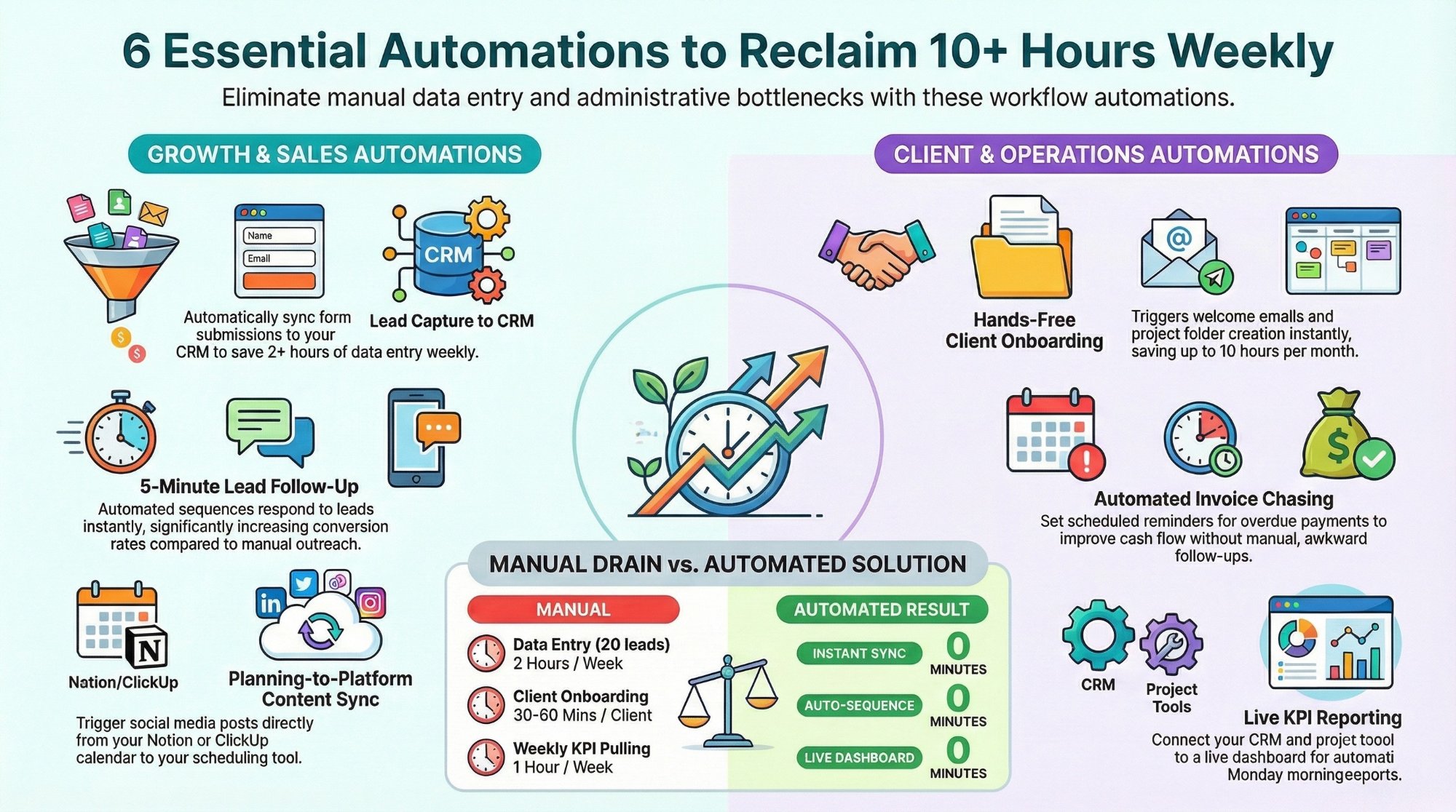
Workflow automations every business owner must set up
The starter automations that reclaim 10+ hours a week with Make, n8n, and Zapier.
Read the playbook →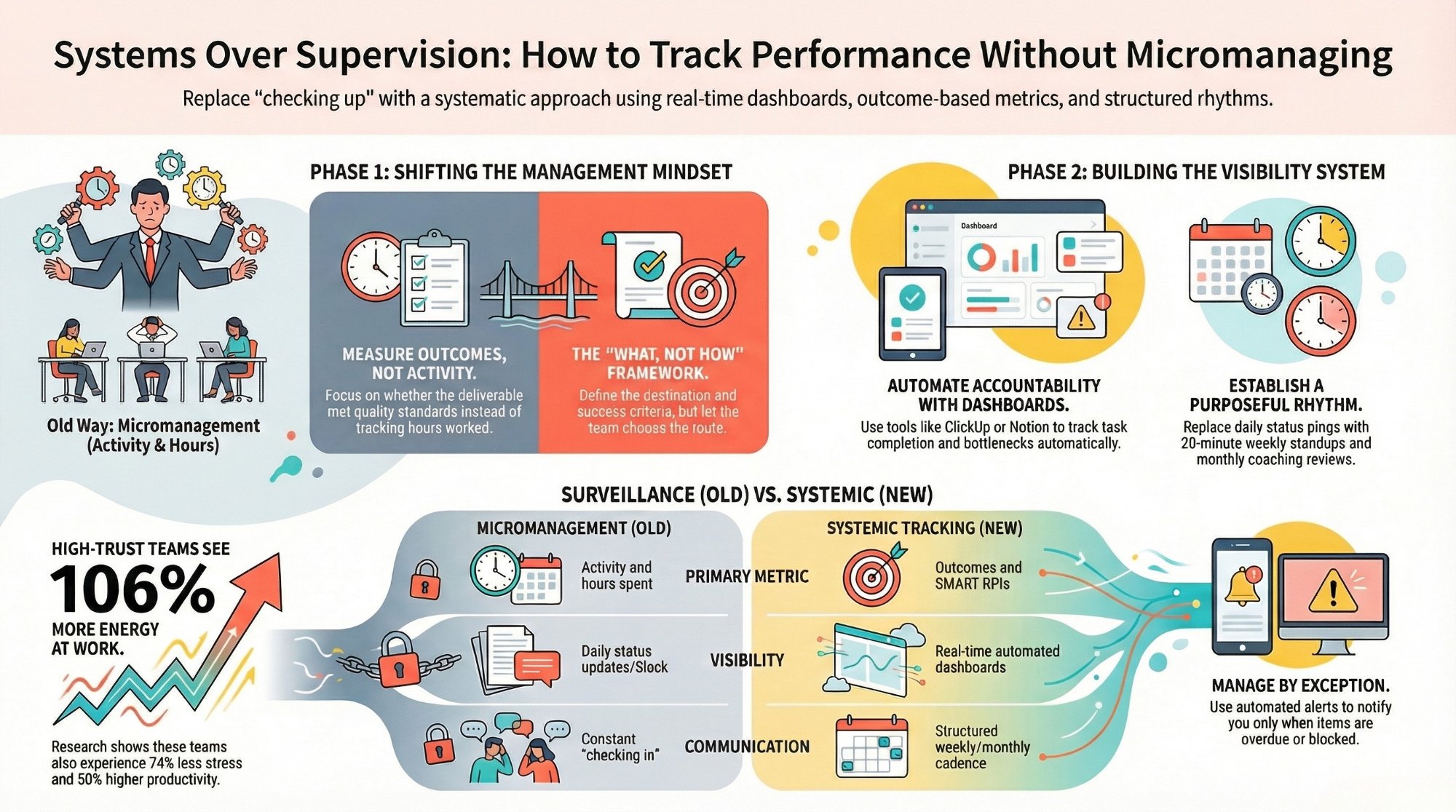
How to track team performance without micromanaging
Dashboards and status systems that show you what matters without hovering.
Read the guide →
The Foundation stage, built for you
A clean Notion or ClickUp operating system your team actually uses, set up for you.
See the offer →Want your systems built for you?
Book a free 30-minute strategy call. We will map your highest-ROI opportunities and give you a build roadmap on the spot. If we are not the right team for you, we will say so and point you somewhere better.
Book a Free Strategy Call →Free 30-minute call. Honest take, even if that means "you do not need us yet."